Circle stock drops nearly 20% as stablecoin yield restrictions spark concern

ambcryptoPublicado em 2026-03-24Última atualização em 2026-03-24

Resumo

Shares of Circle Internet Group (CRCL) fell nearly 19% on March 24, dropping from an intraday high of around $127 to approximately $102. The sharp decline followed a strong rally earlier in March and was accompanied by high trading volume, indicating a shift in investor sentiment. The sell-off appears linked to emerging regulatory concerns, particularly a draft legislative proposal that could prohibit platforms from offering yield or interest-like rewards for holding stablecoins. This restriction, which targets both direct and indirect incentives, may impact Circle’s USDC stablecoin growth and user engagement. The proposal would still permit activity-based rewards but could reduce stablecoins' competitiveness against traditional financial products. The move underscores the sensitivity of crypto equities to regulatory developments.

Shares of Circle Internet Group [CRCL] fell sharply on 24 March, dropping nearly 19% in a single session as markets reacted to emerging concerns around potential restrictions on stablecoin yield and rewards.

The stock declined from an intraday high of around $127 to approximately $102, marking one of its steepest single-day losses in recent weeks. The move comes after a strong rally earlier in March, when CRCL climbed from below $60 to above $130.

Sharp reversal follows March rally

CRCL’s latest decline stands in contrast to its recent momentum, with the stock having more than doubled earlier this month before reversing course.
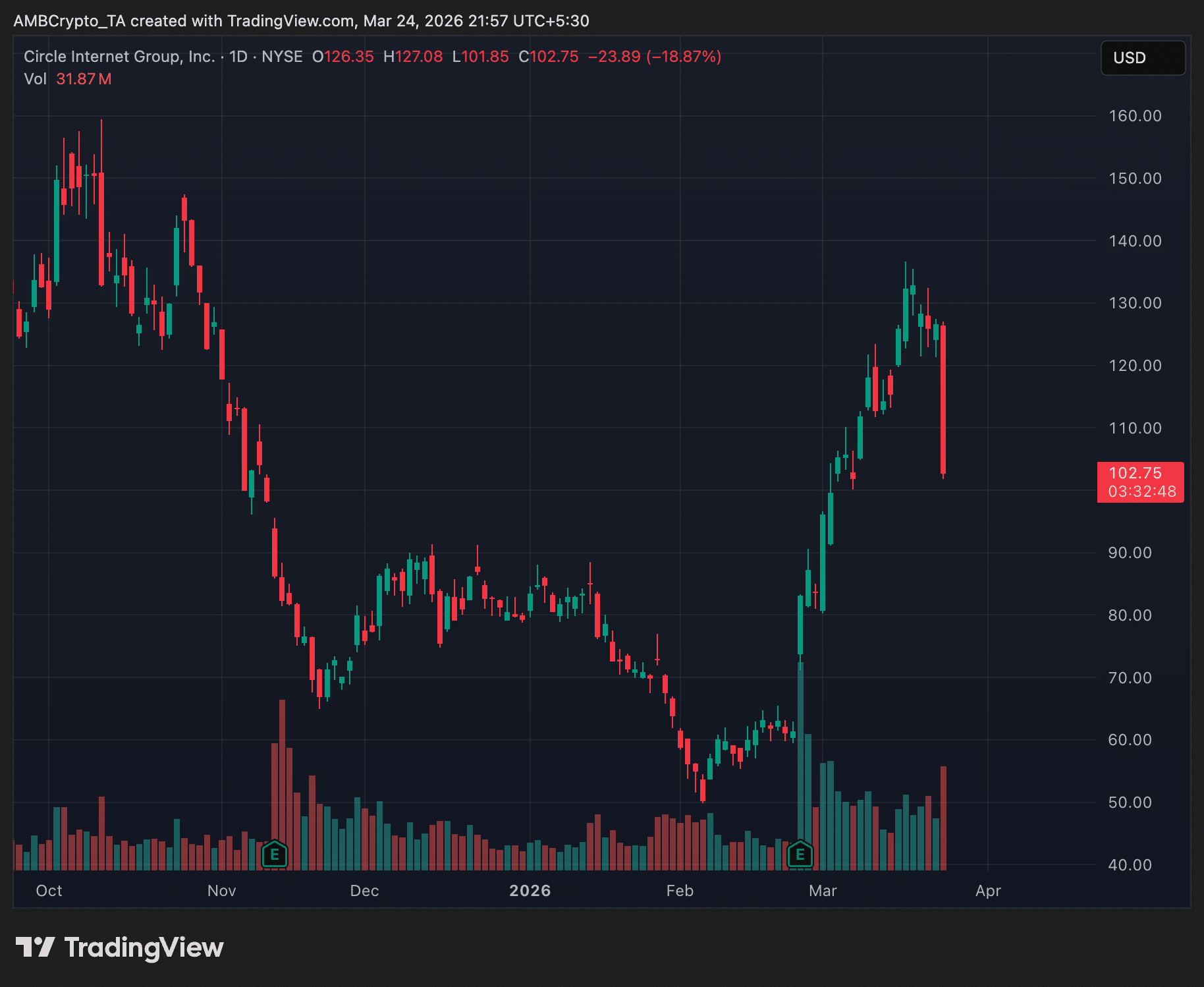
Source: TradingView

The sell-off was accompanied by a spike in trading volume, suggesting strong conviction behind the move rather than routine market fluctuations.

The abrupt reversal suggests a potential shift in sentiment, with investors reacting quickly to new developments in the stablecoin sector.

While no official trigger has been confirmed, the timing of the decline coincides with growing regulatory scrutiny around stablecoins.

Draft proposal targets stablecoin yield

According to a report from Eleanor Terrett, new legislative language under discussion could significantly limit how stablecoin issuers and platforms offer rewards to users.

The proposal would prohibit platforms from offering yield “directly or indirectly” for holding a stablecoin, or in any way that resembles a bank deposit. The restriction would apply broadly across exchanges, brokers, and affiliated services.

It would also ban any mechanism deemed “economically or functionally equivalent” to interest.

At the same time, the draft would allow activity-based rewards tied to user behavior, such as loyalty or promotional programs, provided they are not interpreted as interest-like incentives.

The proposal is expected to undergo further review, including feedback from banking representatives.

Implications for Circle and stablecoin issuers

For Circle, which issues the USDC stablecoin, yield restrictions could have direct implications for growth and user incentives.

Stablecoin yield and reward programs have become a key mechanism for attracting and retaining users across exchanges and platforms.

Limiting these features could reduce stablecoins’ competitiveness relative to traditional financial products and narrow revenue opportunities tied to user balances.

The uncertainty surrounding how regulators may interpret “economic equivalence” adds another layer of risk, particularly for business models that rely on flexible reward structures.


Final Summary

  • Circle’s sharp decline highlights how sensitive crypto-linked equities are to emerging regulatory risks, particularly around stablecoin incentives.
  • Growing scrutiny and industry moves toward transparency suggest a structural shift in how stablecoin issuers operate going forward.


Perguntas relacionadas

QWhat caused Circle's stock (CRCL) to drop nearly 20% on March 24?

AThe sharp decline was triggered by emerging concerns and a draft legislative proposal that could restrict stablecoin issuers and platforms from offering yield or interest-like rewards to users.

QWhat was the price range of CRCL's intraday movement during the sell-off?

AThe stock dropped from an intraday high of around $127 to approximately $102.

QWhat specific activity does the new legislative proposal aim to prohibit regarding stablecoins?

AThe proposal aims to prohibit platforms from offering yield 'directly or indirectly' for holding a stablecoin, or any mechanism deemed 'economically or functionally equivalent' to interest or a bank deposit.

QHow might the proposed restrictions impact Circle and other issuers?

AThe restrictions could reduce stablecoins' competitiveness compared to traditional financial products, narrow revenue opportunities from user balances, and create uncertainty for business models relying on reward structures.

QWhat type of rewards would still be allowed under the draft proposal?

AActivity-based rewards tied to user behavior, such as loyalty or promotional programs, are allowed provided they are not interpreted as interest-like incentives.

Leituras Relacionadas

Dialogue with a Macro Analyst: AI Drains All Liquidity from U.S. Stocks, $40K Bitcoin is the True Bottom

In a recent discussion, macro strategist Luke Groman, founder of FFT LC, presented a sobering analysis of current markets. He argues that while the S&P 500 hits new highs, this is largely driven by just seven AI stocks, which are "sucking all the oxygen and liquidity out of the room." Bitcoin, which he calls the "last working smoke alarm for liquidity," is signaling trouble, having entered a difficult period. Groman explains that the AI boom is fueled by accounting practices that front-load revenue, creating an illusion of high profits while cash is being depleted. He warns this cycle could reverse sharply when construction slows. His base case is that stocks will rise in dollar terms but fall significantly when measured in gold or Bitcoin, highlighting that long-term US Treasury futures have already lost 90% of their value against gold over the past decade. He points to major structural risks, including China's dominance in rare earths—a small commodity market underpinning trillions in tech stock value—and the prolonged closure of the Strait of Hormuz, which he calls a "Suez Moment" for the US. This, combined with a shift towards a "no ticky, no washy" proof-of-work system for settling trade (using gold, not trust), signals deeper systemic distrust. Regarding US debt, Groman notes that historically, all 58 countries that reached a 130% debt-to-GDP ratio defaulted, primarily through inflation. The US crossed this threshold in 2020. He also highlights a contradiction in the AI narrative: if it's as transformative as claimed, it must destroy white-collar jobs, threatening half of US tax revenue—a reality at odds with the "no job loss" messaging from tech leaders. On Bitcoin, Groman sold most of his position near the top and hasn't fully re-entered. Citing technical analysis from Northstar Bad Charts, he suggests a potential bottom around $40,000 could materialize in Q3 or Q4. He concludes that while he may be labeled a doomsayer, his view is simply realistic, grounded in historical precedents and current macro pressures.

marsbitHá 7h

Dialogue with a Macro Analyst: AI Drains All Liquidity from U.S. Stocks, $40K Bitcoin is the True Bottom

marsbitHá 7h

Trading

Spot
Futuros
活动图片




