Circle: From Issuance to Infrastructure

链捕手Publicado em 2026-05-19Última atualização em 2026-05-19

Resumo

Title: Circle: From Issuance to Infrastructure Circle, the issuer of the USDC stablecoin, is undergoing a strategic transformation from a single-product company dependent on reserve interest income to a vertically integrated, full-stack financial platform. Its primary revenue source, earnings from US Treasury reserves backing USDC, is under pressure from declining Federal Reserve interest rates. Furthermore, Circle pays out a significant portion (~60 cents per dollar earned) to partners like Coinbase for distribution and settlement, leading to value leakage. To address these challenges and capture more value across the payment stack, Circle announced three key initiatives in Q1 2026: 1. **Settlement Layer**: Launching its own Layer-1 blockchain, **Arc**. Designed for institutional use with configurable privacy and quantum-resistant architecture, Arc uses USDC as its native gas token, allowing Circle to capture transaction fees currently paid to other blockchains like Ethereum. 2. **Distribution Layer**: Expanding the **Circle Payments Network (CPN)**, which connects financial institutions directly to Circle, reducing reliance on third-party exchanges for USDC distribution and on/off-ramps. 3. **Application Layer**: Building infrastructure for an **AI agent economy**, including tools for agent wallets, nanopayments, and a marketplace. Circle aims to monetize the high volume of AI-driven microtransactions predominantly settled in USDC. This vertical integration strategy ...

Article Compiled By: Block unicorn

The company earned billions in interest income by holding the Treasury reserves backing its stablecoin and paid fees to other platforms for distributing and settling USDC throughout the payments ecosystem. For every dollar Circle earns, it pays about 60 cents to USDC partners. This was sustainable as long as margins were wide. But with low interest rates arriving, the USDC issuer lost too much profit. For most of its history, Circle had only one product: USDC.

In its recently released Q1 2026 earnings report, the USDC issuer announced several initiatives aimed at capturing more value within its operational scope. These included a $222 million presale for its native Layer-1 token ARC at a fully diluted valuation of $3 billion, the launch of AI agent infrastructure, and an expansion of its Circle Payments Network to enable banks to facilitate stablecoin payments by bypassing the volatility of digital assets. The achievements of the past few quarters will change this status quo.

Taken together, these moves signal Circle's attempt to transform from a single-layer company into a full-stack financial platform capable of operating and capturing value at multiple levels of the payments stack.

Today, I'll assess whether Circle can leverage vertical integration to offset the shrinkage of its yield business, which shrinks with each Federal Reserve interest rate cut.

The Disappearing Float

In Q1 2026, Circle's total revenue was $694 million, up 20% year-over-year. This growth was entirely due to an increase in the circulating stablecoin supply, with no improvement in USDC itself. The circulating stablecoin supply grew from $235 billion in March 2025 to $315 billion in March 2026, an increase of over 30%. Over the same period, USDC's market share declined by 62 basis points.

Circle faces a bigger problem. The era of low interest rates has arrived, with the Fed rate dropping from 4.5% a year ago to 3.75% now.

Although the average circulation of USDC increased 39% year-over-year in Q1 2026, Circle's reserve income only grew 17% to $653 million. This is because the average reserve rate fell 66 basis points year-over-year, from 4.16% in Q1 2025 to 3.50% in Q1 2026, significantly offsetting the growth mentioned above.

This is not a one-time phenomenon. Over the past four quarters, the gap between Circle's reserve income growth rate and USDC supply growth rate has been narrowing continuously.
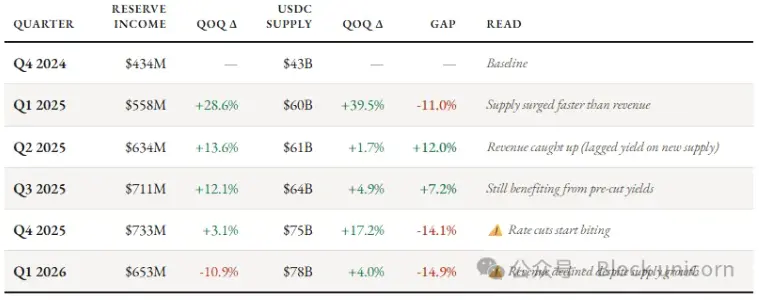
Circle's primary revenue source is not growing proportionally with its circulating stablecoin supply.

The company also faces a value leakage problem.

The 60 Cent Awakening

This means that for every dollar Circle earns, it pays over 60 cents to platforms that hold and distribute USDC. Of the $405 million in USDC distribution costs in Q1 2026, Circle paid $330 million (about 80%) to Coinbase alone. Out of $653 million in reserve income this quarter, Circle paid $405 million to partners for distribution and transaction costs.

In an industry where new players are constantly expanding and integrating across every layer of the tech stack, this is a significant amount of money left on the table.

All signs point to Circle facing reality. Interest rates keep falling, reducing its reserve income; distribution costs remain high, causing persistent value leakage; and Circle's core business remains a proxy for yield, whose value shrinks with each Fed rate cut. Under President Donald Trump, expectations for a dovish Fed stance have intensified.

What is Circle's response? The answer: vertical integration to capture more value across the business chain and reduce reliance on interest income.

To understand what Circle is building, consider what it currently owns.

The USDC issuer started at the bottom of the stablecoin stack—the issuance layer—and has spent years watching others capture value on every layer above it.
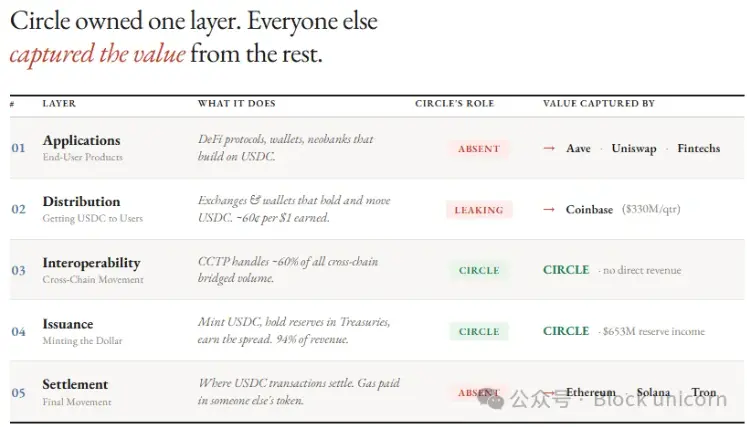
At the issuance layer, Circle issues USDC and EURC, holds US Treasury reserves via the Circl Reserve Fund managed by BlackRock, manages the 1:1 peg, and handles issuance and redemption via Circle Mint. 94% of its total revenue comes from government bond reserve yield.

Subsequently, Circle expanded into the interoperability layer with its Cross-Chain Transfer Protocol (CCTP), which transfers USDC between blockchains and handles about 60% of cross-chain bridging volume. Although this mechanism routes USDC between chains, CCTP itself runs on chains owned by others. Therefore, Circle cannot derive significant direct income from it.

All other layers in the stack belong to others.

The settlement system runs on Ethereum, Solana, and Tron. Every USDC transaction pays gas fees in other tokens (ETH, SOL, TRX), and Circle has no control over congestion, fees, or governance on these chains.

Distribution channels rely primarily on Coinbase, exchanges, and wallets. Circle must pay revenue shares, incentive program fees, and integration costs to get USDC into users' hands.

Third parties, such as DeFi protocols, fintechs, neobanks, and prediction markets, build the applications and products that use USDC. This means the end customer, whether retail or institutional, never has to interact directly with Circle.

This structure results in Circle keeping only 40 cents of every dollar it earns.

Taking Control of the Stack

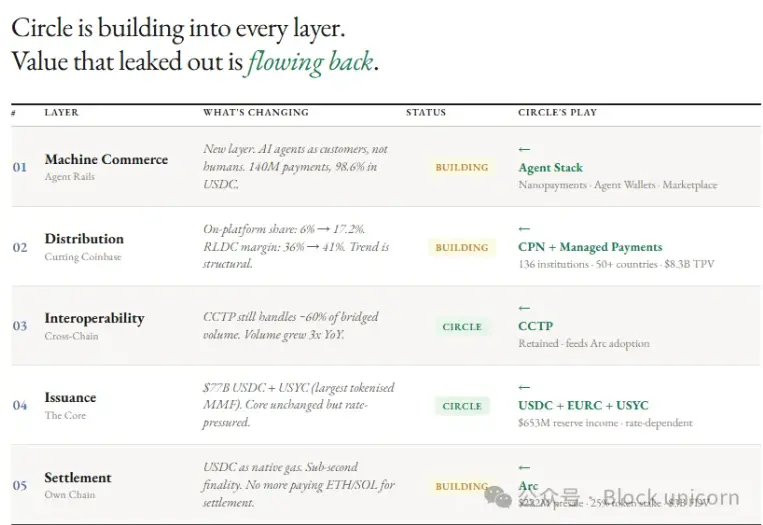
On May 11th, Circle announced three investment plans aimed at vertically integrating different layers of the business it did not previously own.

First is settlement. Circle owns the native Layer-1 blockchain Arc, designed to capture fees currently generated when USDC moves on blockchains like Ethereum, Solana, and Tron.

EVM-compatible Arc offers sub-second finality and uses USDC as its native gas fee token, with transaction costs around $0.001. To make its chain more attractive to institutional users, Circle offers configurable privacy and a quantum-resistant architecture. General-purpose chains like Ethereum and Solana are fully transparent and cannot provide the privacy needed for sensitive transactions like institutional payments.

Circle raised $222 million via an ARC token presale at a $3 billion valuation. This round was led by a $75 million funding round from a16z, with other investors including BlackRock, Apollo Global Management, Intercontinental Exchange (parent of NYSE), Standard Chartered, ARK Invest, SBI Group, IDG Capital, Bullish, and Haun Ventures.

Second is distribution. The Circle Payments Network (CPN) helps the USDC issuer reduce its reliance on Coinbase.

CPN connects financial institutions directly to Circle's network, allowing them to mint, redeem, and route USDC without going through an exchange. The network has 136 registered institutions (up 36% quarter-over-quarter), $8.3 billion in annualized transaction volume (up 17% quarter-over-quarter), and facilitates fiat payments in over 50 countries.

Consequently, the proportion of USDC based on Circle's own infrastructure nearly tripled, from about 6% a year ago to 17.2%. Even as reserve yields declined, the RLDC margin (revenue minus distribution and transaction costs as a percentage of revenue) steadily recovered from 38% in Q2 2025 to 41% in Q1 2026.

Circle has not yet commercialized CPN, prioritizing user growth over fees. But once commercialized, each additional dollar of CPN usage will generate usage-based revenue for Circle, independent of interest rates.

Third is the application layer. Through this third layer, Circle aims to capture ongoing value across the agent economy by charging small fees on large transactions executed by AI agents.

Circle is building a full agent economy through products like Agent Wallets, Nanopayments (supporting gas-free USDC transfers as low as $0.000001 [one-millionth of a dollar]), the Agent Marketplace (where agents can discover and pay for services), and Circle CLI (accelerating agent onboarding and wallet configuration).

How large is the market opportunity for agent payments? Last month, Circle's Head of Marketing, Peter Schroeder, posted that USDC accounted for 98.6% of the 140 million transactions completed by AI agents within nine months.
The Stack Race

Circle's expansion up the payments stack is not easy. Payments giant Stripe started at the top and gradually went deeper through a series of deals and product launches. Acquiring Bridge gave Stripe control over authorization, custody, forex, and issuing layers. Launching Tempo took Stripe into the settlement layer. Today, Stripe controls all seven payments layers, serving 5 million merchants.

Tether uses Plasma, incubated by the USDT issuer, as its settlement chain. However, Tether's regulatory oversight still lags behind USDC's.

Stripe dominates human-to-human transactions, while Tether leads in dollar transactions in emerging markets and crypto trading. Therefore, Circle is positioning itself in institutional settlement and machine-to-machine transactions, where regulatory credibility and programmable infrastructure may be more important than the checkout integrations Stripe dominates.

CRCL's Retort

Although Circle raised $222 million by preselling ARC tokens to institutional investors, the initial development funding for ARC actually came from CRCL's shareholders. Ironically, Circle's biggest challenge might be handling internal resistance.

What is the significance of the Arc token's value growth for a public company? I pointed out this issue last November.

"The nature of the native token will create some controversy in public markets. Why should the market acknowledge or value a native token that captures the value created by Arc and CPN, rather than letting that value flow back to Circle's P&L? Why should Circle's surplus fund a cost center that is not expected to return profits to shareholders? Existing shareholders will not tolerate this. Public market investors bought CRCL for its reserve yield. They are unlikely to stand by and watch a new asset absorb the value appreciation of the infrastructure they invested in."

How will Circle resolve this? Is a separate listing for Arc justified? Only in the first quarter after Arc's mainnet launch will we know the answer.

For now, Circle's long-term goal is to capture as much value as possible by expanding its presence across these layers. Every time USDC settles on Arc, Circle earns a settlement fee. When institutions transact via CPN, Circle will retain distribution profits. Finally, when agents transact via Nanopayments on Arc, Circle hopes to charge fees at that layer as well.


Perguntas relacionadas

QWhat is Circle's primary revenue source, and why is it under pressure?

ACircle's primary revenue source is the interest income from holding US Treasury reserves backing its USDC stablecoin, which accounted for 94% of its total revenue. This revenue is under pressure because the Federal Reserve has been lowering interest rates, reducing the yield on these reserves. In Q1 2026, the average reserve yield dropped to 3.50% from 4.16% a year earlier, significantly slowing revenue growth despite an increase in USDC circulation.

QWhat problem does Circle face with its distribution and transaction costs for USDC?

ACircle faces a significant value leakage problem with its distribution and transaction costs. In Q1 2026, it paid out $405 million (over 60 cents for every dollar of reserve revenue earned) to partners like Coinbase and other platforms for distributing and settling USDC. This high cost represents a major outflow of the value it generates.

QWhat three key initiatives did Circle announce to vertically integrate its business and capture more value?

ACircle announced three key initiatives to vertically integrate: 1) Launching its own Layer-1 blockchain called Arc, which uses USDC as its native gas token and aims to capture settlement fees. 2) Expanding its Circle Payments Network (CPN) to directly connect financial institutions and reduce reliance on distributors like Coinbase. 3) Building an AI agent economy infrastructure (including Agent Wallets, Nanopayments) to capture value from micro-transactions executed by AI agents on its network.

QHow does Circle's new Layer-1 blockchain, Arc, differ from general-purpose blockchains like Ethereum or Solana?

AArc differs from general-purpose blockchains like Ethereum or Solana by being specifically designed for institutional use. Key features include: EVM compatibility, sub-second finality, USDC as the native gas token (with fees around $0.001 per transaction), configurable privacy for sensitive transactions (unlike the fully transparent nature of Ethereum/Solana), and a quantum-resistant architecture.

QWhat potential internal conflict does Circle face regarding the development and value capture of its new Arc blockchain and token (ARC)?

AA potential internal conflict arises because Circle's publicly traded shareholders (CRCL) invested in the company primarily for its reserve yield business. The new Arc blockchain and its separate ARC token are designed to capture the future value generated by Circle's infrastructure (like settlement fees from Arc and CPN). Shareholders may resist this structure if the value flows to the ARC token holders instead of back to Circle's corporate profits and, by extension, to CRCL shareholders. The company will need to justify how this benefits its existing public shareholders.

Leituras Relacionadas

After Three Consecutive Quarters of Decline, Can the Crypto Market Find a Window for Stabilization in Q3?

The cryptocurrency market has just concluded its worst-performing quarter since 2022, with total capitalization dropping 12.6% to $2.1 trillion. All core metrics indicate capital is leaving the sector, not just rotating within it. Bitcoin fell 14.2% and Ethereum dropped 25.4% in Q2, breaking their previous correlation with US tech stocks. A key driver is the reversal in US spot Bitcoin ETF flows, which saw a net outflow of approximately $4.67 billion in Q2, including a record monthly outflow near $4.5 billion in June. While recent data suggests long-term holders are accumulating again, sustained ETF outflows mean continued selling pressure. Market focus is now singularly on the Federal Reserve. The upcoming July FOMC meeting is seen as the most critical event for Q3. A dovish signal could support Bitcoin reclaiming a $68,000-$84,000 range, while a hawkish stance might establish a new trading band around $50,000-$56,000. Additionally, regulatory uncertainty persists, with the progress of the crucial *CLARITY Act* stalling in the Senate, reducing its perceived 2026 passage probability to 40-45%. Despite the broad downturn, a few sectors showed growth. Prediction markets saw nominal volume surge 48.7% year-over-year to $113.8 billion, and tokenized collectibles transaction volume rose 143% quarterly to $1.4 billion. The Real-World Asset (RWA) tokenization sector also continued steady growth, now representing ~$28.1 billion in on-chain value. The market's foundation for an extreme crash appears limited, with Bitcoin price hovering near its 200-week moving average. However, the trading paradigm has shifted from narrative-driven speculation to decisions based on price action, policy developments, and interest rate expectations, making a broad sentiment-driven rally unlikely in the near term.

marsbitHá 19h

After Three Consecutive Quarters of Decline, Can the Crypto Market Find a Window for Stabilization in Q3?

marsbitHá 19h

BIT Trading Moment: BTC Still Suppressed by Weekly 200 EMA, Rejection May Restart Decline; Storage and Semiconductors that Surged Last Night Begin Falling in Evening Trading

**Crypto & Stock Market Wrap: Bitcoin Tests Resistance, Stocks Retreat After AI Surge** Bitcoin consolidates around $66,000, facing key resistance near $68,000—an area seen as a major psychological and technical hurdle where previous rallies have failed. Analysts note the cryptocurrency is caught between its 200-week moving average (~$63,333) and 200-week EMA (~$68,328). A clear break above $68k is needed to signal a stronger bullish trend, while a rejection could lead to a retest of $63k support. Market sentiment remains cautious, with low futures open interest pointing to a low-liquidity rebound rather than a full bull market. Bitcoin spot ETFs saw another $203 million inflow. US stock futures pointed lower after a strong Tuesday session led by a massive rebound in semiconductors and memory stocks. The rally was fueled by renewed optimism about AI-driven hardware demand, with Micron, SanDisk, and SK Hynix surging. However, those gains reversed in pre-market trading. Super Micro Computer (SMCI) soared over 20% after hours on strong guidance and a record backlog. Other standouts included Rocket Lab and nuclear energy plays Oklo and X-Energy. Rising oil prices (Brent above $91) and climbing Treasury yields (10-year near 4.64%), however, are reigniting inflation concerns and acting as a headwind for equities. In Asia, markets were mixed. South Korea's KOSPI pared early gains to close slightly higher as semiconductor stocks like SK Hynix gave back initial surges. Japan's Nikkei edged lower as the yen hit a fresh 38-year low against the dollar, raising fears of potential market intervention. Key events to watch include the Samsung Galaxy launch, AMD's AI event, and a slew of major tech earnings from Alphabet, Tesla, and IBM after the close on Wednesday, followed by the ECB meeting and Intel's earnings on Thursday.

marsbitHá 20h

BIT Trading Moment: BTC Still Suppressed by Weekly 200 EMA, Rejection May Restart Decline; Storage and Semiconductors that Surged Last Night Begin Falling in Evening Trading

marsbitHá 20h

Former CFTC Chairman, Circle President Tarbert: Preaching Long-Termism While Cashing Out $30 Million Himself

Former CFTC Chairman and Circle President Heath Tarbert has consistently advocated for a long-term vision in public, urging patience from investors as Circle’s stock price has fallen significantly from its peak. However, it has been revealed that since Circle’s IPO, Tarbert has continuously sold his CRCL shares through pre-arranged trading plans, cashing out approximately $30 million, without making any public market purchases. This contrast between his public messaging and personal actions has drawn criticism. Tarbert joined Circle in July 2023 as Chief Legal Officer, leveraging his regulatory experience to help guide the company through its IPO and expansion. Despite promoting stablecoins as long-term infrastructure, he established a 10b5-1 trading plan just before Circle went public, leading to substantial stock sales over the following year. In March 2026, he initiated another plan to sell more shares. His career trajectory highlights a pattern of moving between high-level regulatory roles and influential positions in the financial sector. After resigning as CFTC Chairman in early 2021, he joined Citadel Securities as Chief Legal Officer just 27 days later, during a period of intense regulatory scrutiny for the firm. He later joined Circle, aiding its efforts to navigate regulatory challenges for its public listing. While Tarbert's expertise in policy and compliance is valuable to companies like Circle, his actions—advocating long-term confidence while personally divesting—raise questions about the alignment between his public statements and his private financial decisions, leaving investors who followed his advice to bear the market risks.

marsbitHá 20h

Former CFTC Chairman, Circle President Tarbert: Preaching Long-Termism While Cashing Out $30 Million Himself

marsbitHá 20h

Gate Research Institute: The 'Wall Street-ization' Wave of Crypto Financial Products – Competition or Integration?

The article titled "Gate Research Institute: Are Crypto Financial Products Sparking a 'Wall Street' Wave—Competition or Convergence?" explores the evolving relationship between the crypto ecosystem and traditional finance (TradFi). The piece begins by reflecting on Bitcoin's original 2009 vision of decentralization, disintermediation, and moving away from banks. It then contrasts this with the 2024 landscape, where key crypto assets like Bitcoin are increasingly held through Wall Street products like ETFs issued by giants like BlackRock. The article questions whether this signifies that TradFi is systematically taking over the rights to issue, price, custody, and distribute crypto financial assets. The core argument is that this is not a zero-sum takeover but rather a bidirectional convergence where each side addresses the other's weaknesses. Crypto offers 24/7 global markets, programmable settlement, and open access but lacks compliant channels, institutional-grade custody, deep fiat liquidity, and mainstream distribution. TradFi possesses these but is constrained by legacy systems, limited operating hours, and slow settlement. Two primary convergence paths are highlighted: * **Path A (CEX to TradFi):** Exemplified by Gate, which has progressed from offering tokenized stocks and CFDs to providing direct, real stock trading (US, Hong Kong, South Korea) within its platform, using USDT. * **Path B (TradFi to Crypto):** Exemplified by Robinhood, which has integrated crypto trading, acquired exchanges like Bitstamp, and is moving traditional assets like stocks onto the blockchain via tokenization and its own Layer 2. Both paths are ultimately competing to become the next-generation, unified financial account—a "super account" where users can seamlessly trade cryptocurrencies, stocks, ETFs, RWA (Real World Assets), and tokenized treasury products in one interface. The growth of RWA and tokenized treasuries (e.g., BlackRock's BUIDL) is presented as the asset-layer fusion, providing stable, yield-bearing assets on-chain and acting as a bridge between the two worlds. In conclusion, the "Wall Street-ization" of crypto is framed as a mutual transformation. Decentralized ideals persist in the protocol layer, while at the application layer, a more efficient, global, and accessible unified capital market is emerging from this convergence. The future competition lies not between crypto exchanges and stockbrokers, but between platforms vying to offer the most comprehensive asset coverage, liquidity, and user experience within a single account.

marsbitHá 20h

Gate Research Institute: The 'Wall Street-ization' Wave of Crypto Financial Products – Competition or Integration?

marsbitHá 20h

Trading

Spot
活动图片




