In June of last year, Circle went public at $31 per share. Two weeks later, its stock price touched $299. Then, it fell back to $50, a drop of over 80%. Then, after the earnings report came out this February, it doubled in two weeks, reaching $111 today.
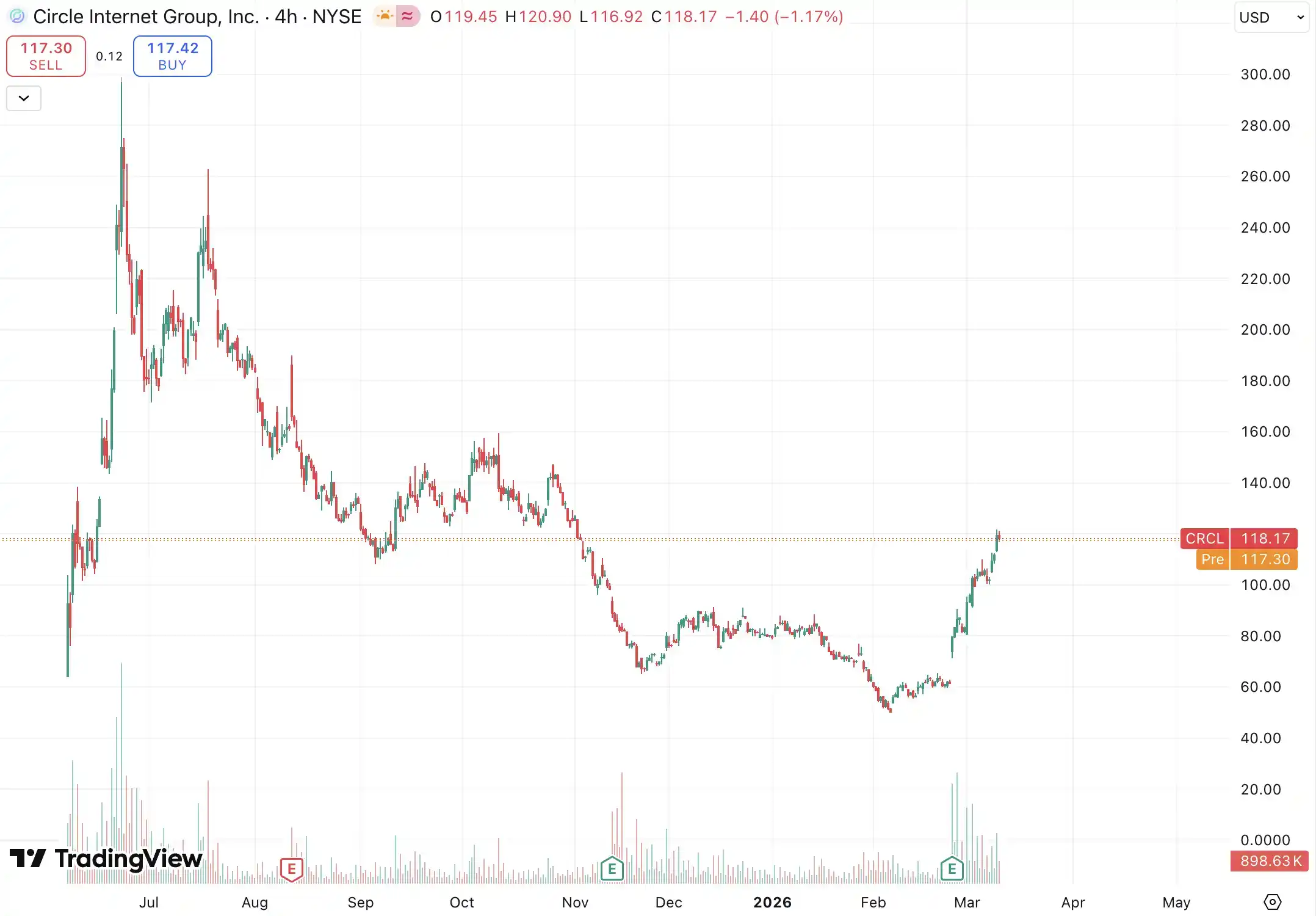
During the same period of the doubling, Bitcoin fell by 40%. The correlation between Circle's stock price and the crypto market has been broken.
"You Are Seeing That Decoupling"
The drop to $50 was not hard for those in the circle to understand.
In September and October 2025, the Fed cut rates by 25 basis points consecutively, lowering the benchmark rate to 3.75%. Reserve yields subsequently declined, with Q3 data showing that the unit reserve yield for USDC fell by 96 basis points year-over-year.
How much money do these 96 basis points represent? Circle calculated it themselves in the prospectus: for every 100bp cut by the Fed, the annualized interest income loss is approximately $618 million. Half of this loss would be offset by a corresponding decrease in distribution costs, resulting in a net loss of about $300 million. But this is a static calculation, assuming the USDC scale remains unchanged. In 2025, the Fed cut rates by a total of 75bp. Just this one variable, interest rates, took nearly $200 million out of Circle's annual revenue.
And that's not all. There is a revenue-sharing agreement between Circle and Coinbase. All reserve earnings generated from USDC held on the Coinbase platform go to Coinbase, while off-platform portions are split 50/50. In Q4, total reserve revenue was $733 million, distribution costs were $461 million, and Circle's actual net retained reserve earnings were $273 million. Non-interest income was $37 million, less than 5% of total revenue.
This structure is the fundamental reason why Circle's stock price fell from $299 to $50. Rate cuts compress reserve yields, the Coinbase sharing structure is fixed, Circle is stuck in the middle, with a clear ceiling on how much revenue it can collect and a clear floor on how much profit it can retain.
But when the earnings report came out on February 25th, Circle's stock rose 35% in a single day.
EPS was $0.43, while analysts expected $0.16. Not a slight beat, but a slap-in-the-face beat. However, what drove the repricing wasn't just the numbers in this quarterly report, but a larger structural fact that this report merely allowed the market to see clearly for the first time.
In 2025, the entire crypto market cap fell over 40% from its peak. During this period, the circulating supply of USDC increased by 72%, reaching $75.3 billion, a record high. The total stablecoin market cap also broke through $314 billion during the same period, also a record high.
Not a tailwind in a bull market, but counter-cyclical growth in a bear market.
The implication of this is fundamental to Circle's pricing logic. Previously, the market's valuation framework for CRCL treated it as a beneficiary of the crypto cycle: in a bull market, people use USDC for trading, its scale increases; in a bear market, on-chain activity decreases, its scale shrinks. Coinbase's logic is like this, trading volume is its lifeblood, bear market transaction fee revenue plummets.
But the 2025 data negated this framework. USDC's growth did not stop in the bear market; not only did it not stop, it accelerated.
Circle CEO Allaire said one thing on the earnings call, "You are seeing that decoupling." He was talking about the decoupling between BTC and stablecoins. But the unspoken half of that sentence is: the use case for stablecoins is shifting from being a unit of account for crypto trading to becoming settlement infrastructure for global payments.
The driving force is no longer speculative trading demand, but a wave of participants who have never appeared in the crypto赛道 are starting to enter. Visa announced an expansion of USDC settlement, allowing US Visa issuers to complete settlements with USDC outside normal banking hours. Mastercard followed suit. JPMorgan launched multiple USDC-related products last year. Intuit announced a partnership with Circle to bring low-cost programmable payments to its tens of millions of business and individual customers. Polymarket completed a large-scale migration using USDC as its core settlement asset.
This isn't crypto-native users depositing and withdrawing money. This is traditional financial institutions embedding USDC into their payment and settlement pipelines. These two use cases correspond to completely different valuation logics. The former follows the crypto cycle; the latter follows the global payment volume. The global cross-border payment market is about $150 trillion annually. USDC's on-chain transaction volume in a single quarter is now $11.9 trillion, up 247% year-over-year. These two numbers cannot be directly compared, but the market has started pricing Circle using the second framework.
The GENIUS Act, and a Pure Play Ticket
A saying circulating widely on X within the circle: "If your thesis is stablecoins eating global payments, CRCL is the most direct bet. COIN is a conglomerate that incidentally eats USDC sharing; the two are different tools for different theses."
This sentence explains why $CRCL could stage a rally while Coinbase's stock price was moving sideways. Coinbase runs an exchange, a wallet, the Base chain, institutional custody; USDC is one of its many business lines. Circle does one thing: issue and circulate USDC. If you want to bet on the stablecoin赛道 itself, there's only one pure-play标的 you can buy on the market.
This logic became clearer after the passage of the GENIUS Act.
In July 2025, the act was passed, establishing the first federal regulatory framework for stablecoins, requiring compliant issuers to hold 100% cash or short-term Treasury backing for reserves and undergo regular audits. On the day the GENIUS Act passed, $CRCL rose 34% in a single day. The market read this signal. This wasn't just a compliance benefit; it was regulation drawing a moat between USDC and USDT, a line Tether couldn't cross in the short term.
JPMorgan's data confirmed this judgment. After the act passed, the overall stablecoin market grew 19%, USDC's market share increased from 24% at the start of the year to 25.5%, while Tether's fell from 67.5% to 60.4%. The on-chain transaction volume numbers are more direct: USDC surpassed USDT in Q4, capturing about 50% of stablecoin on-chain transaction volume. This was the first time Tether had been overtaken in this dimension in years.
But Tether did not concede defeat. After the GENIUS Act passed, Tether launched USAT, teaming up with Anchorage Digital and Cantor Fitzgerald, specifically designed with GENIUS-standard reserves. The CEO leading USAT, Bo Hines, is a former White House crypto advisor. Currently, USAT's circulating supply is about $20 million, almost negligible compared to USDC's $75.3 billion, but Tether has the world's largest stablecoin user network, and Cantor Fitzgerald brings Wall Street connections—not a combination to be taken lightly.
At the same time, a number of names never before seen in the stablecoin赛道 are entering. Fidelity issued FIDD, running on Ethereum, with 100% GENIUS-standard reserves, targeting both institutions and retail. Robinhood and Revolut are reportedly developing their own stablecoins. JPMorgan and US Bancorp are expanding their stablecoin plans. After acquiring Bridge, Stripe embedded a stablecoin settlement pipeline into its $1.9 trillion annual payment flow. Treasury Secretary Bessent said the US stablecoin market could reach $3.7 trillion by the end of the decade. USDC's current $75.3 billion is less than 3% of that figure.
The GENIUS Act didn't open the door just for Circle; it let in the entire traditional financial system. The first-mover advantage is real: native support on 30 blockchains, deep integration with Visa and JPMorgan, years of accumulated enterprise API infrastructure—these are things new entrants cannot replicate in a year or two. Bernstein gave a target price of $190, citing the regulatory moat and the competitive barrier of the tech stack.
But the depth of the moat is unknown until a real stress test arrives. There's another issue rarely discussed head-on within the circle: the revenue-sharing contract between Circle and Coinbase has a fixed term. When it comes up for renegotiation, Coinbase's bargaining chips won't be fewer than now; the proportion of USDC held on its platform has grown from 5% in 2022 to 22% now. The outcome of the negotiation will directly affect how much Circle can actually retain from USDC's growth.
$23 Billion, Betting on a Story That Hasn't Happened Yet
A large part of Circle's valuation today comes from a story that hasn't happened yet.
Allaire spent considerable time on the earnings call talking about the payment needs of AI Agents. When AI Agents perform autonomous tasks, they need to make small, frequent, cross-time-zone payments—calling APIs, buying compute power, completing cross-border settlements. Allaire calls this scenario the "machine economy." His thesis is that when the number of AI Agents surpasses the number of human users, the primary users of payment infrastructure will no longer be people, but machines.
Placing these demands into the traditional payment system introduces friction at every step. Credit cards have business hour restrictions, manual authorization steps, and fee structures that make payments below $0.01 economically unviable. Stripe charges a minimum of $0.30 per transaction plus 2.9%. Visa and Mastercard's cross-border fees average 1.5%-3%. Bank wires don't work on weekends.
USDC, technically, doesn't have these limitations: 24/7 operation, on-chain settlement, with per-transaction costs on high-speed chains like Solana being less than $0.001, with Arc aiming for $0.00001. Circle has specifically developed payment infrastructure for AI Agents; the Arc testnet is already live. This isn't an improvement of "slightly cheaper"; it's an order-of-magnitude difference in the entire cost structure.
Benchmark-StoneX analyst Mark Palmer put it bluntly: "AI Agents need programmable money that can be directly embedded into software workflows, without long settlement windows," and card network infrastructure is designed for human checkout processes, not for machines.
How real this demand is can be seen from the speed of action at the protocol layer.
Coinbase launched the x402 protocol in May 2025, using the long-dormant HTTP 402 status code to enable automatic payments for AI Agents, allowing servers to request USDC payment directly before responding to a request, without human authorization. Five months later, x402 processed over 100 million payments. Google launched AP2 (Agent Payment Protocol). OpenAI is internally testing "Instant Checkout" in ChatGPT, with the settlement layer being a combination of Stripe and stablecoin rails. These aren't whitepapers; they are infrastructure running in production environments.
Visa's data provides an anchor for sensing the scale. In November 2025, Visa's monthly stablecoin-settled flow annualized to about $3.5 billion; by January 2026, it had grown to an annualized $4.5 billion. Compared to Visa's total annual transaction volume of about $16 trillion, this number is almost negligible. But the change in direction is more noteworthy than the absolute value; Visa itself is expanding this pipeline. Coinbase CEO Brian Armstrong echoed the same judgment in early March: "Soon, the number of AI Agents initiating transactions will surpass humans."
The distance between narrative and reality is made clear by the data.
x402's total transaction volume over the past 30 days is $24 million, involving 94,000 buyers and 22,000 sellers. The global e-commerce market size for the same period is projected to be $6.88 trillion. McKinsey estimates that current real payment usage of stablecoins is about $390 billion annually, with B2B accounting for about $226 billion, and retail even less. ECB data shows that organic retail transfers account for about 0.5% of total stablecoin flow.
Circle had a net loss of $70 million for the full year 2025. The Arc mainnet is planned for launch in 2026 and is currently still a testnet. AI and non-interest income combined for the full year accounted for less than 5% of total revenue.
Gartner predicts the AI Agent economy will reach $30 trillion by 2030. Bessent predicts the stablecoin market will reach $3.7 trillion by the end of the decade. If these numbers are true, Circle's current $75.3 billion USDC circulating supply is indeed just the starting point. But the path from $24 million in monthly x402 transaction volume to a $30 trillion Agent economy is a road no one has walked before.
The $23 billion market cap is betting that this road will be traveled.
Circle went public at $31 in June last year, rose to $299 two weeks later, then fell back to $50, and has now doubled again. This curve contains a question that has never been truly answered: What kind of company is Circle ultimately?
An interest rate arbitrage business, compliant stablecoin infrastructure, or the settlement layer for the AI economy? Allaire says, "You are seeing that decoupling," but decoupling to what is another question.







