Circle defends USDC freeze policy after Drift exploit, calls for faster legal frameworks

ambcryptoPublicado em 2026-04-10Última atualização em 2026-04-10

Resumo

Circle has responded to criticism regarding its handling of illicit funds, particularly after the Drift Protocol exploit where over $270 million was drained. The company stated that it cannot freeze USDC assets without legal authorization from relevant authorities, emphasizing that freezing is a legal obligation, not a discretionary action. This follows a report alleging $420 million in compliance lapses due to delayed or absent freezes, including $230 million in USDC during the Drift incident. Circle argues that the mismatch between blockchain speed and legal processes creates structural gaps exploited by bad actors. The company calls for updated legal frameworks, such as the GENIUS and CLARITY Acts, to enable faster intervention while preserving due process and property rights.

Circle has responded to recent criticism over its handling of illicit fund flows. It argues that it cannot freeze assets without legal authorization, following scrutiny tied to the Drift Protocol exploit.

In a blog post published on 10 April, the company said its ability to freeze USDC is “not discretionary,” but instead depends on lawful orders from relevant authorities.

The statement comes days after an on-chain report alleged more than $420 million in compliance lapses linked to delayed or absent freezes.

“Freezing is a legal obligation, not a discretionary tool”

Circle pushed back on the idea that it can act unilaterally to block funds, stating that USDC operates within U.S. and European regulatory frameworks.

According to the company, freezing assets requires a formal legal process. Also, acting outside those constraints could undermine property rights and financial privacy.

The distinction is central to its response: while the technology enables blacklisting, Circle maintains that the decision to act must come from law enforcement or the courts, not the issuer itself.

Drift exploit brought response times into focus

The clarification follows criticism tied to the 1 April exploit of Drift Protocol, during which over $270 million was reportedly drained.

Reports claimed that more than $230 million in USDC was bridged across chains during the incident without being frozen. The event raised questions about how quickly issuers can respond in fast-moving exploit scenarios.

The report also cited past incidents — including Cetus, Mango Markets, and Nomad — where USDC-linked funds were allegedly frozen late or not at all.

Circle’s response does not directly address specific cases. Instead, it reframes the issue as a legal constraint rather than an operational failure.

A gap between technology and law

A key theme in Circle’s statement is what it describes as a mismatch between the speed of blockchain activity and the pace of legal processes.

While tools exist to intervene quickly, the company argues that current regulatory frameworks do not allow for rapid, coordinated action without due process.

This, it says, creates a structural gap that can be exploited by bad actors moving funds across chains in real time.

Policy push gains momentum

Circle explicitly linked the issue to ongoing regulatory efforts in the United States, including the GENIUS Act and the CLARITY Act.

The company called for updated legal frameworks that would enable faster intervention while preserving due process, privacy, and property rights.

The timing is notable. Recent signals from U.S. officials, alongside a White House report challenging restrictions on stablecoin yield, suggest growing alignment within the executive branch on digital asset policy.


Final Summary

  • Circle says it cannot freeze USDC without legal orders, pushing back against criticism following the Drift exploit.
  • The company is calling for faster legal frameworks, linking enforcement challenges to ongoing U.S. regulatory efforts.


Perguntas relacionadas

QWhat is Circle's stated reason for not freezing USDC assets unilaterally following incidents like the Drift Protocol exploit?

ACircle states that it cannot freeze USDC assets without lawful orders from relevant authorities, as its ability to freeze is a legal obligation, not a discretionary tool, and acting unilaterally could undermine property rights and financial privacy.

QHow much USDC was reportedly bridged across chains during the Drift Protocol exploit without being frozen, according to the article?

AReports claimed that more than $230 million in USDC was bridged across chains during the Drift Protocol exploit without being frozen.

QWhat does Circle identify as the key structural problem in responding to fast-moving exploits involving cross-chain fund transfers?

ACircle identifies a mismatch between the speed of blockchain activity and the pace of legal processes as the key structural problem, creating a gap that can be exploited by bad actors moving funds in real time.

QWhich specific U.S. regulatory acts does Circle link to its call for updated legal frameworks in the article?

ACircle links its call for updated legal frameworks to the GENIUS Act and the CLARITY Act in the United States.

QBesides the Drift exploit, which other past incidents are cited in the report as examples of alleged USDC freezing delays or failures?

AThe report also cited past incidents involving Cetus, Mango Markets, and Nomad where USDC-linked funds were allegedly frozen late or not at all.

Leituras Relacionadas

Should You Buy SpaceX Stock at $1.7 Trillion? Here's What the Market Is Worried About

SpaceX is preparing for a massive IPO aiming to raise around $75 billion at a valuation of approximately $1.75 trillion. While its achievements in reusable rockets and the profitable Starlink satellite internet service are clear, the market is concerned about the aggressive valuation. Key issues include: the current $1.75 trillion valuation, which is about 94 times 2025 revenue, seems to price in not just existing businesses but also unproven future ventures like AI infrastructure and orbital data centers. Financially, while Starlink is profitable, the AI division, bolstered by the acquisition of xAI, is incurring massive losses and consuming the majority of capital expenditures. This acquisition also introduced complex related-party financing arrangements and debt onto SpaceX's balance sheet. Furthermore, corporate governance poses a challenge. SpaceX's dual-class share structure ensures founder Elon Musk retains absolute control, limiting ordinary shareholders' influence over high-risk, long-term strategic decisions. The future success of ambitious projects like the Starship rocket—critical for lowering costs and enabling new services—remains a significant variable for the valuation. In summary, the market's apprehension (FUD) centers not on doubting SpaceX's past technological triumphs but on questioning how much premium public investors should pay for a future that combines proven profits with highly speculative and capital-intensive new ventures, all under a governance structure that offers limited shareholder oversight.

marsbitHá 19m

Should You Buy SpaceX Stock at $1.7 Trillion? Here's What the Market Is Worried About

marsbitHá 19m

Breaking the DeFi Cascading Liquidation Curse: Vitalik Proposes a New Solution

Vitalik Buterin has proposed a new DeFi design to eliminate the automatic liquidation mechanism that causes market instability during sharp downturns. The current system, used by protocols like Aave, triggers forced sales when collateral value falls below a threshold, often exacerbating price drops and creating systemic selling pressure. Buterin's alternative model is based on splitting an asset like ETH into two synthetic option-like tokens, P and N, pegged to a price index. Their combined value always equals one ETH. Instead of sudden liquidation, a position's value gradually drifts from its target peg if the market moves. Users must proactively rebalance their holdings to maintain their desired exposure, transferring the management burden from the protocol to the user or automated tools. A key advantage is the reduced reliance on real-time oracles. Pricing decisions are deferred until contract expiry, allowing for more robust, fault-tolerant oracle designs. This removes a clear liquidation threshold that speculators can target for manipulation or MEV extraction. However, significant challenges remain. Frequent rebalancing could incur high slippage and transaction costs, necessitating new liquidity provider models. The design is better suited for hedging instruments than for stablecoins requiring a rigid 1:1 peg. While not an immediate replacement for existing systems, the proposal challenges the foundational assumption that instantaneous forced liquidation is an unavoidable necessity in DeFi, opening the door for fundamentally different risk management architectures.

marsbitHá 24m

Breaking the DeFi Cascading Liquidation Curse: Vitalik Proposes a New Solution

marsbitHá 24m

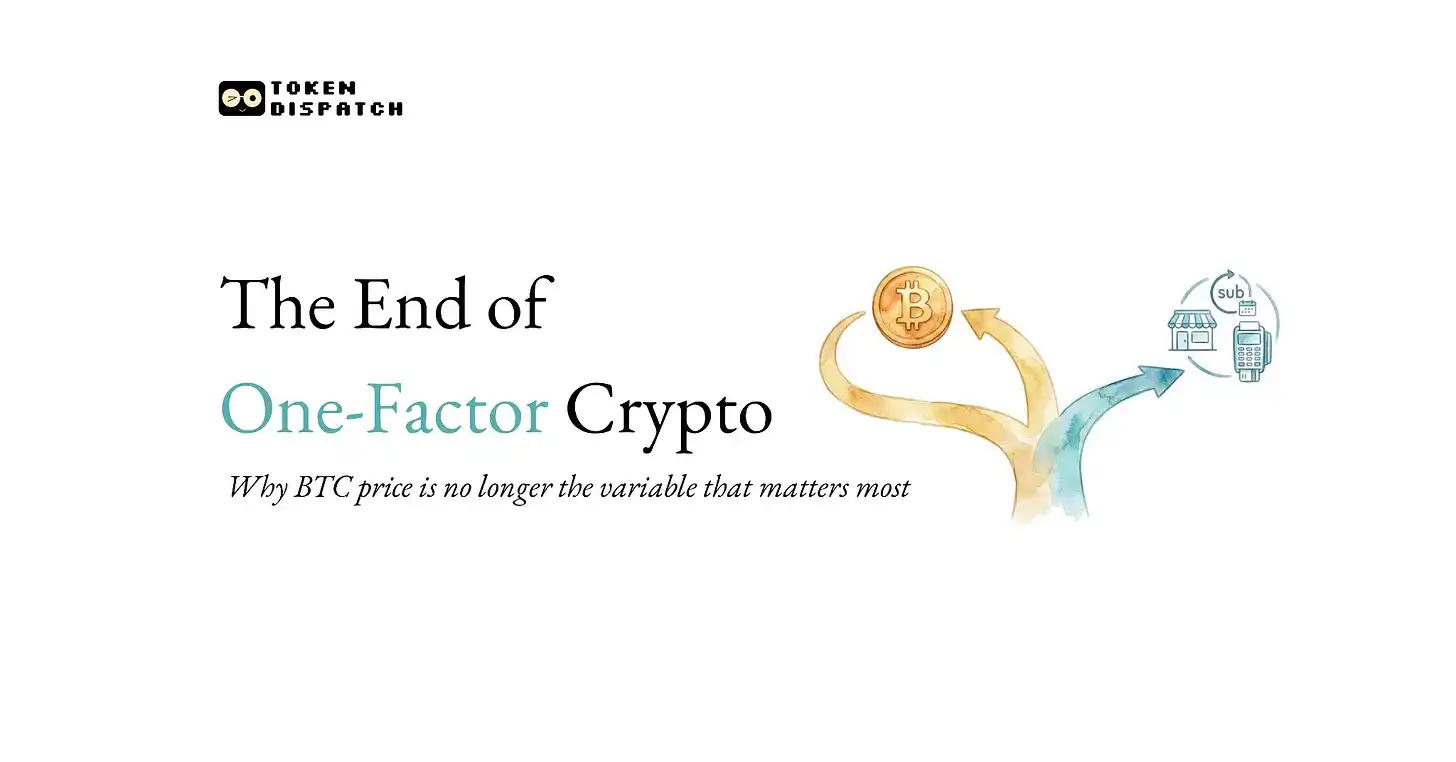
The End of Single-Factor Cryptography

The article "The End of Single-Factor Crypto" posits a fundamental shift in the cryptocurrency ecosystem. It argues the era where crypto asset valuations were predominantly driven by, and correlated with, Bitcoin's price is ending. The space is bifurcating into two distinct economies: endogenous and exogenous. The endogenous economy represents traditional crypto, where token and project values are directly tied to crypto market prices. The emerging exogenous economy comprises projects and businesses that may utilize blockchain technology or tokens but derive their fundamental value from external, non-crypto factors like consumer demand, subscription revenue, or real-world utility. Examples include AI inference platforms like Venice, fintech lenders using blockchain for efficiency, and stablecoin/payment infrastructure companies acquired by giants like Mastercard and Stripe. This shift means investment analysis must change. For exogenous assets, evaluating traditional business fundamentals—such as revenue streams, unit economics, and competitive moats—becomes more critical than tracking Bitcoin charts. While endogenous assets like Bitcoin remain relevant, the growth of the exogenous category is driven by measurable demand independent of crypto price cycles, paving the way for a new, more diversified market phase. Consequently, crypto is evolving from a single-factor, reflexive asset class into a multifaceted ecosystem with varied drivers and investment theses.

marsbitHá 24m

The End of Single-Factor Cryptography

marsbitHá 24m

Morning Post | Bitmine Plans to Raise $300 Million Through Preferred Stock Issuance; Polymarket Accuses Kalshi of Commercial Espionage

ChainCatcher's Daily Crypto Brief: Key developments from the past 24 hours include significant funding moves, regulatory actions, and market predictions. Bitmine announced a $300 million preferred stock fundraising. Polymarket accused rival prediction platform Kalshi of corporate espionage, citing numerous suspicious coincidences in product launches, a claim Kalshi strongly denied. The U.S. Department of Justice, in a joint "Disruption Week" anti-fraud operation with companies like Coinbase and Meta, froze over $3.8 million in cryptocurrency linked to scams. In infrastructure news, Macau completed its integration with the multi-central bank digital currency bridge, mBridge, aiming to build efficient cross-border payment channels. Cosmos Labs acquired the block explorer Mintscan. Market-wise, Geoffrey Kendrick, Standard Chartered's Head of Digital Assets Research, stated Bitcoin is nearing a bottom around $63,000, maintaining a year-end target of $100,000. He noted stability in U.S. spot Bitcoin ETF holdings. Ahead of SpaceX's anticipated IPO, internal insiders at Rocket Lab (RKLB) sold over $18.41 million in stock. In tokenization, Goldman Sachs partnered with Apex and Archax to launch a tokenized real estate fund. The meme token tracker GMGN reported the top trending tokens: on Ethereum, HEX, SHIB, LINK, PEPE, mUSD; on Solana, TROLL, swarms, WORLDCUP, neet, Buttcoin; and on Base, PEPE, toby, ODDS, ELSA, SKI.

链捕手Há 39m

Morning Post | Bitmine Plans to Raise $300 Million Through Preferred Stock Issuance; Polymarket Accuses Kalshi of Commercial Espionage

链捕手Há 39m

Trading

Spot
Futuros

Artigos em Destaque

Como comprar DRIFT

Bem-vindo à HTX.com!Tornámos a compra de Drift Protocol (DRIFT) simples e conveniente.Segue o nosso guia passo a passo para iniciar a tua jornada no mundo das criptos.Passo 1: cria a tua conta HTXUtiliza o teu e-mail ou número de telefone para te inscreveres numa conta gratuita na HTX.Desfruta de um processo de inscrição sem complicações e desbloqueia todas as funcionalidades.Obter a minha contaPasso 2: vai para Comprar Cripto e escolhe o teu método de pagamentoCartão de crédito/débito: usa o teu visa ou mastercard para comprar Drift Protocol (DRIFT) instantaneamente.Saldo: usa os fundos da tua conta HTX para transacionar sem problemas.Terceiros: adicionamos métodos de pagamento populares, como Google Pay e Apple Pay, para aumentar a conveniência.P2P: transaciona diretamente com outros utilizadores na HTX.Mercado de balcão (OTC): oferecemos serviços personalizados e taxas de câmbio competitivas para os traders.Passo 3: armazena teu Drift Protocol (DRIFT)Depois de comprar o teu Drift Protocol (DRIFT), armazena-o na tua conta HTX.Alternativamente, podes enviá-lo para outro lugar através de transferência blockchain ou usá-lo para transacionar outras criptomoedas.Passo 4: transaciona Drift Protocol (DRIFT)Transaciona facilmente Drift Protocol (DRIFT) no mercado à vista da HTX.Acede simplesmente à tua conta, seleciona o teu par de trading, executa as tuas transações e monitoriza em tempo real.Oferecemos uma experiência de fácil utilização tanto para principiantes como para traders experientes.

275 Visualizações TotaisPublicado em {updateTime}Atualizado em 2026.06.02

Como comprar DRIFT

Discussões

Bem-vindo à Comunidade HTX. Aqui, pode manter-se informado sobre os mais recentes desenvolvimentos da plataforma e obter acesso a análises profissionais de mercado. As opiniões dos utilizadores sobre o preço de DRIFT (DRIFT) são apresentadas abaixo.

活动图片