Cipher enters US wholesale power market with Ohio data center acquisition

cointelegraphPublicado em 2025-12-23Última atualização em 2025-12-23

Resumo

Cipher Mining has acquired a 200-megawatt power site in Ohio, marking its first expansion outside Texas and entry into the PJM wholesale electricity market. The site, expected to be operational by Q4 2027, is suitable for Bitcoin mining, high-performance computing, and data center use. This move addresses growing demand from hyperscalers like Amazon Web Services and Google Cloud. The acquisition reflects a broader trend of Bitcoin miners diversifying into power, data center, and infrastructure ventures amid ongoing pressure on mining profitability. Despite low hash prices, mining stocks have surged in 2025, with investors focusing on long-term strategic positioning rather than short-term Bitcoin production.

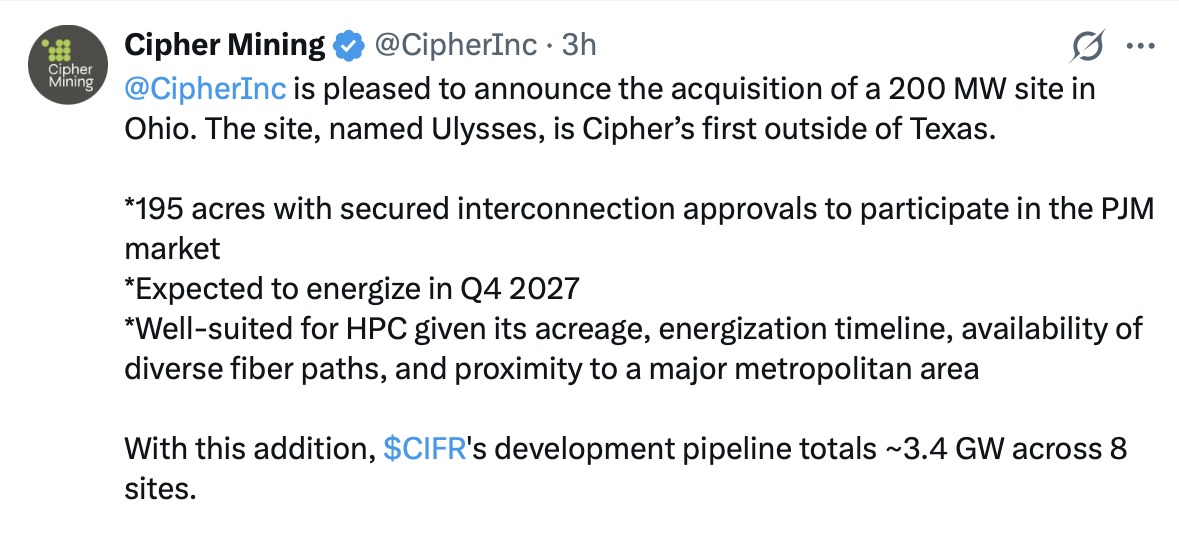
Cipher Mining has acquired a 200-megawatt power site in Ohio called “Ulysses,” marking its first expansion outside of Texas and entry into the PJM wholesale electricity market, the largest power market in the United States.

According to Tuesday’s announcement, the 195-acre site has secured power capacity from AEP Ohio, with all required utility agreements in place, and is expected to be energized in the fourth quarter of 2027.

Cipher said the facility is suitable for high-performance computing and data center use in addition to Bitcoin (BTC) mining. Financial terms of the transaction were not disclosed.

The move aims to meet growing demand from hyperscalers, large cloud computing companies such as Amazon Web Services and Google Cloud, for data centers. “Hyperscalers are driving unprecedented demand for large-scale sites,” said Cipher CEO Tyler Page, adding that the company's new site will give it additional capacity to expand its high-performance computing (HPC) hosting business.
Source: Cipher Mining

The deal follows a broader push by publicly listed Bitcoin miners into power, data center and manufacturing infrastructure beyond traditional mining.

Hut 8, for instance, recently signed a 15-year lease worth about $7 billion to supply 245 megawatts of AI data center capacity at its River Bend campus in Louisiana, with infrastructure provider Fluidstack as the tenant and Google backing lease payments.

A few days later, Bitdeer leased about 188,000 square feet at a logistics facility in Sparks, Nevada, to expand its US manufacturing footprint, according to The Miner Mag.

Related: How Bhutan is building a green Bitcoin economy from the ground up

Bitcoin mining hashprice puts pressure on miners

The Bitcoin mining hash price, a key measure of miner revenue per unit of computing power, has been below $40 since mid-November, a level many operators view as breakeven. The slump has forced mining companies to reassess their operating models as margins across the sector remain under pressure.
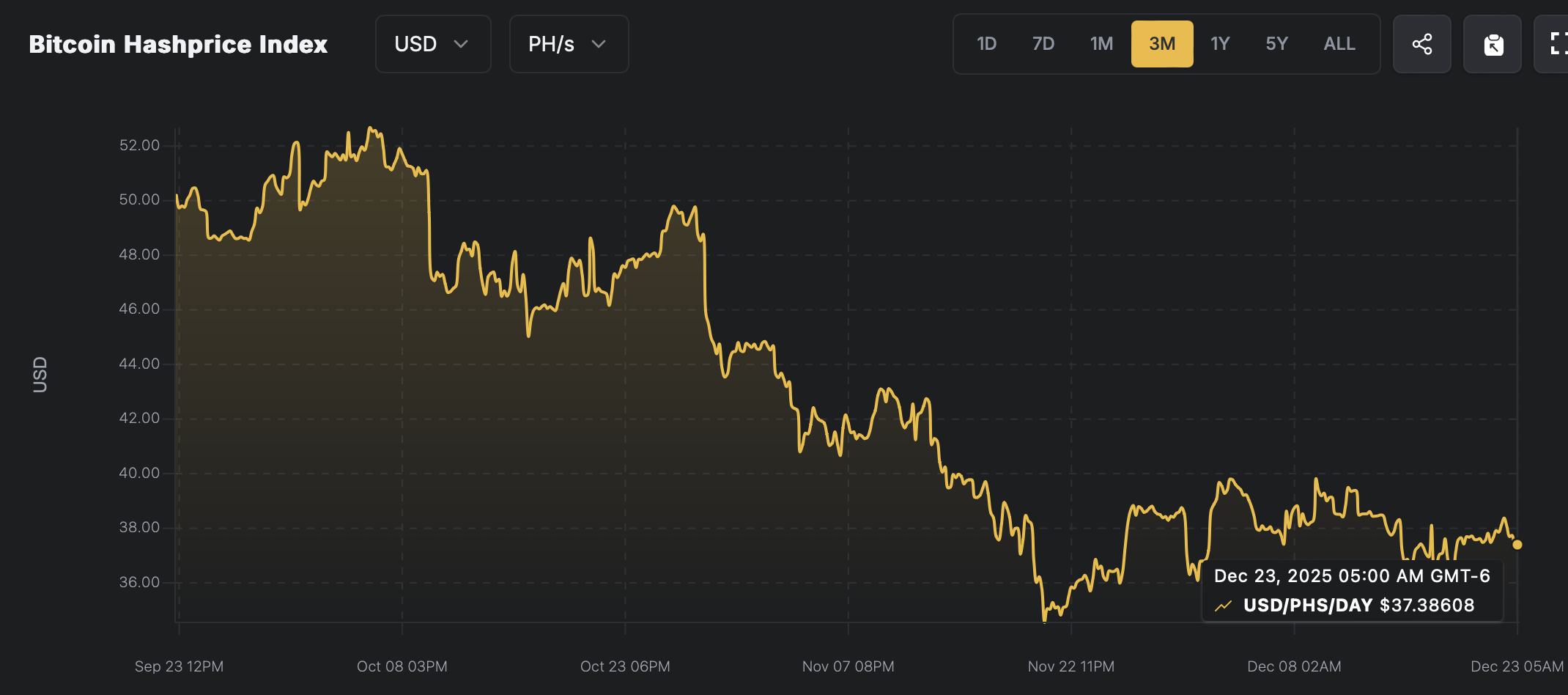
Bitcoin hash price over the past three months. Source: Hashrate Index

While many miners have sought diversification through AI and HPC demand, some are also turning to renewable energy as a way to lower costs and stabilize profitability.

Sangha Renewables recently brought a 20-megawatt solar-powered mining facility online in Ector County, Texas, while Phoenix Group launched a 30-megawatt hydro-powered operation in Ethiopia in November.

Separately, Canaan partnered with Soluna in September to deploy mining capacity at a wind-powered site in Texas and is developing adaptive mining rigs that use AI to optimize energy efficiency.

Despite the mounting pressure on mining economics, Bitcoin mining stocks have rallied sharply in 2025, signaling that public markets are increasingly focused on miners’ long-term strategic positioning rather than near-term Bitcoin production alone.

Among the top five publicly traded miners, IREN Limited is up roughly 331% year-to-date, followed by Applied Digital (246%), Cipher Mining (250%), Hut 8 (160%), and Riot Platforms (36%), according to data from Google Finance.
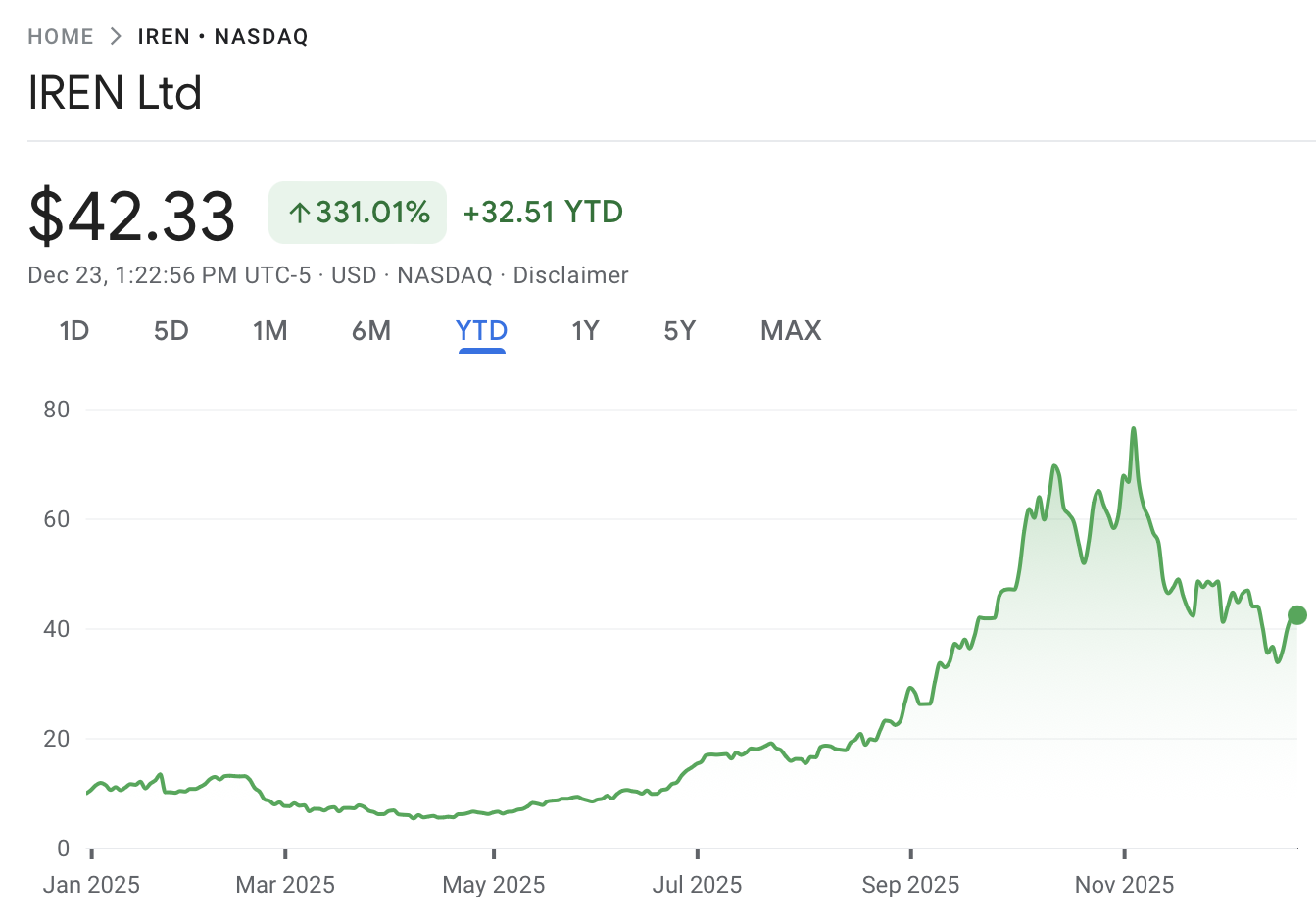
Iren Limited YTD stock price. Source: Google Finance

Magazine: Big questions: Would Bitcoin survive a 10-year power outage?

Perguntas relacionadas

QWhat is the significance of Cipher Mining's acquisition of the Ulysses site in Ohio?

AThe acquisition marks Cipher Mining's first expansion outside of Texas and its entry into the PJM wholesale electricity market, the largest power market in the United States. It is a 200-megawatt power site suitable for Bitcoin mining, high-performance computing, and data center use.

QWhat is the expected timeline for the Ulysses site to become operational, and what key utility agreement is in place?

AThe Ulysses site is expected to be energized in the fourth quarter of 2027. It has secured power capacity from AEP Ohio, with all required utility agreements in place.

QAccording to Cipher's CEO, what is driving unprecedented demand for large-scale sites like Ulysses?

ACipher CEO Tyler Page stated that hyperscalers, which are large cloud computing companies such as Amazon Web Services and Google Cloud, are driving unprecedented demand for large-scale data center sites.

QHow has the low Bitcoin mining hashprice since mid-November affected mining companies?

AThe Bitcoin mining hashprice has been below $40, a level many operators view as breakeven. This slump has forced mining companies to reassess their operating models as margins across the sector remain under pressure.

QWhat are some strategies Bitcoin miners are using to diversify and stabilize profitability amid economic pressures?

AMiners are diversifying through AI and high-performance computing (HPC) demand. They are also turning to renewable energy to lower costs, with examples including solar-powered facilities in Texas, hydro-powered operations in Ethiopia, and wind-powered sites.

Leituras Relacionadas

Google and Amazon Simultaneously Invest Heavily in a Competitor: The Most Absurd Business Logic of the AI Era Is Becoming Reality

In a span of four days, Amazon announced an additional $25 billion investment, and Google pledged up to $40 billion—both direct competitors pouring over $65 billion into the same AI startup, Anthropic. Rather than a typical venture capital move, this signals the latest escalation in the cloud wars. The core of the deal is not equity but compute pre-orders: Anthropic must spend the majority of these funds on AWS and Google Cloud services and chips, effectively locking in massive future compute consumption. This reflects a shift in cloud market dynamics—enterprises now choose cloud providers based on which hosts the best AI models, not just price or stability. With OpenAI deeply tied to Microsoft, Anthropic’s Claude has become the only viable strategic asset for Google and Amazon to remain competitive. Anthropic’s annualized revenue has surged to $30 billion, and it is expanding into verticals like biotech, positioning itself as a cross-industry AI infrastructure layer. However, this funding comes with constraints: Anthropic’s independence is challenged as it balances two rival investors, its safety-first narrative faces pressure from regulatory scrutiny, and its path to IPO introduces new financial pressures. Globally, this accelerates a "tri-polar" closed-loop structure in AI infrastructure, with Microsoft-OpenAI, Google-Anthropic, and Amazon-Anthropic forming exclusive model-cloud alliances. In contrast, China’s landscape differs—investments like Alibaba and Tencent backing open-source model firm DeepSeek reflect a more decoupled approach, though closed-source models from major cloud providers still dominate. The $65 billion bet is ultimately about securing a seat at the table in an AI-defined future—where missing the model layer means losing the cloud war.

marsbitHá 1h

Google and Amazon Simultaneously Invest Heavily in a Competitor: The Most Absurd Business Logic of the AI Era Is Becoming Reality

marsbitHá 1h

Computing Power Constrained, Why Did DeepSeek-V4 Open Source?

DeepSeek-V4 has been released as a preview open-source model, featuring 1 million tokens of context length as a baseline capability—previously a premium feature locked behind enterprise paywalls by major overseas AI firms. The official announcement, however, openly acknowledges computational constraints, particularly limited service throughput for the high-end DeepSeek-V4-Pro version due to restricted high-end computing power. Rather than competing on pure scale, DeepSeek adopts a pragmatic approach that balances algorithmic innovation with hardware realities in China’s AI ecosystem. The V4-Pro model uses a highly sparse architecture with 1.6T total parameters but only activates 49B during inference. It performs strongly in agentic coding, knowledge-intensive tasks, and STEM reasoning, competing closely with top-tier closed models like Gemini Pro 3.1 and Claude Opus 4.6 in certain scenarios. A key strategic product is the Flash edition, with 284B total parameters but only 13B activated—making it cost-effective and accessible for mid- and low-tier hardware, including domestic AI chips from Huawei (Ascend), Cambricon, and Hygon. This design supports broader adoption across developers and SMEs while stimulating China's domestic semiconductor ecosystem. Despite facing talent outflow and intense competition in user traffic—with rivals like Doubao and Qianwen leading in monthly active users—DeepSeek has maintained technical momentum. The release also comes amid reports of a new funding round targeting a valuation exceeding $10 billion, potentially setting a new record in China’s LLM sector. Ultimately, DeepSeek-V4 represents a shift toward open yet realistic infrastructure development in the constrained compute landscape of Chinese AI, emphasizing engineering efficiency and domestic hardware compatibility over pure model scale.

marsbitHá 1h

Computing Power Constrained, Why Did DeepSeek-V4 Open Source?

marsbitHá 1h

Trading

Spot
Futuros

Artigos em Destaque

Como comprar US

Bem-vindo à HTX.com!Tornámos a compra de Talus Network (US) simples e conveniente.Segue o nosso guia passo a passo para iniciar a tua jornada no mundo das criptos.Passo 1: cria a tua conta HTXUtiliza o teu e-mail ou número de telefone para te inscreveres numa conta gratuita na HTX.Desfruta de um processo de inscrição sem complicações e desbloqueia todas as funcionalidades.Obter a minha contaPasso 2: vai para Comprar Cripto e escolhe o teu método de pagamentoCartão de crédito/débito: usa o teu visa ou mastercard para comprar Talus Network (US) instantaneamente.Saldo: usa os fundos da tua conta HTX para transacionar sem problemas.Terceiros: adicionamos métodos de pagamento populares, como Google Pay e Apple Pay, para aumentar a conveniência.P2P: transaciona diretamente com outros utilizadores na HTX.Mercado de balcão (OTC): oferecemos serviços personalizados e taxas de câmbio competitivas para os traders.Passo 3: armazena teu Talus Network (US)Depois de comprar o teu Talus Network (US), armazena-o na tua conta HTX.Alternativamente, podes enviá-lo para outro lugar através de transferência blockchain ou usá-lo para transacionar outras criptomoedas.Passo 4: transaciona Talus Network (US)Transaciona facilmente Talus Network (US) no mercado à vista da HTX.Acede simplesmente à tua conta, seleciona o teu par de trading, executa as tuas transações e monitoriza em tempo real.Oferecemos uma experiência de fácil utilização tanto para principiantes como para traders experientes.

366 Visualizações TotaisPublicado em {updateTime}Atualizado em 2025.12.11

Como comprar US

Discussões

Bem-vindo à Comunidade HTX. Aqui, pode manter-se informado sobre os mais recentes desenvolvimentos da plataforma e obter acesso a análises profissionais de mercado. As opiniões dos utilizadores sobre o preço de US (US) são apresentadas abaixo.

活动图片













