China Mobile Launches Token-Included Phone Plan

marsbitPublicado em 2026-05-19Última atualização em 2026-05-19

Resumo

China's three major telecom operators—China Telecom, China Mobile, and China Unicom—have simultaneously launched nationwide "Token packages" for consumers. Starting from as low as 9.9 RMB per month for 10 million tokens, these plans allow direct payment via phone bills, positioning AI usage tokens as a new type of basic telecom commodity akin to traditional data or call packages. Each operator has adopted slightly different strategies: China Telecom offers tiered personal and enterprise plans bundled with bandwidth and security services; China Mobile integrates tokens with cloud computing packages and partners with Tencent; while China Unicom provides free trial tokens and team plans. Despite minor price variations, their core approach is unified: selling computational tokens directly to their massive combined user base of over 1.7 billion subscribers. The significance lies not in groundbreaking pricing but in the unparalleled distribution channel. By embedding token sales into existing billing systems, operators are demystifying AI access, transforming tokens from a niche developer resource into a mainstream utility. This collective move by state-backed carriers signals a strategic industry shift from "traffic management" to "computing power management," potentially reshaping the AI API market landscape and making token purchases as simple as topping up phone credit.

Breaking News! China Telecom, China Mobile, and China Unicom All Enter the Fray

From May 16th to 17th, the three major telecom operators successively launched nationwide Token plans within two days.

Starting as low as 9.9 yuan/month for 10 million Tokens.

Direct payment via phone bill is supported.

AI has evolved from a tech circle concern into a line item on your phone bill.

What does this mean—Tokens are becoming the new generation of "data packages."
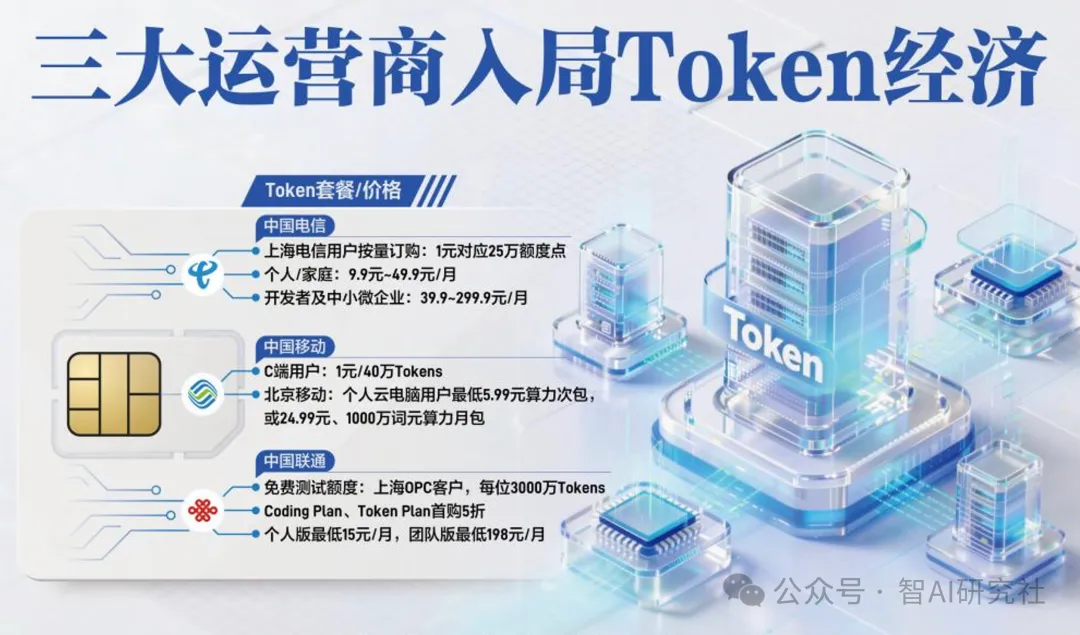
Different Selling Methods, Strikingly Similar Direction

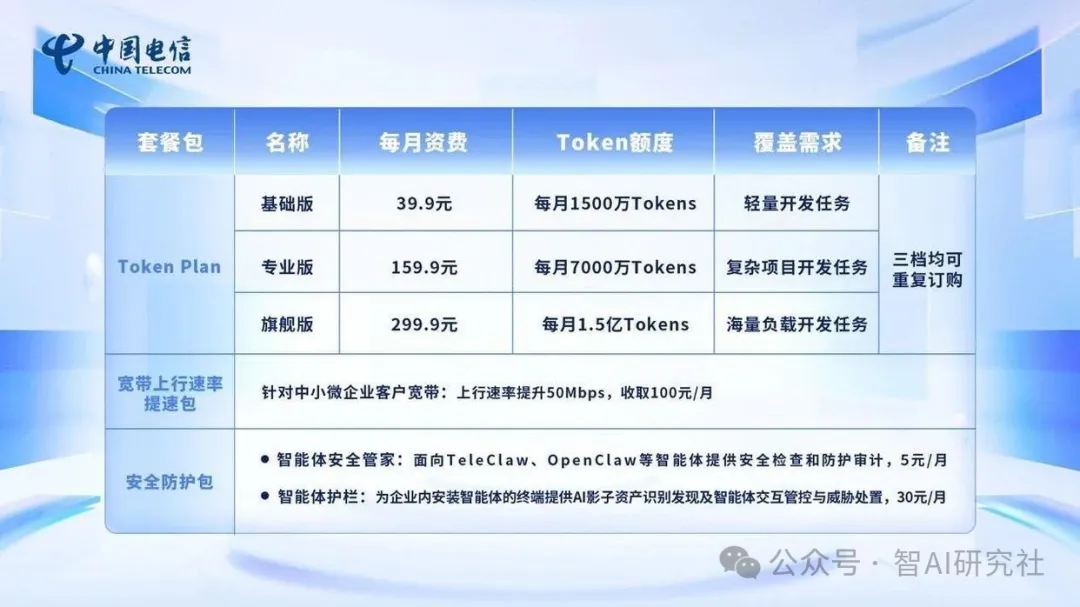
First, look at China Telecom's offering.

Individual plan: Minimum 9.9 yuan/month, includes 10 million Tokens.

Higher tiers include 29.9 yuan and 49.9 yuan, corresponding to 40 million and 80 million Tokens respectively.

For developers and enterprises: Basic version at 39.9 yuan for 15 million Tokens, Professional version at 159.9 yuan, and Flagship version at 299.9 yuan.

China Telecom's selling point is a bundled package of "Tokens + Connectivity + Security," offering broadband uplink speed boost and security protection along with Tokens.
Next, China Mobile.

Shanghai Mobile, in collaboration with Tencent, launched an AI-native workbench, with 1 yuan buying 400k Tokens. Beijing Mobile was even earlier—minimum 5.99 yuan for a computing resource sub-package, and 24.99 yuan for 10 million Tokens.

The most notable move is that China Mobile integrated Tokens into its cloud computer service.

Users without a cloud computer can directly purchase a bundled cloud computer plan with built-in OpenClaw, ready to use upon startup.

China Unicom's approach is also different.

Shanghai Unicom is giving them away—OPC customers can receive a 30 million Token testing quota for free.

Personal version: 15 yuan/month for 6 million Tokens. Team version: 198 yuan/month, also including a one-month free trial of AI cloud desktop.

The prices of the three operators are similar, with each having its own strategic focus.

But the core logic is exactly the same—selling Tokens like phone credit packages.
What's More Worth Noting Than the 9.9 Yuan Price

The 9.9 yuan Token plan itself is not cheaper than offerings from major tech giants.

Some market commentators note that compared to API pricing from major model providers, the operators do not have a clear price advantage.

But the key point here is not the price; it's the distribution channel.

Major tech companies sell Tokens to developers and power users—there's a ceiling there.

Telecom operators sell Tokens to everyone who has a mobile phone.

China Mobile has nearly 1 billion subscribers, China Telecom has nearly 400 million, and China Unicom also has over 300 million.

This user pool is on a completely different scale.

And most importantly, this represents the collective entry of state-owned enterprises.
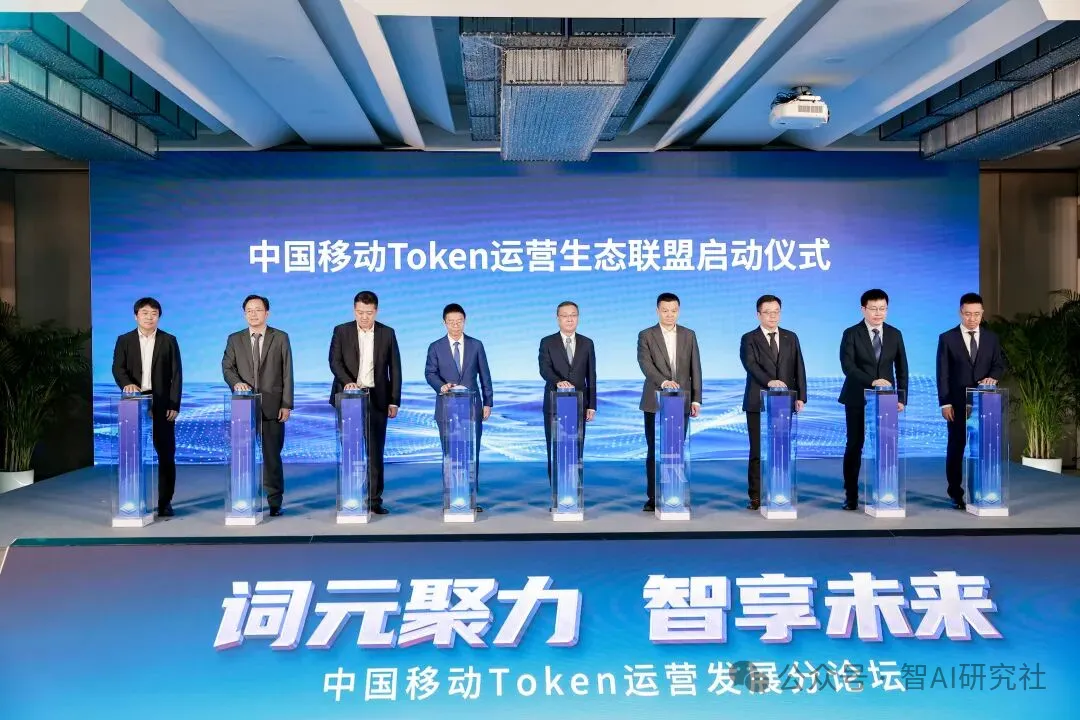
The shift in the telecom industry from traffic management to computing power management is not the decision of a single company.

It is a synchronous pivot by the three major operators.

The data from the National Data Administration is also on the table—the daily Token consumption volume in China surged from 100 billion in early 2024 to over 140 trillion by March 2026.

An increase of over a thousand times in two years.

Tokens are no longer a niche unit in the AI circle; they are becoming a basic telecom commodity alongside data and call credit.

Some telecommunications industry experts judge that if all three operators follow through,

the distribution market for large model APIs might partially shift from cloud providers to the operator system.

In the future, you won't need to understand what an API or a model is to buy Tokens.

You could just go to a service center and say, "Top up 100 yuan worth of Tokens for me," and another line would appear on your phone bill.


Perguntas relacionadas

QWhat is the core new product that China's three major telecom operators (China Telecom, China Mobile, and China Unicom) have recently launched?

AThey have collectively launched national "Token packages" or "Token plans." These are data-like packages where users pay a monthly fee to receive a certain amount of AI model processing tokens.

QWhat is the lowest monthly price point mentioned for these Token packages, and how many tokens does it offer?

AThe lowest monthly price mentioned is 9.9 yuan per month, which offers 10 million tokens. The article cites this as China Telecom's entry-level personal plan.

QWhy is the launch of these Token packages by telecom operators considered significant beyond just pricing?

AThe significance lies in the channel and scale. Unlike AI companies selling primarily to developers, operators can sell Token packages to their entire mobile user base—totaling hundreds of millions of customers—making AI consumption as easy and common as paying a phone bill.

QHow is China Mobile specifically integrating its Token offering?

AChina Mobile is integrating Tokens into its cloud computer service. For users without a cloud computer, they can purchase a fused package that includes a cloud computer pre-installed with 'OpenClaw' AI tools, ready to use upon startup.

QWhat broader industry shift does the article suggest this move by the telecom operators represents?

AIt represents a strategic shift for the telecom industry from 'traffic operation' (focusing on data/bandwidth) to 'computing power operation' (focusing on AI processing tokens and services). This is a coordinated move by the state-backed operators, signaling Tokens are becoming a fundamental telecom commodity.

Leituras Relacionadas

The Age of Decoupling Has Arrived: Bitcoin is No Longer the Sole Compass of Crypto

The era of the cryptocurrency market moving in lockstep with Bitcoin is ending, as the industry splits into two distinct asset categories: endogenous and exogenous. Endogenous assets, like Bitcoin, derive value purely from the crypto market's cycles. Their narratives swing between being "interstellar money" in bull markets and "digital collectibles" in bear markets. Exogenous assets, however, are nominally crypto but operate with independent value drivers. Examples include: * **Venice:** An AI inference service using tokens for payments; its consumer-AI business model is decoupled from crypto price swings. * **Figure:** A fintech lender using blockchain to speed up loan approvals; its core value is in credit, not crypto. * **Stablecoin firms like BVNK:** Acquired by traditional finance giants (Mastercard, Stripe), their growth is tied to payment infrastructure, not market cycles. Hybrid projects like **Hyperliquid** (a decentralized exchange) show a shift, with a growing share of non-crypto trading (e.g., prediction markets). This divergence is fundamental. Endogenous assets remain highly correlated to Bitcoin, similar to gold miners to gold. Exogenous assets are evolving to have their own fundamentals, like the weak correlation between gold and the S&P 500. This changes investment analysis. Evaluating exogenous assets requires traditional fundamental research—assessing user bases, unit economics, and moats—more akin to fintech investing than charting Bitcoin. Promising exogenous sectors include: on-chain exchanges/brokers, AI-crypto fusion, privacy-focused digital banks, lending (institutional/private credit), stablecoins/real-world asset tokenization, payment rails, and non-financial crypto-consumer products. Currently, investing via equity is often safer than via tokens, as token value accrual mechanisms need further regulatory and industry development (e.g., the CLARITY Act). Nonetheless, the core trend is clear: crypto market drivers are diversifying from a single factor (Bitcoin) to multiple fundamentals, ending the era of uniform market moves.

marsbitHá 24m

The Age of Decoupling Has Arrived: Bitcoin is No Longer the Sole Compass of Crypto

marsbitHá 24m

What's New in Jensen Huang's 'Agent Factory'?

In a keynote at COMPUTEX 2026, NVIDIA CEO Jensen Huang shifted the company's focus from hardware "full-stack" solutions to the era of AI Agents. The centerpiece is the Vera Rubin platform, now in production, which is designed specifically for Agent workloads and offers 10x the efficiency of its predecessor. The platform features the new Vera CPU, built for AI, and incorporates Spectrum-X Ethernet Photonics with CPO technology for improved networking and energy efficiency. NVIDIA introduced DSX, an integrated toolkit for designing, simulating, and operating AI data centers, aiming to streamline "AI factory" deployment and management. For end-user deployment, the company unveiled DGX Station for Windows, a desktop AI supercomputer for running Agents locally, and the RTX Spark SoC for AI PCs. On the software front, NVIDIA launched the 550B-parameter Nemotron 3 Ultra model for enterprise Agents and the Cosmos 3 foundation model for physical AI, unifying visual reasoning and action prediction. In robotics, a partnership with Unitree yielded the H2 Plus, a reference humanoid robot built on the Isaac GR00T platform to lower development barriers. Security was emphasized with enhanced confidential computing for Vera Rubin and new data path security features for the BlueField-4 STX storage platform. The presentation highlighted a strategic pivot: NVIDIA is reorganizing its entire technology stack—from chips and data centers to models, software, and robots—around the emerging ecosystem of autonomous, practical AI Agents.

marsbitHá 1h

What's New in Jensen Huang's 'Agent Factory'?

marsbitHá 1h

Trading

Spot
Futuros
活动图片




