China Mobile Launches Token-Included Phone Plan

marsbitPublicado em 2026-05-19Última atualização em 2026-05-19

Resumo

China's three major telecom operators—China Telecom, China Mobile, and China Unicom—have simultaneously launched nationwide "Token packages" for consumers. Starting from as low as 9.9 RMB per month for 10 million tokens, these plans allow direct payment via phone bills, positioning AI usage tokens as a new type of basic telecom commodity akin to traditional data or call packages. Each operator has adopted slightly different strategies: China Telecom offers tiered personal and enterprise plans bundled with bandwidth and security services; China Mobile integrates tokens with cloud computing packages and partners with Tencent; while China Unicom provides free trial tokens and team plans. Despite minor price variations, their core approach is unified: selling computational tokens directly to their massive combined user base of over 1.7 billion subscribers. The significance lies not in groundbreaking pricing but in the unparalleled distribution channel. By embedding token sales into existing billing systems, operators are demystifying AI access, transforming tokens from a niche developer resource into a mainstream utility. This collective move by state-backed carriers signals a strategic industry shift from "traffic management" to "computing power management," potentially reshaping the AI API market landscape and making token purchases as simple as topping up phone credit.

Breaking News! China Telecom, China Mobile, and China Unicom All Enter the Fray

From May 16th to 17th, the three major telecom operators successively launched nationwide Token plans within two days.

Starting as low as 9.9 yuan/month for 10 million Tokens.

Direct payment via phone bill is supported.

AI has evolved from a tech circle concern into a line item on your phone bill.

What does this mean—Tokens are becoming the new generation of "data packages."
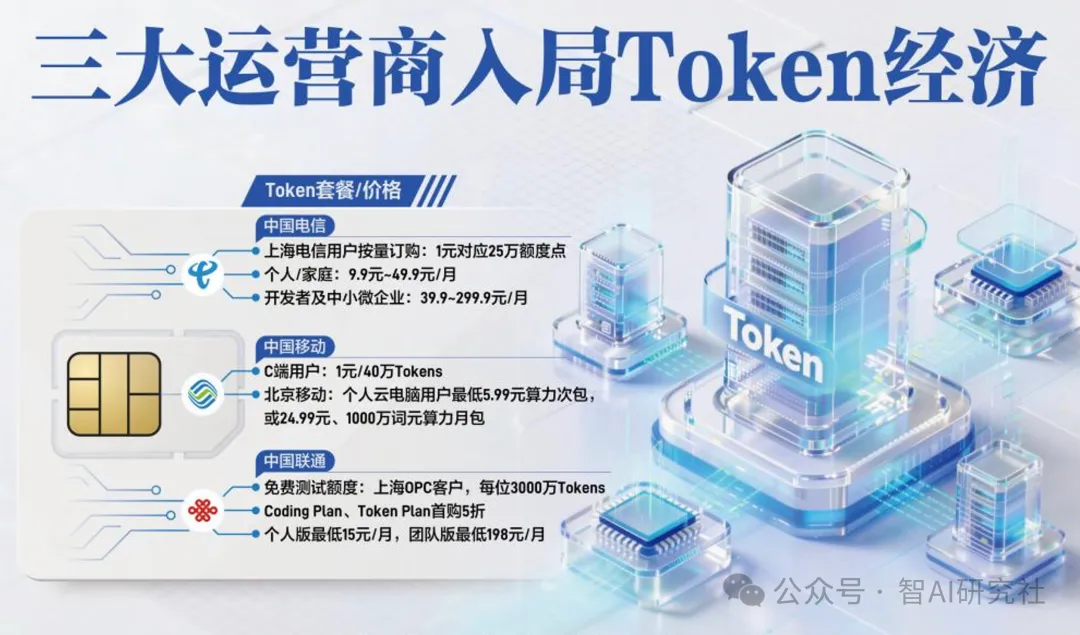
Different Selling Methods, Strikingly Similar Direction

First, look at China Telecom's offering.

Individual plan: Minimum 9.9 yuan/month, includes 10 million Tokens.

Higher tiers include 29.9 yuan and 49.9 yuan, corresponding to 40 million and 80 million Tokens respectively.

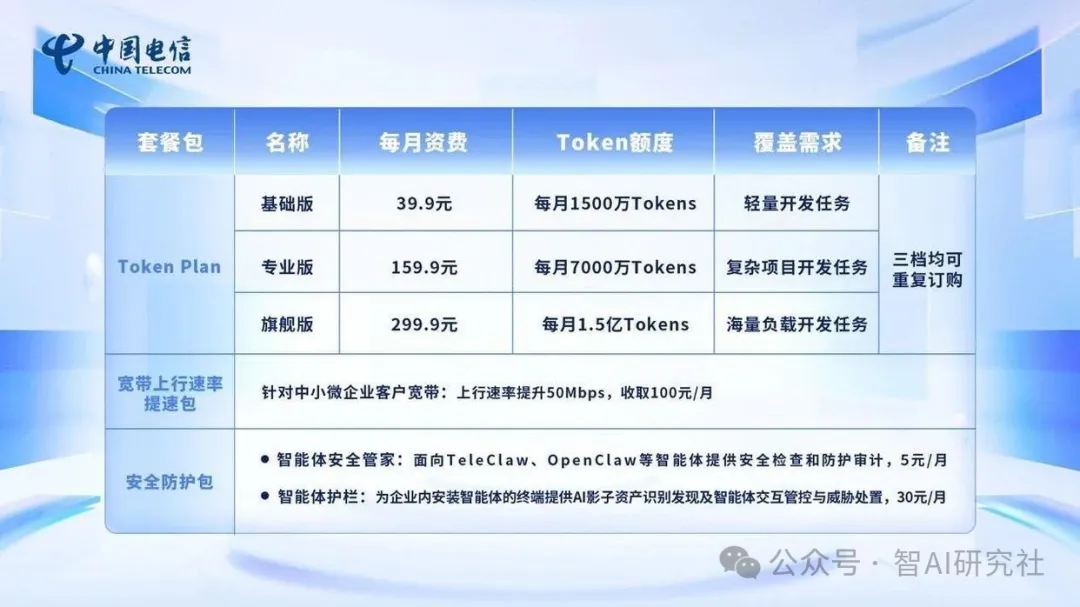
For developers and enterprises: Basic version at 39.9 yuan for 15 million Tokens, Professional version at 159.9 yuan, and Flagship version at 299.9 yuan.

China Telecom's selling point is a bundled package of "Tokens + Connectivity + Security," offering broadband uplink speed boost and security protection along with Tokens.
Next, China Mobile.

Shanghai Mobile, in collaboration with Tencent, launched an AI-native workbench, with 1 yuan buying 400k Tokens. Beijing Mobile was even earlier—minimum 5.99 yuan for a computing resource sub-package, and 24.99 yuan for 10 million Tokens.

The most notable move is that China Mobile integrated Tokens into its cloud computer service.

Users without a cloud computer can directly purchase a bundled cloud computer plan with built-in OpenClaw, ready to use upon startup.

China Unicom's approach is also different.

Shanghai Unicom is giving them away—OPC customers can receive a 30 million Token testing quota for free.

Personal version: 15 yuan/month for 6 million Tokens. Team version: 198 yuan/month, also including a one-month free trial of AI cloud desktop.

The prices of the three operators are similar, with each having its own strategic focus.

But the core logic is exactly the same—selling Tokens like phone credit packages.
What's More Worth Noting Than the 9.9 Yuan Price

The 9.9 yuan Token plan itself is not cheaper than offerings from major tech giants.

Some market commentators note that compared to API pricing from major model providers, the operators do not have a clear price advantage.

But the key point here is not the price; it's the distribution channel.

Major tech companies sell Tokens to developers and power users—there's a ceiling there.

Telecom operators sell Tokens to everyone who has a mobile phone.

China Mobile has nearly 1 billion subscribers, China Telecom has nearly 400 million, and China Unicom also has over 300 million.

This user pool is on a completely different scale.

And most importantly, this represents the collective entry of state-owned enterprises.
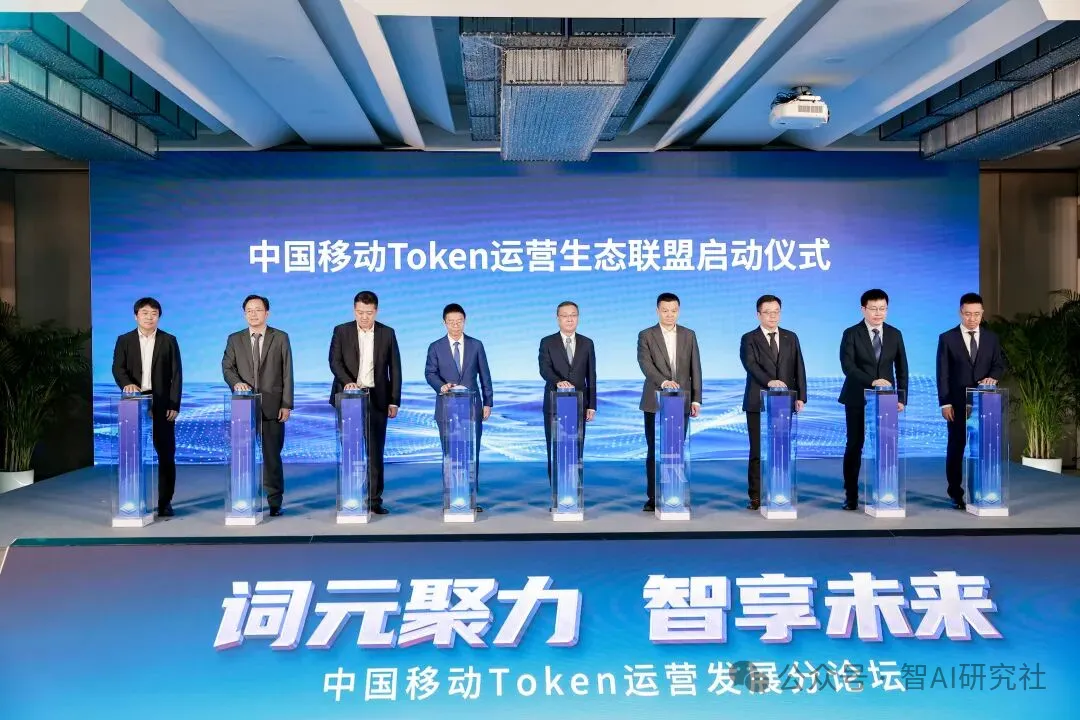
The shift in the telecom industry from traffic management to computing power management is not the decision of a single company.

It is a synchronous pivot by the three major operators.

The data from the National Data Administration is also on the table—the daily Token consumption volume in China surged from 100 billion in early 2024 to over 140 trillion by March 2026.

An increase of over a thousand times in two years.

Tokens are no longer a niche unit in the AI circle; they are becoming a basic telecom commodity alongside data and call credit.

Some telecommunications industry experts judge that if all three operators follow through,

the distribution market for large model APIs might partially shift from cloud providers to the operator system.

In the future, you won't need to understand what an API or a model is to buy Tokens.

You could just go to a service center and say, "Top up 100 yuan worth of Tokens for me," and another line would appear on your phone bill.


Perguntas relacionadas

QWhat is the core new product that China's three major telecom operators (China Telecom, China Mobile, and China Unicom) have recently launched?

AThey have collectively launched national "Token packages" or "Token plans." These are data-like packages where users pay a monthly fee to receive a certain amount of AI model processing tokens.

QWhat is the lowest monthly price point mentioned for these Token packages, and how many tokens does it offer?

AThe lowest monthly price mentioned is 9.9 yuan per month, which offers 10 million tokens. The article cites this as China Telecom's entry-level personal plan.

QWhy is the launch of these Token packages by telecom operators considered significant beyond just pricing?

AThe significance lies in the channel and scale. Unlike AI companies selling primarily to developers, operators can sell Token packages to their entire mobile user base—totaling hundreds of millions of customers—making AI consumption as easy and common as paying a phone bill.

QHow is China Mobile specifically integrating its Token offering?

AChina Mobile is integrating Tokens into its cloud computer service. For users without a cloud computer, they can purchase a fused package that includes a cloud computer pre-installed with 'OpenClaw' AI tools, ready to use upon startup.

QWhat broader industry shift does the article suggest this move by the telecom operators represents?

AIt represents a strategic shift for the telecom industry from 'traffic operation' (focusing on data/bandwidth) to 'computing power operation' (focusing on AI processing tokens and services). This is a coordinated move by the state-backed operators, signaling Tokens are becoming a fundamental telecom commodity.

Leituras Relacionadas

The Verdict in Choi Tae-won's Divorce Case: Revealing the Inheritance Undercurrent Behind SK Hynix's Trillion-Won Empire

SK Group Chairman Chey Tae-won's high-profile divorce case, involving a record 1.38 trillion won settlement, has drawn attention to the succession plans for Korea's second-largest conglomerate, especially its crown jewel, SK hynix. Unlike traditional chaebol scripts centered on the eldest son, Chey's three children from his marriage to former President Roh Tae-woo's daughter, Roh Soh-yeong, are carving distinct, non-traditional paths. Eldest daughter Chey Yun-jung (b. 1989) is seen as the most evident successor. With a scientific and consulting background, she holds executive roles at SK bioscience and SK Inc.'s growth support department, focusing on future strategy and biopharma. Her marriage is to an AI infrastructure entrepreneur, not a traditional business alliance. Second daughter Chey Min-jung (b. 1991) took a unique route, voluntarily serving as a South Korean naval officer, including an anti-piracy deployment. She later worked on policy and strategy for SK hynix in Washington D.C. before co-founding an AI-driven healthcare startup. She married a former U.S. Marine Corps officer, connecting her to U.S. defense and policy circles—networks crucial for a global semiconductor giant. The only son, Chey In-geun (b. 1995), who studied physics like his father, worked briefly at SK E&S before joining McKinsey. Despite fitting the traditional "heir" profile as the eldest son, he remains silent and holds no public position or shares in SK, suggesting the old succession playbook is obsolete. As SK hynix's valuation soars, becoming a geopolitical asset in the AI era, the heirs' legitimacy is no longer automatic. They must prove themselves in fields like AI biotech, global policy, and strategic consulting. Their marriages also reflect new elite networks in tech and defense, not old political alliances. Their inheritance is the complex challenge of navigating a globalized, tech-driven world, not just a corporate throne.

marsbitHá 2h

The Verdict in Choi Tae-won's Divorce Case: Revealing the Inheritance Undercurrent Behind SK Hynix's Trillion-Won Empire

marsbitHá 2h

From OpenSea to OpenRouter: Is Alex Atallah Repeating His 'Exit at the Peak' Playbook?

From OpenSea to OpenRouter: Is Alex Atallah Repeating His "Exit at the Peak" Playbook? According to the Wall Street Journal, payments giant Stripe is in talks to acquire the AI model aggregation platform OpenRouter in a potential deal valuing the company near $100 billion. This would mark founder Alex Atallah's second creation of a company reaching a $100 billion valuation, following his co-founding of NFT marketplace OpenSea. OpenRouter, founded just over three years ago, has grown rapidly by acting as a unified gateway for developers to access over 400 AI models. It currently has about 10 million users and processes over 200 trillion tokens monthly. While the platform's annualized revenue is around $50 million, its valuation has skyrocketed from $1.3 billion in March 2026. The potential acquisition by Stripe, a company OpenRouter's founder once likened it to, represents a major expansion into AI infrastructure for the payments leader. This move echoes Atallah's previous timing with OpenSea, where he departed before the NFT market's significant downturn. For OpenRouter, selling now may be strategic. Despite its scale, its business model—charging a 5-5.5% fee on AI inference calls—faces pressure from competition, open-source models, and potential price wars among model providers, limiting its profitability narrative for an IPO. A key asset for potential acquirers like Stripe is OpenRouter's vast repository of real-world AI usage data, which offers unique insights into model performance and developer preferences that are difficult to replicate. Whether this potential deal signifies a new valuation benchmark for AI infrastructure or another market peak signal remains to be seen.

链捕手Há 3h

From OpenSea to OpenRouter: Is Alex Atallah Repeating His 'Exit at the Peak' Playbook?

链捕手Há 3h

Trading

Spot
活动图片




