Charles Hoskinson Blasts Ripple For Backing Bill That Could Crush Competition

bitcoinistPublicado em 2026-03-31Última atualização em 2026-03-31

Resumo

Cardano founder Charles Hoskinson has sharply criticized Ripple and its CEO Brad Garlinghouse for supporting proposed U.S. legislation that would classify most new tokens as securities by default. Hoskinson argues this approach would harm competition, protect established players like Ripple through exemptions, and remove legal protections for DeFi and open-source developers. He warns the bill replicates the SEC’s aggressive regulatory stance and could expose software creators to unreasonable liability. Hoskinson also addressed the XRP community, clarifying that his criticism targets Ripple’s lobbying—not the token itself—and contrasted Ripple’s “mammoth premine” with Cardano’s more distributed token distribution.

Cardano founder Charles Hoskinson used a lengthy weekly livestream to level one of his sharpest recent attacks at Ripple, arguing that the company is backing legislation that could entrench incumbents, weaken DeFi protections, and make it harder for new crypto projects to compete.

The core of Hoskinson’s complaint was not aimed at XRP holders, but at what he described as Ripple’s policy posture in Washington and the behavior of CEO Brad Garlinghouse. In Hoskinson’s telling, Ripple is pushing for rules that would classify new tokens as securities by default while benefiting from carve-outs that would leave larger, established players in a stronger position.

Hoskinson Takes Aim At Ripple Over Competition Fight

Hoskinson said Garlinghouse was “trying to pass a bill that makes everything by default a security until proven otherwise,” calling that framework a non-starter for the broader market. He argued that such an approach would effectively recreate the kind of regulatory pressure that former SEC Chair Gary Gensler brought to the sector, only this time through legislation supported by industry actors rather than enforcement alone.

“He’s trying to pass a bill that makes everything by default a security until proven otherwise, which was the treatment Gary Gensler inflicted on his own ecosystem,” Hoskinson said. “It’s a non-starter, because he knows that he’s going to get an exemption and it reduces competition. So, [expletive] the whole industry. It’s bad behavior.”

That argument sat at the center of a wider rant about market structure, lobbying, and what Hoskinson sees as crypto’s growing willingness to trade open competition for regulatory protection. He said he had already laid out “four different attack vectors” the SEC could use if such a bill were enacted, and warned that the damage would not stop with token issuers.

According to Hoskinson, the proposal would also leave open-source developers exposed by stripping out protections for DeFi builders. “The bill also removed all developer protections for DeFi developers,” he said. “Who takes care of the Tornado Cash people and these other people writing open-source software? We can’t live in a space where you have transitive unlimited liability.”

He extended that point with one of the livestream’s longer analogies, arguing that holding software developers liable for downstream use of their code would amount to a category error. “You write code and people you’ve never met use that code in places you’ve never been to and you’re held absolutely liable for that,” Hoskinson said. “That’s equivalent to you writing a book, someone reads the book and murders somebody based on a character in your book and then you get charged with murder. It’s basically the same thing.”

Hoskinson also took aim at what he described as the XRP community’s reflexive defense of Ripple whenever he criticizes the company. He said there is “no path for people to listen to the content” of his argument because any criticism of Garlinghouse is treated as an attack on XRP itself. He pushed back on that framing by noting that he publicly supported Ripple when the SEC sued the company years ago, but said that did not obligate him to back its current lobbying goals.

“Guys, I did support you when you got sued by the Securities Exchange Commission,” he said. “There’s videos of me. You can pull them up from years ago where I said it was the wrong decision.”

From there, Hoskinson shifted into one of crypto’s oldest fault lines: token distribution. He argued that Ripple had no need for outside help in its legal fight because the organization “gave themselves a mammoth premine,” saying the company already had the resources to defend itself and pursue acquisitions. He contrasted that with Cardano, saying, “I didn’t give myself 70% of the ADA supply.”

At press time, XRP traded at $1.35.
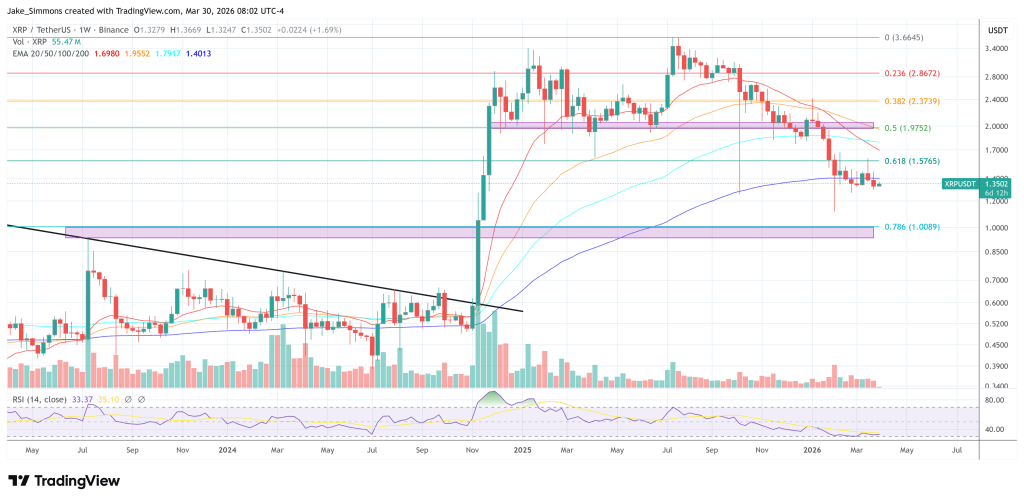
XRP falls below the 200-week EMA again, 1-week chart | Source: XRPUSDT on TradingView.com

Perguntas relacionadas

QWhat is Charles Hoskinson's main criticism against Ripple in this article?

ACharles Hoskinson criticizes Ripple for backing legislation that would classify new tokens as securities by default, which he believes would entrench incumbents, weaken DeFi protections, reduce competition, and benefit established players like Ripple through exemptions.

QAccording to Hoskinson, what negative consequences would the proposed bill have for DeFi developers?

AHoskinson states the bill would remove developer protections for DeFi builders, exposing open-source developers to 'transitive unlimited liability' where they could be held liable for how others use their code, similar to holding an author responsible if someone committed murder after reading their book.

QHow does Hoskinson contrast Cardano's token distribution with Ripple's?

AHoskinson contrasts the two by stating that Ripple 'gave themselves a mammoth premine' of XRP, giving them ample resources, while emphasizing 'I didn't give myself 70% of the ADA supply' for Cardano.

QWhat does Hoskinson say about the XRP community's response to his criticism of Ripple?

AHoskinson says the XRP community has a reflexive defense mechanism where any criticism of Ripple CEO Brad Garlinghouse is treated as an attack on XRP itself, making it difficult for people to actually listen to the content of his arguments.

QWhat historical support does Hoskinson mention he provided to Ripple, and how does it relate to his current stance?

AHoskinson mentions he publicly supported Ripple years ago when the SEC sued the company, calling it 'the wrong decision,' but clarifies that this past support does not obligate him to back Ripple's current lobbying efforts for what he considers anti-competitive legislation.

Leituras Relacionadas

a16z: AI's 'Amnesia', Can Continuous Learning Cure It?

The article "a16z: AI's 'Amnesia' – Can Continual Learning Cure It?" explores the limitations of current large language models (LLMs), which, like the protagonist in the film *Memento*, are trapped in a perpetual present—unable to form new memories after training. While methods like in-context learning (ICL), retrieval-augmented generation (RAG), and external scaffolding (e.g., chat history, prompts) provide temporary solutions, they fail to enable true internalization of new knowledge. The authors argue that compression—the core of learning during training—is halted at deployment, preventing models from generalizing, discovering novel solutions (e.g., mathematical proofs), or handling adversarial scenarios. The piece introduces *continual learning* as a critical research direction to address this, categorizing approaches into three paths: 1. **Context**: Scaling external memory via longer context windows, multi-agent systems, and smarter retrieval. 2. **Modules**: Using pluggable adapters or external memory layers for specialization without full retraining. 3. **Weights**: Enabling parameter updates through sparse training, test-time training, meta-learning, distillation, and reinforcement learning from feedback. Challenges include catastrophic forgetting, safety risks, and auditability, but overcoming these could unlock models that learn iteratively from experience. The conclusion emphasizes that while context-based methods are effective, true breakthroughs require models to compress new information into weights post-deployment, moving from mere retrieval to genuine learning.

marsbitHá 18m

a16z: AI's 'Amnesia', Can Continuous Learning Cure It?

marsbitHá 18m

Can a Hair Dryer Earn $34,000? Deciphering the Reflexivity Paradox in Prediction Markets

An individual manipulated a weather sensor at Paris Charles de Gaulle Airport with a portable heat source, causing a Polymarket weather market to settle at 22°C and earning $34,000. This incident highlights a fundamental issue in prediction markets: when a market aims to reflect reality, it also incentivizes participants to influence that reality. Prediction markets operate on two layers: platform rules (what outcome counts as a win) and data sources (what actually happened). While most focus on rules, the real vulnerability lies in the data source. If reality is recorded through a specific source, influencing that source directly affects market settlement. The article categorizes markets by their vulnerability: 1. **Single-point physical data sources** (e.g., weather stations): Easily manipulated through physical interference. 2. **Insider information markets** (e.g., MrBeast video details): Insiders like team members use non-public information to trade. Kalshi fined a剪辑师 $20,000 for insider trading. 3. **Actor-manipulated markets** (e.g., Andrew Tate’s tweet counts): The subject of the market can control the outcome. Evidence suggests Tate’sociated accounts coordinated to profit. 4. **Individual-action markets** (e.g., WNBA disruptions): A single person can execute an event to profit from their pre-placed bets. Kalshi and Polymarket handle these issues differently. Kalshi enforces strict KYC, publicly penalizes insider trading, and reports to regulators. Polymarket, with its anonymous wallet-based system, has historically been more permissive, arguing that insider information improves market accuracy. However, it cooperated with authorities in the "Van Dyke case," where a user traded on classified government information. The core paradox is reflexivity: prediction markets are designed to discover truth, but their financial incentives can distort reality. The more valuable a prediction becomes, the more likely participants are to influence the event itself. The market ceases to be a mirror of reality and instead shapes it.

marsbitHá 1h

Can a Hair Dryer Earn $34,000? Deciphering the Reflexivity Paradox in Prediction Markets

marsbitHá 1h

Trading

Spot
Futuros
活动图片