CFTC Partners With SEC On ‘Project Crypto’ For Unified Regulatory Approach

bitcoinistPublicado em 2026-01-31Última atualização em 2026-01-31

Resumo

The U.S. SEC and CFTC are relaunched "Project Crypto" as a joint initiative to create a unified regulatory framework for crypto assets. The effort aims to harmonize oversight, clarify jurisdictional boundaries, eliminate redundant compliance requirements, and enhance interagency coordination. Both agencies emphasized the need for precise, innovation-friendly regulation that supports economic growth while protecting investors. Additionally, the SEC delayed its anticipated innovation exemption for crypto firms, originally expected by early 2026, citing the need for careful implementation and potential disruptions from government shutdowns. The exemption would allow crypto products to launch under principles-based conditions rather than prescriptive rules. Both chairs reaffirmed their commitment to ensuring that the U.S. remains a leader in the evolving digital asset landscape.

The Securities and Exchange Commission (SEC) and Commodity Futures Trading Commission (CFTC) have announced they are relaunching the Project Crypto initiative as a joint policy effort to prepare US markets for the digital era.

SEC-CFTC Joint Efforts For Project Crypto

On Thursday, CFTC Chairman Michael Selig revealed that the regulatory agency is partnering with the SEC on its Project Crypto initiative to bring “coordination, coherence, and a unified approach to the federal oversight of crypto asset markets.”

At a joint event on regulatory harmonization, Selig and SEC Chairman Paul Atkins outlined their plan to advance a clear crypto asset taxonomy, clarify jurisdictional lines, remove duplicative compliance requirements, and reduce regulatory fragmentation through their partnership.

The SEC-CFTC harmonization agenda will focus on the fundamentals, as the chairmen detailed, including aligned definitions, coordinated oversight, and seamless, secure data sharing between agencies. “Harmonization strengthens standards through coherence, predictability, and economic rationality.”

The agencies aim to ensure that “innovation takes root on American soil, under American law, and in service of American investors, customers, and businesses,” Selig affirmed during his opening remarks.

He added that he had directed the CFTC staff to work with the SEC to study “joint codification” of the common-sense crypto asset taxonomy recently laid by Atkins, “as an interim measure while Congress finalizes legislation.”

In a joint statement shared by the CFTC, the pro-industry chairmen explained that Project Crypto was designed to ensure that the US is ready to reinforce its global financial leadership when Congress acts:

At its core, Project Crypto and our broader harmonization efforts reflect a shared philosophy: financial regulation must be precise, not punitive. Rules must be narrowly tailored to address material risks, nimble enough to adapt to technological change and remain anchored in our agencies’ statutory authorities.

Innovation Exemption Timeline Pushed Back

During the panel, Chair Atkins discussed the timeline for the Commission’s long-awaited innovation exemption for the crypto industry, which was initially expected to come before the end of January.

As reported by Bitcoinist, the SEC chair said in December that the regulatory agency could issue innovation exemption rules for crypto firms in early 2026. Notably, the Commission has been studying a rule exemption since July 2025.

The measure would allow crypto firms to quickly launch products by complying with “certain principles-based conditions designed to achieve the core policy aims of the federal securities laws” instead of “burdensome prescriptive regulatory requirements that hinder productive economic activity.”

Atkins affirmed that the agency is still working on the innovation exemption, arguing that they “need to measure twice and cut once.” As he outlined, the agency wants to deliver a rule change that is “fit for purpose that will allow enough people to be able to develop their products, you know, within a predictable ambit of maneuver and then with an end date, an off-ramp, that sort of thing.”

In addition, he noted that last year’s government shutdown delayed progress on crypto regulation, adding that the potential new shutdown could further delay the highly anticipated measure.

Atkins denied that the SEC is waiting on the market structure bill to put out the innovation exemption, arguing that it is within the agency’s authority. However, he emphasized that they are taking the upcoming regulation into account because “there are a lot of moving parts to the situation.”

“I just want to make sure that we keep the train going forward at full speed and for all parties’ sake,” he asserted, but did not offer a new potential timeline for the innovation exemption rollout.

Meanwhile, Chair Selig also shared his plan to explore “ways in which the agency can encourage innovation in software development and support builders as they work toward product market fit.” This includes assessing whether an innovation exemption “may be appropriate in certain circumstances.”
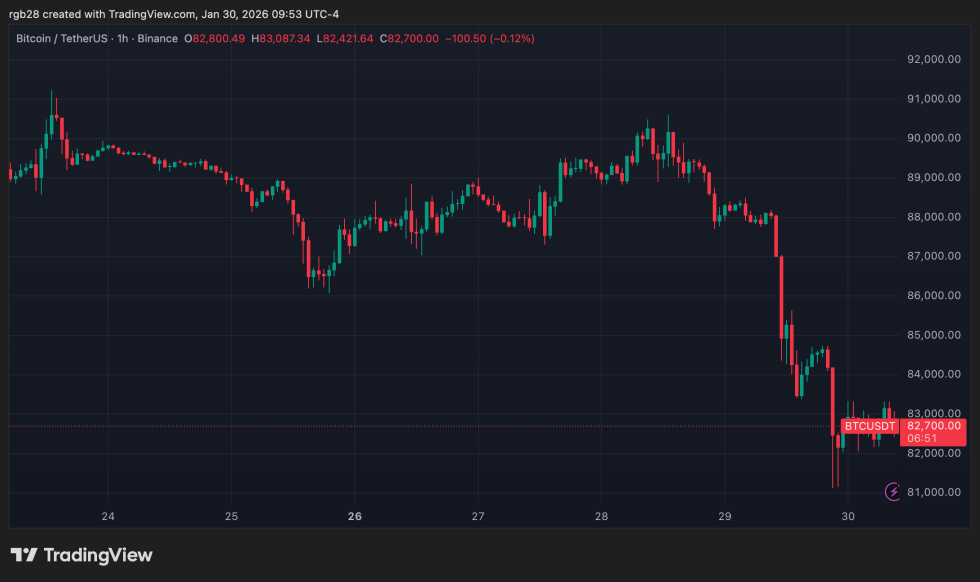
Bitcoin (BTC) trades at $82,700 in the one-week chart. Source: BTCUSDT on TradingView


Perguntas relacionadas

QWhat is the main purpose of the relaunched 'Project Crypto' initiative announced by the SEC and CFTC?

AThe main purpose is to bring coordination, coherence, and a unified approach to the federal oversight of crypto asset markets, preparing US markets for the digital era.

QWhat are the key focus areas of the SEC-CFTC harmonization agenda as detailed by the chairmen?

AThe key focus areas include advancing a clear crypto asset taxonomy, clarifying jurisdictional lines, removing duplicative compliance requirements, reducing regulatory fragmentation, and ensuring aligned definitions, coordinated oversight, and secure data sharing.

QWhat did CFTC Chairman Michael Selig direct his staff to study in collaboration with the SEC?

AHe directed CFTC staff to work with the SEC to study 'joint codification' of the common-sense crypto asset taxonomy recently laid out by SEC Chairman Atkins, as an interim measure while Congress finalizes legislation.

QWhat is the initial expected timeline for the SEC's innovation exemption for crypto firms, and what was the reason for the delay mentioned?

AThe innovation exemption was initially expected by the end of January but is now anticipated in early 2026. The delay was attributed to the need for careful development ('measure twice and cut once') and was further impacted by last year's government shutdown.

QAccording to the chairmen's joint statement, what is the core philosophy behind Project Crypto and their broader harmonization efforts?

AThe core philosophy is that financial regulation must be precise, not punitive, with rules narrowly tailored to address material risks, nimble enough to adapt to technological change, and anchored in the agencies' statutory authorities.

Leituras Relacionadas

iQiyi Is Too Impatient

The article "iQiyi Is Too Impatient" discusses the controversy surrounding the Chinese streaming platform IQiyi's recent announcement of an "AI Actor Library" during its 2026 World Conference. IQiyi claimed over 100 actors, including well-known names like Zhang Ruoyun and Yu Hewei, had joined the initiative. CEO Gong Yu suggested AI could enable actors to "star in 14 dramas a year instead of 4" and that "live-action filming might become a world cultural heritage." The announcement quickly sparked backlash. Multiple actors named in the list issued urgent statements denying they had signed any AI-related authorization agreements. This forced IQiyi to clarify that inclusion in the library only indicated a willingness to *consider* AI projects, with separate negotiations required for any specific role. The incident, which trended on social media with hashtags like "IQiyi is crazy," is presented as a sign of the company's growing desperation. Facing intense competition from short-video platforms like Douyin and Kuaishou, as well as Bilibili and Xiaohongshu, IQiyi's financial performance has weakened, with revenues declining for two consecutive years. The author argues that IQiyi is "too impatient" to tell a compelling AI story to reassure the market, especially as it pursues a listing on the Hong Kong stock exchange. The piece concludes by outlining three key "AI questions" IQiyi must answer: defining its role as a tool provider versus a content creator, balancing the "coldness" of AI with the human element audiences desire, and properly managing the interests of platforms, actors, and viewers. The core dilemma is that while AI can reduce costs and increase efficiency, it risks creating homogenized, formulaic content and devaluing human performers.

marsbitHá 40m

iQiyi Is Too Impatient

marsbitHá 40m

Trading

Spot
Futuros
活动图片