CFTC changes guard as Selig takes reins, Pham departs

cointelegraphPublicado em 2025-12-23Última atualização em 2025-12-23

Resumo

The US Commodity Futures Trading Commission (CFTC) has undergone a leadership transition, with Mike Selig sworn in as the new chairman, replacing acting chair Caroline Pham, who has departed. Selig, confirmed by the Senate after being nominated by President Trump, is now the agency's sole commissioner. He is widely viewed as pro-crypto and has pledged to support innovation in technologies like blockchain by avoiding a "regulation by enforcement" approach. Meanwhile, Pham, who had led the CFTC since January, is moving to crypto fintech company MoonPay. Both expressed support for balanced regulatory frameworks that foster innovation while ensuring market integrity.

The US Commodity Futures Trading Commission has officially undergone a change of leadership, with acting chair Caroline Pham saying she will leave the agency on Monday, while Mike Selig was sworn in as chair.

Pham, who had been serving as the CFTC’s acting chair since January and its sole commissioner since August, said on Monday that it would be her last day at the agency.

Meanwhile, the CFTC confirmed that Selig was sworn in as the agency’s 16th chairman on Monday after being nominated for the role by President Donald Trump on Oct. 27 and confirmed by the Senate on Thursday.

Pham’s departure leaves Selig as the CFTC’s sole commissioner. He is widely seen as pro-crypto and previously served as the chief counsel of the Securities and Exchange Commission’s Crypto Task Force.
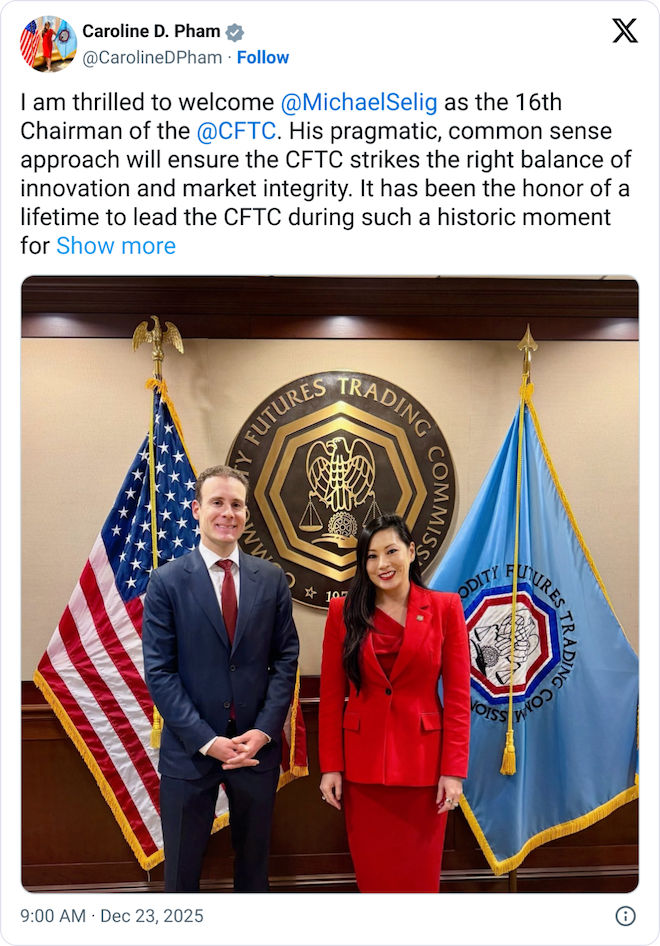
Source: Caroline Pham

Selig to continue positive momentum in crypto oversight

Selig will now serve a term that will expire in April 2029, and has previously vowed to support growth in innovative technologies such as crypto and blockchain by avoiding a so-called “regulation by enforcement” approach.

“I’m grateful for the confidence President Trump has placed in me and for the opportunity to lead the CFTC at this pivotal time,” Selig said.

“We are at a unique moment as a wide range of novel technologies, products, and platforms are emerging, retail participation in the commodity markets is at an all-time high, and Congress is poised to send digital asset market structure legislation to the President’s desk, cementing the US as the Crypto Capital of the World.”

On Monday, White House crypto czar David Sacks said Selig and SEC chair Paul Atkins were a “dream team to define clear regulatory guidelines.”

Pham shifts to crypto after steering CFTC

Pham has long said she would leave the CFTC once Congress confirmed someone to lead the agency, and on Wednesday, MoonPay confirmed earlier reports that Pham was headed to the crypto fintech company.

Pham’s time as acting chair saw her take a proactive approach to supporting crypto regulation.

Related: Wall Street’s bid on crypto dominated 2025 but what’s the demand outlook for 2026?

Pham said in her departing statement that the CFTC had “refocused on our mandate to promote responsible innovation and fair competition as the CFTC prepares to take on expanded oversight of new markets and new products like digital assets, crypto, and prediction markets.”

“I am thrilled to welcome Michael Selig as the 16th Chairman of the CFTC. His pragmatic, common-sense approach will ensure the CFTC strikes the right balance of innovation and market integrity,” she added.

Magazine: Meet the onchain crypto detectives fighting crime better than the cops

Perguntas relacionadas

QWho is the new chairman of the CFTC and when was he sworn in?

AMike Selig is the new chairman of the CFTC. He was sworn in on Monday after being nominated by President Donald Trump on Oct. 27 and confirmed by the Senate.

QWhat is Mike Selig's stance on cryptocurrency regulation and what is the length of his term?

AMike Selig is widely seen as pro-crypto and has vowed to support growth in innovative technologies by avoiding a 'regulation by enforcement' approach. His term will expire in April 2029.

QWhy did Caroline Pham leave the CFTC and what is her new role?

ACaroline Pham left the CFTC once a new chair was confirmed by Congress. She is headed to the crypto fintech company MoonPay.

QWhat did White House crypto czar David Sacks say about the new regulatory leadership?

ADavid Sacks said that Selig and SEC chair Paul Atkins were a 'dream team to define clear regulatory guidelines'.

QWhat was Caroline Pham's approach to crypto regulation during her time as acting chair?

AAs acting chair, Caroline Pham took a proactive approach to supporting crypto regulation, refocusing the CFTC on its mandate to promote responsible innovation and fair competition for new markets like digital assets.

Leituras Relacionadas

Qualcomm Chip Price Hike Deals a Blow to Android Phones

Qualcomm has officially announced a new round of price increases for its entire chip portfolio, effective September 1. The hikes, reaching up to 18% for the flagship Snapdragon 8 Elite Gen 6 Pro, follow similar moves by MediaTek, intensifying cost pressures on the already strained smartphone industry. CEO Cristiano Amon confirmed the plan, citing the need to offset rising industry-wide costs and restore declining profit margins. Qualcomm's Q3 FY2026 results showed a 25% drop in net profit, with mobile revenue plunging 20% year-over-year, hitting its lowest level since 2021. The surge in AI computing demand has led memory manufacturers to prioritize HBM production, creating a shortage in general-purpose DRAM and NAND Flash chips. Their prices soared by 93%-98% and 55%-60% respectively in Q1 2026, causing the memory cost share in smartphones to jump from 10%-15% to over 30%. Coupled with the soaring cost of advanced nodes like TSMC's 2nm and packaging, overall chip costs have reached historic highs. These upstream pressures are forcing downstream smartphone brands like Xiaomi, OPPO, and vivo to cut orders for mid-to-low-end models by up to 20% and use cost-saving measures like older chipsets. Reportedly, the Snapdragon 8E5 will be repurposed as a "long-lasting" chip for sub-brand phones in H2 2026. Amid this cost crisis, the Android market remains sluggish. Q2 2026 smartphone shipments in China fell 4.3% year-over-year, marking five consecutive quarters of decline. Major Android brands saw market share drop, while Huawei and Apple, with their in-house chip advantages, gained share. Qualcomm is diversifying into automotive and IoT sectors to reduce reliance on smartphones, but these new segments cannot yet fill the mobile revenue gap. Industry observers warn that the full impact of component cost hikes will hit in the second half of 2026, likely leading to higher-than-expected price increases for Android flagships and a further contraction in the Chinese smartphone market.

marsbitHá 33m

Qualcomm Chip Price Hike Deals a Blow to Android Phones

marsbitHá 33m

Breaking: GPT-5.6 Prices Slashed Effective Today

OpenAI has announced significant price cuts for its GPT-5.6 model API, effective immediately. The entry-level **GPT-5.6 Luna** sees the most drastic reduction, with input prices dropping 80% to $0.20 per million tokens and output prices falling to $1.20 per million tokens. The mid-tier **GPT-5.6 Terra** is reduced by 20%, now costing $2.00 (input) and $12.00 (output) per million tokens. The flagship **GPT-5.6 Sol** maintains its original price but introduces a new **Fast mode**, offering speeds up to 2.5 times faster for double the cost. The company attributes these price reductions to efficiency gains achieved through **GPT-5.6 Sol's own involvement in optimizing its production systems**. The model assisted in rewriting GPU kernels and improving speculative decoding, leading to a 20% reduction in end-to-end service costs and over 15% improvement in token generation efficiency. OpenAI emphasizes this process remained human-led. A key focus of the降价 is to lower the barrier for running **AI agent workflows**. By making the capable, tool-calling Luna model significantly cheaper, OpenAI aims to enable more frequent use in cost-sensitive, high-volume tasks like code review and monitoring. This creates a potential feedback loop: model-assisted efficiency gains lead to lower costs, which enables broader agent deployment, which in turn drives further optimization. The new pricing and features will also apply to Codex and ChatGPT Work subscriptions. The changes intensify competition in the large language model market, with OpenAI directly challenging rivals like Anthropic to respond.

marsbitHá 1h

Breaking: GPT-5.6 Prices Slashed Effective Today

marsbitHá 1h

Trading

Spot
活动图片