CARF Global Implementation Timeline Overview: What Are the Commitments of Mainland China and Hong Kong?

marsbitPublicado em 2026-01-28Última atualização em 2026-01-28

Resumo

CARF (Crypto-Asset Reporting Framework) is a global framework for the automatic exchange of tax-related data on crypto-assets, targeting crypto-asset service providers as reporting entities. As of the end of 2025, 76 jurisdictions have committed to implementing CARF, with a phased rollout plan. The first group, including the UK and EU member states, will begin automatic information exchange in 2027. The second group, which includes Singapore, the United Arab Emirates, and Hong Kong, is scheduled to fully implement the framework in 2028. Data collection for reportable transactions will begin one year prior, starting in 2026. Hong Kong has explicitly committed to implementing CARF. It plans to start collecting crypto-asset transaction data in 2027 and commence automatic tax information exchange with partner jurisdictions in 2028. Service providers operating in Hong Kong must establish compliance and reporting mechanisms. In contrast, Mainland China has not yet committed to CARF and is not included in any of the implementation batches. It is also not listed by the OECD as a jurisdiction with relevance that has yet to commit. Under its current regulatory framework, which imposes strict limitations on crypto-asset activities, there are no legal crypto-asset service providers that could be integrated into the CARF system. Therefore, in the short term, Mainland China does not meet the conditions for participating in CARF's routine information exchange. It is noted that Mainland C...

Author: Fintax

Basic Positioning of CARF

CARF is a framework for the automatic exchange of tax-related information on crypto-assets, with crypto-asset service providers as the reporting entities, used to support tax authorities in various jurisdictions in obtaining information related to transactions involving their taxpayers.

Global Implementation Progress and Timeline

According to information released by the OECD Global Forum, as of the end of 2025, 76 countries and regions have committed to implementing CARF and will advance its implementation in batches.

The first group of jurisdictions plans to commence the first automatic information exchange in 2027, primarily including the UK and EU member states, etc.; the second group of jurisdictions plans to fully implement in 2028, including Singapore, the United Arab Emirates, and China Hong Kong, etc.

According to the institutional arrangement, the collection of relevant transaction data will commence one year in advance, starting from 2026, crypto-asset service providers will need to systematically organize reportable transaction information.
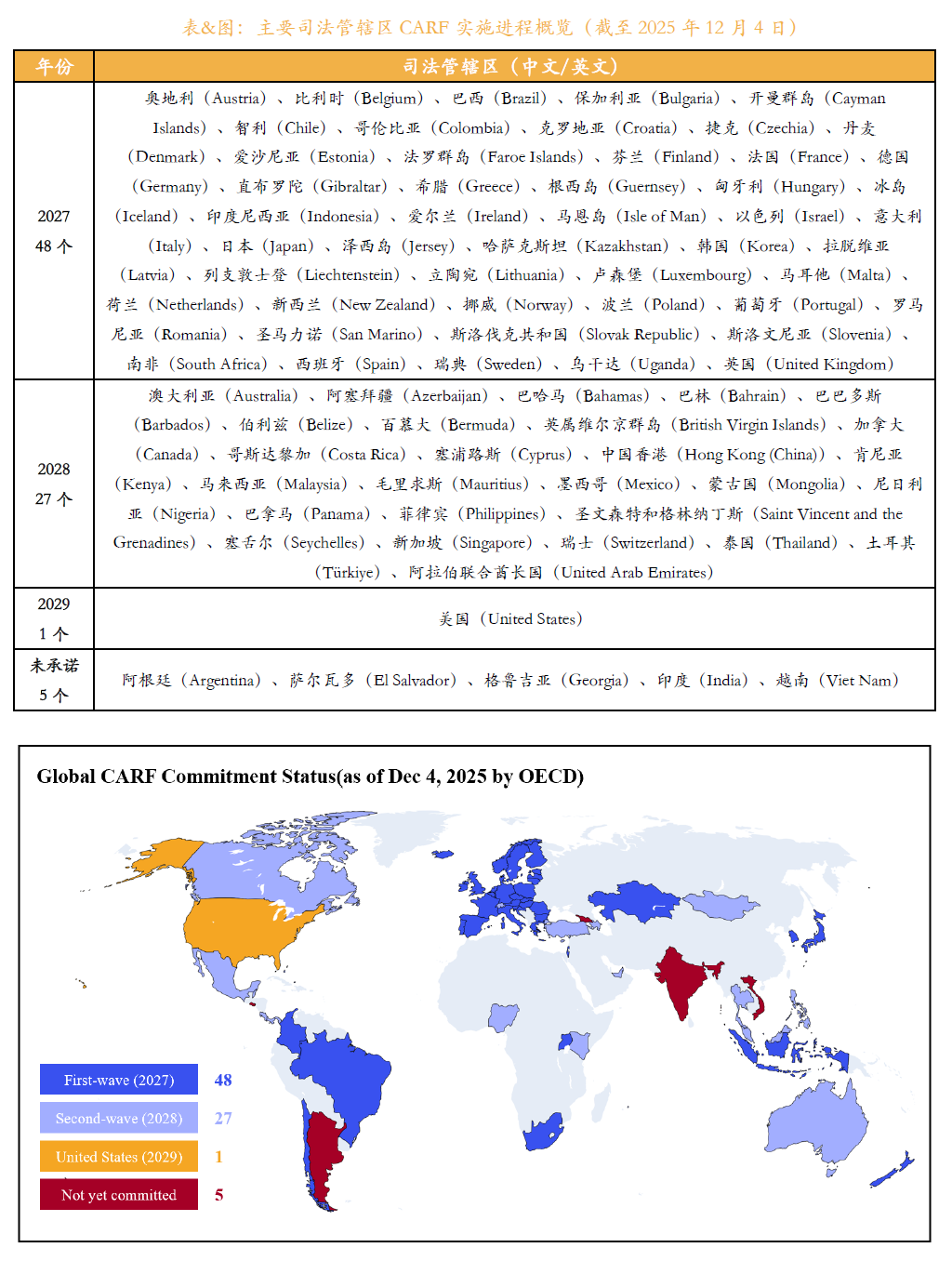
Figure 1: Overview of CARF Implementation Progress in Major Jurisdictions

China Hong Kong: Clear Participation and Timetable Advancement

In the aforementioned arrangement, China Hong Kong has clearly committed to implementing CARF and will advance related work according to the international timetable.

Hong Kong plans to start collecting crypto-asset transaction data from 2027 and commence automatic tax information exchange with other cooperating jurisdictions in 2028.

Crypto-asset service providers operating under Hong Kong's regulatory framework need to establish corresponding data compliance and reporting mechanisms, and relevant reportable transactions will be included in the cross-border information exchange process.

Mainland China: Not Yet Committed and Outside the Implementation Scope

In comparison, Mainland China has not yet made an implementation commitment to CARF.

As of the current stage, Mainland China is not included in any implementation batch of CARF, nor has it been listed by the OECD as a jurisdiction that is relevant but has not yet committed to participation.

Under the current regulatory framework, the mainland adopts a strict restrictive attitude towards cryptocurrency trading activities, and there are no legal crypto-asset service providers within the country that can be纳入 the CARF reporting system; therefore, it does not currently meet the institutional conditions for participating in CARF's regularized information exchange.

Future Possibilities and Realistic Judgment

It should be pointed out that Mainland China has fully implemented CRS since 2018 and has mature experience in financial account information exchange.

If future crypto-asset regulatory policies are adjusted, the mainland has the institutional and technical conditions to对接 CARF.

However, given the current policy environment, the possibility of Mainland China joining this framework around the 2027 launch of CARF and in the following years remains relatively low.

Perguntas relacionadas

QWhat is the CARF and what is its primary purpose?

AThe CARF (Crypto-Asset Reporting Framework) is an international framework for the automatic exchange of tax-related information on crypto-assets. It targets crypto-asset service providers as the reporting entities, aiming to support tax authorities in various jurisdictions in obtaining information related to transactions involving their taxpayers.

QHow many jurisdictions have committed to implementing the CARF as of the end of 2025, and what is the implementation timeline?

AAs of the end of 2025, 76 countries and regions have committed to implementing the CARF. The first group of jurisdictions, including the UK and EU member states, plan to commence the first automatic information exchange in 2027. The second group, which includes Singapore, the United Arab Emirates, and Hong Kong, China, is scheduled to fully implement the framework in 2028.

QWhat is the commitment and implementation plan of Hong Kong, China regarding the CARF?

AHong Kong, China has explicitly committed to implementing the CARF. It plans to start collecting crypto-asset transaction data from 2027 and begin automatic exchange of tax information with other cooperating jurisdictions in 2028. Crypto-asset service providers operating under Hong Kong's regulatory framework will need to establish corresponding data compliance and reporting mechanisms.

QWhat is the current status of Mainland China's commitment to the CARF?

AMainland China has not yet made a commitment to implement the CARF. It is not included in any of the implementation batches listed by the OECD and is not currently classified as a relevant jurisdiction that has yet to commit. Under its current regulatory framework, which imposes strict restrictions on crypto-asset activities, there are no legitimate crypto-asset service providers that could be incorporated into the CARF reporting system, making short-term participation unlikely.

QDoes Mainland China have the foundational experience to potentially join the CARF in the future?

AYes, Mainland China has comprehensive experience in financial account information exchange, having fully implemented the CRS (Common Reporting Standard) since 2018. This provides it with the technical and institutional foundation to potentially adapt to the CARF requirements if its crypto-asset regulatory policy were to change in the future. However, given the current policy environment, the possibility of joining the CARF around its 2027 launch or in the subsequent few years remains relatively low.

Leituras Relacionadas

Strategy's Loss in the Second Quarter Reaches $8.22 Billion Amid Bitcoin Decline

Strategy, the largest corporate holder of Bitcoin, reported a net loss of $8.22 billion for the second quarter. This loss was primarily driven by an $8.32 billion unrealized loss on its Bitcoin holdings due to a decline in the asset's price during the period. Despite these paper losses, the company increased its Bitcoin holdings to 843,775 BTC, a 25% growth since the start of the year. As part of a new monetization strategy, Strategy sold approximately $218.4 million worth of Bitcoin, mainly to fund dividends for preferred shareholders, with $216 million of that sold after Q2 ended. The company also built a $3.75 billion cash reserve, which it claims is sufficient to cover over two years of dividend and interest payments, aiming to insulate itself from Bitcoin's volatility while meeting obligations. Following the earnings release, Strategy's stock (MSTR) rose 4.7% in regular trading but corrected slightly after-hours. This pattern reflects how the company's accounting results are heavily tied to Bitcoin's price swings, even as its long-term strategy remains unchanged. The report indicates that Strategy is maintaining its core strategy of accumulating Bitcoin while building a financial buffer. This quarterly loss follows a recognizable pattern, with the company posting significant unrealized losses in previous quarters (e.g., $12.4 billion in Q4 2025 and ~$12.5 billion in Q1 2026) due to fair-value accounting. A key technical shift is its new monetization program, which introduces periodic selling pressure on the market, transitioning Strategy from a pure accumulator to a participant that occasionally adds supply. A critical question remains: how long can the cash reserve cover dividend obligations if a Bitcoin price downturn persists beyond two years?

cryptonews.ruHá 16m

Strategy's Loss in the Second Quarter Reaches $8.22 Billion Amid Bitcoin Decline

cryptonews.ruHá 16m

Will Terrorist Durov Ban Russian Officials?

Telegram founder Pavel Durov publicly reacted to being labeled a "terrorist" by Russian authorities, stating the designation came after he refused demands for mass surveillance and censorship on the platform. In a Telegram post, he highlighted that this status formally bans him from "publishing information online." Durov concluded with a statement widely circulated: Russian officials "clearly don't understand who can ban whom on the internet." This remark suggests Durov could potentially restrict official Russian government and officials' channels on Telegram, which continue to operate on the platform despite its formal blocking in Russia. The situation parallels previous, slow-moving state directives, like switching officials to domestic cars, contrasted with the current push to migrate all government communication to the Russian-made messenger MAX by 2030. However, reports indicate many officials still use Telegram via workarounds, fearing surveillance on MAX, while alternatives like BiP and KakaoTalk recently became inaccessible in Russia without a VPN. Durov has not specified any immediate actions against state channels. His statement is an initial response, with further developments depending on the authorities' reaction. The dynamic differs from 2020 when Russian regulators lifted a block on Telegram; now, Durov implies control from within the platform itself over the official accounts that persisted through that earlier blockade.

cryptonews.ruHá 16m

Will Terrorist Durov Ban Russian Officials?

cryptonews.ruHá 16m

DeepSeek V4 Official Version Arrives, New Capabilities Emerge, Value-for-Money King Enters the Fray

On July 31st, DeepSeek officially launched the public API beta for its DeepSeek-V4-Flash model. A key highlight is its performance on multiple Agent benchmark tests, reportedly nearing or even surpassing the level of the V4-Pro preview version from three months ago. Notably, the Flash model achieves this with significantly smaller scale (130B active parameters vs. Pro's 490B), suggesting that post-training optimization and data quality may be as crucial as raw model size. DeepSeek emphasized that the V4-Flash-0731 uses the same model architecture and size as its preview version, with improvements attributed solely to "re-trained post-training." The update also marks the official debut of DeepSeek's self-developed Agent framework, "Harness." The move signals DeepSeek's strategic push to position its cost-effective Flash model as a competitive base for Agent applications—scenarios requiring autonomous planning, tool usage, and complex task execution—where inference speed and cost are critical. By natively supporting OpenAI's Responses API format and adapting for code-generation scenarios, DeepSeek aims not just to be a cheaper alternative but to establish its own ecosystem in the Agent era. This release follows DeepSeek's record-breaking ~$50 billion fundraising round roughly two months prior, underscoring market confidence in its technology and commercialization prospects. The company is reportedly preparing for another funding round at a valuation of approximately $71 billion. The Flash model's advancement represents a step in fulfilling the high expectations that come with this valuation, setting the stage for the impending release of the V4-Pro official version and intensifying competition in the global Agent landscape.

marsbitHá 21m

DeepSeek V4 Official Version Arrives, New Capabilities Emerge, Value-for-Money King Enters the Fray

marsbitHá 21m

Trading

Spot
活动图片