Cardano’s whale growth is positive, but will it be enough for demand to catch up?

ambcryptoPublicado em 2026-04-08Última atualização em 2026-04-08

Resumo

Cardano's ADA price has moved sideways amid a weak altcoin market, but whale accumulation has increased significantly. Wallets holding at least 10 million ADA reached a 4-month high, rising 5.2% over nine weeks, suggesting growing confidence among large holders. However, this accumulation has not translated into strong price momentum, with ADA gaining only about 11% since February's low. The price remains range-bound between $0.24–$0.25, facing selling pressure near $0.27 and $0.31. Weak demand, limited capital inflow, and competition from other narratives like AI and RWA have capped ADA's upside. While whale growth is positive, a sustained breakout depends on broader altcoin strength and stronger market demand.

Cardano’s [ADA] price has continued to move sideways within a broader altcoin market that lacks strong directional momentum.

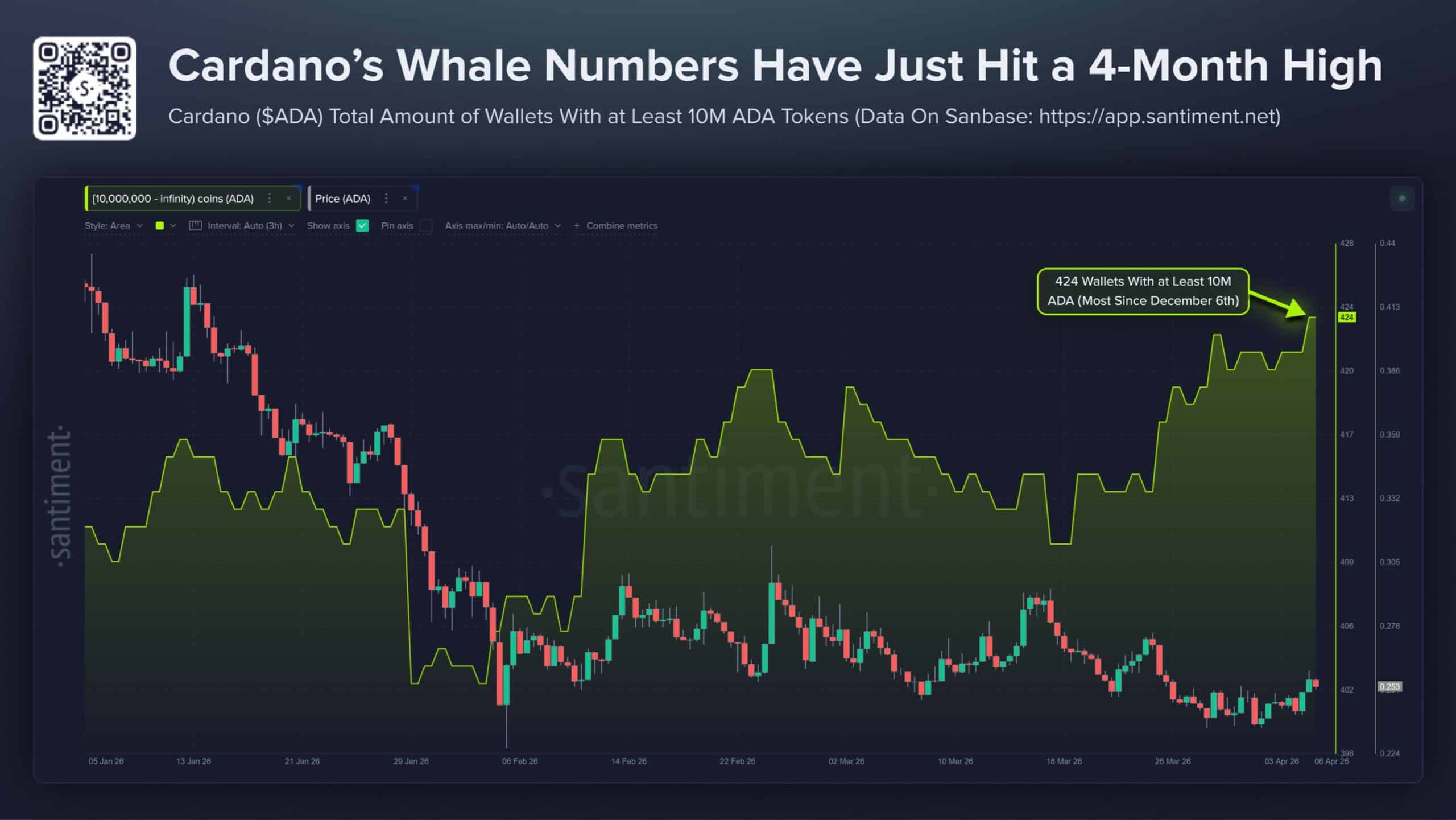
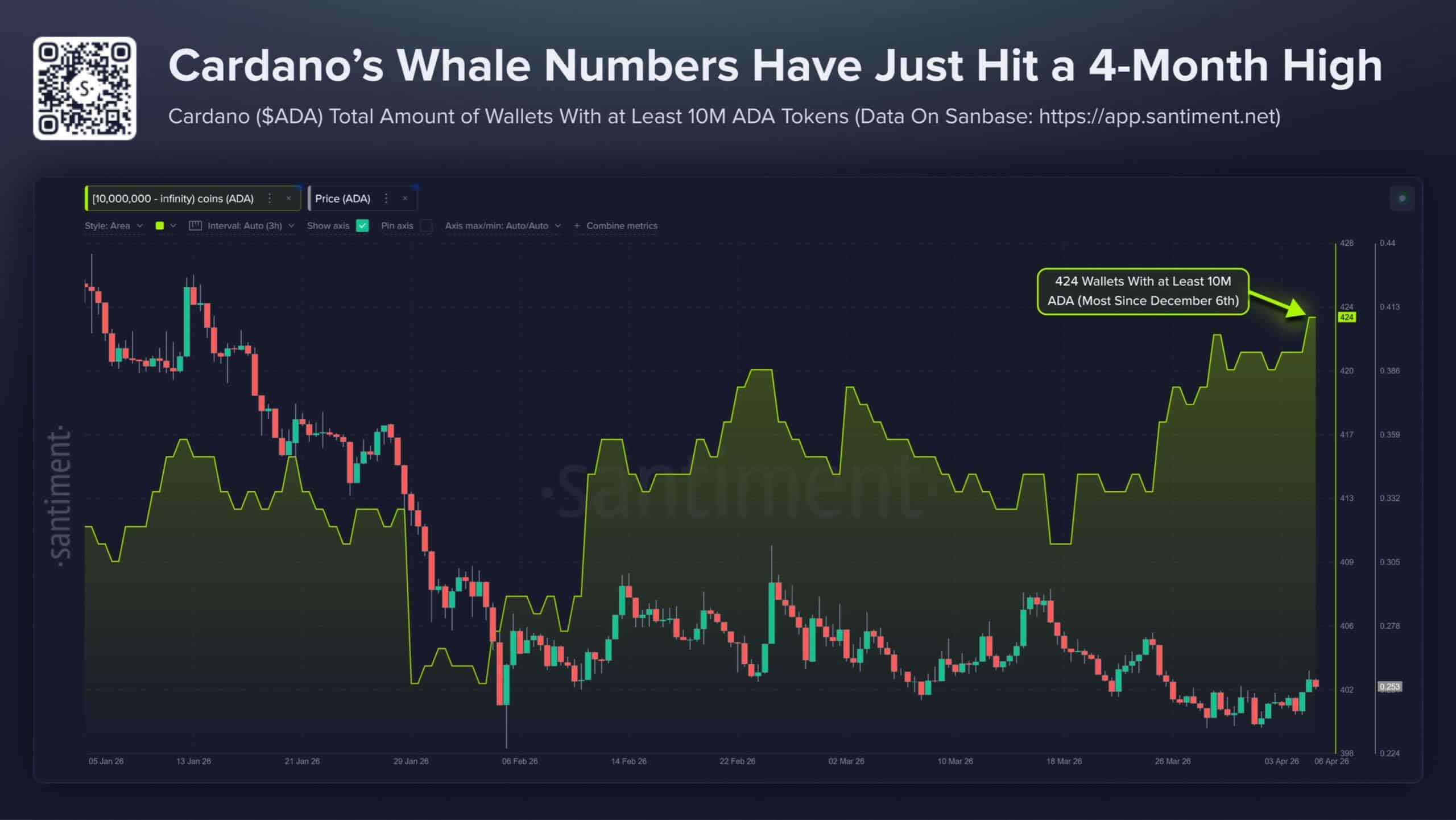
However, ownership dynamics tell us a different story as large holders quietly increase their exposure. In fact, wallets holding at least 10 million ADA have climbed to 424 – A 4-month high, with figures for the same rising by 5.2% over nine weeks.
Source: Santiment

Meanwhile, the price has only gained about 11% since 05 February’s low, showing limited follow-through. As whale numbers trend higher, the price has remained constrained – A sign that accumulation may be absorbing available supply.

This dynamic may be evidence of growing confidence among large holders, but it also suggested that demand might not have fully translated into momentum. If accumulation persists, it may support future upside, although near-term price action could remain range-bound.

A price compression on the charts

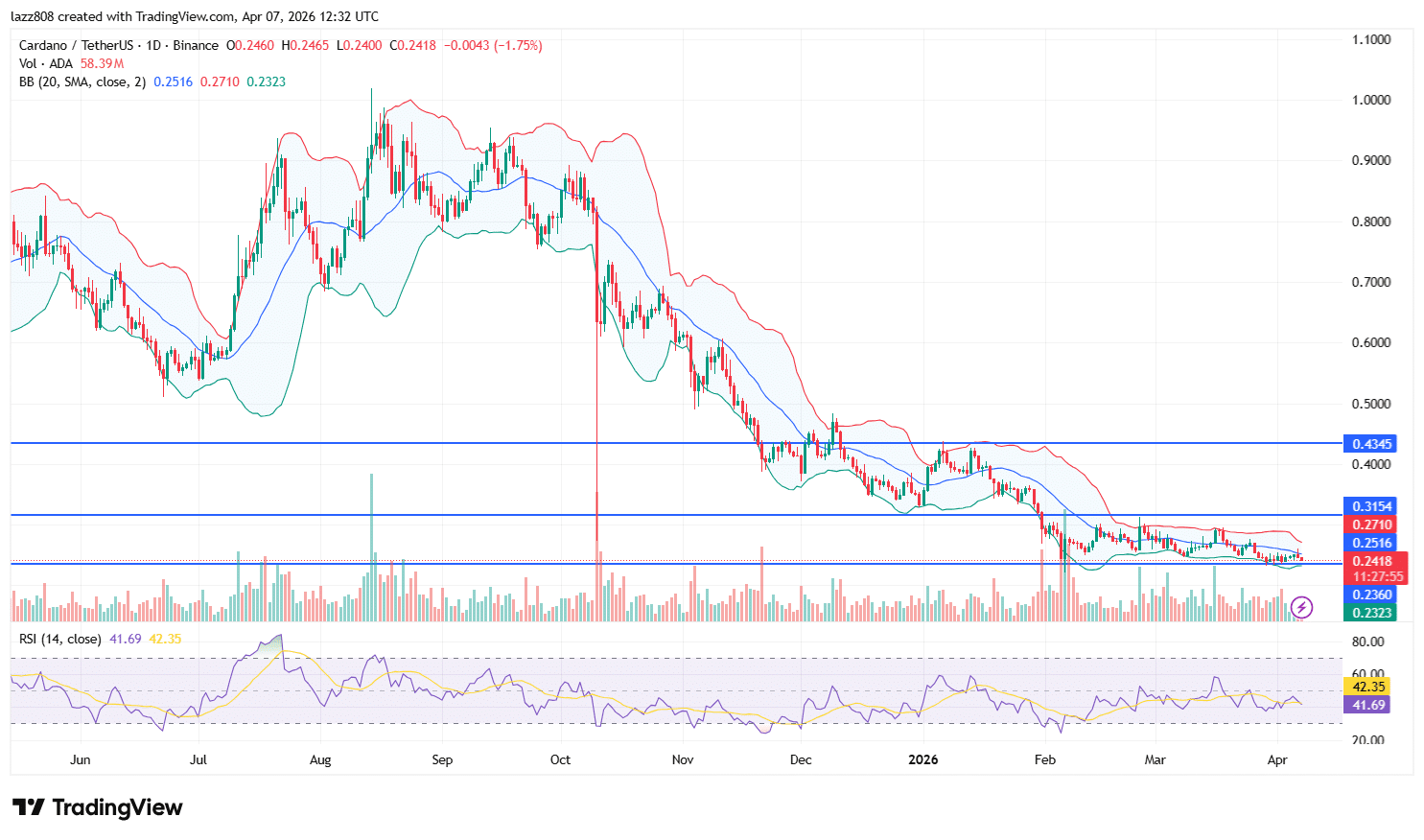
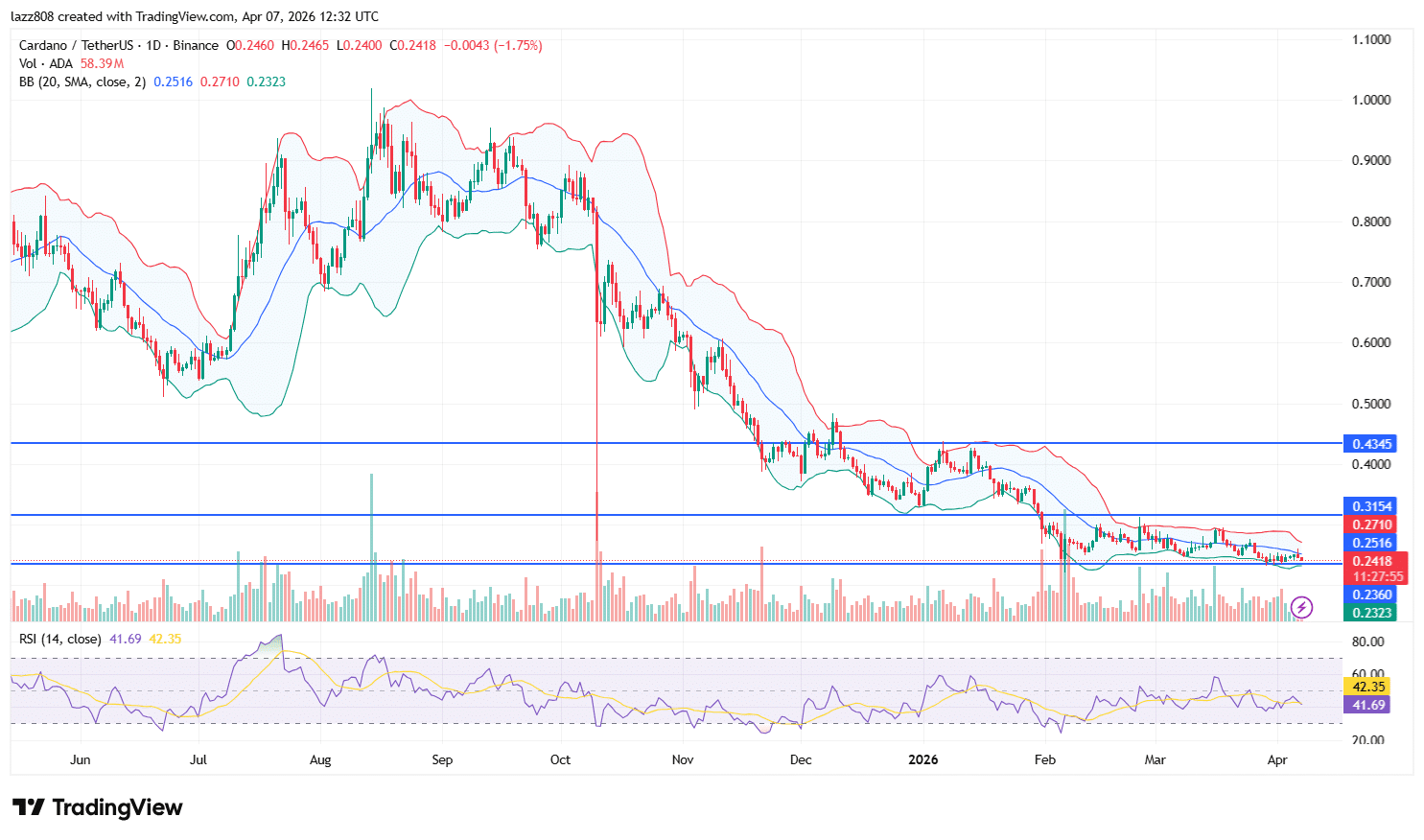
The gap between rising whale accumulation and muted price action appeared to be more evident across ADA’s structure. After failing to hold above $0.43, the price trended lower and later stabilized around $0.24–$0.25.

As rallies approach $0.27 and $0.31, prior holders could move to exit near breakeven. This could keep upside capped. Meanwhile, Bollinger Bands seemed to tighten sharply too, signaling volatility compression and a market waiting for direction.
Source: ADA/USDT on TradingView

At press time, the price was tracking the lower band, reflecting persistent selling pressure. The RSI near 42 supported this subdued sentiment too.

This dynamic suggested that accumulation may be ongoing. However, weak capital rotation has delayed some momentum, leaving ADA range-bound until stronger demand emerges.

Weak demand caps ADA’s breakout potential

Sustained price compression could point to a deeper issue, one where accumulation alone fails to drive expansion. While the price may be holding near $0.24–$0.25, new demand has been limited, keeping rallies from extending themselves.

As capital rotates into narratives like AI, RWAs, and high-beta L2s, ADA has received less attention, weakening its momentum. At press time, its DeFi activity reflected this, with the TVL near $132 million – Far below competing ecosystems.

Worth noting, however, that Cardano’s rising whale accumulation is evidence of growing long-term confidence. And yet, weak price performance and limited demand could delay any meaningful breakout or sustained momentum.

This would leave ADA reliant on broader altcoin strength, with its positioning reflecting early accumulation rather than confirmed recovery or independent upside expansion.


Final Summary

  • Weak demand and overhead supply have kept Cardano’s price price range-bound, delaying breakout.
  • Cardano remains tied to broader altcoin momentum, especially as limited capital rotation continues to cap upside.


Perguntas relacionadas

QWhat has been the trend in Cardano (ADA) whale accumulation recently, and what does it indicate?

AWallets holding at least 10 million ADA have increased to 424, a 4-month high, representing a 5.2% rise over nine weeks. This indicates growing long-term confidence among large holders and suggests that accumulation is absorbing available supply.

QHow has the price of ADA performed in relation to the increase in whale holdings?

ADespite the growth in whale accumulation, the price of ADA has only gained about 11% since its low on February 5th and has remained range-bound, primarily between $0.24 and $0.25. This shows a disconnect, where the increased holdings have not yet translated into significant price momentum.

QWhat technical indicators suggest that ADA is experiencing selling pressure and subdued sentiment?

AThe price was tracking the lower Bollinger Band, which reflects persistent selling pressure. Additionally, the Relative Strength Index (RSI) was near 42, further supporting the view of subdued market sentiment.

QAccording to the article, what is a key factor capping the upside potential for ADA's price?

AWeak demand and limited new capital rotation into ADA are key factors capping its upside potential. Capital is instead flowing into other narratives like AI, Real-World Assets (RWAs), and high-beta Layer 2 solutions, leaving ADA with less attention and momentum.

QWhat is the current state of Cardano's DeFi ecosystem, as measured by Total Value Locked (TVL)?

ACardano's DeFi activity is weak, with a Total Value Locked (TVL) of around $132 million at the time of writing. This is far below the TVL of competing ecosystems.

Leituras Relacionadas

La Liga Team Bets $1 Million Against Themselves Before Match: Does Using Prediction Markets for Insurance Comply with Sports Regulations?

A Spanish La Liga club, reportedly Osasuna, purchased insurance against relegation and was linked to a transaction of over $1 million on the prediction market platform Kalshi, betting against its own victory in a crucial season-ending match. While Osasuna confirmed buying €1.2 million insurance for a potential €6 million payout in case of relegation through broker Howden, it did not confirm involvement with Kalshi. The reported trade involved intermediaries like Game Point Capital and Greenlight Commodities, with quant firm Susquehanna as the counterparty. This incident highlights the blurring line between financial hedging and gambling in prediction markets. Such markets allow trading on future event outcomes, like sports results. In the US, Kalshi operates as a regulated event contract market under the CFTC. However, Spanish authorities recently initiated penalties against Kalshi and Polymarket, considering their activities unlicensed gambling. The case raises core questions about prediction markets: who can trade, how insider information is handled, and whether participants can influence outcomes, especially in sports where results are human-driven. While leagues like La Liga and Serie A have partnered with Polymarket in North America, the regulatory clash and potential for conflicts of interest, as seen in this club's alleged transaction, present significant challenges as prediction markets evolve toward institutional risk management.

Foresight NewsHá 13m

La Liga Team Bets $1 Million Against Themselves Before Match: Does Using Prediction Markets for Insurance Comply with Sports Regulations?

Foresight NewsHá 13m

From Shouting 150 Dollars to Liquidating HYPE in Just Three Days, How Much Credibility Does Arthur Hayes Have Left?

How much of Arthur Hayes's market credibility remains? Recently, the "godfather of crypto perpetual swaps" and BitMEX co-founder has faced public criticism, including accusations from on-chain investigator ZachXBT about creating exit liquidity for his followers. Starting last week, Hayes executed multiple sudden sell-offs. He had repeatedly publicly predicted the HYPE token would reach $150. After a $100,000 bet defending Hyperliquid on June 1st, he announced just three days later that he had completely sold his HYPE and NEAR holdings, successfully exiting near the peak. He also sold ZEC and WLD. His sale of WLD appeared to be a classic "pump and dump" maneuver. On June 3rd, he publicly set a $10 target for WLD, causing its price to surge over 35%. By June 6th, he announced he had sold his WLD, citing "anomalous" SpaceX pre-IPO price action, which triggered a sharp price drop. On June 9th, Hayes published a lengthy article explaining his actions, citing factors like rising energy costs and a potential AI bubble burst. Consequently, his family office, Maelstrom, now holds positions in US energy producers and only core crypto assets BTC and ETH, having sold AI-related stocks and non-core cryptocurrencies. This pattern is not new. In 2025, he similarly touted HYPE before selling it at what turned out to be a cycle peak, only to repurchase it at the next cycle's low. Similar scenarios played out with tokens like ETHFI and ENA. Long-term observers have developed a strategy: ignore Hayes's public statements but closely monitor his on-chain actions—be cautious following his buys, but decisively follow his sells. If he continues these tactics, especially as seen with the WLD case, his market credibility risks being permanently damaged. As Hayes himself admitted in his latest article, "I remain an unapologetic gambler."

marsbitHá 31m

From Shouting 150 Dollars to Liquidating HYPE in Just Three Days, How Much Credibility Does Arthur Hayes Have Left?

marsbitHá 31m

Fundraising is Like a Strange Dance: The 'Absurd Drama' of Silicon Valley Founders' Capital Raises

The article details a series of absurd and revealing anecdotes shared by Silicon Valley founders about their venture capital fundraising experiences, sparked by Greg Isenberg's story of pitching to a sleeping a16z partner. Founders describe surreal pitch meetings: one faced a barefoot, peanut-eating investor who offered triple the requested amount after 30 seconds; another performed a pitch in a VC's parked car; a founder discovered his audience understood no English beyond "yes." These stories highlight the often irrational and performative nature of fundraising. Beyond the absurdity, darker power imbalances are exposed. Stories include investors suggesting founders fire co-founders for their equity, blatant market misjudgments, disrespectful behavior from LPs, and discriminatory remarks. A debate also emerges around "Sequoia's" practice of splitting a round into two valuations. However, the thread isn't solely critical. Positive counter-narratives celebrate supportive VCs who offered crucial advice during crises, respected founders' timelines, and showed simple gestures of respect—like a partner personally fetching coffee before a major pitch. Ultimately, the collective sharing acts as a pressure release, illustrating that fundraising is a complex dance of power, trust, and sometimes sheer theater. It underscores that beyond capital, mutual respect and integrity remain the most enduring foundations of the founder-investor relationship.

marsbitHá 44m

Fundraising is Like a Strange Dance: The 'Absurd Drama' of Silicon Valley Founders' Capital Raises

marsbitHá 44m

Trading

Spot
Futuros

Artigos em Destaque

Como comprar ADA

Bem-vindo à HTX.com!Tornámos a compra de Cardano (ADA) simples e conveniente.Segue o nosso guia passo a passo para iniciar a tua jornada no mundo das criptos.Passo 1: cria a tua conta HTXUtiliza o teu e-mail ou número de telefone para te inscreveres numa conta gratuita na HTX.Desfruta de um processo de inscrição sem complicações e desbloqueia todas as funcionalidades.Obter a minha contaPasso 2: vai para Comprar Cripto e escolhe o teu método de pagamentoCartão de crédito/débito: usa o teu visa ou mastercard para comprar Cardano (ADA) instantaneamente.Saldo: usa os fundos da tua conta HTX para transacionar sem problemas.Terceiros: adicionamos métodos de pagamento populares, como Google Pay e Apple Pay, para aumentar a conveniência.P2P: transaciona diretamente com outros utilizadores na HTX.Mercado de balcão (OTC): oferecemos serviços personalizados e taxas de câmbio competitivas para os traders.Passo 3: armazena teu Cardano (ADA)Depois de comprar o teu Cardano (ADA), armazena-o na tua conta HTX.Alternativamente, podes enviá-lo para outro lugar através de transferência blockchain ou usá-lo para transacionar outras criptomoedas.Passo 4: transaciona Cardano (ADA)Transaciona facilmente Cardano (ADA) no mercado à vista da HTX.Acede simplesmente à tua conta, seleciona o teu par de trading, executa as tuas transações e monitoriza em tempo real.Oferecemos uma experiência de fácil utilização tanto para principiantes como para traders experientes.

1.3k Visualizações TotaisPublicado em {updateTime}Atualizado em 2026.06.02

Como comprar ADA

Discussões

Bem-vindo à Comunidade HTX. Aqui, pode manter-se informado sobre os mais recentes desenvolvimentos da plataforma e obter acesso a análises profissionais de mercado. As opiniões dos utilizadores sobre o preço de ADA (ADA) são apresentadas abaixo.

活动图片












