Cardano Price Forecast Turns Bearish as ADA Loses ETF Ground and $0.29 Support Weakens

bitcoinistPublicado em 2026-02-06Última atualização em 2026-02-06

Resumo

The Cardano (ADA) price outlook is turning increasingly bearish as it faces multiple headwinds. A weakening market structure, fading optimism around ETF inclusion, and a broader crypto risk-off sentiment are pressuring the token. ADA is struggling to maintain support at the critical $0.29 level, a zone that has been tested repeatedly and is now showing signs of weakness. The loss of momentum is exacerbated by a shift in institutional focus, evidenced by Grayscale removing ADA from its CoinDesk Crypto 5 ETF in favor of more liquid assets like BNB. This has left Cardano with diminished support and a thinner order book, making it more vulnerable to downside moves. Technical analysis indicates that a sustained break below $0.29 could lead to a deeper correction, with limited support until much lower price levels. Broader on-chain and derivatives data across the crypto market signal caution, with reduced buying activity. For ADA to stabilize, a significant improvement in overall market sentiment or a new demand catalyst is needed. Until then, the forecast remains bearish.

The Cardano price outlook is tilting further to the downside as weakening market structure, fading ETF optimism, and broader crypto risk-off sentiment weigh on ADA.

While much of the recent attention has been on sharp declines in large-cap tokens like XRP, the same forces are quietly pressuring Cardano, pushing it closer to a key technical inflection point around the $0.29 level.

ADA has struggled to attract sustained demand since the start of the year, with rallies repeatedly stalling as liquidity thins across the altcoin market. The token’s inability to hold above short-term support zones now raises the risk of a deeper correction.
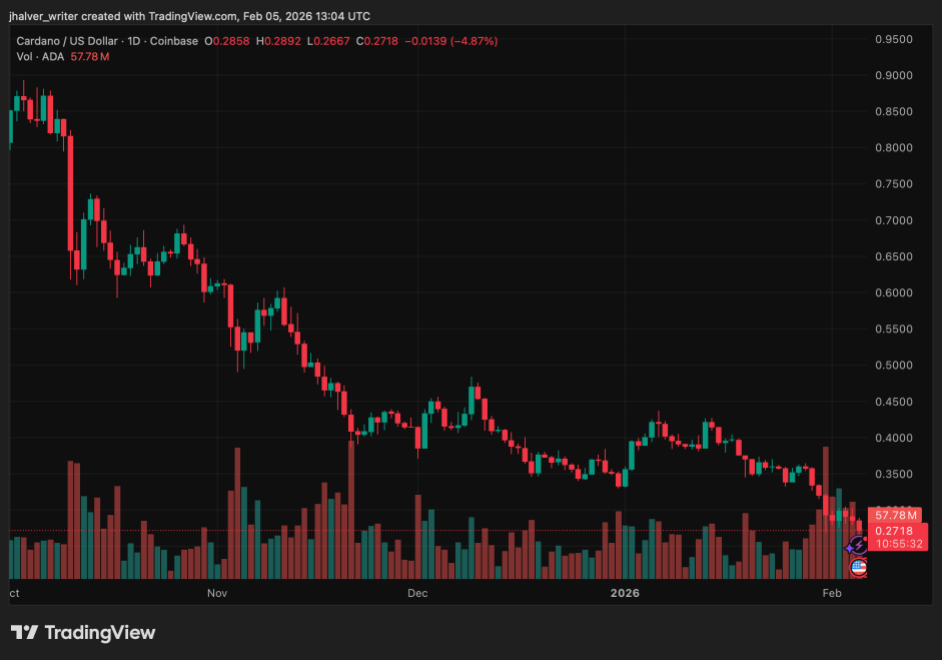
ADA's price trends to the downside on the daily chart. Source: ADAUSD on Tradingview

ETF Momentum Fades as Market Focus Narrows

One factor weighing on the Cardano price is the loss of relative ETF momentum. As institutional attention concentrates on assets with clearer regulatory narratives or active derivatives demand, ADA has slipped out of the spotlight.

Capital flows are rotating toward more liquid large-cap plays, leaving Cardano with diminished support during market stress. This dynamic is evident in Grayscale’s decision to drop Cardano from its CoinDesk Crypto 5 ETF in favor of BNB.

This shift mirrors patterns seen elsewhere in the market. XRP, for instance, has experienced heavy selling despite ETF-related products remaining active, highlighting that ETF presence alone is no longer enough to offset broader bearish sentiment.

For Cardano, which lacks the same level of derivatives activity or headline-driven catalysts, the impact is more pronounced. The result is a thinner order book and weaker follow-through on rebounds, making ADA more vulnerable to downside moves if risk appetite continues to deteriorate.

$0.29 Cardano Price Support Under Pressure

From a technical perspective, the $0.29 level has emerged as a critical zone for the Cardano price. This area has acted as a demand floor in recent months, but repeated tests have reduced its strength. Price action around this level shows buyers stepping in with less conviction, while sellers remain active on minor rallies.

If $0.29 fails to hold on a sustained basis, chart structure points to limited support until lower historical consolidation zones. Momentum indicators have also softened, aligning with the broader downtrend across altcoins as Bitcoin’s weakness drags sentiment lower.

Broader Market Signals Remain Cautious

On-chain and derivatives data across the crypto market continue to signal caution. Falling open interest, reduced spot buying, and muted activity from large holders suggest investors are prioritizing capital preservation over accumulation.

This environment leaves assets like Cardano exposed, particularly when bullish narratives fade.

For ADA to stabilize, the market would likely need a broader improvement in risk sentiment or a clear catalyst that draws fresh demand. Until then, the Cardano price forecast remains bearish, with traders watching closely to see whether the $0.29 support can hold or give way to another leg lower.

Cover image from ChatGPT, ADAUSD chart from Tradingview

Perguntas relacionadas

QWhat are the main factors contributing to the bearish Cardano (ADA) price outlook mentioned in the article?

AThe main factors are weakening market structure, fading ETF optimism, and broader crypto risk-off sentiment.

QWhy has Cardano (ADA) lost ETF momentum according to the article?

AInstitutional attention has concentrated on assets with clearer regulatory narratives or active derivatives demand, causing capital to rotate toward more liquid large-cap plays and leaving ADA with diminished support.

QWhat is the critical technical support level for the Cardano price, and why is it significant?

AThe critical technical support level is $0.29. It has acted as a demand floor, but repeated tests have weakened it, and a sustained break below could lead to a deeper correction with limited support until lower historical consolidation zones.

QHow did Grayscale's decision impact Cardano (ADA)?

AGrayscale dropped Cardano from its CoinDesk Crypto 5 ETF in favor of BNB, which is cited as an example of the diminishing institutional support and ETF momentum for ADA.

QWhat broader market signals suggest a cautious environment for cryptocurrencies like Cardano?

ABroader market signals include falling open interest, reduced spot buying, and muted activity from large holders, indicating that investors are prioritizing capital preservation over accumulation.

Leituras Relacionadas

The Value Distribution of Stablecoins

**Summary: The Value Distribution of Stablecoins** The article argues that stablecoins are evolving from mere trading tools into broader channels for dollar access. It divides the stablecoin ecosystem into four layers to analyze how value is distributed: 1. **Issuance Layer:** Mints stablecoins, holds reserve assets, and captures the spread between reserve yield and user costs (e.g., Tether, Circle). This layer currently earns the largest profit margin. 2. **Infrastructure Layer:** Connects stablecoins to the traditional financial system, handling fiat on/off-ramps, banking integration, compliance (KYC/AML), and asset management (e.g., Bridge, BVNK). This is the "unglamorous" but critical work, building the essential bridges between crypto and real-world finance. 3. **Acquiring/Distribution Layer:** Integrates stablecoins into merchant systems, manages payment flows, and provides enterprise financial software (e.g., Stripe, Coinbase). They act as the access point for businesses. 4. **Application Layer:** The end-users and businesses that ultimately use stablecoins for payments, settlements, or as a store of value. They benefit from convenience but have little pricing power. The core thesis is that while the issuance layer currently dominates profits, the often-overlooked **infrastructure layer holds significant long-term potential**. The real challenge and barrier to mass adoption is not the on-chain transfer of stablecoins (which is simple), but the complex "last mile" integration into existing business workflows, banking systems, and regulatory frameworks across different countries. Companies in this layer are currently in a "land grab" phase, investing heavily to build networks, secure bank partnerships, and establish compliance pathways. While their position is currently pressured by the profitable issuers above and distribution platforms below, the article suggests that if stablecoins become a default financial rail for businesses, the infrastructure providers who have done the hard work of integration will ultimately gain strong pricing power and become entrenched, essential players.

marsbitHá 5h

The Value Distribution of Stablecoins

marsbitHá 5h

The Value Distribution of Stablecoins

The Value Distribution of Stablecoins The article argues that stablecoins are evolving from a mere trading tool into a broad "dollar channel." It analyzes the industry's value chain through four layers: 1. **Issuance Layer (e.g., Tether, Circle):** The top layer that mints stablecoins, holds reserve assets, and captures the thickest interest rate spread. 2. **Infrastructure Layer (e.g., Bridge, BVNK):** Connects stablecoins to the traditional financial system, handling critical but complex "dirty work" like fiat on/off-ramps, banking integration, compliance (KYC/AML), and cross-border settlement. 3. **Acquiring/Distribution Layer (e.g., Stripe, Coinbase):** Embeds stablecoins into merchant systems, manages payment flows, and integrates with enterprise software. 4. **Application Layer:** End-users and businesses that ultimately use stablecoins for payments, settlement, or storing value. The author posits that while the issuance layer currently captures the most profit, the most overlooked and potentially critical layer is infrastructure. The core challenge for stablecoin adoption isn't the on-chain transfer (which is simple), but bridging the gap between blockchain and the real-world financial system. This involves solving practical problems for businesses: fiat conversion, reconciliation, tax handling, and user onboarding. Infrastructure companies are currently in a difficult "land-grab" phase—building networks, securing banking relationships, and achieving compliance country-by-country. They face pressure from both the profitable issuance layer above and distribution platforms below. However, the author suggests this layer is building a crucial moat. Once stablecoins become a default business rail, the infrastructure players who have done the hard work of integration may gain significant, durable value and pricing power.

链捕手Há 5h

The Value Distribution of Stablecoins

链捕手Há 5h

How to Do Research Well: Deliberately Practice the Real Skills That Matter

No one truly teaches you how to do research. You're often given a desk, a pre-selected problem, and vague instructions to "create something new." Consequently, many people reverse-engineer the job based on visible outputs—papers, posts, announcements—learning only how to *appear* like a researcher rather than how to *become* one. True research capability is built from stacking small, trainable skills, nearly all of which can be developed through deliberate practice. **Pick Your Own Problem:** Most researchers absorb problems from advisors or trends, lacking the underlying reasoning. Choosing a problem you genuinely care about, as John Schulman advises, leads to original work. Develop "taste" like a muscle: predict experiment outcomes, guess paper results from methods, and track which findings remain important over time. **Upgrade Your Inputs:** Relying on shared reading lists (arXiv hot lists, filtered group chats) leads to unoriginal conclusions. Undervalued old literature often holds crucial insights (e.g., MoE, LSTM, backpropagation). Richard Sutton's "The Bitter Lesson" or Claude Shannon's 1952 talk on creative thinking are more predictive than lengthy modern surveys. Breadth matters as much as depth: draw from neuroscience, mechanism design, hardware knowledge, and honest statistics. Read papers directly, especially appendices and limitations sections. **Write Everything Down:** As Paul Graham noted, writing exposes flaws in seemingly mature ideas. Writing is the cheapest defense against self-deception. Following Feynman's principle, Darwin programmatically wrote down facts contradicting his theory to combat memory bias. Maintain a detailed log of hypotheses, setups, predictions, results, and updated understandings. Reviewing past logs fosters essential humility.

marsbitHá 7h

How to Do Research Well: Deliberately Practice the Real Skills That Matter

marsbitHá 7h

Trading

Spot
Futuros

Artigos em Destaque

Como comprar ADA

Bem-vindo à HTX.com!Tornámos a compra de Cardano (ADA) simples e conveniente.Segue o nosso guia passo a passo para iniciar a tua jornada no mundo das criptos.Passo 1: cria a tua conta HTXUtiliza o teu e-mail ou número de telefone para te inscreveres numa conta gratuita na HTX.Desfruta de um processo de inscrição sem complicações e desbloqueia todas as funcionalidades.Obter a minha contaPasso 2: vai para Comprar Cripto e escolhe o teu método de pagamentoCartão de crédito/débito: usa o teu visa ou mastercard para comprar Cardano (ADA) instantaneamente.Saldo: usa os fundos da tua conta HTX para transacionar sem problemas.Terceiros: adicionamos métodos de pagamento populares, como Google Pay e Apple Pay, para aumentar a conveniência.P2P: transaciona diretamente com outros utilizadores na HTX.Mercado de balcão (OTC): oferecemos serviços personalizados e taxas de câmbio competitivas para os traders.Passo 3: armazena teu Cardano (ADA)Depois de comprar o teu Cardano (ADA), armazena-o na tua conta HTX.Alternativamente, podes enviá-lo para outro lugar através de transferência blockchain ou usá-lo para transacionar outras criptomoedas.Passo 4: transaciona Cardano (ADA)Transaciona facilmente Cardano (ADA) no mercado à vista da HTX.Acede simplesmente à tua conta, seleciona o teu par de trading, executa as tuas transações e monitoriza em tempo real.Oferecemos uma experiência de fácil utilização tanto para principiantes como para traders experientes.

1.3k Visualizações TotaisPublicado em {updateTime}Atualizado em 2026.06.02

Como comprar ADA

Discussões

Bem-vindo à Comunidade HTX. Aqui, pode manter-se informado sobre os mais recentes desenvolvimentos da plataforma e obter acesso a análises profissionais de mercado. As opiniões dos utilizadores sobre o preço de ADA (ADA) são apresentadas abaixo.

活动图片