Cardano Network Sees Sharp Growth As User Activity Reaches New Heights

bitcoinistPublicado em 2026-04-09Última atualização em 2026-04-09

Resumo

Despite facing prolonged bearish price pressure, the Cardano network has experienced a significant surge in user activity and engagement, reaching a historic milestone of over 120 million transactions on its mainnet. This growth reflects heightened adoption and strengthens Cardano's position in the blockchain sector. Additionally, large investors, or "whales," are returning, with addresses holding at least 10 million ADA increasing by 5.2% over nine weeks, indicating renewed confidence in the network's long-term potential. While ADA’s price remains under pressure, the rise in both transactions and whale activity could signal a potential recovery and broader market performance ahead.

Cardano’s (ADA) prolonged downside price action has failed to influence or slow down the engagement and demand for the leading blockchain network. During fading price strength, the network has been building up its pace with user activity witnessing one of its biggest growth in history.

Network Usage On Cardano Makes History

With a growing, volatile cryptocurrency landscape, the price of Cardano has steadily faced bearish pressure and persistent pullback. However, this has not been the case for the Cardano network, as momentum has been observed growing across the blockchain and its ecosystem.

After a steady growth, the network is experiencing notable interest, reaching yet another major milestone in its activity. As more players connect through transactions, decentralized apps, and on-chain services, the most recent milestone is indicative of consistent growth in the network’s user base.

In this waning period, transactions conducted on the network are spiking hard. Data from Cexplorer, the biggest and most featured OG blockchain explorer, shows that Cardano has just crossed 120,000,000 on the mainnet, cementing its position as a top contender in the crypto and blockchain sector.
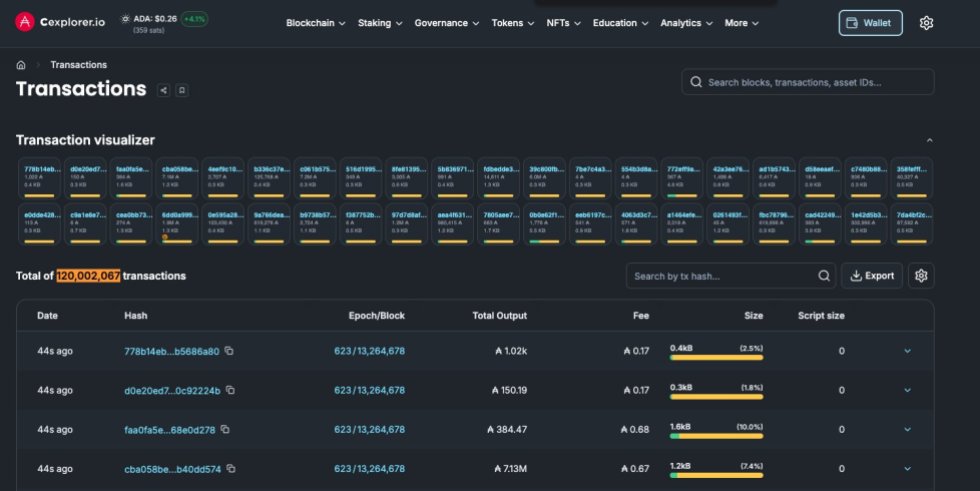
Source: Chart from Cexplorer on X

Currently, transaction counts on the network stand at 120,002,067, as seen in the chart shared by the platform. Such a huge amount of transactions demonstrates heightened adoption and strengthens Cardano’s standing in the larger blockchain environment. Should the user engagement continue expanding, it could spur a broader market performance, allowing ADA’s price to bounce back to key resistance levels.

Large ADA Investors Are Stepping Back In At A Fast Rate

Prior to the report regarding transaction growth, there was news about wallet addresses on the network spiking significantly to levels not seen in several months. These are not just mere ADA holders but wallet addresses holding a substantial amount of ADA, who are considered large investors or whales.

In the report shared on X by Santiment, a leading on-chain data analytics platform, it was highlighted that the number of wallet addresses holding at least 10 million ADA has skyrocketed. The rise in large-holder addresses indicates that wealthy investors are gradually increasing their holdings, which may indicate a resurgence of faith in the network’s long-term prospects.

Currently, these investors are not positioned at a 4-high 424, which represents a +5.2% rise in 9 weeks. Despite its downside trend, Cardano has not yet decoupled from other leading altcoins in 2026. ADA’s market value experienced a +11% since it reached its bottom back on February 5th, 2026.

Large investors are often seen as the main drivers for massive price movements, which implies that their activity could shape the impending move for ADA in the short and long term. In a bullish outlook, the growth might mark the start of a stronger phase for the altcoin.

ADA trading at $0.25 on the 1D chart | Source: ADAUSDT on Tradingview.com

Criptomoedas em alta

Perguntas relacionadas

QWhat major milestone did the Cardano network recently achieve in terms of transaction count?

AThe Cardano network recently crossed 120,000,000 transactions on its mainnet.

QAccording to the article, what is the significance of the increase in wallet addresses holding at least 10 million ADA?

AThe increase indicates that large investors, or 'whales', are gradually increasing their holdings, which may signal a resurgence of faith in the network's long-term prospects.

QWhat is the current price of ADA as shown in the chart from Tradingview.com?

AADA is trading at $0.25.

QWhich on-chain data analytics platform reported the growth in large ADA wallet addresses?

ASantiment, a leading on-chain data analytics platform, reported the growth on X.

QDespite ADA's bearish price trend, what has been the trend in user activity on the Cardano network?

AUser activity on the Cardano network has been growing significantly, reaching new heights and major milestones, with transactions spiking hard.

Leituras Relacionadas

Amidst Capital's Encirclement, Decentralization is the Sole Defense for Public Blockchains

In a landscape dominated by power and profit motives, the author argues that decentralization is not merely one desirable feature among many in blockchain design—it is the singular, non-negotiable defense against corporate and capital capture. The article adopts a Machiavellian, realist perspective on human institutions, positing that businesses will inevitably attempt to co-opt any valuable network to protect their profits and dominance. While external attacks like 51% forks are often discussed, the greater existential risk is internal capture—the gradual erosion of a protocol’s neutrality by vested interests, as seen historically with platforms like Visa and Google. The piece critiques permissioned chains, highly centralized “permissionless” layer-1s, and layer-2s without sufficient decentralization (e.g., single sequencers) as inherently vulnerable. These compromised systems, promoted by established financial players, are framed as delaying tactics to stifle truly open networks that threaten existing high-fee, inefficient business models. Real-world examples, such as closed enterprise consortiums that exclude competitors, illustrate how such systems cement oligopolies rather than foster innovation. The author concludes that while decentralized protocols like Ethereum are imperfect and costly to operate, they represent the only viable long-term equilibrium. In a market where value naturally flows to the most secure and neutral settlement layer, only maximally decentralized public blockchains can resist being subsumed by capital and powerful incumbents.

Foresight NewsHá 11m

Amidst Capital's Encirclement, Decentralization is the Sole Defense for Public Blockchains

Foresight NewsHá 11m

Who Decides the Rules of Bitcoin? BIP-110 Ignites Governance Debate

Bitcoin's governance is once again at the center of a heated debate, this time ignited by BIP-110, the "Reduced Data Temporary Softfork." This proposal aims to curb non-monetary data (like inscriptions and Runes) by introducing seven new consensus-layer restrictions over a year, such as limiting new output scripts to 34 bytes and restoring the OP_RETURN cap to 83 bytes. The controversy stems from BIP-110's fundamental shift: it moves the battle against "spam" from node relay and miner policies to the consensus layer, rendering currently valid transactions invalid. Supporters, arguing that default policy governance has failed (highlighted by Bitcoin Core v30's relaxation of OP_RETURN limits), see this as necessary to protect node resources and Bitcoin's monetary focus. Opponents, led by figures like Michael Saylor and Adam Back, warn it dangerously centralizes governance. Saylor listed 110 reasons against it, criticizing its low 55% miner activation threshold and potential for chain splits. Back emphasized Bitcoin's "permissionless" ethos, arguing no single group should impose value judgments via consensus rules. Further complicating matters, technical critiques suggest BIP-110 may be technically circumventable, and a "BlockSlop" vulnerability in its upgrade path poses a consensus risk. The debate has drawn in diverse stakeholders: miners (with pools like Ocean signaling support and Foundry polling clients), node operators (like Bitcoin Knots), and new players like corporate treasury holder MicroStrategy (Saylor), whose market influence adds a novel dimension. Ultimately, BIP-110 acts as a governance stress test, exposing the unresolved question: who decides Bitcoin's rules? It pits the authority of miners, node operators, developers, and capital holders against each other, with each side claiming to defend Bitcoin's core principles of neutrality and security.

marsbitHá 28m

Who Decides the Rules of Bitcoin? BIP-110 Ignites Governance Debate

marsbitHá 28m

Who Decides Bitcoin's Rules? BIP-110 Ignites Governance Debate

Title: Who Decides Bitcoin's Rules? BIP-110 Ignites Governance Debate A new technical proposal, BIP-110 (Reduced Data Temporary Softfork), has sparked a fundamental governance debate within the Bitcoin community. It aims to impose new consensus rules for one year to limit non-financial data (like inscriptions and Runes) on-chain, moving beyond simple node and miner policy filters to invalidate currently valid transactions. Supporters argue that default policies have failed due to workarounds, necessitating consensus-layer changes to protect Bitcoin's core monetary function from data spam. Critics, including Michael Saylor and Adam Back, contend this dangerously centralizes judgment, undermines permissionlessness, and sets a risky governance precedent. They advocate for market-based solutions like fees or Layer 2s instead. The debate exposes deeper tensions: miners are divided on activation; node operators assert their sovereignty; Bitcoin Core developers influence defaults without direct accountability; and large corporate holders like MicroStrategy now wield narrative influence. Technically, BIP-110 may not fully block data and carries a disclosed consensus bug risk. Ultimately, BIP-110 acts as a stress test, forcing the community to confront the unresolved question: who legitimately decides what Bitcoin is and how it evolves, amidst competing claims from miners, nodes, developers, and capital holders.

链捕手Há 40m

Who Decides Bitcoin's Rules? BIP-110 Ignites Governance Debate

链捕手Há 40m

Zcash's New Node Zakura Goes Live: Privacy Payments Can Reach 50,000 TPS, Aiming to Rival Visa and Mastercard

Zcash, a privacy-focused cryptocurrency, has launched a new full node software called Zakura version 1.0.0. Developed by Zcash co-founder Sean Bowe and Dev Ojha, with private ZEC donations, its goal is to enable Zcash to process over 50,000 transactions per second (TPS)—matching the scale of Visa and Mastercard—while maintaining full transaction privacy and verifiability. This addresses a key bottleneck, as Zcash currently handles only about 1 private transaction per second. Zakura is a fork of the Zcash Foundation's Zebra node. It features chain pruning and snapshots, reducing disk usage and allowing new nodes to sync in under two minutes. It also offers compatibility with the legacy `zcashd` client interface. The scalability challenge stems from the large data size of privacy proofs. Bowe's Tachyon project aims to use recursive proofs to reduce consensus-layer data needs from ~500 MB/s to ~100 MB/s. For wallet scalability, Valar Group is researching Private Information Retrieval (PIR) tech to allow wallets to fetch their data privately. Zakura supports fast block propagation and the upcoming "Ironwood" network upgrade (NU6.3), scheduled for activation around July 28th. Ironwood was created to contain a critical inflation bug discovered in the Orchard shielded pool in May 2024. The fix uses "turnstiles" to trap any counterfeit ZEC created during the vulnerability period within the shielded pool, preventing it from entering circulation and restoring supply integrity.

marsbitHá 54m

Zcash's New Node Zakura Goes Live: Privacy Payments Can Reach 50,000 TPS, Aiming to Rival Visa and Mastercard

marsbitHá 54m

Trading

Spot

Artigos em Destaque

Como comprar ADA

Bem-vindo à HTX.com!Tornámos a compra de Cardano (ADA) simples e conveniente.Segue o nosso guia passo a passo para iniciar a tua jornada no mundo das criptos.Passo 1: cria a tua conta HTXUtiliza o teu e-mail ou número de telefone para te inscreveres numa conta gratuita na HTX.Desfruta de um processo de inscrição sem complicações e desbloqueia todas as funcionalidades.Obter a minha contaPasso 2: vai para Comprar Cripto e escolhe o teu método de pagamentoCartão de crédito/débito: usa o teu visa ou mastercard para comprar Cardano (ADA) instantaneamente.Saldo: usa os fundos da tua conta HTX para transacionar sem problemas.Terceiros: adicionamos métodos de pagamento populares, como Google Pay e Apple Pay, para aumentar a conveniência.P2P: transaciona diretamente com outros utilizadores na HTX.Mercado de balcão (OTC): oferecemos serviços personalizados e taxas de câmbio competitivas para os traders.Passo 3: armazena teu Cardano (ADA)Depois de comprar o teu Cardano (ADA), armazena-o na tua conta HTX.Alternativamente, podes enviá-lo para outro lugar através de transferência blockchain ou usá-lo para transacionar outras criptomoedas.Passo 4: transaciona Cardano (ADA)Transaciona facilmente Cardano (ADA) no mercado à vista da HTX.Acede simplesmente à tua conta, seleciona o teu par de trading, executa as tuas transações e monitoriza em tempo real.Oferecemos uma experiência de fácil utilização tanto para principiantes como para traders experientes.

1.3k Visualizações TotaisPublicado em {updateTime}Atualizado em 2026.06.02

Como comprar ADA

Discussões

Bem-vindo à Comunidade HTX. Aqui, pode manter-se informado sobre os mais recentes desenvolvimentos da plataforma e obter acesso a análises profissionais de mercado. As opiniões dos utilizadores sobre o preço de ADA (ADA) são apresentadas abaixo.

活动图片