Cardano Millionaire Wallets Reach Record 25B ADA Holdings

bitcoinistPublicado em 2026-05-15Última atualização em 2026-05-15

Resumo

Cardano's millionaire-tier wallets, holding at least 1 million ADA (approx. $262,400), have accumulated to a new all-time high of 25.09 billion ADA, according to on-chain data from Santiment. This represents about 67.47% of the total supply. Notably, this accumulation has persisted through the recent bearish market, during which ADA's market cap has fallen 71% over nine months, suggesting large investors are buying at discounted prices. In related news, Bitcoin sharks and whales have also added over 50,000 BTC in the past month. While large holders accumulate, smaller retail entities have shown net selling. At the time of reporting, ADA is trading around $0.264, down 1.9% in 24 hours.

On-chain data shows the Cardano sharks and whales have quietly accumulated amid the market decline as their holdings have hit a new record.

Cardano Sharks & Whales Have Pushed Supply To A New All-Time High

In a new post on X, on-chain analytics firm Santiment has talked about the latest trend in the supply of millionaire Cardano wallets. A “millionaire wallet” in the context of ADA refers to an address with 1 million tokens, worth roughly $262,400 at the current exchange rate. The cohorts that are part of this range are popularly known as the sharks and whales.

Since investors with larger holdings have a greater potential influence on the market, holders that fall in this class are considered key for the network. As such, the behavior of the sharks and whales can be worth keeping an eye on.

Now, here is the chart shared by Santiment that shows the trend in the combined amount of supply held by the millionaire Cardano wallets over the last few years:
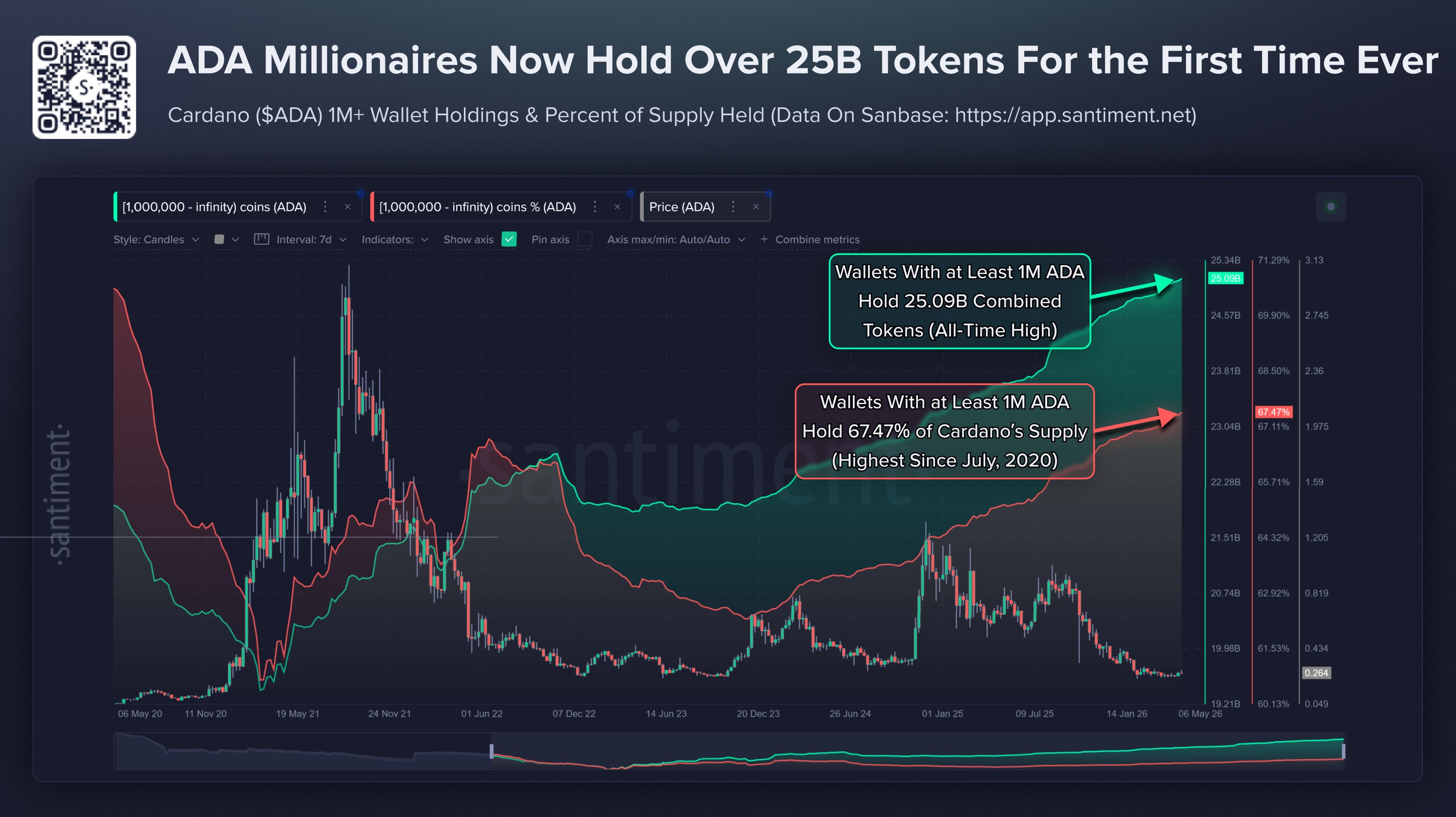
The value of the metric seems to have been climbing in recent years | Source: Santiment on X

As displayed in the above graph, the Cardano sharks and whales have seen their supply follow a pretty consistent uptrend since December 2023. During 2024 and 2025, the wider cryptocurrency sector followed a bullish trend, so it’s not surprising to see that large holders were accumulating.

Interestingly, however, the uptrend in the supply of the millionaire ADA wallets has maintained even through the bearish market shift that has followed since the last quarter of 2025. The analytics firm noted:

Although the asset has lost -71% of its market cap over the past 9 months, the “millionaire” tier of sharks and whales appear to be content with adding more while prices are at a discount.

Following the latest continuation of the metric’s upward trajectory, its value has reached the 25.09 billion ADA mark, which is a new all-time high (ATH). Though while this is a record in terms of the pure number of tokens, it’s not quite an ATH in terms of the supply share. Cardano has seen its supply go up over the years, so sharks and whales today control about 67.47% of the cryptocurrency’s supply, which is below the highs from 2020.

In related news, the Bitcoin sharks and whales have also participated in accumulation recently, as Santiment has highlighted in another X post. For BTC, these investors correspond to the 10 to 10,000 coins range.

As the chart below shows, these large investors have added 50,241 BTC to their holdings over the past month, representing an increase of 0.37%.
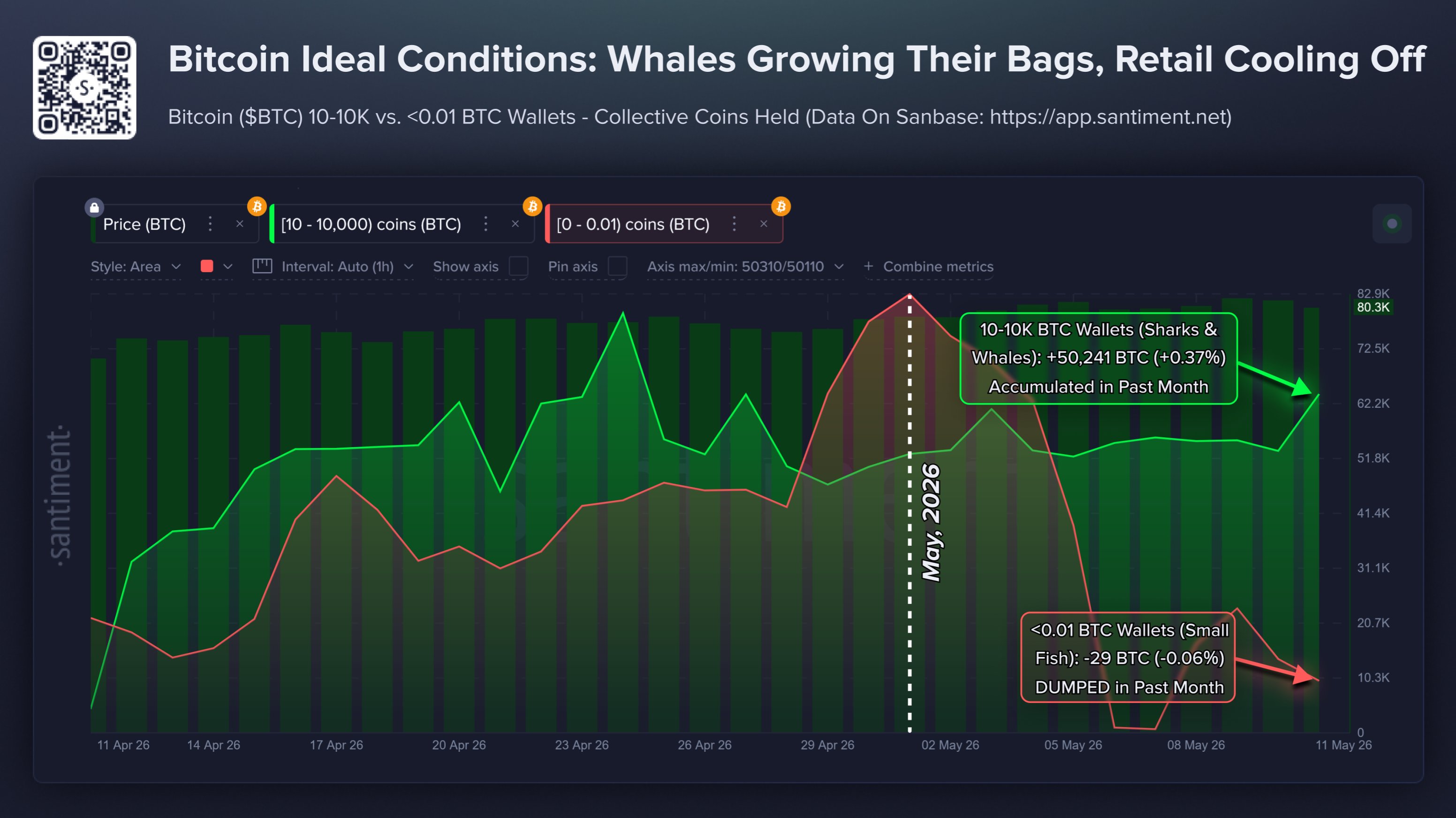
How the supply of the BTC sharks and whales has changed recently | Source: Santiment on X

While the large holders have been accumulating, the small entities carrying less than 0.01 BTC have collectively sold 29 BTC in this window instead. “Ideal conditions for any coin consist of large stakeholders continuing to add more to their bags, as retail shows FUD,” explained the analytics firm.

ADA Price

At the time of writing, Cardano is trading around $0.264, down 1.9% over the last 24 hours.

The trend in the price of the coin over the last five days | Source: ADAUSDT on TradingView


Criptomoedas em alta

Perguntas relacionadas

QAccording to the article, what is a 'millionaire wallet' in the context of Cardano (ADA)?

AA 'millionaire wallet' in the context of Cardano refers to an address holding 1 million ADA tokens, which is worth roughly $262,400 at the current exchange rate. Investors in this cohort are known as sharks and whales.

QWhat new record has the supply held by Cardano shark and whale wallets reached?

AThe combined supply held by Cardano millionaire wallets (sharks and whales) has reached a new all-time high of 25.09 billion ADA.

QDespite the market decline, what behavior have the Cardano sharks and whales shown?

ADespite the market decline where ADA has lost -71% of its market cap over the past 9 months, Cardano sharks and whales have continued to accumulate more tokens, adding to their holdings while prices are at a discount.

QHow do the sharks and whales' holdings in terms of supply share compare to highs from 2020?

AWhile the sharks and whales hold a record 25.09 billion ADA in pure token numbers, their supply share is about 67.47% of Cardano's total supply, which is below the highs from 2020.

QWhat contrasting behavior is noted between large BTC holders and small BTC entities over the past month?

AOver the past month, large Bitcoin holders (sharks and whales with 10 to 10,000 BTC) accumulated 50,241 BTC, while small entities holding less than 0.01 BTC collectively sold 29 BTC.

Leituras Relacionadas

Collateral Dollars: How Does a 'Second-Layer Dollar' Above Stablecoins Form?

Collateral Dollars: How Does a "Second Layer of Dollars" Form on Top of Stablecoins? Most assume stablecoins replicate Eurodollar functions, expanding the offshore dollar system. However, stablecoins primarily replace specific functions like operational dollar balances for settlement. They do not inherently create new dollar credit; they substitute existing claims. The key question is: what happens when financial intermediaries use stablecoins as collateral to create a new layer of dollar-denominated claims? This "collateral dollar" channel operates through secured lending, not direct money creation. A money-like event only occurs when a liability issued against the controlled stablecoin is funded, rolled over, or accepted at near-par value by another balance sheet. The discount (haircut) prices the gap between "effective control over the token" and "reliable convertibility to bank dollars." Elasticity stems not from the stablecoin itself but from the liability issued against it and the willingness of third-party balance sheets to treat that liability as a near-par asset. Compared to the traditional Eurodollar system—where elasticity originates from bank deposit creation—the stablecoin collateral chain is structurally different. Eurodollar deposits are credit-expansive from inception. Stablecoins are initially substitutive; elasticity emerges later if an intermediary's liability against them gains monetary acceptance. Stablecoins disrupt specific tiers of the offshore dollar system, mainly replacing operational settlement balances. They do not replace the need for full dollar balance-sheet capacity (credit lines, hedging, maturity transformation). For systemic impact, the second-layer liability must pass three tests: transferability, funding capacity, and monetary acceptance (being fundable or held at par by others). Pressure transmission also differs. In the Eurodollar system, stress moves up a hierarchy of claims. In a stablecoin collateral chain, the second-layer liability can lose its money-like status well before the underlying stablecoin faces a run, often triggered by haircut increases and margin calls that create a dynamic spiral of falling token prices and rising discounts. In conclusion, the "collateral dollar" is not the stablecoin itself. It is the second-layer liability issued against a controlled token balance that is willing to be funded and maintained at near-par value. Its existence depends on that liability surviving the leap from "token liquidity" to "bank dollar liquidity."

marsbitHá 7m

Collateral Dollars: How Does a 'Second-Layer Dollar' Above Stablecoins Form?

marsbitHá 7m

Collateral Dollars: How the 'Second-Layer Dollar' Above Stablecoins Takes Shape?

"Collateralized Dollars: How a 'Second Layer of Dollars' Forms on Top of Stablecoins" Most assume stablecoins replicate Eurodollars and expand the offshore dollar system, but this is not accurate. Stablecoins primarily replace certain functions within the existing system, especially operational dollar balances for daily settlement. The critical question is what happens when financial intermediaries create a new layer of dollar claims *on top of* stablecoins. This article explains how this new collateralized funding channel works. Stablecoins introduce tokenized private dollar claims. Even if issuers and reserves are within the US legal perimeter, their circulation and use as collateral can become economically "offshore." Enforceable control over collateral opens a secured credit channel but does not itself create a monetary claim. A true monetary event occurs only when another balance sheet funds, rolls over, or accepts a liability issued against the controlled token at near-par value. The discount prices the gap between "effective control over the token" and "reliable convertibility into bank dollars." Elasticity comes from the balance sheet issuing the liability against the token and from third-party willingness to treat that liability as a near-par asset. Collateralized Dollars are not the stablecoins themselves; they are the second-layer liability that another balance sheet is willing to issue, fund, and maintain at near-par against a controlled token balance. The Eurodollar system is a hierarchy of claims, with elasticity originating in expandable bank liabilities. In contrast, the stablecoin collateral chain starts with a tokenized asset. It gains systemic significance only when an intermediary's liability against that token is treated as money-like by other balance sheets. Key determining factors include: who has effective control, the legal/operational path to bank dollars, and whether the resulting claim can still be financed near-par under stress. Pressure in this new channel manifests differently. The upper-layer (intermediary) claim fails first, losing its money-like status, potentially while the underlying stablecoin remains solvent. Increased haircuts and forced sales can create a destructive feedback loop, widening the very gap the discount measures. In conclusion, the Eurodollar analogy has limits. Reserve quality supports the underlying token's solvency, but the leverage, credit, and liabilities built atop it face a separate test. Collateral eligibility is not monetary acceptance. Only when a claim built on stablecoins survives the leap from "token liquidity" to "bank dollar liquidity" do Collateralized Dollars truly exist.

链捕手Há 13m

Collateral Dollars: How the 'Second-Layer Dollar' Above Stablecoins Takes Shape?

链捕手Há 13m

Don't Be Misled by the $1.25 Billion Cap: MicroStrategy's Three-Pronged Bitcoin Sale Pools Hide Massive Selling Pressure

Don't Be Misled by the $1.25B Cap: Strategy's Three-Tier Bitcoin Sales Plan Hides Massive Potential Selling Pressure Strategy recently sold 3,588 BTC (~$216M) to fund a dividend and replenish its dollar reserve, while claiming its $1.25B "reserve build" capacity remains fully available. This highlights a key nuance: the widely cited $1.25B limit applies only to sales for "Building" the reserve. Strategy's broader capital framework, however, allows Bitcoin sales for three primary purposes, each with different scales: 1. **Building the Reserve:** Selling BTC to raise up to $1.25B for the reserve. 2. **Covering Priority Share Expenses:** Selling BTC to pay dividends/interest or to replenish the reserve after such payments are made from it (no specified limit). 3. **Share Repurchase Funding:** Selling BTC to fund up to $1B each in convertible note and common stock repurchases (totaling $2B potential). Combined, just the capped "Build" and "Repurchase" channels could facilitate over $3B in Bitcoin sales, excluding the uncapped "Cover Expenses" channel. The accounting distinction between "Building" (adding cash before a payout) and "Replenishing" (adding cash after a payout) is operationally blurry but allows sales like the recent $216M transaction without touching the $1.25B "Build" quota. This gives Strategy significant flexibility. The move signifies a strategic shift: Strategy is transforming from a simple Bitcoin accumulator into an active capital manager, akin to a hedge fund. Bitcoin is now a financial lever to balance pressures between common stock, convertible notes, dollar reserves, and Bitcoin holdings. This creates inherent tensions—actions benefiting one part of the capital structure may harm another. Investors must understand that the potential Bitcoin sales are far greater than the surface-level $1.25B figure. Strategy has become a complex financial entity where every term in its disclosures matters. Betting on it now is a wager on its active capital management skill to navigate these internal contradictions without a systemic failure.

Foresight NewsHá 20m

Don't Be Misled by the $1.25 Billion Cap: MicroStrategy's Three-Pronged Bitcoin Sale Pools Hide Massive Selling Pressure

Foresight NewsHá 20m

When the Largest BTC Buyer Becomes a Seller, Who's Buying After MicroStrategy Sells 3,588 Bitcoin?

MicroStrategy, once the largest corporate buyer of Bitcoin, sold 3,588 BTC for approximately $216 million to fund its preferred stock dividends, marking a significant shift from buyer to seller. This move occurred after its market-to-NAV premium vanished, breaking its "print stock to buy Bitcoin" financial model. A roundtable discussion featuring Austin Campbell, Ram Ahluwalia, and Chris Perkins analyzed the implications. They noted that MicroStrategy's dominance has become a narrative bottleneck for the broader crypto market, with some speculating that Bitcoin's price might only surge significantly after the company's influence wanes. The conversation expanded to examine the capital structure conflict between traditional equity and crypto tokens, arguing that most current tokens will fail as they don't fit neatly into existing debt/equity frameworks. A "stablecoin war" was identified as a major trend, with entities like Tether, Robinhood, and the OUSD alliance competing. Tether's decision to abandon the European MiCA market highlights strategic divergences. The panelists argued that bank-issued stablecoins could revolutionize global finance by allowing US banks to capture net interest margins from international transactions, potentially making JPMorgan the first trillion-dollar bank. They concluded that while capital is currently being siphoned by AI/semiconductors, markets will eventually refocus on fundamentals and cash flow, which could benefit cryptocurrencies with real utility.

marsbitHá 27m

When the Largest BTC Buyer Becomes a Seller, Who's Buying After MicroStrategy Sells 3,588 Bitcoin?

marsbitHá 27m

Bitcoin’s path to $80K may hinge on THIS hidden trend

Bitcoin's potential path toward $80,000 is influenced by conflicting market signals. Data shows the Coinbase Bitcoin Premium Index has recorded its longest-ever streak of consecutive negative premiums, indicating muted institutional demand or net selling from U.S. institutions. While such a trend often signals short-term weakness, it doesn't necessarily forecast a long-term bear market. Additionally, a bearish crossover occurred in Bitcoin's Net Unrealized Profit/Loss (NUPL), with its short-term average falling below the longer-term average, suggesting declining investor profitability and waning market momentum. Historically, major bear market bottoms saw the 100-day NUPL drop below zero, but this cycle it remains positive, implying either an unprecedented bottom or a further decline is needed. Currently trading around $63,148, Bitcoin has seen weekly gains but remains below its May peak. Technical indicators present a mixed picture: the MACD shows bullish momentum, while the RSI signals bearish pressure. A positive development is the return of inflows to Bitcoin ETFs after eight weeks of outflows. Analysts hold divergent views; some highlight a key liquidity zone between $48,000-$50,000 where a market bottom could form, while others maintain a more optimistic long-term outlook. Ultimately, while some bullish signs exist, a strong push from institutional investors appears crucial for Bitcoin to challenge the $80,000 level.

ambcryptoHá 1h

Bitcoin’s path to $80K may hinge on THIS hidden trend

ambcryptoHá 1h

Trading

Spot

Artigos em Destaque

Como comprar ADA

Bem-vindo à HTX.com!Tornámos a compra de Cardano (ADA) simples e conveniente.Segue o nosso guia passo a passo para iniciar a tua jornada no mundo das criptos.Passo 1: cria a tua conta HTXUtiliza o teu e-mail ou número de telefone para te inscreveres numa conta gratuita na HTX.Desfruta de um processo de inscrição sem complicações e desbloqueia todas as funcionalidades.Obter a minha contaPasso 2: vai para Comprar Cripto e escolhe o teu método de pagamentoCartão de crédito/débito: usa o teu visa ou mastercard para comprar Cardano (ADA) instantaneamente.Saldo: usa os fundos da tua conta HTX para transacionar sem problemas.Terceiros: adicionamos métodos de pagamento populares, como Google Pay e Apple Pay, para aumentar a conveniência.P2P: transaciona diretamente com outros utilizadores na HTX.Mercado de balcão (OTC): oferecemos serviços personalizados e taxas de câmbio competitivas para os traders.Passo 3: armazena teu Cardano (ADA)Depois de comprar o teu Cardano (ADA), armazena-o na tua conta HTX.Alternativamente, podes enviá-lo para outro lugar através de transferência blockchain ou usá-lo para transacionar outras criptomoedas.Passo 4: transaciona Cardano (ADA)Transaciona facilmente Cardano (ADA) no mercado à vista da HTX.Acede simplesmente à tua conta, seleciona o teu par de trading, executa as tuas transações e monitoriza em tempo real.Oferecemos uma experiência de fácil utilização tanto para principiantes como para traders experientes.

1.3k Visualizações TotaisPublicado em {updateTime}Atualizado em 2026.06.02

Como comprar ADA

Discussões

Bem-vindo à Comunidade HTX. Aqui, pode manter-se informado sobre os mais recentes desenvolvimentos da plataforma e obter acesso a análises profissionais de mercado. As opiniões dos utilizadores sobre o preço de ADA (ADA) são apresentadas abaixo.

活动图片