Cardano Lines Up An $80 Million War Chest: DDC Fund Goes Live

bitcoinistPublicado em 2026-01-14Última atualização em 2026-01-14

Resumo

The Cardano Foundation has proposed an on-chain action to allocate up to $75 million from its treasury to the new Cardano x Draper Dragon Ecosystem Fund (DDC Fund), targeting a total of $80 million with external investment. Managed by Draper Dragon, the fund will invest in Cardano-native startups over six years, aiming to generate returns for the treasury and boost ecosystem growth. Financial targets include a 3x return on capital and a 25%+ IRR, with goals to increase Cardano's total value locked (TVL) from $300 million to over $3 billion. The proposal includes a transparent governance structure and a buffer for ADA price volatility.

The Cardano Foundation is backing an on-chain “info action” that would route up to $75 million from Cardano’s treasury into a new, Draper Dragon-managed ecosystem fund targeting a total $80 million raise, with a mandate to invest in Cardano-native startups while sending proceeds back to the treasury over time.

If approved, the vehicle, dubbed the Cardano x Draper Dragon Ecosystem Fund (the “DDC Fund”), would run for at least six years, deploy venture-style capital across early-stage teams and ecosystem growth programs, and report performance via a public dashboard and quarterly disclosures, the Foundation said in a forum post published roughly a day before the announcement.

Cardano Moves To Turn Its Treasury Into A VC Engine

The proposal is designed as a budget info action that would authorize three treasury withdrawal tranches over 438 epochs: a fixed $15 million first tranche, followed by two tranches targeting $30 million each in years two and four. The withdrawals are denominated in ADA and capped at 175 million ADA in aggregate, with per-tranche caps of 50 million ADA for the first and 85 million ADA for the second and third.

The remaining $5 million to reach the $80 million headline size is expected to come from qualified external limited partners (eLPs), a structure the post frames as both incremental capital and a way to “prov[e] the value proposition of Cardano investments to a larger audience.”

Cardano’s pitch is that the fund turns the treasury from a passive pool into a compounding capital vehicle. “The goals of this proposal are straightforward and ambitious: Deliver a return multiple back to the Treasury; make Cardano self-sustaining while increasing the ecosystem’s total value locked (‘TVL’), on-chain activity, and developer participation; and transform the Treasury from a passive reserve into an active growth engine that compounds Cardano ecosystem value,” the post said.

Under the proposed structure, Draper Dragon acts as general partner and controls investment decisions. An affiliate adviser, described as an “exempt reporting adviser regulated by the Securities Exchange Commission”, would provide due diligence and advisory support. The Cardano Foundation positions itself as an enabler rather than an investment decision-maker, taking responsibility for orchestrating the legal setup and administering the proposal under the Cardano constitution.

To route economics back to the treasury, the plan creates a Cayman Islands special purpose vehicle (SPV) that would serve as the fund’s limited partner on behalf of the treasury. The SPV is described as “ownerless” and intended to exist solely for the economic benefit of the treasury, with an initial three-director setup that includes an independent director, a Foundation director, and a community-elected “Community SPV Director.”

Targets Of The DCC Fund

The DDC Fund’s financial targets are framed in institutional VC terms: a roughly 3x gross multiple on invested capital and a 25%+ IRR, benchmarked against institutional blockchain and crypto venture funds, with the post stressing projections are illustrative and not performance guarantees.

On the ecosystem side, the ambition is explicit: contribute to increasing Cardano TVL from “the current $300M to $3B+,” split between $1.5B+ in RWA and $1.5B+ in DeFi, while also pushing higher on-chain usage, network revenue, and developer participation.

The treasury-funded $75 million would be allocated across direct investments, growth capital, and educational support, plus fund and administration costs. Direct investments are slated to take the largest share ($50 million), while growth capital ($11.5 million) and educational support ($6 million) fund marketing, liquidity initiatives, exchange introductions, and Draper University programming such as accelerators and hacker houses.

Because withdrawals are voted through governance over time, the plan bakes in a 20% buffer for ADA price fluctuations, and allows the GP discretion to time conversions to USD or stablecoins and to defer capital calls for up to six months. Excess value from a rising ADA price is meant to reduce later tranches; shortfalls can be handled via the buffer, deferrals, top-up governance actions, or adjustments within the tranche and aggregate caps.

The post also outlines failure modes. If treasury withdrawals repeatedly fail, specifically, “at least three successive Treasury withdrawals fail to pass within a calendar year”, the GP may wind the fund down and liquidate assets in a controlled process.

Transparency is promised via a public KPI dashboard and quarterly fund reports, plus AMAs and roundtables, but with a clear boundary: deal terms, valuations, and certain portfolio information would remain confidential, consistent with “standard” venture fund practice.

At press time, ADA traded at $0.4215.
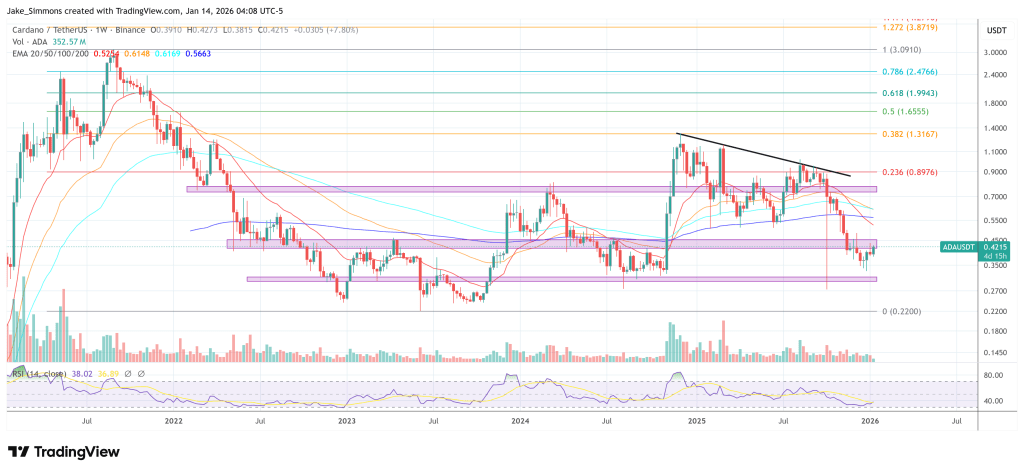
ADA faces key resistance zone, 1-week chart | Source: ADAUSDT on TradingView.com

Perguntas relacionadas

QWhat is the total target size of the Cardano x Draper Dragon Ecosystem Fund (DDC Fund) and how is it being funded?

AThe total target size of the DDC Fund is $80 million. It is being financed with up to $75 million from the Cardano treasury and the remaining $5 million is expected to come from qualified external limited partners (eLPs).

QWhat are the primary financial return targets for the DDC Fund, as stated in the proposal?

AThe fund's financial targets are a roughly 3x gross multiple on invested capital and an Internal Rate of Return (IRR) of 25% or more, benchmarked against institutional blockchain and crypto venture funds.

QWhat specific ecosystem goal does the proposal set for Cardano's Total Value Locked (TVL)?

AThe proposal aims to contribute to increasing Cardano's TVL from the current $300 million to over $3 billion, with a split of over $1.5 billion in Real World Assets (RWA) and over $1.5 billion in Decentralized Finance (DeFi).

QWhat role does the Cardano Foundation play in the proposed DDC Fund structure?

AThe Cardano Foundation positions itself as an enabler, not an investment decision-maker. It is responsible for orchestrating the legal setup, administering the proposal under the Cardano constitution, and will have a director on the board of the Cayman Islands SPV.

QHow will transparency be maintained for the fund, and what information will remain confidential?

ATransparency will be provided through a public KPI dashboard, quarterly fund reports, AMAs, and roundtables. However, consistent with standard venture fund practice, confidential information such as specific deal terms, valuations, and certain portfolio details will not be publicly disclosed.

Leituras Relacionadas

$9.4 Billion: The Largest Robotics Funding This Year Has Emerged

Munich-based humanoid robotics company Neura has completed a $1.4 billion (approximately RMB 94.9 billion) Series C funding round, valuing the company at around $7 billion and positioning it among the global leaders in the sector. The investment round is notable not just for its size—reportedly the largest in robotics this year—but also for its strategic backers, which include tech giants like NVIDIA and Amazon, alongside established industrial players such as German engineering firms Bosch and Schaeffler. This mix of investors signals a significant shift in the industry's focus from technological demonstrations and general-purpose narratives toward practical, industrial deployment and commercialization. Neura's approach centers on developing humanoid robots for defined, high-value industrial tasks rather than pursuing a general-purpose model. Its early validation comes from a partnership with BMW, where its robots are being tested on actual production lines. The involvement of Bosch and Schaeffler, companies deeply embedded in global manufacturing, underscores a growing belief that humanoid robots are transitioning from labs to viable factory-floor solutions. The article highlights two converging trends driving investment: advancements in AI and large language models, which enhance robots' perception and decision-making in unstructured environments, and mounting pressure from labor shortages and rising costs in major manufacturing regions. The funding landscape is now bifurcating between companies like Figure AI, focusing on versatile general-purpose robots, and firms like Neura, targeting specific vertical industrial applications with clearer, shorter paths to ROI. While technical hurdles remain, the core challenges for widespread adoption are increasingly seen as engineering and commercial in nature: managing the high integration and customization costs for different factory environments and establishing robust, localized maintenance and service networks. The record investment in Neura, particularly from industrial capital, indicates the industry's growing confidence in moving from proving feasibility to solving the practical problems of scalability, reliability, and building sustainable business models around humanoid robots in real-world settings like automotive manufacturing and hazardous labor environments.

marsbitHá 7h

$9.4 Billion: The Largest Robotics Funding This Year Has Emerged

marsbitHá 7h

Trading

Spot
Futuros

Artigos em Destaque

Como comprar ADA

Bem-vindo à HTX.com!Tornámos a compra de Cardano (ADA) simples e conveniente.Segue o nosso guia passo a passo para iniciar a tua jornada no mundo das criptos.Passo 1: cria a tua conta HTXUtiliza o teu e-mail ou número de telefone para te inscreveres numa conta gratuita na HTX.Desfruta de um processo de inscrição sem complicações e desbloqueia todas as funcionalidades.Obter a minha contaPasso 2: vai para Comprar Cripto e escolhe o teu método de pagamentoCartão de crédito/débito: usa o teu visa ou mastercard para comprar Cardano (ADA) instantaneamente.Saldo: usa os fundos da tua conta HTX para transacionar sem problemas.Terceiros: adicionamos métodos de pagamento populares, como Google Pay e Apple Pay, para aumentar a conveniência.P2P: transaciona diretamente com outros utilizadores na HTX.Mercado de balcão (OTC): oferecemos serviços personalizados e taxas de câmbio competitivas para os traders.Passo 3: armazena teu Cardano (ADA)Depois de comprar o teu Cardano (ADA), armazena-o na tua conta HTX.Alternativamente, podes enviá-lo para outro lugar através de transferência blockchain ou usá-lo para transacionar outras criptomoedas.Passo 4: transaciona Cardano (ADA)Transaciona facilmente Cardano (ADA) no mercado à vista da HTX.Acede simplesmente à tua conta, seleciona o teu par de trading, executa as tuas transações e monitoriza em tempo real.Oferecemos uma experiência de fácil utilização tanto para principiantes como para traders experientes.

1.3k Visualizações TotaisPublicado em {updateTime}Atualizado em 2026.06.02

Como comprar ADA

Discussões

Bem-vindo à Comunidade HTX. Aqui, pode manter-se informado sobre os mais recentes desenvolvimentos da plataforma e obter acesso a análises profissionais de mercado. As opiniões dos utilizadores sobre o preço de ADA (ADA) são apresentadas abaixo.

活动图片













