Cardano Isn’t ‘Fading,’ Hoskinson Says: ‘I’ve Lost Over $3B’ And Still Building

bitcoinistPublicado em 2026-02-06Última atualização em 2026-02-06

Resumo

Charles Hoskinson, during a livestream from Tokyo, refuted claims that Cardano is "fading" or "dead," emphasizing that the project is transitioning into a phase of commercialization after years of infrastructure development. Despite the bear market, he highlighted that key building blocks like decentralization and governance are complete, and efforts are now focused on developing real-world use cases such as Hydra for scaling and the privacy-focused sidechain Midnight. Hoskinson argued that global economic shifts and institutional mistrust make blockchain-based systems essential for a neutral global settlement layer. Addressing critics who attribute his optimism to wealth, he revealed he has lost over $3 billion but remains committed to Cardano, stating he is "here for life" regardless of financial outcomes. At the time of reporting, ADA was trading at $0.2521.

Charles Hoskinson used a Feb. 6 livestream from Tokyo to push back on a familiar narrative he says he’s hearing on the ground in Japan: that Cardano is “fading” or “dead,” and that the bear market has drained the ecosystem’s momentum.

Speaking midway through a multi-city tour tied to Cardano’s third cohort of ambassadors, Hoskinson said long-time community members and newcomers alike have been approaching him with relief that the project is still active. He framed the trip as a signal that Cardano, after years of protocol work, is shifting into what he called a commercialization phase, building products that feel less like infrastructure demos and more like mainstream use cases.

Hoskinson Rallies Cardano Through The Downturn

“We’ve been on tour all throughout Japan,” Hoskinson said, describing meetings with “a lot of investors, a lot of developers,” including people who have followed Cardano “for more than 10 years.” The message he said he’s delivering is that major building blocks are in place: “The infrastructure is strong. We’re fully decentralized. Governance has been done. So now it’s the time to go build some fun, exciting, real use cases and get them into the ecosystem.”

Hoskinson name-checked Hydra, Cardano’s scaling effort, and pointed to projects he characterized as the “vanguard” of the next phase, including Midnight — the privacy-focused sidechain he has promoted as a cornerstone of Cardano’s broader roadmap. He also referenced “Starstream,” a WASM-based zero-knowledge virtual machine (zkVM) designed for the Cardano blockchain to enable private, scalable smart contracts.

The backdrop, he acknowledged, is a market environment that “is red, red, red,” with sentiment weak enough that some attendees told him they had assumed Cardano’s best days were behind it. Hoskinson’s response was less a price defense than a thesis about why crypto persists through cycles and why he believes the longer-term direction of global finance makes open networks unavoidable.

“Globalism has finally reached its peak, accelerated by AI and accelerated by demographic changes,” he said. “The human race is starting to think in terms of we instead of nation by nation... And the old guard and the old way of doing things is fading. And they’re kicking and screaming as they’re being dragged off the stage.”

He argued that a more integrated global economy ultimately needs a neutral settlement layer: an “economic franca,” in his words and that blockchain-based systems are the practical option. “The only way to run a world like this is through cryptocurrency. Full stop,” Hoskinson said. “Otherwise, you have to build an empire and no one’s strong enough to conquer the world right now... We need an economic franca. And you tell me how we’re going to do that without a blockchain.”

The livestream veered into broader institutional mistrust, with Hoskinson citing political instability, corruption, and high-profile scandals as evidence that “deep down inside, we all know this can’t last.” He cast crypto as a mechanism to constrain human behavior through “rules” and “regulating functions,” rather than relying on institutional goodwill.

But the most pointed moment came when he anticipated a common critique that his optimism is easy because he’s wealthy and responded with a personal financial claim and a commitment to keep building regardless of market outcomes:

“Every now and then you hear something like this, you say, ‘Yes, but it’s easy for you to say, Charles, you’re rich. You can ride it out.’ I’ve lost more money than anyone listening to this. Over $3 billion now. It would have been real easy to cash out. Just walk away. And do you think I honestly care if I lose it all? Do you think I’m doing this for money? You’re pretty mistaken if you do.”

Hoskinson also portrayed his distance from past industry blowups as a matter of personal discipline rather than luck. “There’s a reason I didn’t get rolled up in FTX,” he said, adding that his “default answer is no” when it comes to the kinds of deals that later become liabilities.

In closing, Hoskinson urged builders and community members to treat the drawdown as an endurance test rather than a verdict, tying Cardano’s ambassador programs, including a call to become a Midnight ambassador and engage via Intersect.

His core message was simple: the market may get “more red” but he isn’t leaving. “I’m here for life,” Hoskinson said. “As long as I’m alive, I’m just going to keep going.”

At press time, ADA traded at $0.2521.
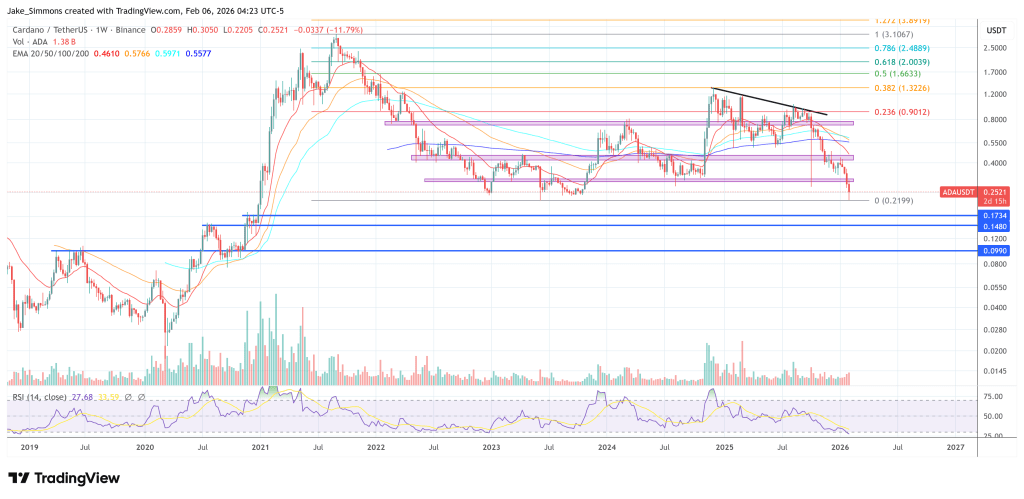
ADA fell to the June 2023 low again, 1-week chart | Source: ADAUSDT on TradingView.com

Perguntas relacionadas

QWhat is the main narrative that Charles Hoskinson is pushing back against during his livestream from Tokyo?

AHoskinson is pushing back against the narrative that Cardano is 'fading' or 'dead,' and that the bear market has drained the ecosystem's momentum.

QAccording to Hoskinson, what phase is Cardano now entering after years of protocol work?

AHoskinson stated that Cardano is shifting into a 'commercialization phase,' building products that feel more like mainstream use cases rather than infrastructure demos.

QWhat was Hoskinson's personal financial claim to counter the critique that his optimism is due to his wealth?

AHoskinson claimed that he has lost over $3 billion and stated that he is not doing this for money, emphasizing that he would continue building even if he lost it all.

QWhat did Hoskinson argue is the only practical way to run a more integrated global economy?

AHoskinson argued that the only way to run a more integrated global economy is through cryptocurrency, which he called an 'economic franca,' as a neutral settlement layer.

QWhat two specific Cardano projects did Hoskinson name-check as part of the 'vanguard' of its next phase?

AHoskinson name-checked Hydra, Cardano's scaling effort, and Midnight, a privacy-focused sidechain.

Leituras Relacionadas

North Korean Hackers Loot $500 Million in a Single Month, Becoming the Top Threat to Crypto Security

North Korean hackers, particularly the notorious Lazarus Group and its subgroup TraderTraitor, have stolen over $500 million from cryptocurrency DeFi platforms in less than three weeks, bringing their total theft for the year to over $700 million. Recent major attacks on Drift Protocol and KelpDAO, resulting in losses of approximately $286 million and $290 million respectively, highlight a strategic shift: instead of targeting core smart contracts, attackers are now exploiting vulnerabilities in peripheral infrastructure. For instance, the KelpDAO attack involved compromising downstream RPC infrastructure used by LayerZero's decentralized validation network (DVN), allowing manipulation without breaching core cryptography. This sophisticated approach mirrors advanced corporate cyber-espionage. Additionally, North Korea has systematically infiltrated the global crypto workforce, with an estimated 100 operatives using fake identities to gain employment at blockchain companies, enabling long-term access to sensitive systems and facilitating large-scale thefts. According to Chainalysis, North Korean-linked hackers stole a record $2 billion in 2025, accounting for 60% of all global crypto theft that year. Their total historical crypto theft has reached $6.75 billion. Post-theft, they employ specialized money laundering methods, heavily relying on Chinese OTC brokers and cross-chain mixing services rather than standard decentralized exchanges. Security experts, while acknowledging the increased sophistication, emphasize that many attacks still exploit fundamental weaknesses like poor access controls and centralized operational risks. Strengthening private key management, limiting privileged access, and enhancing coordination among exchanges, analysts, and law enforcement immediately after an attack are critical to improving defense and fund recovery chances. The industry's challenge now extends beyond secure smart contracts to safeguarding operational security at the infrastructure level.

marsbitHá 34m

North Korean Hackers Loot $500 Million in a Single Month, Becoming the Top Threat to Crypto Security

marsbitHá 34m

Circle CEO's Seoul Visit: No Korean Won Stablecoin Issuance, But Met All Major Korean Banks

Circle CEO Jeremy Allaire's recent activities in Seoul indicate a strategic shift for the company, moving away from issuing a Korean won-backed stablecoin and instead focusing on embedding itself as a key infrastructure provider within Korea’s financial and crypto ecosystem. Despite Korea accounting for nearly 30% of global crypto trading volume—with a market characterized by high retail participation and altcoin dominance—Circle has chosen not to compete for the role of stablecoin issuer. Instead, Allaire met with major Korean banks (including Shinhan, KB, and Woori), financial groups, leading exchanges (Upbit, Bithumb, Coinone), and tech firms like Kakao. This approach reflects a broader industry transition: the core of stablecoin competition is shifting from issuance rights to systemic positioning. With Korean regulators still debating whether banks or tech companies should issue stablecoins, Circle is avoiding regulatory uncertainty by strengthening its role as a service and technology partner. The company is deepening integration with trading platforms, building connections, and promoting stablecoin infrastructure. This positions Circle to benefit regardless of which entity eventually issues a won stablecoin. Allaire also noted the potential for a Chinese yuan stablecoin in the next 3–5 years, underscoring a regional trend of stablecoins becoming more regulated and integrated with traditional finance. Ultimately, Circle’s strategy highlights that future influence in the stablecoin market will belong not necessarily to the issuers, but to the foundational infrastructure layers that enable cross-system transactions.

marsbitHá 1h

Circle CEO's Seoul Visit: No Korean Won Stablecoin Issuance, But Met All Major Korean Banks

marsbitHá 1h

SpaceX Ties Up with Cursor: A High-Stakes AI Gambit of 'Lock First, Acquire Later'

SpaceX has secured an option to acquire AI programming company Cursor for $60 billion, with an alternative clause requiring a $10 billion collaboration fee if the acquisition does not proceed. This structure is not merely a potential acquisition but a strategic move to control core access points in the AI era. The deal is designed as a flexible, dual-path arrangement, allowing SpaceX to either fully acquire Cursor or maintain a binding partnership through high-cost collaboration. This "option-style" approach minimizes immediate regulatory and integration risks while ensuring long-term alignment between the two companies. At its core, the transaction exchanges critical AI-era resources: SpaceX provides its Colossus supercomputing cluster—one of the world’s most powerful AI training infrastructures—while Cursor contributes its AI-native developer environment and strong product adoption. This synergy connects compute power, models, and application layers, forming a closed-loop AI capability stack. Cursor, founded in 2022, has achieved rapid growth with over $1 billion in annual revenue and widespread enterprise adoption. Its value lies in transforming software development through AI agents capable of coding, debugging, and system design—positioning it as a gateway to future software production. For SpaceX, this move is part of a broader strategy to evolve from a aerospace company into an AI infrastructure empire, integrating xAI, supercomputing, and chip manufacturing. Controlling Cursor fills a gap in its developer tooling layer, strengthening its AI narrative ahead of a potential IPO. The deal reflects a shift in AI competition from model superiority to ecosystem and entry-point control. With programming tools as a key battleground, securing developer loyalty becomes crucial for dominating the software production landscape. Risks include questions around Cursor’s valuation, technical integration challenges, and potential regulatory scrutiny. Nevertheless, the deal underscores a strategic bet: controlling both compute and software development access may redefine power dynamics in the AI-driven future.

marsbitHá 1h

SpaceX Ties Up with Cursor: A High-Stakes AI Gambit of 'Lock First, Acquire Later'

marsbitHá 1h

Trading

Spot
Futuros

Artigos em Destaque

Como comprar T

Bem-vindo à HTX.com!Tornámos a compra de Threshold Network Token (T) simples e conveniente.Segue o nosso guia passo a passo para iniciar a tua jornada no mundo das criptos.Passo 1: cria a tua conta HTXUtiliza o teu e-mail ou número de telefone para te inscreveres numa conta gratuita na HTX.Desfruta de um processo de inscrição sem complicações e desbloqueia todas as funcionalidades.Obter a minha contaPasso 2: vai para Comprar Cripto e escolhe o teu método de pagamentoCartão de crédito/débito: usa o teu visa ou mastercard para comprar Threshold Network Token (T) instantaneamente.Saldo: usa os fundos da tua conta HTX para transacionar sem problemas.Terceiros: adicionamos métodos de pagamento populares, como Google Pay e Apple Pay, para aumentar a conveniência.P2P: transaciona diretamente com outros utilizadores na HTX.Mercado de balcão (OTC): oferecemos serviços personalizados e taxas de câmbio competitivas para os traders.Passo 3: armazena teu Threshold Network Token (T)Depois de comprar o teu Threshold Network Token (T), armazena-o na tua conta HTX.Alternativamente, podes enviá-lo para outro lugar através de transferência blockchain ou usá-lo para transacionar outras criptomoedas.Passo 4: transaciona Threshold Network Token (T)Transaciona facilmente Threshold Network Token (T) no mercado à vista da HTX.Acede simplesmente à tua conta, seleciona o teu par de trading, executa as tuas transações e monitoriza em tempo real.Oferecemos uma experiência de fácil utilização tanto para principiantes como para traders experientes.

376 Visualizações TotaisPublicado em {updateTime}Atualizado em 2025.03.21

Como comprar T

Discussões

Bem-vindo à Comunidade HTX. Aqui, pode manter-se informado sobre os mais recentes desenvolvimentos da plataforma e obter acesso a análises profissionais de mercado. As opiniões dos utilizadores sobre o preço de T (T) são apresentadas abaixo.

活动图片