Cardano Founder Says ‘Leios Is Coming’ As Proposal Heads To DReps

bitcoinistPublicado em 2026-05-15Última atualização em 2026-05-15

Resumo

Cardano founder Charles Hoskinson announced progress on the Leios consensus upgrade as a ₳27.7 million funding proposal moves toward DRep approval. The proposal seeks to advance Leios from a public testnet prototype to a mainnet-ready release candidate, aiming to increase Cardano's transaction capacity by 10–65x to support its 2030 scaling goals of handling over 27 million monthly transactions. The upgrade enhances, rather than replaces, the existing Ouroboros Praos protocol. The six to nine-month project is structured around development, rigorous testing, and hard-fork enablement, with funding managed via milestone-based disbursements. The proposal acknowledges risks including community readiness, governance dependencies, and potential operational impacts on stake pool operators.

Cardano founder Charles Hoskinson signaled renewed momentum behind Leios, the network’s next major consensus upgrade, as Input Output moved a ₳27.7 million funding proposal toward DRep approval. The proposal seeks to mature Leios from an early public testnet prototype into a mainnet-ready release candidate, positioning the upgrade as a central piece of Cardano’s 2030 scaling strategy.

“Leios is coming,” Hoskinson wrote on X, quoting Sebastian Nagel, who said: “Cardano, if your governance permits, we’ll ship Leios.” The short exchange framed the next phase of Cardano’s scaling roadmap as both a technical delivery question and a governance decision.

Cardano’s Biggest Scaling Bet

The proposal, authored by Carlos Lopez de Lara and Nagel, asks DReps to approve a treasury withdrawal of ₳27,714,342 to fund six to nine months of development. The work is intended to move Leios from its current prototype and testnet phase toward a release candidate suitable for mainnet integration. According to the proposal, each milestone would be independently assured, while undisbursed ada would be returned to the treasury.

Leios is designed to enhance, rather than replace, Ouroboros Praos, Cardano’s existing consensus protocol. The proposal says the upgrade introduces endorser blocks and committee-based validation to increase transaction capacity while preserving Praos’s security model. IO frames the design as a way to scale Cardano without undermining decentralization or making stake pool operations economically unviable.

“Cardano needs a step change in throughput to meet its 2030 ambitions, and Leios is how it gets there. This proposal funds the path from public testnet to a mainnet-ready release candidate — delivering a 10–65x increase in transaction capacity,” the proposal states. “Why this scale matters: Cardano’s 2030 strategy targets growth from roughly 800,000 monthly transactions to over 27 million.”

That 2030 target is a key justification for the funding request. The proposal argues that sustainable utilization at that level would require at least 6x current capacity, while Leios is expected to deliver 10x or more under validated parameter settings. Elsewhere, the accompanying IO article says Leios could support a phased throughput increase from 2x to 30x current capacity on mainnet, with full capacity demonstrated on testnet before broader rollout.

The work is organized around three objectives. The first is a release candidate, including a substantial rewrite of consensus components, implementation of the Leios block structure for the Dijkstra era, conformance testing against the Agda formal specification, and integration into the primary node by the fourth quarter of 2026.

The second is “high confidence,” built through parameter exploration, continuous load testing, adversarial testing, red-team exercises, and an updated threat model. The third is hard-fork enablement, covering client interfaces, technical documentation, SPO and developer workshops, support for adjacent infrastructure such as DB-Sync, Mithril and Blockfrost, testnet hard forks, governance artifacts and contingency procedures.

The proposal is careful to separate work within IO’s control from external dependencies. A mainnet hard fork would still depend on broader ecosystem readiness, governance action submission and a community vote. The document explicitly describes those as risks rather than promises.

Funding would be administered through Intersect’s treasury reserve smart contract framework, with milestone-based disbursements and third-party assurance. The budget allocates ₳23.83 million, or 86%, to development, with smaller portions assigned to infrastructure, security and audits, legal and compliance, ecosystem support, operations, governance and other costs.

The risk section is direct. It identifies community readiness, hard-fork timing, final cardano-node integration and possible governance constraints as factors that could delay or limit activation. It also notes technical limitations, including potential higher operational costs for SPOs, greater chain growth, and high-throughput assumptions tied to adversarial stake conditions.

At press time, ADA traded at $0.2661.
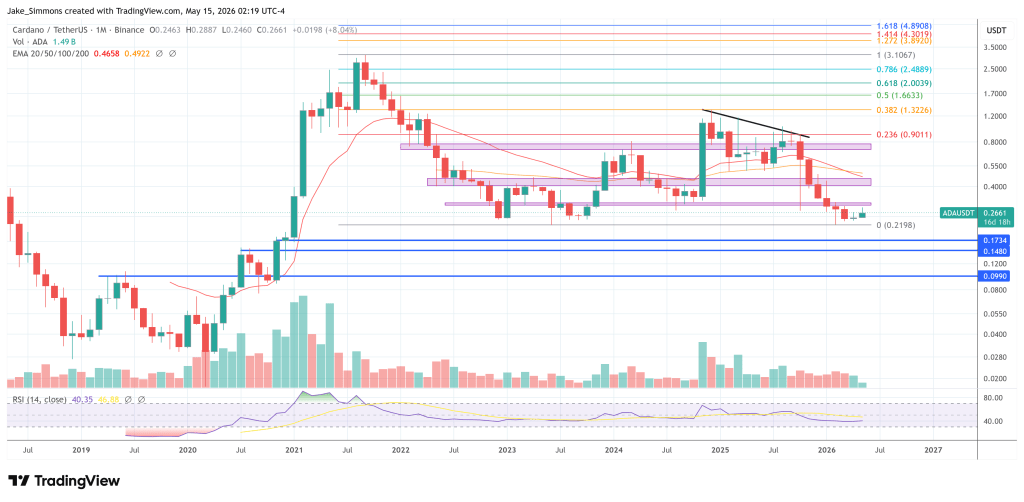
ADA remains below key resistance, 1-monthly chart | Source: ADAUSDT on TradingView.com

Perguntas relacionadas

QWhat is the purpose of the 27.7 million ADA funding proposal submitted to the DReps for Leios?

AThe purpose of the 27.7 million ADA funding proposal is to mature Leios from an early public testnet prototype into a mainnet-ready release candidate, funding six to nine months of development work to achieve this goal.

QHow does the Leios upgrade aim to improve Cardano's transaction capacity according to the proposal?

AThe Leios upgrade aims to increase Cardano's transaction capacity by 10x to 65x, introducing endorser blocks and committee-based validation to enhance throughput while preserving the security model of the existing Ouroboros Praos consensus protocol.

QWhat are the three main objectives of the Leios development work outlined in the proposal?

AThe three main objectives are: 1) Delivering a release candidate with a rewritten consensus, 2) Building high confidence through extensive testing and security exercises, and 3) Enabling the hard fork through client interfaces, documentation, workshops, and ecosystem support.

QWhat are some of the key risks associated with the Leios activation mentioned in the proposal?

AKey risks include community readiness, hard-fork timing dependencies, final node integration, potential governance constraints, higher operational costs for SPOs, increased chain growth, and high-throughput assumptions tied to adversarial stake conditions.

QWhat is the target for Cardano's monthly transactions by 2030 as cited in the article, and why does it necessitate the Leios upgrade?

ACardano's 2030 strategy targets growth from roughly 800,000 to over 27 million monthly transactions. This necessitates the Leios upgrade because sustainable utilization at that level requires at least a 6x increase in capacity, which Leios is designed to provide (10x or more).

Leituras Relacionadas

GitHub, Transfixed by AI

On the night of February 9th, GitHub suffered a major outage caused by a simple configuration change—reducing a cache refresh interval from 12 to 2 hours—that triggered a cascade of failures. This was not an isolated event, but part of a broader pattern. In early 2026, GitHub experienced at least 8 major incidents, failing to meet its promised 99.9% availability. These outages stemmed from structural issues: explosive growth in load, tight service coupling, and insufficient protection against abnormal traffic. This unprecedented load is driven by AI Agents. In 2025, GitHub handled ~1 billion commits. By 2026, weekly commits reached 275 million, projecting to ~14 billion for the year—a 14x increase. AI tools like Claude Code now contribute 4.5% of all public repository commits, with weekly submissions surging 25x in just three months. AI-generated pull requests jumped from 4 million to 17 million per month in half a year. Unlike human developers, AI Agents work continuously, generating commits at a scale that overwhelms infrastructure designed for human rhythms. The surge also shattered GitHub's business model. Copilot's flat-rate pricing, based on assisting human developers, became unsustainable as Agentic AI sessions consumed resources worth hundreds of dollars for a few dollars in fees. In response, GitHub imposed usage limits and, by June 1st, shifted to a pay-per-use "AI Credits" system. Facing this new reality, GitHub realized a 10x scaling plan was insufficient. It announced a need to *redesign* its architecture for 30x current scale—decoupling services, adding fault isolation, and improving change management to prevent cascading failures. Other platforms like Stripe and AWS are facing similar challenges with AI Agents. Fundamentally, GitHub is transitioning from a human collaboration platform to an "exhaust pipe" for automated AI workflows. Its detailed post-mortem reports aim to maintain trust during this turbulent rebuild. The February outage was not just a technical glitch, but a signal of the software industry's entry into a new, AI-driven era.

marsbitHá 11m

GitHub, Transfixed by AI

marsbitHá 11m

Both Suffer Massive Losses Exceeding $90 Billion, Which Is in Greater Peril: Strategy or Bitmine?

Facing massive paper losses exceeding $90 billion each amidst a sharp market downturn, "Digital Asset Treasury" (DAT) giants Strategy and Bitmine find themselves in a precarious position, but with different underlying risks. Strategy, heavily invested in Bitcoin (BTC), faces significant financial strain. Its strategy relies heavily on debt, including convertible notes and preferred stock (STRC) requiring substantial dividend payments. With its cash reserves dwindling and BTC offering no staking yield for cash flow, Strategy's high leverage makes it vulnerable. A continued price decline could force asset sales to meet obligations, potentially creating a negative feedback loop. Its market value has already fallen sharply. In contrast, Bitmine, an Ethereum (ETH) holder, appears on firmer financial ground. It primarily funds its purchases through equity offerings (like ATM programs), avoiding debt pressure. It also generates income by staking a large portion of its ETH holdings. While not immune to market drops and shareholder dilution concerns, Bitmine maintains more flexibility, recently announcing a new preferred share offering to raise further capital. The core divergence lies in their financing: Bitmine uses equity (investor money), while Strategy uses debt (borrowed money). Consequently, Bitmine currently faces less immediate liquidity pressure than Strategy, which must navigate the dual challenge of servicing debt/dividends and a declining core asset (BTC) price.

marsbitHá 18m

Both Suffer Massive Losses Exceeding $90 Billion, Which Is in Greater Peril: Strategy or Bitmine?

marsbitHá 18m

Where the AI Bubble Really Is: Which Layer of Players Are Naked

AI Bubble: Where It Really Is and Who's Swimming Naked This analysis dissects the AI industry not as a single entity but as a five-layer pyramid, arguing that bubbles are concentrated in specific tiers, not uniformly distributed. **Key Distinction from the 2000 Dot-com Bubble:** Unlike 2000, where companies had stock prices before revenue, today's leading AI players have massive, contract-backed revenue driving their valuations. Core infrastructure demand is real, with every GPU running at full capacity for paying customers. **The Five-Layer Pyramid & Bubble Assessment:** * **L0 (Fab/Manufacturing) & Top L4 (Leading AI Apps): NO BUBBLE.** Companies like TSMC, NVIDIA, major cloud providers (Microsoft, Google, Meta, Amazon), and top AI labs have real revenues and orders. Supply is tightly constrained by TSMC's disciplined capacity control and physical limits like power/land for data centers, preventing a supply glut. * **L1 (Memory): BATTLEGROUND.** Sky-high HBM margins could signal a new structural cycle or a classic "boom before bust." The oligopoly of three major players may enforce supply discipline, making this a high-stakes bet. * **L2 (Interconnect/Optical Modules): BUBBLE TERRITORY.** Companies like Lumentum and AAOI have seen stock surges (4-10x) far outpacing revenue growth. This hardware segment has lower physical barriers to expansion than fabs, allowing speculation. It mirrors the 2000 bubble's epicenter—optics. * **L3 (Infrastructure/"GPU Landlords"): VULNERABLE.** GPU leasing companies profit from the current compute shortage but own no long-term moat. Their business model relies on a temporary bottleneck that will ease as big tech expands and new tech (e.g., potential space-based data centers) emerges. * **L4 Long Tail (VC-backed Startups): STRONG BUBBLE SIGNALS.** VC funding concentration in AI is twice that of the 1999 peak. Many startups with little revenue use the valuation logic of successful giants to justify their own, creating high risk of a "valuation crunch" when funding dries up. **Critical Risks to Monitor:** 1. **GPU Depreciation & Accounting:** Companies extending the assumed useful life of GPUs artificially boost profits. The true economic life depends on future generational leaps from NVIDIA. 2. **"GPU Credit" & Off-Balance-Sheet Leverage:** Emerging structures where shell companies borrow to buy GPUs and lease them out (with chipmakers sometimes investing) move debt off major balance sheets. This echoes the "vendor financing" of 2000 and the securitization risks of 2008, though currently small-scale. 3. **TSMC Abandoning Caution:** If the primary supply bottleneck (TSMC's conservative capacity planning) breaks, runaway supply could trigger a bust. 4. **Algorithmic Efficiency Breakthrough:** A major leap in software efficiency could drastically reduce the need for raw compute hardware, undermining the investment thesis. **Conclusion:** The AI boom is expensive and has frothy areas, but its core is underpinned by real demand and physical supply constraints. The bubble risk is layered: most present in optical components, GPU leasing, and the long-tail startup ecosystem, while the foundational chip manufacturing and leading application layers remain relatively solid—for now.

marsbitHá 31m

Where the AI Bubble Really Is: Which Layer of Players Are Naked

marsbitHá 31m

Trading

Spot
Futuros

Artigos em Destaque

Como comprar ADA

Bem-vindo à HTX.com!Tornámos a compra de Cardano (ADA) simples e conveniente.Segue o nosso guia passo a passo para iniciar a tua jornada no mundo das criptos.Passo 1: cria a tua conta HTXUtiliza o teu e-mail ou número de telefone para te inscreveres numa conta gratuita na HTX.Desfruta de um processo de inscrição sem complicações e desbloqueia todas as funcionalidades.Obter a minha contaPasso 2: vai para Comprar Cripto e escolhe o teu método de pagamentoCartão de crédito/débito: usa o teu visa ou mastercard para comprar Cardano (ADA) instantaneamente.Saldo: usa os fundos da tua conta HTX para transacionar sem problemas.Terceiros: adicionamos métodos de pagamento populares, como Google Pay e Apple Pay, para aumentar a conveniência.P2P: transaciona diretamente com outros utilizadores na HTX.Mercado de balcão (OTC): oferecemos serviços personalizados e taxas de câmbio competitivas para os traders.Passo 3: armazena teu Cardano (ADA)Depois de comprar o teu Cardano (ADA), armazena-o na tua conta HTX.Alternativamente, podes enviá-lo para outro lugar através de transferência blockchain ou usá-lo para transacionar outras criptomoedas.Passo 4: transaciona Cardano (ADA)Transaciona facilmente Cardano (ADA) no mercado à vista da HTX.Acede simplesmente à tua conta, seleciona o teu par de trading, executa as tuas transações e monitoriza em tempo real.Oferecemos uma experiência de fácil utilização tanto para principiantes como para traders experientes.

1.2k Visualizações TotaisPublicado em {updateTime}Atualizado em 2026.06.02

Como comprar ADA

Discussões

Bem-vindo à Comunidade HTX. Aqui, pode manter-se informado sobre os mais recentes desenvolvimentos da plataforma e obter acesso a análises profissionais de mercado. As opiniões dos utilizadores sobre o preço de ADA (ADA) são apresentadas abaixo.

活动图片