Cardano Founder Praises ShieldUSD Milestone On Midnight

bitcoinistPublicado em 2026-03-17Última atualização em 2026-03-17

Resumo

Cardano founder Charles Hoskinson highlights the significance of privacy-preserving stablecoins, particularly praising the recent deployment of a minimum-viable ShieldUSD contract on Midnight's preview environment. Developed by W3i, ShieldUSD is a private stablecoin designed for confidential financial use cases like payroll and institutional DeFi, while supporting regulatory compliance through selective disclosure. This aligns with Midnight's core vision of a privacy-first blockchain using zero-knowledge proofs. Hoskinson's endorsement echoes his previous support for Moneta's USDM stablecoin, positioning ShieldUSD as an extension of regulated, privacy-focused digital dollars. The project remains in development, serving as an early proof-of-concept for Midnight's upcoming production phase.

Charles Hoskinson is again spotlighting privacy-preserving stablecoins as one of Cardano’s most consequential bets, this time tying his praise directly to fresh progress on Midnight.

In a post on X on March 16, the Cardano founder called the effort “one of the most exciting initiatives” and said it was “a bellwether for the growing utility of Midnight as a development platform.” That matters because Midnight has been positioned by its builders as a privacy-first chain built around zero-knowledge proofs and selective disclosure, with production-grade financial applications viewed as one of its core targets.

Why The Cardano Founder Is Bullish On ShieldUSD

The immediate trigger was an update from CTO at W3i Andrew Westberg, who said, “A minimum-viable shieldUSD contract has been deployed to the Midnight preview environment,” and added: “Right now, the constraints on contract size are limiting what we can do and requires a lot of consolidation transactions. We’re working closely with Midnight Foundation. We are able to successfully perform private transfers with selective disclosure for regulatory auditors.”

For Midnight, that is not some secondary feature. The network’s own documentation describes selective disclosure as a core design principle, allowing builders to prove validity or compliance without exposing the full underlying data on-chain. In practice, the idea is straightforward: transactions, balances, or identities can remain confidential to the public, while authorized parties can be shown only the information they are entitled to see. Midnight has framed that balance as essential for real-world financial use cases rather than purely crypto-native privacy experiments.

The stablecoin effort itself has been taking shape in public for months. In January, W3i Software announced shieldUSD, a privacy-preserving USD stablecoin for the Midnight Network, saying it would be co-issued by Moneta Digital and Norwegian Block Exchange. According to that announcement, shieldUSD is being built for financial workflows where confidentiality matters, including payroll, B2B settlement and institutional DeFi, while still supporting “compliance, auditability, and selective disclosure.” Midnight repeated that positioning in its January network update, presenting shieldUSD as one of the ecosystem projects intended to bring privacy-preserving finance into practical use.

That also helps explain why Hoskinson’s latest comment echoes his earlier rhetoric around Moneta’s USDM. Back in July 2025, he wrote that “Moneta’s USDM is becoming the most advanced stablecoin ever built.” Moneta describes USDM as a Cardano-native, fiat-backed stablecoin backed 1:1 by US dollar reserves, with Moneta Digital acting as issuer and redeemer. The latest Midnight work appears to extend that broader push from a regulated Cardano dollar into a privacy-preserving environment designed for more sensitive transaction flows.

Still, Westberg’s post made clear that the project is not presenting a finished product. The contract is only in Midnight’s Preview environment, which the network documents position as a development stage for builders migrating applications and testing new tooling rather than a live production venue. Midnight’s January roadmap update said the network is moving through its Hilo phase toward Kūkolu, the stage meant to introduce the first wave of production applications on a federated mainnet. In that context, the ShieldUSD deployment looks less like a launch and more like an early proof that Midnight’s compliance-friendly privacy model can be made concrete.

At press time, Cardano traded at $0.287.
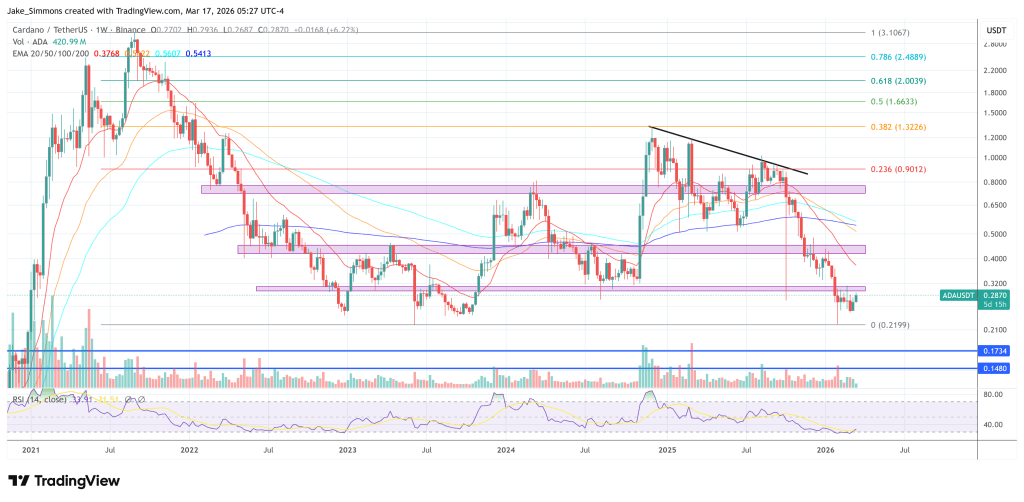
ADA hovers below key resistance, 1-week chart | Source: ADAUSDT on TradingView.com

Criptomoedas em alta

Perguntas relacionadas

QWhat is the Cardano founder praising in his recent post on X?

ACharles Hoskinson is praising the progress on ShieldUSD, a privacy-preserving stablecoin, as a significant milestone for the Midnight development platform.

QAccording to the article, what is a core design principle of the Midnight network?

AA core design principle of the Midnight network is selective disclosure, which allows builders to prove compliance without exposing all the underlying on-chain data.

QWhich companies are co-issuing the shieldUSD stablecoin?

AThe shieldUSD stablecoin is being co-issued by Moneta Digital and Norwegian Block Exchange (NBX).

QIn what environment was the minimum-viable shieldUSD contract deployed?

AThe minimum-viable shieldUSD contract was deployed to the Midnight preview environment, which is a development stage for testing, not a live production venue.

QHow does the article describe the broader significance of ShieldUSD for Midnight?

AThe article describes ShieldUSD as a bellwether for Midnight's growing utility and a key project intended to bring privacy-preserving finance into practical use for real-world financial workflows.

Leituras Relacionadas

Misjudged A-Shares: Resilience, Expectations, and Confidence

China's A-share market recently faced selling pressure, especially in tech sectors, initially triggered by a global tech sell-off that began in South Korea. However, the article argues this is a case of "mistaken injury" and highlights the market's underlying resilience. This resilience stems from three main pillars: **1) Tech Sector Fundamentals:** Unlike Korea's market dominated by a few memory chip stocks, China's tech sector is diversified across computing, communications, electronics, and semiconductors, supported by dual narratives of global AI supply chains and domestic substitution. Core areas like optical modules and fiber optics continue to show strong earnings growth. **2) "National Team" Support:** State-backed institutions and large corporations have made significant market purchases and announced buybacks, providing liquidity and signaling confidence. This is seen as a stabilizing policy signal, often associated with market bottoms. **3) Broader Market Pillars:** Other major sectors are showing endogenous recovery momentum. Consumer stocks benefit from stabilizing CPI and signs of sector recovery (e.g., liquor price hikes). Cyclical sectors like aluminum have high earnings, potential price increases due to tight supply, and low valuations. The financial sector offers stable dividends and low valuations. The conclusion is that the sell-off was driven by external contagion, not a collapse in fundamentals. With strong policy support and recovering momentum across key sectors, the A-share market possesses the toughness to regain stability.

marsbitHá 26m

Misjudged A-Shares: Resilience, Expectations, and Confidence

marsbitHá 26m

The Clarity Act's Journey Through Congress: The Thorny Path of Bipartisan Compromise in the U.S.

The U.S. Congress is struggling to advance the crypto market structure bill known as the Clarity Act, with bipartisan compromise proving difficult. Key hurdles include unresolved disputes over "yield" products and, more critically, the inclusion of strong ethics provisions for elected officials—a non-negotiable demand for many Democrats. While a compromise on yield was reached in May, securing only limited Democratic support in committee, the separate Senate Agriculture Committee version later passed with no Democratic votes due to the ethics impasse. As Republicans push for a full Senate vote in July, demands for ethics rules have expanded, and other contentious issues like developer protections and concerns from law enforcement and large banks further complicate negotiations. Despite consensus on the need for legislation, the path forward is unclear. Recent discussions between senators and White House officials aim to find acceptable ethics language. Some lawmakers question whether a compromise text can garner enough bipartisan support, with one Democrat stating the current proposal lacks the strong ethics provisions required for their vote. Potential short-term goals for the crypto community include symbolic Senate action before the August recess, a longer-term aim for passage by 2026, or establishing a detailed framework that addresses ethics and other compromises. The process remains arduous, relying on the traditional, vote-by-vote effort to build bipartisan support.

marsbitHá 45m

The Clarity Act's Journey Through Congress: The Thorny Path of Bipartisan Compromise in the U.S.

marsbitHá 45m

Are Kalshi and Polymarket Founders at Odds? This Business Rivalry Is More Brutal Than You Think

"The Rivalry Between Kalshi and Polymarket Founders Turns Bitter and Litigious" The intense feud between Tarek Mansour, CEO of Kalshi, and Shayne Coplan, founder of Polymarket, has escalated far beyond typical business competition into personal animosity and regulatory battles. Both lead billion-dollar prediction market platforms, but their approaches differ sharply. Kalshi positions itself as the compliant operator, securing U.S. regulatory approval before launching. In contrast, Polymarket initially operated offshore, allowing U.S. users to access its platform via VPN, which drew regulatory scrutiny. The conflict reached a peak in November 2024 when FBI agents raided Coplan's New York apartment. While Coplan publicly blamed political motives, his team privately suspected Kalshi was involved. According to sources, Kalshi's lawyers had previously reported Polymarket's operations to federal prosecutors, highlighting its accessibility to U.S. users despite a ban. This incident fueled mutual accusations and underhanded tactics, including social media smear campaigns and attempts to sabotage each other's major business deals. Their rivalry also played out in Washington, influencing regulatory debates. Kalshi actively lobbied against Polymarket's practices, framing them as illegal and unethical. Polymarket, after facing a CFTC fine and investigation, later acquired a licensed U.S. firm to launch a domestic app, regaining a foothold. Despite the hostility, both companies have seen massive growth, with combined trading volumes soaring. However, increased regulatory scrutiny, particularly around insider trading on Polymarket's platform, continues to pose challenges. The founders' deep-seated mutual disdain ensures their battle for market dominance remains as much a personal vendetta as a commercial one.

marsbitHá 54m

Are Kalshi and Polymarket Founders at Odds? This Business Rivalry Is More Brutal Than You Think

marsbitHá 54m

Trading

Spot

Artigos em Destaque

Como comprar ADA

Bem-vindo à HTX.com!Tornámos a compra de Cardano (ADA) simples e conveniente.Segue o nosso guia passo a passo para iniciar a tua jornada no mundo das criptos.Passo 1: cria a tua conta HTXUtiliza o teu e-mail ou número de telefone para te inscreveres numa conta gratuita na HTX.Desfruta de um processo de inscrição sem complicações e desbloqueia todas as funcionalidades.Obter a minha contaPasso 2: vai para Comprar Cripto e escolhe o teu método de pagamentoCartão de crédito/débito: usa o teu visa ou mastercard para comprar Cardano (ADA) instantaneamente.Saldo: usa os fundos da tua conta HTX para transacionar sem problemas.Terceiros: adicionamos métodos de pagamento populares, como Google Pay e Apple Pay, para aumentar a conveniência.P2P: transaciona diretamente com outros utilizadores na HTX.Mercado de balcão (OTC): oferecemos serviços personalizados e taxas de câmbio competitivas para os traders.Passo 3: armazena teu Cardano (ADA)Depois de comprar o teu Cardano (ADA), armazena-o na tua conta HTX.Alternativamente, podes enviá-lo para outro lugar através de transferência blockchain ou usá-lo para transacionar outras criptomoedas.Passo 4: transaciona Cardano (ADA)Transaciona facilmente Cardano (ADA) no mercado à vista da HTX.Acede simplesmente à tua conta, seleciona o teu par de trading, executa as tuas transações e monitoriza em tempo real.Oferecemos uma experiência de fácil utilização tanto para principiantes como para traders experientes.

1.3k Visualizações TotaisPublicado em {updateTime}Atualizado em 2026.06.02

Como comprar ADA

Discussões

Bem-vindo à Comunidade HTX. Aqui, pode manter-se informado sobre os mais recentes desenvolvimentos da plataforma e obter acesso a análises profissionais de mercado. As opiniões dos utilizadores sobre o preço de ADA (ADA) são apresentadas abaixo.

活动图片