Cardano Founder Hoskinson Says Midnight Mainnet Is Now Live

bitcoinistPublicado em 2026-04-01Última atualização em 2026-04-01

Resumo

Cardano founder Charles Hoskinson announced the mainnet launch of Midnight, a privacy-focused blockchain within the Cardano ecosystem. The network, which has already produced over 163,000 blocks, is currently in a controlled "guarded era" with federated node operators ensuring stability. It features programmable privacy through zero-knowledge proofs, allowing selective data sharing. The ecosystem uses a dual-token model: NIGHT for governance and DUST for renewable transaction fees. Institutional partners include Worldpay, Google Cloud, and eToro. Hoskinson also released a free book on zero-knowledge proofs and confirmed upcoming Lace wallet updates.

Cardano founder Charles Hoskinson said Monday that Midnight is now live, marking the mainnet debut of the privacy-focused network that has been one of the highest-profile infrastructure bets tied to the broader Cardano ecosystem. In his March 30 livestream, Hoskinson said the chain had already been running for a while, with average block times holding at roughly six seconds, more than 163,000 blocks produced, and a finality gap of about two blocks.

Midnight Launch Marks Major Cardano Ecosystem Milestone

The launch itself was formally announced by Midnight via X. The project said the genesis block had been produced and that developers, partners and institutions would now be able to deploy applications and migrate assets onto the network. The release lands on the timeline the team had previously outlined in February, when Midnight said mainnet was scheduled for late March 2026. It also follows the December 2025 launch of NIGHT, the network’s native token, on Cardano.

Hoskinson framed the current phase as a controlled production launch rather than an instant jump to open decentralization. He described Midnight as being in a “guarded era,” with a strong federated network and an active post-launch bug-fix queue already numbering more than 130 items. None, he said, were showstoppers, but the team expects to spend the next two to three weeks hardening the system while partners and developers begin building against a live environment.

That characterization matches Midnight’s official rollout plan. The foundation said the network is entering production through a phased application deployment period designed to prioritize operational stability and security before later stages of decentralization. In this initial setup, federated node operators run the core infrastructure under explicit participation rules, with the longer-term goal of progressing toward a more decentralized and permissionless model.

Midnight’s launch post highlights a roster of federated node partners that includes Worldpay, Bullish, MoneyGram, Pairpoint by Vodafone, eToro, AlphaTON Capital, Google Cloud, Blockdaemon and Shielded Technologies. That institutional mix is central to Midnight’s pitch: a privacy-preserving public blockchain intended to support live applications without asking enterprises to accept the data exposure typical of fully transparent ledgers.

Midnight’s technical proposition is built around programmable privacy. According to the project’s launch materials, the network combines public and private data through a hybrid ledger architecture, uses client-side generation of zero-knowledge proofs so sensitive data remains on user devices, and supports both shielded and unshielded assets depending on the application’s needs. The protocol also supports selective disclosure, allowing counterparties, auditors or regulators to view specific records when application logic requires it, without exposing all underlying transaction data by default.

Economically, Midnight is also trying to differentiate itself from conventional gas-token networks. The chain uses a dual-component model in which NIGHT acts as the unshielded governance and utility token, while DUST functions as the renewable transaction resource consumed by applications. Midnight says DUST regenerates over time based on NIGHT holdings, with a full recharge reached over seven days, a design meant to make transaction costs more predictable for businesses and allow developers to subsidize usage for end users.

Hoskinson used the livestream to pair the launch announcement with a broader educational push. He said he has published a free book, Proving Nothing: A Complete Guide to Zero-Knowledge Proof Systems, aimed at non-technical readers who want a comprehensive overview of how ZK systems work.

On the product side, Hoskinson said Lace would receive an update tied to Midnight mainnet support, with version 136.2 already submitted for approval at the browser extension store. He added that Lace v2 and a mobile release are both expected in April.

At press time, Cardano traded at $0.24.
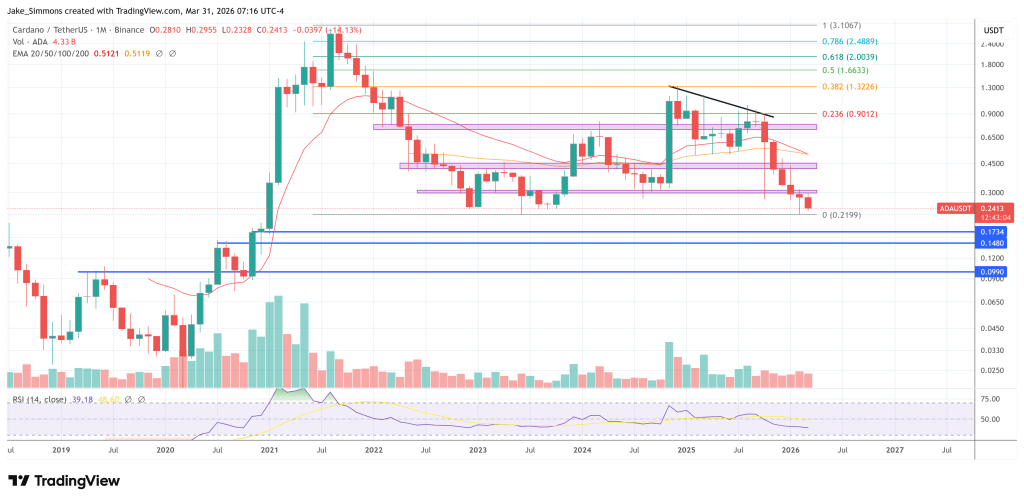
Cardano hovers below key resistance, 1-monthly chart | Source: ADAUSDT on TradingView.com

Perguntas relacionadas

QWhat is the significance of the mainnet launch for Midnight, as announced by Charles Hoskinson?

AThe mainnet launch marks the debut of the privacy-focused network Midnight, a high-profile infrastructure project within the Cardano ecosystem, and represents a major milestone for the broader Cardano ecosystem.

QHow does Midnight's initial 'guarded era' phase operate, according to the announcement?

AIn the initial 'guarded era,' Midnight operates with a strong federated network of node operators under explicit participation rules, prioritizing operational stability and security. This controlled production phase includes an active bug-fix queue and is designed to harden the system before progressing toward a more decentralized model.

QWhat key technical feature does Midnight use to ensure privacy for its users?

AMidnight uses a hybrid ledger architecture that combines public and private data, employs client-side generation of zero-knowledge proofs to keep sensitive data on user devices, and supports selective disclosure for authorized viewing of specific records without exposing all transaction data.

QWhat is the economic model of Midnight, and how does it differ from conventional blockchain networks?

AMidnight uses a dual-token model: NIGHT acts as the unshielded governance and utility token, while DUST functions as a renewable transaction resource that regenerates over time based on NIGHT holdings. This design aims to make transaction costs more predictable and allow developers to subsidize end-user usage, differentiating it from conventional gas-token networks.

QWhat did Charles Hoskinson announce alongside the mainnet launch to support broader education on the technology?

ACharles Hoskinson announced the publication of a free book titled 'Proving Nothing: A Complete Guide to Zero-Knowledge Proof Systems,' aimed at providing a comprehensive overview of ZK systems for non-technical readers.

Leituras Relacionadas

Who Funds the Agents?

**Summary: Who Funds AI Agents?** OpenAI recently shut down a feature allowing AI agents to shop for users, highlighting the challenge of creating a secure and regulated environment for agent-driven transactions. While payment infrastructure exists, a crucial governance layer—defining spending limits, fraud detection, tax handling, and return policies—is largely missing. The potential is enormous: AI agents already processed $73M across 176M transactions last year, with McKinsey forecasting this could grow to $3-5T in global consumer commerce by 2030. The core competition isn't just about processing payments, which can be very cheap (especially with crypto-based settlement), but about controlling the rules that govern agent spending. Key players like Stripe and Coinbase are racing to dominate this governance layer. Stripe's acquisition of wallet provider Privy allows it to set spending policies, identity checks, and human-in-the-loop approvals directly at the wallet level. Similarly, Coinbase's stack, including its x402 protocol and AgentKit, embeds governance rules. This vertical integration across settlement, wallet, and governance layers is becoming the dominant strategy. Control over the governance layer is where significant future value lies. If agents handle trillions in transactions, even a small fee for managing compliance, fraud prevention, and policy enforcement could generate billions in annual revenue. The companies that successfully integrate across the payment stack will capture value from idle agent balances, transaction fees, and governance services, positioning themselves as the foundational banks of the AI agent economy.

marsbitHá 1m

Who Funds the Agents?

marsbitHá 1m

A Nation Blocks Chips, a Giant Buys a Nuclear Power Plant: Why It's Time to Seriously Consider DeAI

**Title: Great Powers Blockade Chips, Giants Buy Nuclear Plants: Why It's Time to Seriously Consider DeAI** In May 2026, the US closed loopholes for Chinese firms to acquire advanced NVIDIA chips via overseas subsidiaries. That same month, Kenya halted a $1B geothermal data center project involving Microsoft, fearing its immense energy consumption. Meanwhile, Huawei announced mass production of its Ascend AI chip. These disparate events underscore a new reality: the competition for computing power ("compute") has escalated beyond the tech industry, becoming a geopolitical and infrastructural battleground. A new era of oligopoly is forming, with control over the AI stack—from GPU chips (NVIDIA) and cloud platforms (AWS, Azure, Google Cloud) to foundational models (OpenAI, Anthropic)—concentrating in a few Western "AI Octopus" corporations. This centralization creates systemic risks: pricing power and platform lock-in for users, infrastructure fragility, and a widening "compute divide" that threatens to marginalize nations without independent AI capacity. An "AI Iron Curtain" is deepening through export controls. In response, some nations like Saudi Arabia and the UAE are investing heavily to buy compute power, aiming to transition from oil to AI economies. The EU seeks to triple its compute capacity by 2030 to reduce dependency. However, the spending gap is vast, with four US tech giants alone planning ~$750B in AI capex for 2026. The race is increasingly constrained by energy, with AI tasks consuming up to 1000x more power than web searches, pushing firms to even acquire nuclear plants. This landscape is fueling interest in Decentralized AI (DeAI). It proposes a third way: using open protocols to coordinate a global network of idle GPUs, independent developers, and data centers, creating an AI infrastructure without a single controlling entity. Leveraging blockchain and cryptographic verification, DeAI aims to break market concentration, disperse energy demands, reduce geopolitical dependencies, and enhance transparency. While still nascent in performance and stability, DeAI's core promise is not immediate superiority but providing a crucial alternative architecture to resist monopoly, censorship, and centralized power. As specialized AI hardware costs fall and open-source models flourish, the window to build this foundation is open. The very existence of such competition serves as a vital check against the inevitable abuse of concentrated power.

marsbitHá 55m

A Nation Blocks Chips, a Giant Buys a Nuclear Power Plant: Why It's Time to Seriously Consider DeAI

marsbitHá 55m

Outpoll Review: A Prediction Market Platform Built for Active Traders

Outpoll Review: A Prediction Market Platform Built for Active Traders In recent years, prediction markets have grown from a niche sector to a mainstream arena, attracting billions in trading volume and institutional capital. However, the user experience and tools for traders have not kept pace. Outpoll, a new global prediction market platform, aims to fill this gap by providing enhanced trading infrastructure for active and professional traders. Built on standard prediction market principles, Outpoll allows users to trade on the outcome of specific events. It uses fully collateralized contracts with USDC settlement, charges a competitive 0.1% fee per trade, and provides clear settlement rules upfront to minimize disputes. A key focus for Outpoll is its professional-grade trading tools. The platform supports limit and market orders, as well as take-profit and stop-loss orders for open positions—features uncommon in prediction markets. For automated trading, Outpoll offers comprehensive REST and WebSocket APIs, enabling portfolio management, price arbitrage, and integration with existing tools. The platform also features a creator-led market model, where approved experts and community leaders can create and manage markets for niche topics under platform supervision. Its integrated interface combines news feeds directly with trading functions, allowing users to monitor events and manage positions seamlessly. Outpoll launched with a native Android app (available on Google Play) and plans an iOS version later this year. In summary, Outpoll distinguishes itself with trader-focused tools, practical APIs, transparent and collateralized markets, integrated news, and an expanding creator program. For active traders, its advanced order types and API access alone make it a platform worth watching. Outpoll is now globally accessible via outpoll.com and Google Play.

marsbitHá 1h

Outpoll Review: A Prediction Market Platform Built for Active Traders

marsbitHá 1h

Trading

Spot
Futuros

Artigos em Destaque

Como comprar ADA

Bem-vindo à HTX.com!Tornámos a compra de Cardano (ADA) simples e conveniente.Segue o nosso guia passo a passo para iniciar a tua jornada no mundo das criptos.Passo 1: cria a tua conta HTXUtiliza o teu e-mail ou número de telefone para te inscreveres numa conta gratuita na HTX.Desfruta de um processo de inscrição sem complicações e desbloqueia todas as funcionalidades.Obter a minha contaPasso 2: vai para Comprar Cripto e escolhe o teu método de pagamentoCartão de crédito/débito: usa o teu visa ou mastercard para comprar Cardano (ADA) instantaneamente.Saldo: usa os fundos da tua conta HTX para transacionar sem problemas.Terceiros: adicionamos métodos de pagamento populares, como Google Pay e Apple Pay, para aumentar a conveniência.P2P: transaciona diretamente com outros utilizadores na HTX.Mercado de balcão (OTC): oferecemos serviços personalizados e taxas de câmbio competitivas para os traders.Passo 3: armazena teu Cardano (ADA)Depois de comprar o teu Cardano (ADA), armazena-o na tua conta HTX.Alternativamente, podes enviá-lo para outro lugar através de transferência blockchain ou usá-lo para transacionar outras criptomoedas.Passo 4: transaciona Cardano (ADA)Transaciona facilmente Cardano (ADA) no mercado à vista da HTX.Acede simplesmente à tua conta, seleciona o teu par de trading, executa as tuas transações e monitoriza em tempo real.Oferecemos uma experiência de fácil utilização tanto para principiantes como para traders experientes.

1.2k Visualizações TotaisPublicado em {updateTime}Atualizado em 2026.06.02

Como comprar ADA

Discussões

Bem-vindo à Comunidade HTX. Aqui, pode manter-se informado sobre os mais recentes desenvolvimentos da plataforma e obter acesso a análises profissionais de mercado. As opiniões dos utilizadores sobre o preço de ADA (ADA) são apresentadas abaixo.

活动图片