Cardano Founder Hoskinson Just Released A Free Book On Zero-Knowledge

bitcoinistPublicado em 2026-03-30Última atualização em 2026-03-30

Resumo

Cardano founder Charles Hoskinson has released a free, 357-page book titled "Proving Nothing: A Layered Guide to Zero-Knowledge Proof Systems" under a Creative Commons license. Designed as a non-technical introduction, the book uses a seven-layer framework to explain ZK systems, covering topics from cryptography and proof systems to private smart contracts and zkVMs. Hoskinson stated the project aims to address the low understanding of ZK technology and also serves as an introduction to Midnight, Cardano’s privacy-focused network. The book is intended to be a living document, with plans to update it as Midnight develops and new advancements emerge.

Cardano founder Charles Hoskinson has released a free book aimed at explaining zero-knowledge systems to a broader crypto audience, framing it as both an educational project and an on-ramp into Midnight, Cardano’s privacy-focused network. The linked GitHub repository shows the work is being published under a Creative Commons Attribution 4.0 license, while the latest public release is now titled Proving Nothing: A Layered Guide to Zero-Knowledge Proof Systems.

Cardano Founder Drops Free 337-Page ZK Book

In a March 27 livestream, Hoskinson said the project grew out of what he described as a “shockingly low level of understanding” around zero-knowledge proofs and ZK cryptography. “So I wrote a 337 page book over the last few months,” he said. He described it as a non-technical manual, though one that still contains a significant amount of technical material, built around a seven-layer framework for understanding how ZK systems are designed from setup and languages down to proof systems, cryptography, and the verification environment.

That structure is central to the pitch. The Cardano founder said the framework is meant to help readers “understand all ZK systems from that lens,” then move upward into adjacent privacy-enhancing technologies and, eventually, Midnight itself. The repository’s README makes the same case in more formal language, describing the book as a guide to “the entire zero-knowledge stack from the ground up” and arguing that ZK systems do not remove trust so much as decompose it into smaller, testable pieces.

The Midnight angle is not incidental. Hoskinson explicitly presented the book as “a good way of introducing Midnight to people,” and said one chapter is dedicated to the network, even if the broader work is designed as a general introduction to zero-knowledge.

He also said the book goes beyond the seven-layer model into private smart contracts, the Aleo-linked ZEXE model, Midnight’s Kachina system, zkVMs, STARK-to-SNARK pipelines, and the wider market landscape for privacy and proof systems.

That scope has already expanded since the version Hoskinson described on video. The GitHub release notes for v1.10, published on March 30, show the book was renamed from The Seven-Layer Magic Trick to Proving Nothing, and now ships in both EPUB and PDF formats. The file inventory in that release lists a 357-page dark-mode PDF, while the chapter notes show edits and additions across 14 chapters, including sections on zkVMs, market structure, eIDAS 2.0, rollups, and a more detailed Midnight case study.

Hoskinson also made clear that this is not a static publication. “This is the first edition, version 1.01,” he said in the livestream. “I’ll keep adding and changing and work on it throughout the weekends as more things come up and as more stuff in Midnight gets launched, I’ll add to this.” That matters because the book appears designed less as a one-off manifesto than as a living educational document tied to Midnight’s rollout and the broader commercialization of privacy tech.

At press time, Cardano traded at $0.2468.
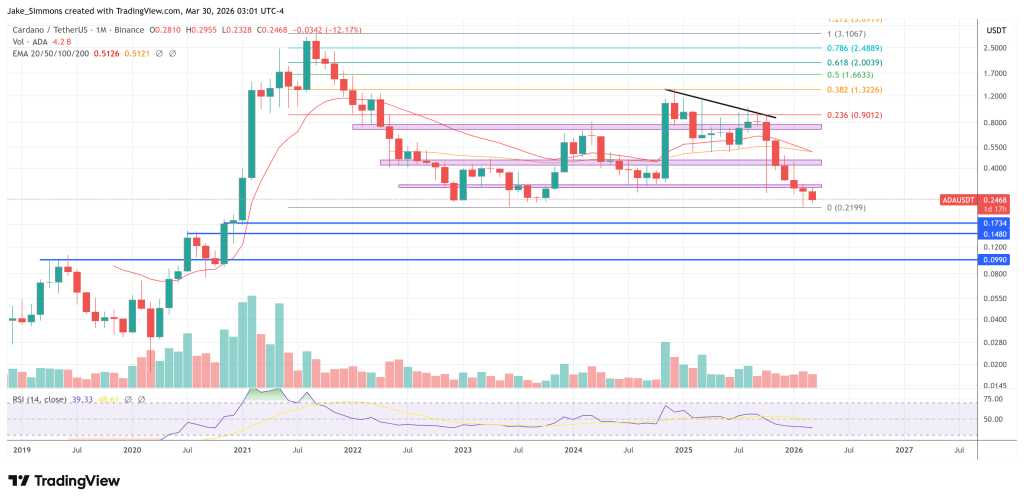
Cardano hovers below key resistance, 1-monthly chart | Source: ADAUSDT on TradingView.com

Criptomoedas em alta

Perguntas relacionadas

QWho is the author of the free book on zero-knowledge systems and what is the book's title?

AThe author is Charles Hoskinson, the founder of Cardano, and the book is titled 'Proving Nothing: A Layered Guide to Zero-Knowledge Proof Systems'.

QWhat was the primary motivation for Charles Hoskinson to write this book?

AHe was motivated by what he described as a 'shockingly low level of understanding' around zero-knowledge proofs and ZK cryptography, aiming to provide an educational resource for a broader audience.

QHow is the book structured to help readers understand zero-knowledge systems?

AThe book is built around a seven-layer framework that explains how ZK systems are designed, from setup and languages down to proof systems, cryptography, and the verification environment.

QWhat is the connection between this book and the Midnight network?

AThe book is framed as an educational on-ramp into Midnight, Cardano's privacy-focused network, with one chapter dedicated to it and the broader work designed to introduce people to the technology behind it.

QIs the book a static publication, and what is its current version and format?

ANo, it is a living document that will be updated. The current version at the time of the article is v1.10, and it is available in both EPUB and PDF formats.

Leituras Relacionadas

In-depth: The Foreign Guest Genspark

The article "The Foreign Guest: Genspark" investigates the identity and business practices of AI startup Genspark, which presents itself as a Palo Alto-based "AI Costco" offering a subscription bundle of over 70 models and numerous AI agent tools. Despite its official Silicon Valley narrative, Genspark's founding team has deep roots in Chinese tech giant Baidu, a history systematically downplayed in its branding. The company actively cultivates an image as an elite US firm, heavily publicizing partnerships and endorsements from OpenAI, Anthropic, and Microsoft, while distancing itself from the Chinese AI community and obscuring its connections to Chinese investors and open-weight models (like those from DeepSeek, Moonshot AI, and MiniMax) that power its services. Genspark's core strategy involves rapidly cloning and integrating successful AI product concepts (e.g., from Perplexity, Manus, Plaud) into its unified platform, supported by aggressive marketing, including Super Bowl ads and paid native content in publications like The Wall Street Journal. Critically, the article suggests a significant portion of its engineering and product development is conducted by a team in Beijing, operating outside its official US corporate structure. This duality allows Genspark to leverage Chinese talent and models for efficiency and cost reduction while constructing a public facade as a purely American success story. The piece concludes that Genspark's most effective agent is its own corporate identity, meticulously engineered to obscure its Chinese underpinnings and be perceived solely as a Silicon Valley company.

marsbitHá 40m

In-depth: The Foreign Guest Genspark

marsbitHá 40m

Debate: Korean Workers Fear Unemployment, While Musk Envisions a Society 'Without Work'?

While South Korean auto workers fear job losses from robotics, Elon Musk envisions a future where AI and robots render most work optional. This article explores the growing tension between immediate anxieties over automation and long-term visions of a post-work society. The piece begins with recent strikes at Hyundai's Korean plants, where unions, amid standard wage negotiations, also sought job guarantees against advancing robotics—specifically mentioning Boston Dynamics' Atlas. This reflects how anxiety about technological displacement is emerging even before robots are fully capable of replacing skilled labor on assembly lines. The author argues that while current robotics still struggle with the nuanced, experiential knowledge of veteran workers, the *perception* of imminent replacement is fueling social conflict prematurely. This modern "Luddite" sentiment is compared to the 19th-century English textile workers who smashed machines. Historically, Luddites weren't simply anti-technology; they were protesting the rapid devaluation of their skills and the unequal distribution of productivity gains. Similarly, today's workers ask who will bear the cost of transition and share in the new wealth created by machines. In contrast, figures like Elon Musk propose an optimistic endpoint: with AI and robotics driving extreme abundance, the link between work and survival could break. He suggests concepts like "Universal High Income" could allow society to share the technological bounty, transforming work from a necessity into a choice. The core challenge, however, lies in the transition. The author notes that technology's benefits diffuse slowly, while its disruptive costs—job losses, skill obsolescence—can be concentrated and immediate. The risk is a painful interim period where productivity gains are captured by a few before new social contracts, safety nets, and retraining systems are established. The conclusion calls for proactive governance. Just as past industrial revolutions gave rise to labor standards and social safety nets, the robotics era needs its own frameworks. These should address job transition support, distribution of productivity gains, safety liability, and ethical deployment. Embracing such "constraints" is not opposition to progress but a necessary step to ensure technology benefits society broadly. The discussion sparked by Hyundai's workers, therefore, is not premature but essential.

marsbitHá 53m

Debate: Korean Workers Fear Unemployment, While Musk Envisions a Society 'Without Work'?

marsbitHá 53m

Trading

Spot

Artigos em Destaque

Como comprar ADA

Bem-vindo à HTX.com!Tornámos a compra de Cardano (ADA) simples e conveniente.Segue o nosso guia passo a passo para iniciar a tua jornada no mundo das criptos.Passo 1: cria a tua conta HTXUtiliza o teu e-mail ou número de telefone para te inscreveres numa conta gratuita na HTX.Desfruta de um processo de inscrição sem complicações e desbloqueia todas as funcionalidades.Obter a minha contaPasso 2: vai para Comprar Cripto e escolhe o teu método de pagamentoCartão de crédito/débito: usa o teu visa ou mastercard para comprar Cardano (ADA) instantaneamente.Saldo: usa os fundos da tua conta HTX para transacionar sem problemas.Terceiros: adicionamos métodos de pagamento populares, como Google Pay e Apple Pay, para aumentar a conveniência.P2P: transaciona diretamente com outros utilizadores na HTX.Mercado de balcão (OTC): oferecemos serviços personalizados e taxas de câmbio competitivas para os traders.Passo 3: armazena teu Cardano (ADA)Depois de comprar o teu Cardano (ADA), armazena-o na tua conta HTX.Alternativamente, podes enviá-lo para outro lugar através de transferência blockchain ou usá-lo para transacionar outras criptomoedas.Passo 4: transaciona Cardano (ADA)Transaciona facilmente Cardano (ADA) no mercado à vista da HTX.Acede simplesmente à tua conta, seleciona o teu par de trading, executa as tuas transações e monitoriza em tempo real.Oferecemos uma experiência de fácil utilização tanto para principiantes como para traders experientes.

1.4k Visualizações TotaisPublicado em {updateTime}Atualizado em 2026.06.02

Como comprar ADA

Discussões

Bem-vindo à Comunidade HTX. Aqui, pode manter-se informado sobre os mais recentes desenvolvimentos da plataforma e obter acesso a análises profissionais de mercado. As opiniões dos utilizadores sobre o preço de ADA (ADA) são apresentadas abaixo.

活动图片