Cardano Founder Hoskinson Accused Of Selling 1.5 Billion ADA In 2021 Rally

bitcoinistPublicado em 2026-06-10Última atualização em 2026-06-10

Resumo

Cardano founder Charles Hoskinson faces new allegations from NFT creator Masato Alexander, who claims on-chain tracing reveals large ADA transactions linked to Hoskinson during the 2021 rally. Alexander's analysis suggests a 925 million ADA transaction and nine 20 million ADA payments had a closer common ancestor to IOG's funds than previously known, reducing intermediary hops. He published transaction graphs but noted this traces funding paths, not proving control or sales. This follows prior claims Hoskinson used "genesis keys" to move ~318 million unclaimed ADA into reserves. Hoskinson and a Cardano report denied this, stating most vouchers were redeemed. Separately, Thomas Braziel raised governance questions using Isle of Man filings, inquiring about foundation control and fund allocation during Cardano's early ICO period. Both sets of claims revisit debates over Cardano's early allocation and governance transparency.

Cardano founder Charles Hoskinson is facing a new round of allegations after NFT creator Masato Alexander published additional on-chain tracing work tied to large ADA movements during the 2021 market rally. The claims add another layer to an already contentious debate over Cardano’s early allocation history, governance structure, and voucher redemption process.

Large Cardano Flows To IOG-Linked Pool Pledges

Alexander, who previously became a central figure in the Cardano ADA voucher controversy, said on X that IOG’s on-chain footprint extended beyond its original Genesis UTxO and included several stake pools operated over the years. According to him, those pools required owners and pledged ADA, creating additional paths for tracing funds through Cardano’s UTxO model.

“However, IOG had a larger onchain footprint than just their Genesis UTxO, they operated a number of stake pools over the years,” Alexander wrote. “Each pool requires an owner and pledge ADA to be put up.”

The latest allegation is framed around large ADA transactions that critics claim were linked to Hoskinson and occurred during the 2021 rally. Alexander said his updated tracing work shows that both a 925 million ADA transaction and nine 20 million ADA payments had a closer common ancestor than IOG’s original genesis ADA. In his telling, that reduces the number of intermediary hops between IOG and the transactions from roughly 40 to between one and seven transactions.

“Turns out both the 925m AND the x9 20m payments have a closer common ancestor than IOG’s genesis ADA, which cuts the # of intermediary hops between IOG and these Txs from ~40 to ~1 to 7 Txs,” Alexander wrote. “They gather up ~21 of the 64m ADA pledge’s from IOG’s private pools.”

Alexander also published a dedicated transaction graph and a broader report containing what he described as a hop-by-hop trace, an interactive flow graph, and raw identifiers linked to Cardanoscan. He presented the work cautiously, saying it was not a final adjudication of intent or legal responsibility.

“This is best effort attempt at looking into what transpired on chain, draw your own conclusions,” he wrote. “If you find any errors in the data or methodology, please feel free to reach out and i’ll update it.”

The distinction matters. The material cited by Alexander focuses on tracing transaction ancestry and common funding paths. It does not, on its own, prove who controlled every wallet, whether funds were sold on exchanges, or what contractual obligations may have applied. It does, however, revive questions about Cardano’s early distribution and the transparency of large ADA movements during one of the asset’s most significant bull-market periods.

Isle Of Man Filings Add Another Governance Question

Alexander’s renewed claims follow his earlier allegation that Hoskinson used Cardano “genesis keys” during the 2021 Allegra hard fork to alter or sweep old ICO and voucher-related UTxOs, moving roughly 318 million ADA into Cardano reserves or treasury rather than leaving them directly claimable by original voucher holders.

Hoskinson denied that allegation, saying IOG did not give itself hundreds of millions of unclaimed ADA and that most vouchers were eventually redeemed.

A later Cardano redemption transparency report said the allegations had “no basis.” According to the report, 99.2% of vouchers representing 99.7% of ADA sold through the voucher program were redeemed. It also stated that after Byron-era on-chain redemption ended, 390 vouchers representing 318 million ADA remained unredeemed and were swept into the reserve while a post-sweep redemption process continued.

The scrutiny is not limited to Alexander’s on-chain work. Thomas Braziel of 117 Partners separately said he had collected original Isle of Man filings related to Cardano’s earliest foundation structure. Braziel said the documents appeared to show an early foundation involving Hoskinson, Jeremy Wood, Ken Kodama, and a corporate services provider, while later filings showed Hoskinson serving as the foundation’s “Enforcer.”

Under Isle of Man foundation law, Braziel argued, an Enforcer is not simply a passive observer but a key oversight role meant to ensure that the council follows the foundation’s purposes and governing documents. He linked that question to the timing of Cardano’s ICO, which began in September 2015, before the Swiss Cardano Foundation was established in September 2016.

“The question is not whether development companies should be compensated,” Braziel wrote. “The question is: who negotiated those arrangements on behalf of ICO participants and the Isle of Man Foundation?”

Braziel said he was “not alleging wrongdoing” but asking for documentation on who controlled the Isle of Man Foundation, what happened to roughly 1,090 BTC historical materials indicate were allocated to it, how development agreements were negotiated, and what governance protections existed for ADA purchasers.

At press time, ADA traded at $0.16.
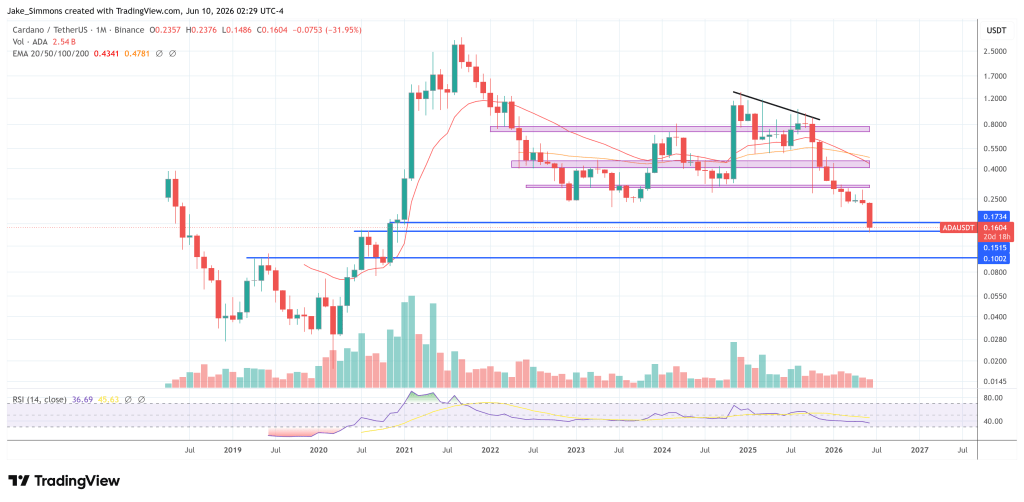
ADA hovers above key support, 1-month chart | Source: ADAUSDT on TradingView.com

Perguntas relacionadas

QWho published the on-chain tracing work that forms the basis of the new allegations against Charles Hoskinson?

AThe on-chain tracing work was published by NFT creator Masato Alexander.

QAccording to the article, what was the approximate total amount of ADA transactions that Alexander's tracing work focused on from the 2021 rally?

AThe tracing work focused on a 925 million ADA transaction and nine separate 20 million ADA payments, for an approximate total of 1.105 billion ADA.

QWhat does the article state was the outcome of the 318 million ADA in unredeemed vouchers after the Byron-era redemption ended?

AAccording to a later Cardano redemption transparency report cited in the article, the 318 million ADA from 390 unredeemed vouchers was swept into the Cardano reserve, while a post-sweep redemption process continued.

QWhat role in the early Isle of Man Foundation does Thomas Braziel claim Charles Hoskinson served, according to the filings he collected?

AThomas Braziel claims that later filings show Charles Hoskinson served as the "Enforcer" of the early Isle of Man Foundation.

QWhat is the core governance question Thomas Braziel raises based on the Isle of Man foundation documents and the timing of the ICO?

AThe core governance question he raises is: "who negotiated those arrangements [development agreements] on behalf of ICO participants and the Isle of Man Foundation?" given that the ICO began before the Swiss Cardano Foundation was established.

Leituras Relacionadas

The Value Distribution of Stablecoins

**Summary: The Value Distribution of Stablecoins** The article argues that stablecoins are evolving from mere trading tools into broader channels for dollar access. It divides the stablecoin ecosystem into four layers to analyze how value is distributed: 1. **Issuance Layer:** Mints stablecoins, holds reserve assets, and captures the spread between reserve yield and user costs (e.g., Tether, Circle). This layer currently earns the largest profit margin. 2. **Infrastructure Layer:** Connects stablecoins to the traditional financial system, handling fiat on/off-ramps, banking integration, compliance (KYC/AML), and asset management (e.g., Bridge, BVNK). This is the "unglamorous" but critical work, building the essential bridges between crypto and real-world finance. 3. **Acquiring/Distribution Layer:** Integrates stablecoins into merchant systems, manages payment flows, and provides enterprise financial software (e.g., Stripe, Coinbase). They act as the access point for businesses. 4. **Application Layer:** The end-users and businesses that ultimately use stablecoins for payments, settlements, or as a store of value. They benefit from convenience but have little pricing power. The core thesis is that while the issuance layer currently dominates profits, the often-overlooked **infrastructure layer holds significant long-term potential**. The real challenge and barrier to mass adoption is not the on-chain transfer of stablecoins (which is simple), but the complex "last mile" integration into existing business workflows, banking systems, and regulatory frameworks across different countries. Companies in this layer are currently in a "land grab" phase, investing heavily to build networks, secure bank partnerships, and establish compliance pathways. While their position is currently pressured by the profitable issuers above and distribution platforms below, the article suggests that if stablecoins become a default financial rail for businesses, the infrastructure providers who have done the hard work of integration will ultimately gain strong pricing power and become entrenched, essential players.

marsbitHá 1h

The Value Distribution of Stablecoins

marsbitHá 1h

The Value Distribution of Stablecoins

The Value Distribution of Stablecoins The article argues that stablecoins are evolving from a mere trading tool into a broad "dollar channel." It analyzes the industry's value chain through four layers: 1. **Issuance Layer (e.g., Tether, Circle):** The top layer that mints stablecoins, holds reserve assets, and captures the thickest interest rate spread. 2. **Infrastructure Layer (e.g., Bridge, BVNK):** Connects stablecoins to the traditional financial system, handling critical but complex "dirty work" like fiat on/off-ramps, banking integration, compliance (KYC/AML), and cross-border settlement. 3. **Acquiring/Distribution Layer (e.g., Stripe, Coinbase):** Embeds stablecoins into merchant systems, manages payment flows, and integrates with enterprise software. 4. **Application Layer:** End-users and businesses that ultimately use stablecoins for payments, settlement, or storing value. The author posits that while the issuance layer currently captures the most profit, the most overlooked and potentially critical layer is infrastructure. The core challenge for stablecoin adoption isn't the on-chain transfer (which is simple), but bridging the gap between blockchain and the real-world financial system. This involves solving practical problems for businesses: fiat conversion, reconciliation, tax handling, and user onboarding. Infrastructure companies are currently in a difficult "land-grab" phase—building networks, securing banking relationships, and achieving compliance country-by-country. They face pressure from both the profitable issuance layer above and distribution platforms below. However, the author suggests this layer is building a crucial moat. Once stablecoins become a default business rail, the infrastructure players who have done the hard work of integration may gain significant, durable value and pricing power.

链捕手Há 1h

The Value Distribution of Stablecoins

链捕手Há 1h

How to Do Research Well: Deliberately Practice the Real Skills That Matter

No one truly teaches you how to do research. You're often given a desk, a pre-selected problem, and vague instructions to "create something new." Consequently, many people reverse-engineer the job based on visible outputs—papers, posts, announcements—learning only how to *appear* like a researcher rather than how to *become* one. True research capability is built from stacking small, trainable skills, nearly all of which can be developed through deliberate practice. **Pick Your Own Problem:** Most researchers absorb problems from advisors or trends, lacking the underlying reasoning. Choosing a problem you genuinely care about, as John Schulman advises, leads to original work. Develop "taste" like a muscle: predict experiment outcomes, guess paper results from methods, and track which findings remain important over time. **Upgrade Your Inputs:** Relying on shared reading lists (arXiv hot lists, filtered group chats) leads to unoriginal conclusions. Undervalued old literature often holds crucial insights (e.g., MoE, LSTM, backpropagation). Richard Sutton's "The Bitter Lesson" or Claude Shannon's 1952 talk on creative thinking are more predictive than lengthy modern surveys. Breadth matters as much as depth: draw from neuroscience, mechanism design, hardware knowledge, and honest statistics. Read papers directly, especially appendices and limitations sections. **Write Everything Down:** As Paul Graham noted, writing exposes flaws in seemingly mature ideas. Writing is the cheapest defense against self-deception. Following Feynman's principle, Darwin programmatically wrote down facts contradicting his theory to combat memory bias. Maintain a detailed log of hypotheses, setups, predictions, results, and updated understandings. Reviewing past logs fosters essential humility.

marsbitHá 3h

How to Do Research Well: Deliberately Practice the Real Skills That Matter

marsbitHá 3h

Trading

Spot
Futuros

Artigos em Destaque

Como comprar ADA

Bem-vindo à HTX.com!Tornámos a compra de Cardano (ADA) simples e conveniente.Segue o nosso guia passo a passo para iniciar a tua jornada no mundo das criptos.Passo 1: cria a tua conta HTXUtiliza o teu e-mail ou número de telefone para te inscreveres numa conta gratuita na HTX.Desfruta de um processo de inscrição sem complicações e desbloqueia todas as funcionalidades.Obter a minha contaPasso 2: vai para Comprar Cripto e escolhe o teu método de pagamentoCartão de crédito/débito: usa o teu visa ou mastercard para comprar Cardano (ADA) instantaneamente.Saldo: usa os fundos da tua conta HTX para transacionar sem problemas.Terceiros: adicionamos métodos de pagamento populares, como Google Pay e Apple Pay, para aumentar a conveniência.P2P: transaciona diretamente com outros utilizadores na HTX.Mercado de balcão (OTC): oferecemos serviços personalizados e taxas de câmbio competitivas para os traders.Passo 3: armazena teu Cardano (ADA)Depois de comprar o teu Cardano (ADA), armazena-o na tua conta HTX.Alternativamente, podes enviá-lo para outro lugar através de transferência blockchain ou usá-lo para transacionar outras criptomoedas.Passo 4: transaciona Cardano (ADA)Transaciona facilmente Cardano (ADA) no mercado à vista da HTX.Acede simplesmente à tua conta, seleciona o teu par de trading, executa as tuas transações e monitoriza em tempo real.Oferecemos uma experiência de fácil utilização tanto para principiantes como para traders experientes.

1.3k Visualizações TotaisPublicado em {updateTime}Atualizado em 2026.06.02

Como comprar ADA

Discussões

Bem-vindo à Comunidade HTX. Aqui, pode manter-se informado sobre os mais recentes desenvolvimentos da plataforma e obter acesso a análises profissionais de mercado. As opiniões dos utilizadores sobre o preço de ADA (ADA) são apresentadas abaixo.

活动图片













