Cardano Approves Critical Integrations Budget In Key Governance Vote

bitcoinistPublicado em 2025-12-31Última atualização em 2025-12-31

Resumo

Cardano's governance body has approved the "Critical Integrations Budget Info Action" with strong support, a key step to fund and execute priority ecosystem integrations. The proposal received 6 out of 7 Constitutional Committee approvals and over 85% DRep support. This approval shifts focus to the Treasury Withdrawal Action, where the proposal moves from intent to on-chain execution. Two major integrations were confirmed under this framework: Pyth Network will provide real-time market data to support DeFi applications like lending and derivatives, while Dune will integrate Cardano data into a shared analytics platform for easier analysis and comparison. EMURGO emphasized that this governance milestone reflects strong ecosystem alignment and sets the stage for 2026 execution. The next critical test will be maintaining this support during the treasury withdrawal phase, transitioning consensus into actual spending.

Cardano’s governance process closed out 2025 with a tangible green light: the “Critical Integrations Budget Info Action” has been ratified, a step EMURGO framed as foundational to getting priority ecosystem integrations funded and executed.

In a post on X late Tuesday, EMURGO said the action cleared with “6 out of 7 Constitutional Committee approval and over 85% DRep support,” positioning the proposal to move into its next, more consequential phase. “With the BIA complete, focus now shifts to the Treasury Withdrawal Action,” EMURGO wrote. “This next step transitions the proposal from intent to execution which requires continued active review and support from the CC and DReps.”

Why This Is Crucial For Cardano

The distinction matters in Cardano’s post-Voltaire governance flow. The Budget Info Action signals alignment around scope and direction, while the Treasury Withdrawal Action is the point at which the ecosystem’s intent is translated into an on-chain withdrawal, meaning governance scrutiny typically intensifies as the discussion moves from principle to disbursement.

EMURGO also used the moment to emphasize that the process is already yielding concrete outputs under what it called the “Critical Integrations framework,” describing coordination across the “Pentad” that includes Input Output (IOG), the Cardano Foundation, EMURGO, Intersect, and the Midnight Foundation.

Two integrations were highlighted as already confirmed. The first is Pyth Network, which EMURGO described as “real time, institutional-grade market data coming to Cardano,” aimed at supporting DeFi primitives that depend on robust price feeds. EMURGO pointed to use cases including “lending, derivatives, stablecoins, and onchain risk management,” underscoring that oracle availability remains a gating factor for more complex on-chain markets.

The second is Dune, which EMURGO said will bring “Cardano data integrated into a shared analytics platform used across the industry,” making on-chain activity “easier to analyze, compare, and build on.” For builders and funds that already rely on common analytics tooling across ecosystems, the pitch is straightforward: lower friction for monitoring Cardano activity alongside other chains, and less bespoke infrastructure work to get dashboards, queries, and reporting into production.

EMURGO cast the vote outcome as an indicator of governance maturity and ecosystem alignment, explicitly thanking Constitutional Committee members and DReps for participation “even during the holiday period.” It also framed the timing as a setup for 2026 execution, writing that “this momentum reflects an ecosystem working together with a shared goal” and that Cardano is “positioned to enter 2026 stronger, more capable, and ready to support the next phase of ecosystem growth with these critical integrations in place.”

The near-term question now shifts to whether the Treasury Withdrawal Action maintains similar levels of support as the conversation moves from approvals to actual treasury spend, an inflection point that will test not just consensus, but the community’s appetite for follow-through on what “critical integrations” should look like in practice.

At press time, ADA traded at $0.351.
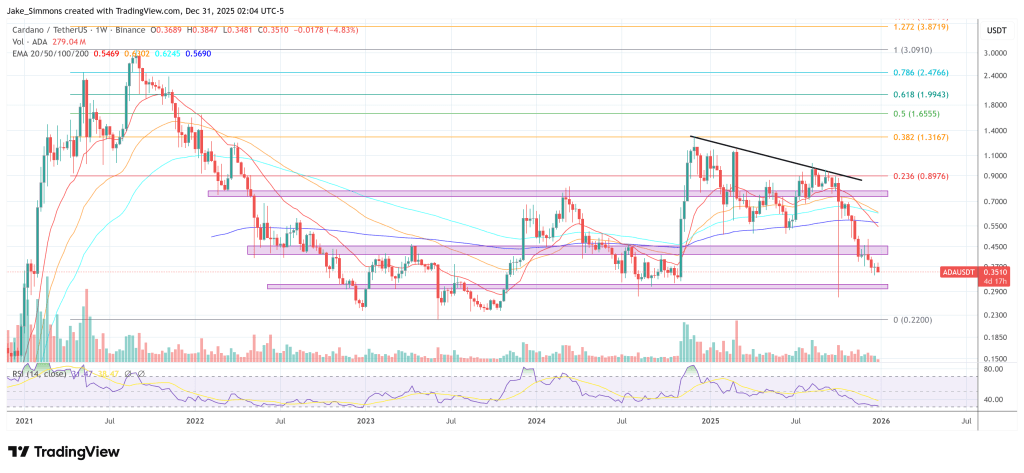
ADA fell below key support, 1-week chart | Source: ADAUSDT on TradingView.com

Criptomoedas em alta

Perguntas relacionadas

QWhat was the outcome of the Cardano governance vote on the 'Critical Integrations Budget Info Action'?

AThe 'Critical Integrations Budget Info Action' was ratified with 6 out of 7 Constitutional Committee approval and over 85% DRep support.

QAccording to EMURGO, what is the next step after the completion of the Budget Info Action?

AThe next step is the Treasury Withdrawal Action, which transitions the proposal from intent to execution and requires continued review and support from the Constitutional Committee and DReps.

QWhich two specific integrations were highlighted as already confirmed under the Critical Integrations framework?

AThe two confirmed integrations are Pyth Network, which will provide real-time market data to Cardano, and Dune, which will integrate Cardano data into a shared analytics platform.

QHow did EMURGO describe the significance of the vote outcome for Cardano's ecosystem?

AEMURGO described the vote outcome as an indicator of governance maturity and ecosystem alignment, positioning Cardano to enter 2026 stronger and more capable with these critical integrations in place.

QWhat is the key distinction between the Budget Info Action and the Treasury Withdrawal Action in Cardano's governance process?

AThe Budget Info Action signals alignment around scope and direction, while the Treasury Withdrawal Action is the ecosystem's intent translated into an on-chain withdrawal, where governance scrutiny typically intensifies.

Leituras Relacionadas

Global Stock Market's Storm Center: South Korea's Stock Market De-leveraging Is Largely Complete

Storm's Eye: South Korean Market De-leveraging Nears Completion The recent sharp correction in South Korean equities, with the KOSPI index dropping 32% from its June high, has been a key trigger for global tech stock volatility. The core driver was not a fundamental shift but a forced de-leveraging process within the market's unique structure, which is now largely complete. Two main leverage channels amplified the sell-off: 1. **Leveraged ETFs:** Their size, proportionally four times larger than in the U.S., peaked near $50 billion. Their mandatory daily rebalancing mechanism created a vicious cycle of "price drop → forced selling → further drop." Approximately 75% of this excess has been unwound, shrinking to $26 billion, with regulatory curbs now blocking new inflows. 2. **Hedge Fund Leverage:** Using swaps to magnify exposure, hedge funds saw their net long positioning fall by over 50% from peak levels. The most intense phase of this institutional de-leveraging is over. In contrast, **retail margin debt** poses minimal systemic risk. At 0.5% of market cap, it is far lower than in the U.S. or China, lacks automatic triggers, and is concentrated in smaller stocks. The conclusion: the high-leverage structures most prone to "chain-reaction selling" have been substantially cleared. The market is transitioning from a liquidity-driven crash to one priced more on fundamentals. The article argues that the AI trend—centered on Korean memory chips—remains intact. This episode represents a painful but necessary clearing of crowded trades, not the end of the AI revolution. For investors, the key question is conviction in the long-term AI direction; if the trend is real, current volatility is a cost of entry, not a terminal risk.

链捕手Há 1h

Global Stock Market's Storm Center: South Korea's Stock Market De-leveraging Is Largely Complete

链捕手Há 1h

Trading

Spot

Artigos em Destaque

Como comprar ADA

Bem-vindo à HTX.com!Tornámos a compra de Cardano (ADA) simples e conveniente.Segue o nosso guia passo a passo para iniciar a tua jornada no mundo das criptos.Passo 1: cria a tua conta HTXUtiliza o teu e-mail ou número de telefone para te inscreveres numa conta gratuita na HTX.Desfruta de um processo de inscrição sem complicações e desbloqueia todas as funcionalidades.Obter a minha contaPasso 2: vai para Comprar Cripto e escolhe o teu método de pagamentoCartão de crédito/débito: usa o teu visa ou mastercard para comprar Cardano (ADA) instantaneamente.Saldo: usa os fundos da tua conta HTX para transacionar sem problemas.Terceiros: adicionamos métodos de pagamento populares, como Google Pay e Apple Pay, para aumentar a conveniência.P2P: transaciona diretamente com outros utilizadores na HTX.Mercado de balcão (OTC): oferecemos serviços personalizados e taxas de câmbio competitivas para os traders.Passo 3: armazena teu Cardano (ADA)Depois de comprar o teu Cardano (ADA), armazena-o na tua conta HTX.Alternativamente, podes enviá-lo para outro lugar através de transferência blockchain ou usá-lo para transacionar outras criptomoedas.Passo 4: transaciona Cardano (ADA)Transaciona facilmente Cardano (ADA) no mercado à vista da HTX.Acede simplesmente à tua conta, seleciona o teu par de trading, executa as tuas transações e monitoriza em tempo real.Oferecemos uma experiência de fácil utilização tanto para principiantes como para traders experientes.

1.3k Visualizações TotaisPublicado em {updateTime}Atualizado em 2026.06.02

Como comprar ADA

Discussões

Bem-vindo à Comunidade HTX. Aqui, pode manter-se informado sobre os mais recentes desenvolvimentos da plataforma e obter acesso a análises profissionais de mercado. As opiniões dos utilizadores sobre o preço de ADA (ADA) são apresentadas abaixo.

活动图片













