Can KAITO sustain its 13% rally before $14.9mln token unlock?

ambcryptoPublicado em 2026-07-17Última atualização em 2026-07-17

Resumo

The KAITO token surged over 13% in 24 hours, extending its weekly gains beyond 25%. This rally was supported by significant market activity, with Open Interest (OI) hitting a yearly high of $70.88 million and daily trading volume soaring above $47 million. The price broke out of its previous consolidation range, confirming a bullish structure, but is now encountering resistance between $0.80 and $0.85. A key test for the rally's sustainability is an upcoming token unlock in three days, which will release 17.60 million KAITO tokens (worth approximately $14.93 million) into circulation, potentially creating selling pressure. While strong capital inflows and buying activity currently support the uptrend, the market's direction will depend on whether demand can absorb the increased supply.

Kaito [KAITO] gained more than 13% in 24 hours as trading activity accelerated. The rally pushed its weekly gains above 25%, extending the altcoin’s bullish structure.

However, an upcoming token unlock could test whether buyers have enough capital to sustain the move.

Why is trader interest rising?

Derivative traders showed the highest level of interest in the KAITO token this year, as the Open Interest (OI) reached $70.88 million. The OI surpassed the $60 million mark, which was hit at the start of the year and has been the highest all along.

When OI is rising alongside the price action, it indicates that more long positions are being stacked.
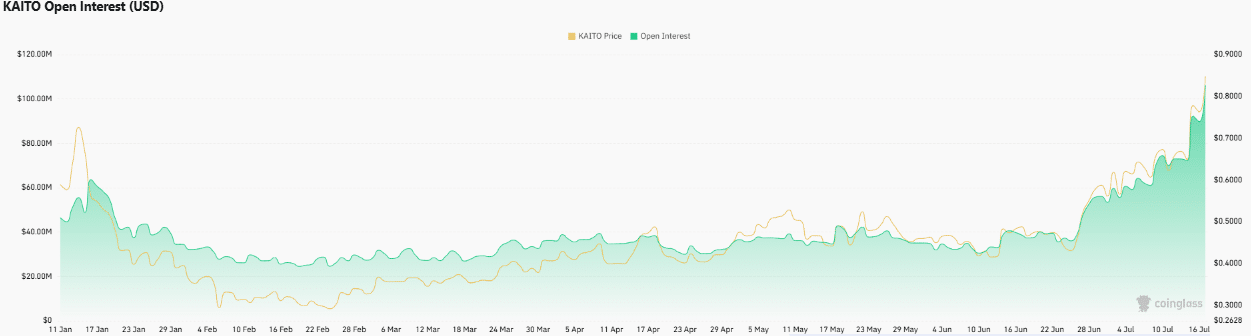
Source: CoinGlass

Additionally, daily trading volume more than tripled from $15 million on the 12th of July to above $47 million.

Token Terminal placed the weekly total slightly above $209 million. Its chart also showed steady growth over five consecutive days. Together, rising volume and Open Interest showed stronger market participation behind KAITO’s rally.
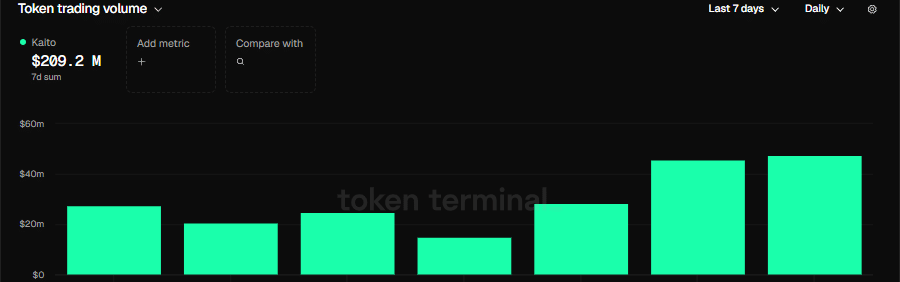
Source: Token Terminal

Can bulls clear $0.85?

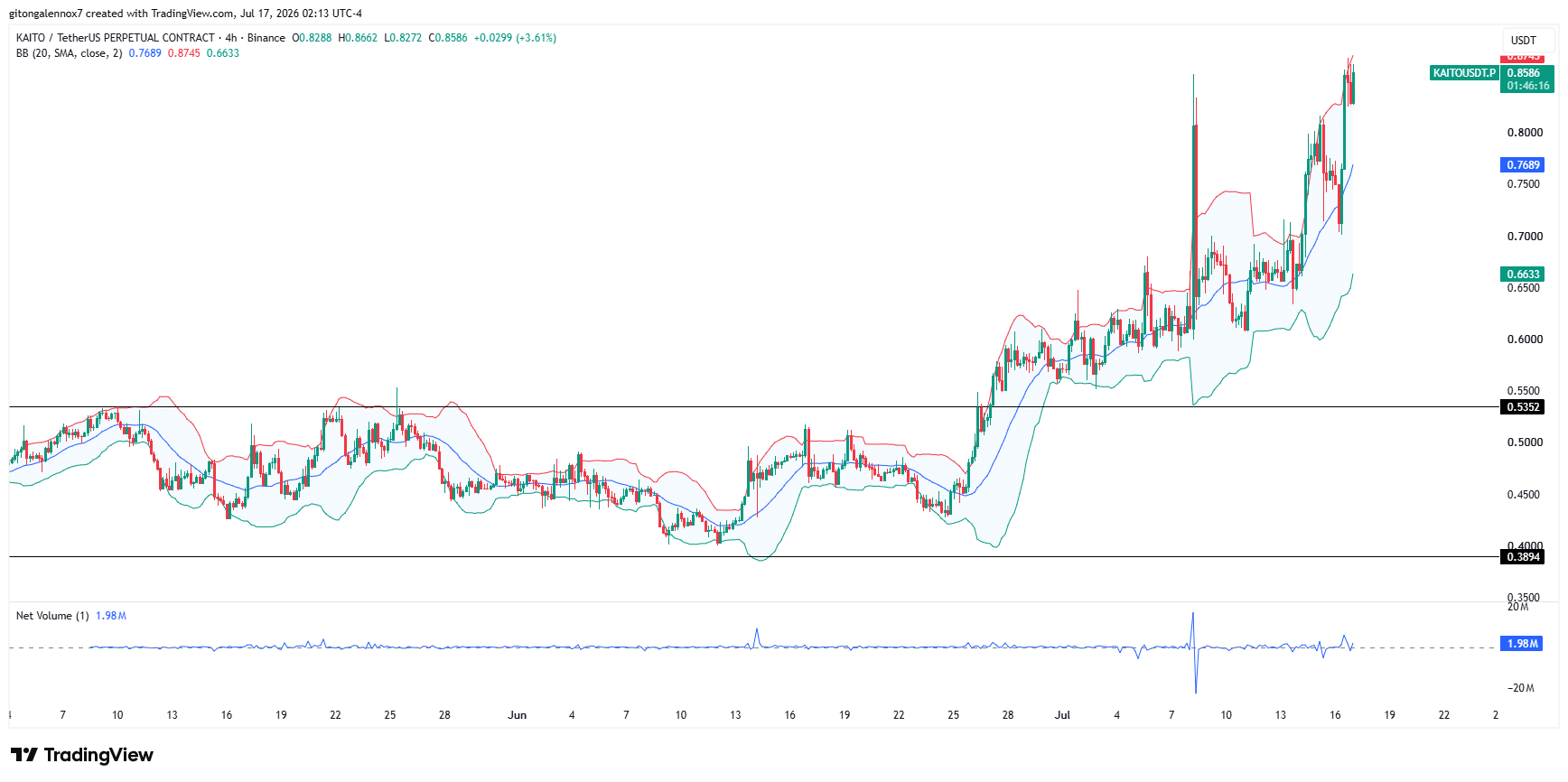
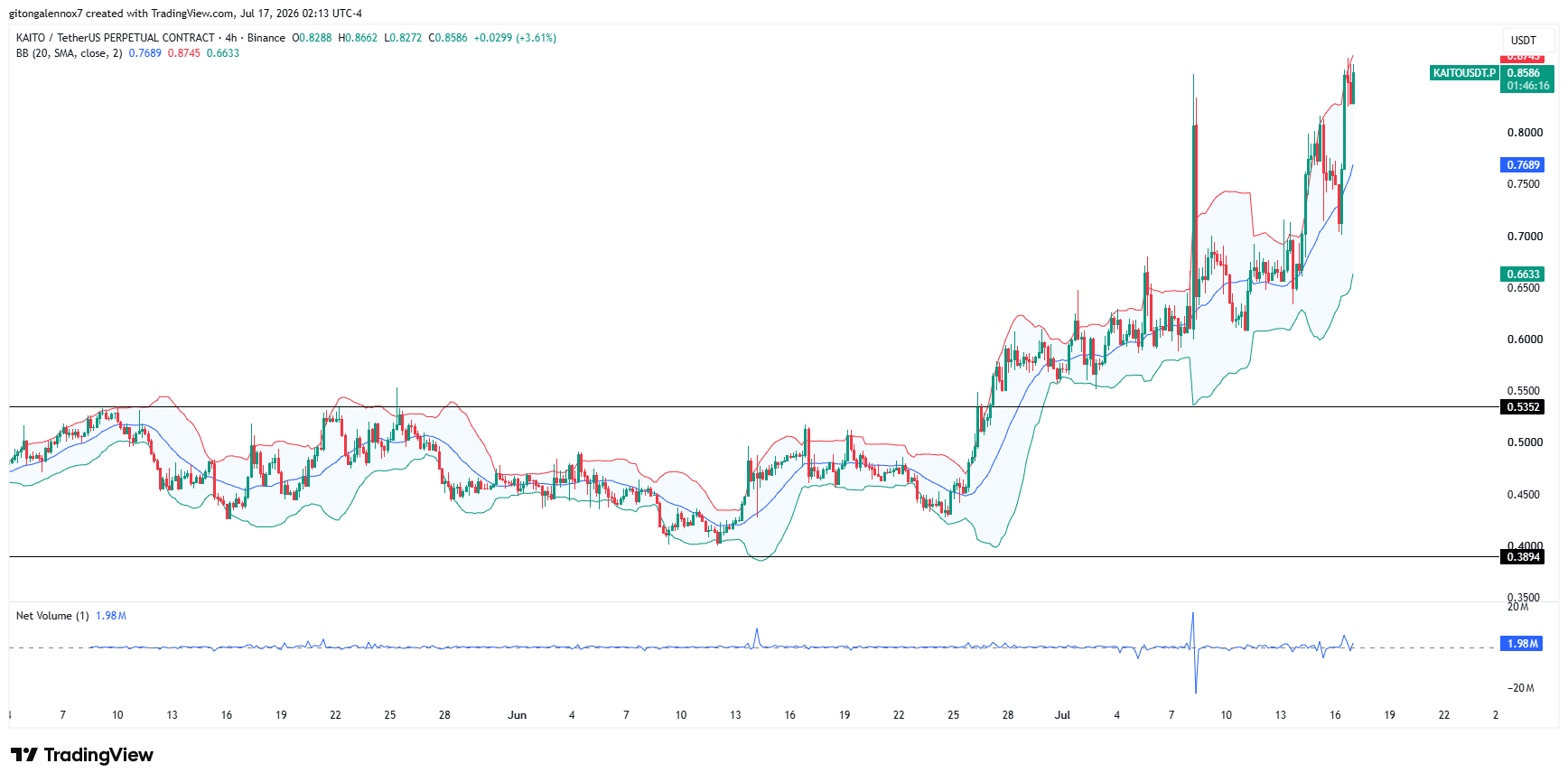
KAITO also broke above the $0.38–$0.54 range, which had contained the price since late March.

Buyers cleared the range’s upper boundary in early July, confirming a bullish structural shift. Net Volume remained positive, with net buying reaching approximately 1.98 million KAITO at press time.
Source: KAITO/USDT on TradingView

Meanwhile, the Bollinger Bands expanded after an earlier compression. This indicated that price volatility had increased following the breakout.

Even so, KAITO encountered resistance between $0.80 and $0.85. Price momentum slowed around this zone, placing the rally’s next test firmly in view.

Will the token unlock stall KAITO?

The potential reason behind this lag could be the anticipated selling pressure from the upcoming token unlocks.

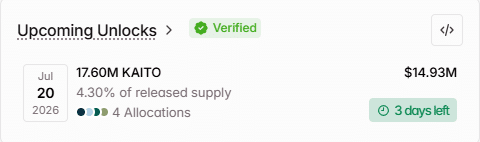
As per Tokenomist, about 17.60 million KAITO tokens worth $14.93 million would be unlocked in three days’ time. Usually, such activities tend to create selling pressure as they increase the circulating supply in the market.
Source: Tokenomist

Still, with capital to absorb this supply, the price action may continue surging, especially if bulls continue buying.

Therefore, the market structure remains bullish in the short term, but that could change if supply dynamics outweigh capital inflows.


Final Summary

  • KAITO AI rallies 13% in 24 hours as OI reaches the highest level this year and token volume increases by 3x this week.
  • KAITO price broke above a sideways market this month and has been rising, but faces a key test amid the upcoming token unlock.


Criptomoedas em alta

Perguntas relacionadas

QWhat are the key factors driving the recent 13% rally in KAITO's price?

AThe rally is driven by increased trading activity, with Open Interest (OI) reaching its highest level this year at $70.88 million and daily trading volume more than tripling from $15 million to over $47 million. This indicates strong market participation and a build-up of long positions.

QWhat potential challenge could test the sustainability of KAITO's bullish move?

AAn upcoming token unlock could test the rally's sustainability. In three days, approximately 17.60 million KAITO tokens worth $14.93 million will be unlocked, which typically increases circulating supply and can create selling pressure.

QWhat technical level is identified as the next key resistance for KAITO's price?

AKAITO is encountering resistance in the price zone between $0.80 and $0.85. Price momentum has slowed around this area, making it the next key test for the rally.

QHow does the article describe the change in KAITO's market structure?

AThe market structure has shifted to bullish. KAITO broke above the $0.38–$0.54 trading range that had contained it since late March, confirming a bullish structural shift with the breakout occurring in early July.

QAccording to the article, what two conditions will determine if the price surge continues despite the token unlock?

AThe price surge may continue if there is sufficient capital in the market to absorb the increased supply from the unlock and if bulls continue their buying activity. Otherwise, if supply dynamics outweigh capital inflows, the bullish structure could change.

Leituras Relacionadas

Stable Vaults Are the Final Piece in Aave's Mass Commercialization Puzzle

Aave's introduction of "Stable Vaults" aims to bridge the gap between complex DeFi protocols and mainstream users by offering a simplified, predictable savings product. The core innovation is a fixed-yield layer built atop Aave's volatile underlying lending pools. Partnering platforms (like digital banks or wallets) can offer users a guaranteed interest rate (e.g., 4%), shielding them from market fluctuations. The partner absorbs the risk and profit/loss from the difference between this fixed rate and Aave's variable rate. From the user's perspective, Stable Vaults provide ease of use, predictable returns, and familiar services like customer support and account recovery, addressing key barriers like wallet management and volatility. However, users pay a price: they cap their potential earnings (forgoing higher market yields), add counterparty risk from the partner platform, and may lack transparency into the true spread being captured. For partners, Stable Vaults turn idle user funds into a revenue stream via the yield spread. For Aave, this strategy attracts sticky, "sticky" capital from mass-market applications, providing a stable fee revenue stream crucial for its tokenomics (e.g., buyback mechanisms), especially in bear markets. The article contrasts this approach with direct DeFi interaction, where users keep all yield but face complexity and volatility. It argues that Stable Vaults align with proven consumer behavior: most users prioritize convenience, safety, and predictability over maximizing returns, willingly paying a "peace of mind" premium. Examples like Coinbase and Robinhood offering similar "savings" products validate this demand. Thus, Stable Vaults represent Aave's strategic move to commercialize by catering to fundamental human preferences for simplicity and stability in finance.

marsbitHá 43m

Stable Vaults Are the Final Piece in Aave's Mass Commercialization Puzzle

marsbitHá 43m

Support Rate Less Than 1%, BIP-110 Still Pushes Bitcoin Towards a Soft Fork?

Title: BIP-110 Pushes Bitcoin Towards a Soft Fork Despite Less Than 1% Approval With its August mandatory activation window approaching, the controversial BIP-110 proposal is back in the spotlight. Proposed in December 2025 by Dathon Ohm and supported by Bitcoin Core developer Luke Dashjr, BIP-110 aims to impose a one-year limit on arbitrary/non-monetary data in Bitcoin transactions, primarily targeting large data storage like Ordinals and Bitcoin NFTs, to reduce network "spam" and refocus Bitcoin on its monetary function. However, the proposal faces overwhelming opposition. To activate, BIP-110 requires a 55% threshold, yet current miner support is below 1%. Of the 102,674 network nodes, only 14.64% (15,035) signal readiness to enforce it. Despite this lack of consensus, BIP-110 has a contentious "mandatory window" mechanism: if the threshold isn't met by block height 961,632, supporting nodes will begin rejecting non-compliant blocks from height 961,632 to 963,647, attempting to force activation by block 965,664. This could lead to a chain split in early August between a minority chain enforcing BIP-110 and the main chain. Proponents, led by Luke Dashjr (founder of Ocean mining pool), argue that inscriptions constitute an "attack" on Bitcoin, congesting block space and raising transaction fees, thereby undermining Bitcoin's primary use as money. They view BIP-110 not as a change but as a reversal of a harmful change. Opponents, including figures like Adam Back, Jameson Lopp, and Michael Saylor, contend that BIP-110 fails to solve the spam problem while creating new risks. They warn it could stifle future innovation (e.g., impacting BitVM), introduce transaction censorship—eroding Bitcoin's neutrality—and potentially cause a damaging chain split that fragments developer resources, hash power, and monetary consensus. They argue market-based fee pressure and block size limits already manage congestion effectively. Potential outcomes post-activation include: 1) The BIP-110 chain stalling due to insufficient hash power; 2) The BIP-110 chain becoming the longest chain if it gains majority miner support (though currently, Ocean holds only 2.6% of hash power vs. opponents like F2Pool at 13.6%); or 3) A persistent minority chain that remains economically unviable, potentially leading to a permanent fork. Most analysts and prediction markets deem BIP-110's success unlikely, with one market giving only a 10% probability that it will become the accepted longest chain by September 2026.

marsbitHá 48m

Support Rate Less Than 1%, BIP-110 Still Pushes Bitcoin Towards a Soft Fork?

marsbitHá 48m

Mining Stocks Are Moving Further Away from Crypto

Title: Mining Stocks Are Drifting Away from Crypto Summary: Despite Bitcoin (BTC) falling approximately 46% over the past year, leading Bitcoin mining stocks (e.g., HUT, WULF, IREN) have surged significantly. This divergence stems from a fundamental shift in how the market values these companies. Their stock prices are no longer tied primarily to crypto prices, mining output, or hash rates. Instead, investors are now pricing them as AI infrastructure plays. Mining companies possess critical assets for AI data centers: pre-permitted land, grid-connected power capacity, and operational expertise for high-load facilities—resources facing severe shortages and long lead times for new entrants. For example, CleanSpark signed a 20-year, ~$6.6 billion infrastructure lease for an AI data center, while Marathon Digital acquired a project with up to 2 GW of planned power capacity. Analysts note a strong correlation between a mining company's market valuation and its contracted or potential AI power capacity in North America. CoinShares predicts that by year-end, up to 70% of revenue for listed miners could come from AI/HPC, compared to about 30% at the start of 2026. However, this re-rating introduces new risks: 1) Valuation volatility linked to the broader AI/semiconductor sector, 2) Potentially low baseline return rates (estimated at 4-5% for some firms), and 3) Execution risks including massive financing needs, regulatory permits, and tenant quality. This strategic pivot is also changing miner behavior. They are selling BTC holdings more aggressively to fund AI capex, meaning selling pressure may persist regardless of Bitcoin's price. Furthermore, once power and sites are locked into long-term AI contracts, they are unlikely to return to Bitcoin mining, potentially altering the network's hash rate dynamics long-term. In essence, mining firms are being valued for what they are becoming—AI infrastructure providers—rather than pure-play crypto miners.

链捕手Há 54m

Mining Stocks Are Moving Further Away from Crypto

链捕手Há 54m

Trading

Spot

Artigos em Destaque

Como comprar KAITO

Bem-vindo à HTX.com!Tornámos a compra de Kaito (KAITO) simples e conveniente.Segue o nosso guia passo a passo para iniciar a tua jornada no mundo das criptos.Passo 1: cria a tua conta HTXUtiliza o teu e-mail ou número de telefone para te inscreveres numa conta gratuita na HTX.Desfruta de um processo de inscrição sem complicações e desbloqueia todas as funcionalidades.Obter a minha contaPasso 2: vai para Comprar Cripto e escolhe o teu método de pagamentoCartão de crédito/débito: usa o teu visa ou mastercard para comprar Kaito (KAITO) instantaneamente.Saldo: usa os fundos da tua conta HTX para transacionar sem problemas.Terceiros: adicionamos métodos de pagamento populares, como Google Pay e Apple Pay, para aumentar a conveniência.P2P: transaciona diretamente com outros utilizadores na HTX.Mercado de balcão (OTC): oferecemos serviços personalizados e taxas de câmbio competitivas para os traders.Passo 3: armazena teu Kaito (KAITO)Depois de comprar o teu Kaito (KAITO), armazena-o na tua conta HTX.Alternativamente, podes enviá-lo para outro lugar através de transferência blockchain ou usá-lo para transacionar outras criptomoedas.Passo 4: transaciona Kaito (KAITO)Transaciona facilmente Kaito (KAITO) no mercado à vista da HTX.Acede simplesmente à tua conta, seleciona o teu par de trading, executa as tuas transações e monitoriza em tempo real.Oferecemos uma experiência de fácil utilização tanto para principiantes como para traders experientes.

220 Visualizações TotaisPublicado em {updateTime}Atualizado em 2026.06.02

Como comprar KAITO

Discussões

Bem-vindo à Comunidade HTX. Aqui, pode manter-se informado sobre os mais recentes desenvolvimentos da plataforma e obter acesso a análises profissionais de mercado. As opiniões dos utilizadores sobre o preço de KAITO (KAITO) são apresentadas abaixo.

活动图片