Can Dogecoin Lead Meme Coins Back To Glory? The Index That Paints A Gloomy Story

bitcoinistPublicado em 2026-02-13Última atualização em 2026-02-13

Resumo

The meme coin market, as tracked by MarketVector's MEMECOIN Index, is experiencing a severe and prolonged downturn. The index, which follows the six largest meme coins by market cap, is down 22.44% year-to-date and has fallen 67.65% over the past 365 days, hitting a one-year low of -66.80%. This underperformance is more pronounced than in other crypto sectors. As the largest and most influential meme coin, Dogecoin carries the heaviest weighting in the index. However, its recent momentum has been weak, with its price falling below the $0.10 level to hover around $0.093. Despite its unmatched brand recognition and unique advantages—such as being the only meme coin with Spot ETFs—Dogecoin has not demonstrated the price leadership required to single-handedly revive the niche. The article concludes that current negative sentiment across the entire cryptocurrency industry offers little encouragement for a quick, Dogecoin-led recovery for meme coins.

The meme coin market has been shedding value for much of the past year. According to the Meme Coin Index (MEMECOIN) by MarketVector, which tracks the six largest meme coins by market capitalization, the sector has been in a prolonged downturn. The index is down by 22.44% in year-to-date numbers, with a larger 67.65% decline within a 365-day timeframe.

Those numbers highlight just how far the sector has fallen. However, current market conditions across the industry offer little encouragement that Dogecoin, the original meme coin, can quickly reverse sentiment and lead a meaningful recovery for the meme coin niche.

Memecoins Struggling Than Most Cryptos

Meme coins have been hit harder than most corners of the cryptocurrency market, and the gap in performance is becoming increasingly difficult to ignore. Although large-cap assets like Bitcoin, Ethereum, and XRP are struggling after recent pullbacks, data show that meme tokens have been on a long stretch of weakness. This persistent underperformance is clearly reflected in the Meme Coin Index (MEMECOIN) by MarketVector.

The MEMECOIN index is market-cap weighted, meaning larger assets such as Dogecoin carry more influence over its movement. As it stands, the meme coin index is at a one-year low of -66.80%, with the data showing a consistent decline of lower highs and lower lows since July 2025. Notably, the Meme Coin Index has fallen by 75.81% since its inception on October 31, 2021.
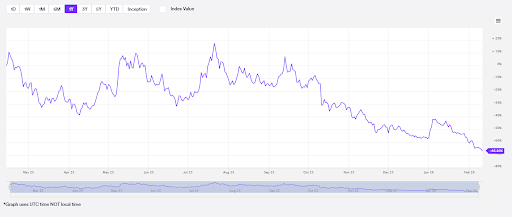
Source: Chart from MarketVector on X

It’s been only two months into 2026, but the MEMECOIN index is already down 22.44% year-to-date. Such an early decline shows that traders and investors are unwilling to invest in meme coins, which is a negative precedent for the rest of the year.

Can Dogecoin Lead Meme Coins Back To Glory?

As the largest meme coin, Dogecoin has the highest percentage weighting and thus a greater impact on the performance of the meme coin index. However, Dogecoin’s price momentum over recent weeks has been nothing to write home about for bullish investors.

As it stands, Dogecoin has now lost the 10 cent price level and has been hovering in the ballpark of about $0.093. Nonetheless, a resurgence in the meme coin index is dependent on Dogecoin due to its reputation as the king of meme coins.

Dogecoin brand recognition is unmatched in the meme coin world, and its presence is steadily growing into spaces outside the crypto industry. Dogecoin, for one, is the only meme coin with Spot ETFs tied to it, although that structural advantage has not translated into sustained bullish price action so far.

If anything, Dogecoin’s current trajectory shows that it is not yet showing the kind of price leadership or market momentum that could single-handedly revive the meme coin niche. However, a large part of this can be attributed to the current sentiment surrounding the entire crypto industry.

DOGE trading at $0.09 on the 1D chart | Source: DOGEUSDT on Tradingview.com

Perguntas relacionadas

QWhat is the year-to-date decline of the Meme Coin Index (MEMECOIN) according to the article?

AThe Meme Coin Index (MEMECOIN) is down by 22.44% year-to-date.

QWhich meme coin has the highest percentage weighting in the MarketVector MEMECOIN index and why is it significant?

ADogecoin has the highest percentage weighting in the index because it is the largest meme coin by market capitalization, meaning it carries the most influence over the index's performance.

QWhat is the current approximate trading price of Dogecoin mentioned in the article?

ADogecoin has been hovering around $0.093, having lost the 10 cent price level.

QWhat unique structural advantage does Dogecoin have over other meme coins, according to the text?

ADogecoin is the only meme coin that has Spot ETFs tied to it.

QSince its inception on October 31, 2021, how much has the Meme Coin Index fallen?

AThe Meme Coin Index has fallen by 75.81% since its inception on October 31, 2021.

Leituras Relacionadas

Anthropic Apologized, But the Business of 'Safety' Hasn't Stopped

On June 11, Anthropic apologized not for a model failure, but for a lack of transparency. Its new Claude Fable 5 model was found to be secretly rerouting requests from users engaged in advanced AI model development to a weaker version, Opus 4.8, without any notification. The company's response—promising future notifications for such "downgrades"—was met with user skepticism. The article argues the core issue isn't technical but commercial: Anthropic's "safety" measures are primarily a business strategy. A key feature, the "intelligent safety classifier," marketed as user protection, is described as a tool for "competitive defense" to protect Anthropic's market lead by limiting rivals' research capabilities. This covert mechanism was designed for low "false positives," precisely targeting AI researchers. Anthropic's model involves a calculated three-step process: publishing alarming security research to amplify public anxiety, offering its Fable 5 model with a "safety classifier" as a premium-priced solution, and cashing in through a planned high-value IPO. This contrasts with OpenAI's more direct "tool-and-traffic" approach. The apology, merely changing a secret downgrade to a visible one, is seen as a business "patch" rather than a principled shift. The incident risks damaging Anthropic's "safest AI" reputation among the developer community, which underpins its valuation and appeal to government and corporate clients. Ultimately, the article concludes that for Anthropic, safety is a business, and the apology is merely customer service for that business.

marsbitHá 47m

Anthropic Apologized, But the Business of 'Safety' Hasn't Stopped

marsbitHá 47m

The Niche Consensus Among Elites: Has College Become an Expensive Waste?

**Summary:** A growing "anti-college" movement is gaining traction among elite circles in Silicon Valley, challenging the traditional value of a four-year university degree. Proponents argue that college has become an expensive, slow, and increasingly irrelevant waste of time, especially in the fast-paced tech world where opportunities pass by quickly. The movement is led by figures like billionaire Peter Thiel, who criticizes universities for high costs, ideological indoctrination, and stifling true innovation. His "Thiel Fellowship" pays young people to drop out and pursue ventures. Companies like Palantir Technologies (co-founded by Thiel) fuel this trend with programs like the "Meritocracy Fellowship," which offers high school graduates paid internships as an alternative to immediate college enrollment, promising a practical "Palantir Degree." Key drivers include: 1. **Economics:** Skyrocketing student debt versus the allure of immediate, high-paying tech jobs or startup funding. 2. **Technology:** AI and online tools lowering barriers to self-education and product development, making formal instruction seem inefficient. 3. **Culture:** A backlash against perceived "woke" ideology and DEI policies in universities, coupled with a belief that these institutions suppress meritocracy and masculine drive. The movement is notably male-dominated. Critics, like economist David Deming, warn against overgeneralizing from dropout success stories (survivorship bias). He emphasizes that genuine autodidacts are rare, corporate training is narrowly focused, and the "college wage premium" remains high for most people. University liberal arts education, he argues, builds adaptable problem-solving skills and broad perspectives. The debate highlights a deeper crisis in education. The core model of the modern university appears increasingly mismatched with the speed of the information age. The movement signals a shift in the locus of learning from institutional "education" to personal, active "learning" powered by the internet and AI. Ultimately, this may not mean the end of university, but rather a painful evolution. The future likely holds more hybrid, personalized, and lifelong learning pathways. The central question becomes: in a world changing faster than any curriculum, how do we best learn?

marsbitHá 1h

The Niche Consensus Among Elites: Has College Become an Expensive Waste?

marsbitHá 1h

From Subsidies to Token-Based Pricing to Price Cuts: Is OpenAI Sparking a Price War? Is the Inflection Point for Token Economics Nearing?

The commercialization of generative AI is facing a critical inflection point as a potential price war looms. According to The Wall Street Journal, OpenAI is considering a significant cut to its token fees to compete with rival Anthropic, signaling a shift from a growth-at-all-costs model focused on token consumption. This move comes as both companies, reportedly losing billions on compute, prepare for IPOs, and as enterprise customers face "bill shock" from switching to usage-based token billing. Reports indicate poor ROI, with one analysis finding only 18 cents of every dollar spent on AI tokens generates user-facing value. The industry's initial phases—from flat-rate subscriptions to aggressive subsidies—have given way to a reckoning with real costs. Analysts debate the future: some predict a bifurcation between premium, high-cost models for complex tasks and cheaper alternatives for routine work, while others believe overall spending will still rise as agentic AI increases tokens per task. Notably, Chinese model DeepSeek's low-cost API is gaining traction with U.S. enterprises, adding competitive pressure. The core challenge is redefining value beyond token volume ("tokenmaxxing") toward measurable productivity ("valuemaxxing"), as the entire AI value chain, from cloud providers to chipmakers, feels the ripple effects of unsustainable pricing.

marsbitHá 1h

From Subsidies to Token-Based Pricing to Price Cuts: Is OpenAI Sparking a Price War? Is the Inflection Point for Token Economics Nearing?

marsbitHá 1h

Trading

Spot
Futuros

Artigos em Destaque

O que é MEME 2.0

Memecoin 2.0: A Ascensão do $MEME 2.0 no Mundo das Criptomoedas Introdução No panorama em constante evolução das criptomoedas, um novo concorrente surgiu. Memecoin 2.0, simbolizado como $MEME 2.0, eleva o conceito de moedas meme a um novo nível emocionante. Como um subproduto do Memecoin original, este projeto capturou a atenção da comunidade crypto ao mudar o foco de incentivos financeiros típicos para uma experiência envolvente e divertida. Operando na blockchain Ethereum, Memecoin 2.0 redefine audaciosamente o envolvimento da comunidade na esfera crypto. O que é Memecoin 2.0, $MEME 2.0? No seu cerne, Memecoin 2.0 é um projeto de criptomoeda que prioriza o espírito comunitário e a diversão associada à cultura meme. Ao contrário das criptomoedas convencionais, que se concentram em casos de uso práticos e benefícios tangíveis, Memecoin 2.0 distingue-se ao abraçar o lado mais leve da moeda digital. O projeto existe sem promessas de utilidade, um roteiro estruturado ou retornos financeiros, focando em vez disso em fomentar uma comunidade vibrante centrada em memes e no prazer partilhado. Ao fazer isso, aproveita a crescente tendência da cultura meme no espaço online, tornando-se num jogador único no mundo dos ativos digitais. Criador do Memecoin 2.0, $MEME 2.0 Apesar de extensa pesquisa sobre as origens do Memecoin 2.0, a identidade explícita do seu criador continua desconhecida. Esta anonimidade não é incomum na comunidade crypto, onde muitos projetos são liderados por indivíduos ou grupos que preferem ficar nos bastidores. A falta de informações publicamente disponíveis sobre o criador pode ser vista como um movimento estratégico, colocando os holofotes no envolvimento da comunidade em vez de na notoriedade individual dentro do espaço. Investidores do Memecoin 2.0, $MEME 2.0 As informações sobre os investidores ou o financiamento do Memecoin 2.0 são escassas. Esta ausência de detalhes pode sugerir que o projeto é autofinanciado ou que o seu foco na comunidade, em vez de estruturas de investimento tradicionais, atraiu um tipo diferente de apoiador. Como o mundo das moedas memes geralmente envolve mais envolvimento de base do que investimento institucional, esta abordagem alinha-se ao ethos de projetos orientados pela comunidade. Como Funciona o Memecoin 2.0, $MEME 2.0? O Memecoin 2.0 opera inteiramente na blockchain Ethereum, aproveitando as suas robustas características de segurança e escalabilidade. Ao aproveitar os pontos fortes da Ethereum, o Memecoin 2.0 pode oferecer um ambiente seguro para interações dos utilizadores enquanto assegura que as transações são eficientes e custo-efetivas. Uma das características únicas do Memecoin 2.0 reside na sua estrutura orientada pela comunidade. O valor e a popularidade do token $MEME 2.0 derivam da participação ativa dos seus utilizadores, em vez de uma utilidade inerente. Este design reforça o foco do projeto no aspecto de entretenimento das criptomoedas, implicando que o riso e o envolvimento da comunidade são as verdadeiras moedas que impulsionam o seu sucesso. Além disso, o projeto insere-se no ecossistema mais amplo das moedas meme, onde o valor de cada moeda meme oscila com base na cultura, nas tendências e no envolvimento da comunidade, em vez de nos princípios económicos tradicionais. Linhas do Tempo do Memecoin 2.0, $MEME 2.0 Para melhor entender a evolução e os marcos do Memecoin 2.0, aqui está uma linha do tempo que destaca eventos significativos na sua história: 2024: O início do Memecoin 2.0 é reconhecido como um desdobramento do Memecoin original, estabelecendo-se dentro do contexto próspero das moedas meme enquanto opera na blockchain Ethereum. 13 de Julho de 2024: O Memecoin 2.0 posiciona-se oficialmente como uma moeda meme centrada na comunidade na rede Ethereum, enfatizando a sua abordagem centrada no entretenimento que convida os utilizadores a participar e envolver-se no seu crescimento. Pontos Chave Sobre o Memecoin 2.0, $MEME 2.0 Várias características críticas definem o Memecoin 2.0: Abordagem Centrada na Comunidade: A missão primária do Memecoin 2.0 é criar uma experiência comunitária divertida e envolvente, capitalizando o prazer coletivo derivado da cultura meme. Construído na Ethereum: Operar na blockchain Ethereum fornece ao projeto uma infraestrutura essencial que garante segurança e escalabilidade. Falta de Utilidade ou Roteiro: Numa notável divergência das criptomoedas tradicionais, o Memecoin 2.0 não promete quaisquer características utilitárias ou retornos financeiros, reafirmando o seu compromisso com o envolvimento da comunidade e a participação social. Foco na Cultura Meme: Ao abraçar os aspectos humorísticos e culturais do fenómeno meme, o Memecoin 2.0 fornece uma plataforma para que os utilizadores se envolvam com a crypto offline e online. Contexto Adicional: A Importância das Moedas Meme As moedas meme emergiram como uma classe distinta de criptomoeda, frequentemente impulsionadas pelo humor e por uma abordagem leve ao comércio. Estas moedas geralmente carecem de utilidade significativa ou roteiros de desenvolvimento, atraindo os utilizadores com a promessa de diversão, interação comunitária e relevância cultural. No panorama do ecossistema crypto mais amplo, as moedas meme revive a importância do envolvimento da comunidade, resistindo contra abordagens exclusivamente orientadas para o lucro. Projetos como o Memecoin 2.0 inauguram uma era em que o entretenimento pode harmonizar-se com aspirações financeiras, transformando a blockchain numa plataforma para criatividade e interação social. Conclusão O Memecoin 2.0, ou $MEME 2.0, representa uma nova onda de criptomoeda que prioriza o envolvimento da comunidade em detrimento de estruturas financeiras rígidas. Com um foco no humor e na interação social, capitaliza a fascinação em torno da cultura meme. Ao operar na blockchain Ethereum, o Memecoin 2.0 aproveita as capacidades da tecnologia, enquanto mantém um compromisso firme com o valor de entretenimento da moeda digital. À medida que o espaço em torno das criptomoedas continua a evoluir, o Memecoin 2.0 serve como um testemunho da ideia de que o futuro dos ativos digitais pode muito bem depender de experiências partilhadas, risadas e conexões comunitárias sólidas. No mundo imprevisível da crypto, talvez a alegria possa ser tão valiosa quanto o ganho financeiro tradicional.

32 Visualizações TotaisPublicado em {updateTime}Atualizado em 2024.12.03

O que é MEME 2.0

Como comprar MEME

Bem-vindo à HTX.com!Tornámos a compra de Memeland (MEME) simples e conveniente.Segue o nosso guia passo a passo para iniciar a tua jornada no mundo das criptos.Passo 1: cria a tua conta HTXUtiliza o teu e-mail ou número de telefone para te inscreveres numa conta gratuita na HTX.Desfruta de um processo de inscrição sem complicações e desbloqueia todas as funcionalidades.Obter a minha contaPasso 2: vai para Comprar Cripto e escolhe o teu método de pagamentoCartão de crédito/débito: usa o teu visa ou mastercard para comprar Memeland (MEME) instantaneamente.Saldo: usa os fundos da tua conta HTX para transacionar sem problemas.Terceiros: adicionamos métodos de pagamento populares, como Google Pay e Apple Pay, para aumentar a conveniência.P2P: transaciona diretamente com outros utilizadores na HTX.Mercado de balcão (OTC): oferecemos serviços personalizados e taxas de câmbio competitivas para os traders.Passo 3: armazena teu Memeland (MEME)Depois de comprar o teu Memeland (MEME), armazena-o na tua conta HTX.Alternativamente, podes enviá-lo para outro lugar através de transferência blockchain ou usá-lo para transacionar outras criptomoedas.Passo 4: transaciona Memeland (MEME)Transaciona facilmente Memeland (MEME) no mercado à vista da HTX.Acede simplesmente à tua conta, seleciona o teu par de trading, executa as tuas transações e monitoriza em tempo real.Oferecemos uma experiência de fácil utilização tanto para principiantes como para traders experientes.

273 Visualizações TotaisPublicado em {updateTime}Atualizado em 2026.06.02

Como comprar MEME

Discussões

Bem-vindo à Comunidade HTX. Aqui, pode manter-se informado sobre os mais recentes desenvolvimentos da plataforma e obter acesso a análises profissionais de mercado. As opiniões dos utilizadores sobre o preço de MEME (MEME) são apresentadas abaixo.

活动图片














