Bybit Pay Integrates With Yape and Plin to Enable Crypto Payments Across Peru

TheNewsCryptoPublicado em 2026-01-15Última atualização em 2026-01-15

Resumo

Bybit Pay, the payment service of the world’s second-largest crypto exchange, has integrated with Yape and Plin—two of Peru’s most widely used digital payment platforms. This integration enables millions of users in Peru to make everyday transactions using cryptocurrencies such as USDT, USDC, BTC, and ETH, which are instantly converted to Peruvian Sol (PEN). Customers can pay via Yape QR codes or Plin phone-number transfers both online and at local merchants, benefiting from fast settlement and enhanced security. The move supports Peru’s growing digital economy, where over 50% of adults use mobile wallets. To celebrate the launch, Bybit is offering incentives including a 50% discount voucher for new users and cashback rewards for existing customers.

Yape and Plin, two of the most widely used digital payment systems in Peru, have seamlessly integrated with Bybit Pay, which has been launched by Bybit, the second-largest cryptocurrency exchange in the world based on trading volume. Millions of users of digital wallets in Peru now have access to real-world cryptocurrency payment capabilities thanks to this expansion, which is another significant step in connecting conventional banking with the Latin American digital economy.

Boosting the Digital-First Economy in Peru

The usage of digital wallets has increased dramatically in Peru in recent years; in 2024, Yape and Plin will each have around 14 million users. Bybit Pay’s most recent integration combines the innovation of digital assets with the familiarity of Peru’s most trusted payment methods, allowing Peruvian customers to make cryptocurrency-backed payments both online and at local merchants using their existing Plin phone-number transfers and Yape QR codes.

Yape handled 54% of in-person transactions and PLIN handled 34% in 2024, placing Bybit Pay at the center of Peru’s quickly developing cashless economy. According to research, more than 50% of Peruvian adults use digital wallets that are based on their phones.

Using the extensive local networks of Plin and Yape, Bybit Pay customers in Peru can now:

  • Use QR codes to make payments: To instantly pay with cryptocurrencies at participating retailers around the country, use your current Yape QR code.
  • Money Transfer using Phone Number: Use crypto holdings to support safe Plin phone number transfers.
  • Use Digital Assets to Shop: Access payments at actual retail stores as well as online.
  • Enjoy Fast Settlement: Take advantage of improved security and almost instantaneous transaction confirmation.

Several cryptocurrencies, such as USDT, USDC, BTC, ETH, and other significant digital assets, are supported in Peru by the platform, which instantly converts them for smooth Peruvian Sol (PEN) transactions.
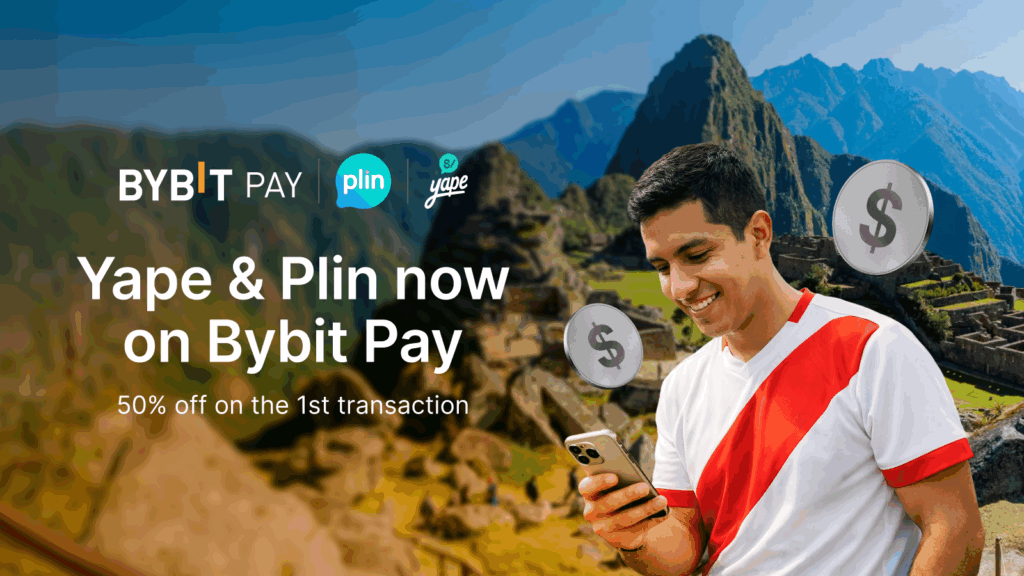
Bybit Pay is providing consumers in Peru with previously unheard-of incentives to commemorate the launch:

  • Exclusive to New Users: New customers who successfully register for Bybit Pay may get a 50% discount voucher on their first phone-number transfer or QR code payment in addition to additional welcome perks.
  • Benefits to Current Users: Current Bybit Pay customers may get 2–10% reward on each payment made via phone number transfer or QR code.

“By integrating with mainstream payment methods Peruvians already know and trust, Bybit Pay is removing barriers to digital asset adoption and making crypto genuinely useful for everyday transactions,” said Patricio Mesri, CEO of Bybit LATAM. “Peru represents one of Latin America’s most dynamic digital payment markets, and we are proud to be building the infrastructure for financial innovation and inclusion together with our partners.”

Through collaborations with top regional organizations and payment infrastructure suppliers from Brazil to Argentina, Bybit Pay has been making progress throughout Central and Latin America. Users may visit How to Make Payment with QR Pay utilizing Bybit Pay to find out more about how to utilize Bybit Pay.

Currently, Bybit Pay provides services to users worldwide who have successfully finished Bybit’s Identity Verification process. At this time, local Bybit entities and users from Service Restricted Countries are not supported. Users may visit the official Bybit Pay site for the most recent information as well as comprehensive terms and conditions.


TagsBybitexchange

Perguntas relacionadas

QWhat is the significance of Bybit Pay's integration with Yape and Plin in Peru?

AThe integration enables millions of digital wallet users in Peru to make real-world cryptocurrency payments, connecting traditional banking with the Latin American digital economy and placing Bybit Pay at the center of Peru's cashless economy.

QWhich cryptocurrencies are supported by Bybit Pay for transactions in Peru?

AThe platform supports several cryptocurrencies including USDT, USDC, BTC, ETH, and other significant digital assets, which are instantly converted for smooth Peruvian Sol (PEN) transactions.

QWhat specific payment methods can Peruvian users now employ through Bybit Pay's integration?

APeruvian users can make payments using Yape QR codes at participating retailers and conduct safe money transfers using Plin phone number transfers, all backed by their cryptocurrency holdings.

QWhat incentives is Bybit offering to users in Peru to celebrate the launch?

ANew users may receive a 50% discount voucher on their first phone-number transfer or QR code payment, while existing users can get a 2–10% reward on each payment made through these methods.

QHow does Bybit Pay's CEO view the impact of this integration on digital asset adoption in Peru?

ACEO Patricio Mesri stated that by integrating with mainstream payment methods Peruvians already trust, Bybit Pay is removing barriers to digital asset adoption and making crypto genuinely useful for everyday transactions in one of Latin America's most dynamic digital payment markets.

Leituras Relacionadas

Bitcoin's 'Rally Ends,' Officially Entering the Later Stage of a Bear Market?

Bitcoin prices declined 13% this week, reversing the recent rebound and signaling a likely transition into the later stages of a bear market. Key on-chain metrics deteriorated, with the short-term holder cost basis falling below the Realized Price—a pattern last seen in early 2022, characteristic of bear market maturity. The rally to ~$82k proved to be a bear market bounce, as evidenced by the 90-day realized profit/loss ratio failing to sustain above the bullish threshold of 2. Daily realized losses surged to $1.35B, including significant selling from long-term holders who accumulated near cycle tops, indicating ongoing supply redistribution. Price was rejected almost precisely at the aggregate US spot ETF cost basis of ~$83k, turning that level into resistance and leaving the average ETF investor underwater again. Spot market selling pressure intensified, with the 7-day volume delta turning significantly negative to its weakest level since February. While a major long liquidation event cleared over $400M in leverage, spot demand has not yet stepped in to absorb the resulting supply. Options markets continue pricing in higher future volatility (elevated volatility risk premium) and maintain a skew toward put options, reflecting persistent demand for downside protection, though not yet panic. Overall, market structure remains fragile. Sustained recovery likely requires a reclaim of the ETF cost basis, a shift back to positive spot demand, and a slowdown in realized loss-taking. Until then, the market risks further downside or extended consolidation within the broader bear trend.

Foresight NewsHá 1h

Bitcoin's 'Rally Ends,' Officially Entering the Later Stage of a Bear Market?

Foresight NewsHá 1h

How Risky is the "Death Spiral" of MSTR and STRC?

Summary: This article explores the perceived "death spiral" risk between MicroStrategy (MSTR), its Bitcoin holdings, and its perpetual preferred stock (STRC), drawing comparisons to the LUNA-UST collapse. While both systems feature price anchors, high yields for holders, and potential feedback loops, their core mechanisms differ fundamentally. The MSTR-STRC structure relies on continuous financing to sustain its high dividend payouts, primarily through stock ATM offerings. A negative feedback cycle could occur: falling MSTR stock price makes raising equity capital harder, increasing pressure to sell Bitcoin, which undermines STRC confidence and further depresses MSTR. However, unlike LUNA-UST's automated, direct linkage, the MSTR-STRC loop is weaker and has brakes: STRC dividends can be deferred or rates lowered, and STRC holders have a $100/share liquidation preference in bankruptcy, providing a price floor. The company's sustainability hinges on its ability to continue financing. Its current ~$900 million USD reserves cover only about 6.3 months of its ~$1.71 billion annual interest/dividend burden. The next six months are critical, aligning with both the potential bottom in Bitcoin's four-year cycle and the depletion timeline of its reserves. While a LUNA-style catastrophic collapse is deemed highly unlikely due to structural differences, the key question is whether MicroStrategy can navigate this period through healthy deleveraging to restart its capital engine.

Foresight NewsHá 1h

How Risky is the "Death Spiral" of MSTR and STRC?

Foresight NewsHá 1h

Trading

Spot
Futuros
活动图片