Bybit Partners with Stockholm Open as LiquidChain Redefines Cross-Chain Infrastructure

bitcoinistPublicado em 2026-02-10Última atualização em 2026-02-10

Resumo

Bybit has partnered with the Stockholm Open, rebranding it the 'BNP Paribas Nordic Open,' as part of a strategic move to target high-net-worth and institutional investors in Europe. This shift reflects a broader trend of crypto exchanges building credibility with sophisticated capital. However, this institutional interest highlights a critical weakness in the market: fragmented on-chain infrastructure and liquidity across major blockchains like Bitcoin, Ethereum, and Solana. This gap is driving demand for unified cross-chain solutions. LiquidChain ($LIQUID) is addressing this by building a Layer 3 infrastructure designed to fuse liquidity from these ecosystems into a single execution layer. Its 'Cross-Chain Virtual Machine' aims to enable 'Single-Step Execution,' allowing users to perform complex actions across chains in one transaction without manual bridging. The protocol is currently in its presale phase, having raised over $533K with tokens priced at $0.0136. This early capital inflow indicates investor interest in utility-driven infrastructure projects that solve liquidity fragmentation, positioning them to capture the next wave of DeFi volume as the need for interconnected blockchain rails intensifies.

Trusted Editorial content, reviewed by leading industry experts and seasoned editors. Ad Disclosure

Quick Facts:

  • ➡️ Bybit’s partnership with the Stockholm Open signals a strategic pivot toward high-net-worth and institutional demographics in Europe.
  • ➡️ The gap between institutional interest and on-chain user experience is driving demand for unified infrastructure solutions.
  • ➡️ LiquidChain is addressing liquidity fragmentation by fusing BTC, ETH, and SOL ecosystems into a single execution layer.
  • ➡️ Infrastructure projects are seeing steady capital inflows, with early backers focusing on utility-driven tokenomics over pure governance rights.

The intersection of digital assets and elite sports hit another milestone this week.

Bybit announced its title partnership with the Stockholm Open, rebranding the tournament to the ‘BNP Paribas Nordic Open’ with the exchange as a top-tier partner. This isn’t just about slapping a logo on a court; it’s a calculated push into high-net-worth territory.

By aligning with the oldest ATP indoor tournament, Bybit is positioning itself directly in front of a European institutional audience, a demographic that has historically been skittish about entering the volatile crypto fray.

Why the shift? Sports sponsorships have evolved from simple awareness plays to strategic credibility moves. Just as Crypto.com’s arena naming rights tried to normalize digital assets for retail, Bybit’s entry into the ‘gentleman’s sport’ of tennis targets a sophisticated, capital-rich investor class.

The data suggests exchanges are pivoting marketing spend toward trust-building, anticipating a market shift from retail speculators to long-term holders.

But there’s a catch. Bringing institutional capital on-chain exposes a glaring weakness in the current market structure: infrastructure fragmentation. While exchanges smooth the on-ramp, the actual on-chain experience is still plagued by complex bridging, wrapped asset risks, and liquidity that’s fractured across chains like Ethereum and Solana.

As traditional finance (TradFi) eyes the exit, the rails they’re expected to run on are still being built. This gap between marketing promise and technical reality has shifted smart money focus toward Layer 3 (L3) solutions capable of unifying these ecosystems.

Among the protocols addressing this friction is LiquidChain ($LIQUID), a cross-chain liquidity layer that has quietly started accumulating capital in its early presale stages.

Read more about $LIQUID here.

Unifying Fragmented Liquidity Across Bitcoin, Ethereum, and Solana

The current DeFi landscape effectively forces users and developers into silos. A developer building on Solana can’t easily access Ethereum liquidity without relying on cumbersome bridges or wrapped tokens, mechanisms that have historically been vectors for major hacks.

LiquidChain ($LIQUID) aims to solve this via its Layer 3 infrastructure, designed to fuse Bitcoin, Ethereum, and Solana liquidity into a single execution environment.

This distinction is critical. Most ‘interoperability’ protocols merely message between chains. LiquidChain operates as a Cross-Chain Virtual Machine (VM), enabling what the protocol calls ‘Single-Step Execution.’ In practice, a user could stake an asset on Ethereum and take a loan against it on Solana in a single transaction, without manually bridging funds.

For developers, the appeal lies in the ‘Deploy-Once’ architecture, writing code once that can simultaneously tap into the user bases of the three largest blockchains.

Of course, the risk here is execution complexity. Building an L3 that handles verifiable settlement across non-EVM (Bitcoin) and high-speed (Solana) chains is a heavy technical lift. Yet, the demand for a Unified Liquidity Layer is undeniable.

As liquidity fragmentation continues to dilute capital efficiency, protocols that can abstract away the underlying chain are positioned to capture the next wave of DeFi volume.

$LIQUID is available here.

Early Capital Flows Into LiquidChain’s $0.0135 Presale Round

While the broader market reacts to macro signals and exchange partnerships, on-chain metrics show a rotation into infrastructure plays.

LiquidChain has currently raised $533K in its ongoing presale, with tokens priced at $0.0136. This raise amount is notable not for its size relative to the massive ICOs of 2017, but for the steady accumulation during a period where capital is generally risk-averse.
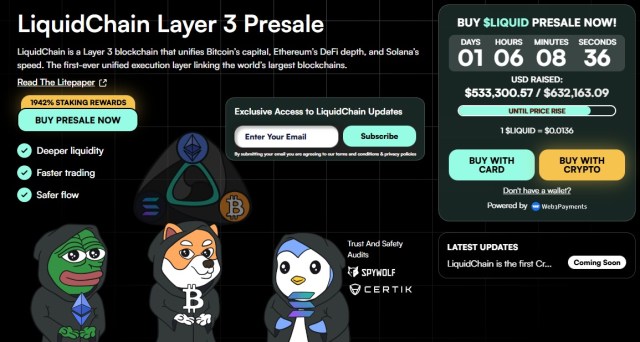
The pricing structure suggests early positioning before the protocol moves toward mainnet deployment. Investors seem to be betting on the ‘transaction fuel’ narrative, where the native $LIQUID token is required to power cross-chain operations and liquidity staking.

Unlike governance-only tokens, infrastructure tokens often derive value from network usage volume. If LiquidChain succeeds in capturing even a fraction of the cross-chain arbitrage and settlement market, the utility demand for the token could theoretically decouple from pure speculation.

What most coverage misses is the timing. With Bitcoin’s ecosystem expanding via L2s and Solana’s dominance in retail memes, the need for a connecting layer hasn’t been higher. The presale data points to a subset of the market hedging against the “winner takes all” chain thesis, opting instead to invest in the rails that connect them all.

$LIQUID is available here.

This article is not financial advice. Cryptocurrency investments, including presales and Layer 3 protocols, carry high risks, including total loss of capital. Always conduct independent due diligence before investing.

Editorial Process for bitcoinist is centered on delivering thoroughly researched, accurate, and unbiased content. We uphold strict sourcing standards, and each page undergoes diligent review by our team of top technology experts and seasoned editors. This process ensures the integrity, relevance, and value of our content for our readers.

patrubogdan

Follow

Full Profile

Related Posts

Meme Coins Outpace Blue Chips as Retail Liquidity Rotates, Igniting Maxi Doge’s $4.5M Rise

AI Can’t Save the Market Alone, But It Can Transform It: How SUBBD Token Redefines Content Economics

Russian Lawmaker Predicts Bitcoin Collapse While Smart Money Rotates into Layer 2 Utility

Solana’s Low Fees Create Strong Competition for Base, BNB, and Polygon and Fuel SUBBD Token

Chainlink Founder Sergey Nazarov Identifies 3 Trends That Will Define the Cryptosphere as Hyper Token Soars

Bitcoin Demand Plunges Per CryptoQuant, Yet Maxi Doge Endures

Perguntas relacionadas

QWhat is the strategic significance of Bybit's partnership with the Stockholm Open?

ABybit's partnership with the Stockholm Open, rebranding it to the 'BNP Paribas Nordic Open', is a strategic move to target a high-net-worth and institutional European audience. It's a calculated effort to build credibility and position itself in front of a sophisticated, capital-rich investor class that has been cautious about entering the volatile crypto market.

QWhat key problem in the crypto market is LiquidChain aiming to solve?

ALiquidChain is addressing the problem of liquidity fragmentation across different blockchains. It aims to unify the fractured liquidity silos of Bitcoin, Ethereum, and Solana into a single execution layer, eliminating the need for complex bridges and wrapped assets which are vectors for hacks.

QHow does LiquidChain's 'Single-Step Execution' work?

ALiquidChain's 'Single-Step Execution' is enabled by its Cross-Chain Virtual Machine (VM). It allows a user to perform a complex action, such as staking an asset on Ethereum and taking a loan against it on Solana, in a single transaction without manually bridging funds between the chains.

QWhat is the current status and price of LiquidChain's ($LIQUID) presale?

AAs detailed in the article, LiquidChain's presale has raised $533K. The tokens are currently priced at $0.0136 in this ongoing early funding round.

QAccording to the article, how are infrastructure project tokens like $LIQUID different from governance-only tokens?

AInfrastructure tokens like $LIQUID derive their value from network usage and utility, as they are required to power cross-chain operations and liquidity staking. This is in principle from governance-only tokens, whose value is more closely tied to speculation and voting rights rather than direct utility demand from transaction volume.

Leituras Relacionadas

Unlocking $100 Million in Liquidity? Pump.fun's New Policy Tests the 5-Minute Pump Technique

Pump.fun, a popular meme coin launchpad, has introduced a new standard mechanism called BOOST. It aims to address a significant capital efficiency issue: when a newly launched token graduates from its initial bonding curve to a liquidity pool (LP), roughly 20% of its liquidity becomes permanently locked as "dead liquidity," estimated to waste over $100 million annually. Instead of locking these funds permanently, BOOST repurposes them. Upon a token's migration, approximately 20% of the settlement funds (e.g., 17.6 SOL or ~$2516 USDC) are used to buy back the token on the open market over a 5-minute period via a Time-Weighted Average Price (TWAP) mechanism. All purchased tokens are immediately burned. This creates a brief, systematic buy pressure immediately after migration, potentially generating a short-term price surge ("pump") while permanently reducing the token's circulating supply. The goal is to enhance the immediate post-launch trading experience, potentially increasing trader retention and sustainable protocol revenue, which funds ongoing token buybacks. However, concerns exist that this artificial 5-minute boost could lower the barrier for launching low-quality tokens and lead to steeper price crashes once the buy pressure stops, if followed by large sell-offs. The feature automatically applies to tokens migrating after July 21, 2024, but not to previously migrated tokens or those launched via the Mayhem AI Agent lab.

marsbitHá 5m

Unlocking $100 Million in Liquidity? Pump.fun's New Policy Tests the 5-Minute Pump Technique

marsbitHá 5m

Podcast Notes | Conversation with GSR Asset Management Head: To Determine if This Crypto Rally is Real, Just Watch the Lending Rates on Aave

Podcast Summary: Dialogue with GSR's Head of Asset Management: To Determine if This Crypto Rally is Real, Just Check Lending Rates on Aave Andy Baehr, Managing Director of Asset Management at GSR, discusses the current crypto market, characterizing it as stuck in a state of "ambivalence" with short-lived, unsustainable rallies. He outlines a simple framework: the market moves between "ambivalence" and "conviction" (sustained upward momentum). Currently, every rally resembles a single-stage rocket booster that quickly fizzles out. Baehr identifies three key signals to watch: 1) DeFi lending rates, 2) the potential passage of the CLARITY Act, and 3) the market forming a consensus on the "Fed hawkish peak." He emphasizes that the most immediate indicator for the sustainability of the recent CPI-triggered rally is the USDC borrowing rate on Aave, currently around 3.75%—close to U.S. Treasury yields. The absence of a credit spread indicates low leverage demand and a lack of market energy. He explains that a healthy, sustained rally requires layered buying pressure. Last year's rally progressed from an ETH short squeeze to crypto-native trader influx and finally to ETF inflows. Currently, this structure is missing. Other potential structural buyers like Digital Asset Treasury (DAT) companies are absent, and ETF flows have proven transient. Baehr notes that while small-cap crypto tokens outperformed large caps in Q2—a potential sign of capitation in major assets—capital is also flowing to more exciting opportunities like AI stocks and tech IPOs, leaving crypto sidelined. Regarding DeFi, he highlights that platforms like Aave provide a clear, real-time signal of leverage demand through their supply/demand-driven interest rates. A significant, sustained rate increase would signal genuine market conviction. He also observes the quiet emergence of fixed-income-like products and vaults in DeFi. On regulation, the probability of the CLARITY Act passing before the August 7th deadline has dropped linearly from 75% to below 40% on Polymarket. Baehr suggests its passage would be treated as a bullish surprise, a potent driver for price movement. However, political hurdles, including ethical clause debates and disclosures about the First Family's crypto profits, remain significant obstacles. Ultimately, the market awaits clarity on the Fed's terminal rate under Chair Warsh. Until the "Fed Solstice"—the point where the market collectively understands the peak of hawkish policy—sustained conviction will be difficult to achieve.

marsbitHá 36m

Podcast Notes | Conversation with GSR Asset Management Head: To Determine if This Crypto Rally is Real, Just Watch the Lending Rates on Aave

marsbitHá 36m

Trading

Spot
活动图片





