BTC on a Roller Coaster, HYPE Hits New Highs | Guest Analysis

marsbitPublicado em 2026-05-18Última atualização em 2026-05-18

Resumo

**Market Analysis: BTC Volatility and HYPE's New Highs** This week, markets experienced significant volatility. Macro pressures intensified with a bond market sell-off, rising rate hike expectations, and oil surpassing $110. Bitcoin (BTC) broke below $78K and is currently testing a critical range. The core debate centers on the nature of BTC's rally from its February low: Is it the start of a new uptrend (Path 1: bullish) or merely a B-wave rally within a larger monthly corrective structure (Path 2: bearish)? The outcome of the battle in the $78,500-$79,500 zone is key this week. * **For BTC:** * **Mid-term:** Maintain a neutral, cash position. * **Short-term:** Two contingency plans with ≤30% position size and strict stop-losses: * **Plan A (Bearish):** Sell if price rebounds but faces resistance in the $78,500-$79,500 zone. * **Plan B (Bearish):** Sell if price convincingly breaks below the $73,500-$75,000 support. * A break above $90,000-$93,100 would strongly favor the bullish Path 1 scenario. * **For HYPE:** HYPE continues its independent rally, hitting new highs with over 10% gains this week. The trend remains bullish as long as price holds above the key support at $38.41. * **Short-term Strategies (≤30% position):** * **Plan A (Bullish):** Buy on a confirmed break above $45.76. * **Plan B (Bearish):** Sell short on a confirmed break below $45.76. * **Plan C (Bullish):** Buy on a pullb...

Having experienced this week, it feels like being on a roller coaster.

This week saw a concentrated release of macro pressures - bond market crash, rising rate hike expectations, oil prices breaking $110, BTC falling below $78K, currently hovering in a critical range.

Structurally, I have focused on analyzing two path projections since the February low: Has a new uptrend already started, or is this a B-wave rally within a monthly-level major correction? This judgment is currently inconclusive, but the outcome of the multi/empty battle in the $78,500-$79,500 region is the most important observation window this week.

In terms of trading, for medium-term positions, continue to hold no position and observe. For short-term trading, A/B contingency plans have been prepared around support and resistance levels, with positions controlled within 30%, strictly adhering to stop-loss.

Summary of Core Trading Views for This Week:

• BTC Multi-cycle Price Structure Analysis (Comparison of two subsequent path projections) (Details in Part 1)

• BTC Market Forecast and Medium/Short-term Trading Strategies for This Week (Details in Part 2)

• HYPE Daily Chart Price Structure Analysis (Details in Part 3)

• HYPE Market Forecast and Short-term Trading Strategy for This Week (Details in Part 4)

Market Verification of Last Week's Trading Strategy and Core Views:

• BTC Short-term Trade Performance: Bitcoin completed one short-term long position trade last week (1x leverage), successfully achieving a profit of approximately 2.02%. (Details in Table 1)

• Market Verification of BTC Price Trend Forecast: In last week's article, we pointed out: The probability is high that the market will experience high-level wide-range fluctuations around the $79,500~$80,600 region. The current market movement verifies our previous forecast.

I. First, Let's Look at BTC's Projections

1. Analysis of BTC's Price Structure Since the February Low: Two Key Path Projections and Multi/Empty Battle

In previous weekly review articles, when analyzing Bitcoin's daily chart correction structure since the October 2025 high ($126,200), we proposed three main Elliott Wave structure projections. Currently, due to the D-wave rally cycle in Projection Two (complex five-wave correction structure) significantly exceeding the previous B-wave in terms of duration, excessively extending in the time dimension and disrupting the equilibrium of the wave structure, its probability of occurrence has greatly decreased. Therefore, the core market divergence and future directional choice will focus on the two other projections. This section will provide an in-depth analysis and probability comparison of these two projection paths.

1. Path One: Correction Ended, New Uptrend Has Begun (Bullish Mindset)

Bitcoin _ Daily Chart:
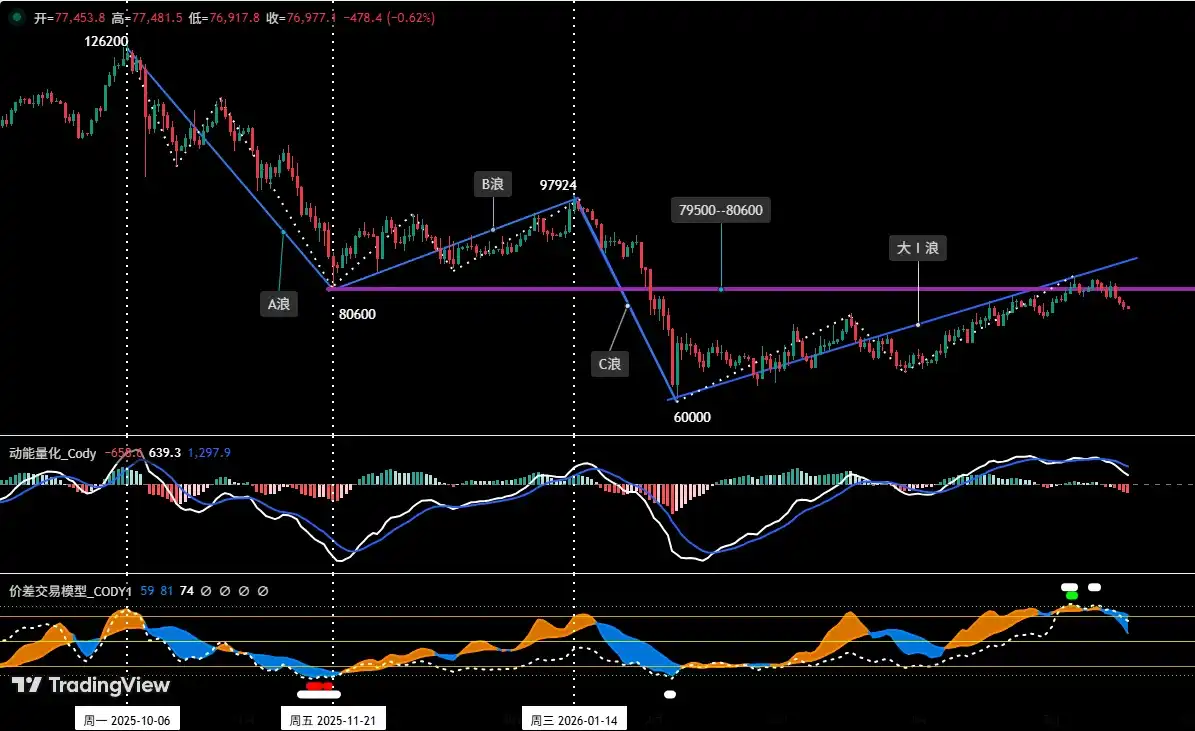
Figure 1

As shown in (Figure 1), this view holds that: The daily-level correction starting from the previous high of $126,200 has completed an A-B-C three-wave structure, where the C-wave ended at $60,000 (low on Feb 6th), and the market has shifted from a downtrend to an uptrend. It is currently running the major Wave I (i.e., the initial rally wave). (This content has been detailed in previous articles and will not be elaborated here)

• Major Wave I (Initial Rally Wave): From $60,000 (2026-02-06) to present, running for about 100 days, with a maximum gain of about 38.1%, and still ongoing.

• Potential Major Wave II (Corrective Wave): The correction wave about to run after the end of Major Wave I's rally, its low point will not break below $60,000.

2. Path Two: Monthly-level Correction Structure, Currently in a B-wave Rally (Bearish Mindset)

Bitcoin _ Monthly Chart:
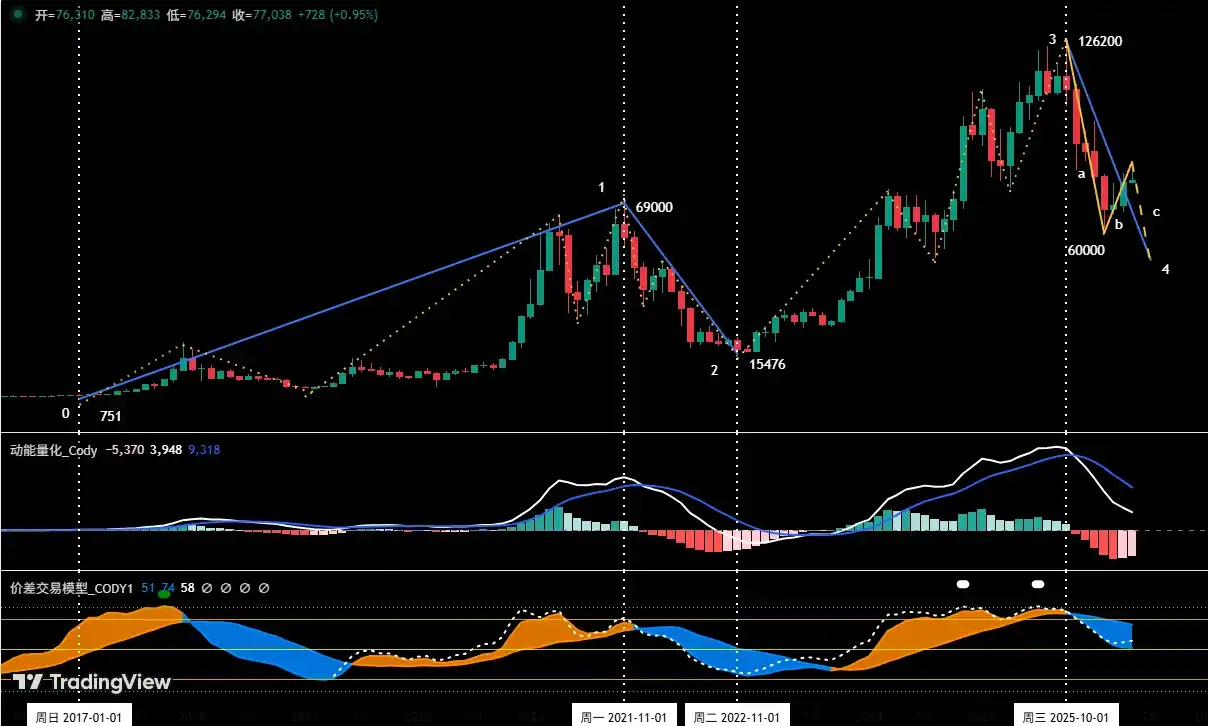
Figure 2

As shown in (Figure 2), this view holds that: The correction starting from the previous high of $126,200 may present a monthly-level a-b-c three-wave correction structure, and it is currently running the b-wave rally.

• a-wave (Decline Wave): From $126,200 (2025-10-06) to $60,000 (2026-02-06), lasting about 4 months (approx. 122 days), with a maximum decline of about 52.5%.

• b-wave (Rally Wave): From $60,000 (2026-02-06) to present, lasting over 3 months (approx. 100 days), with a maximum gain of about 38.1%, and still ongoing.

• Potential c-wave (Decline Wave): The correction wave about to run after the end of the b-wave rally, its low point may break below the $60,000 mark.

3. Assessing the Possibility of "Path Two" from a Monthly Chart Perspective

The Bitcoin monthly chart shows: From January 1, 2017, to present (only this segment of complete trading data is extracted), it can be subdivided into a 4-segment structure;

• Segment 0-1 (Rally Cycle): From $751 (2017-01-01) to $69,000 (2021-11-10), lasting about 59 months (approx. 1774 days).

• Segment 1-2 (Correction Cycle): From $69,000 (2021-11-10) to $15,476 (2022-11-21), lasting about 13 months (approx. 376 days). A deep correction against the previous rally phase (i.e., Segment 0-1), with a maximum decline of about 77.57%.

• Segment 2-3 (Rally Cycle): From $15,476 (2022-11-21) to $126,200 (2025-10-06), lasting about 35 months (1050 days). The main uptrend wave that reached new historical highs, with a maximum gain of about 715.46%.

• Segment 3-4 (Correction Cycle): From $126,200 (2025-10-06) to present, running for about 7 months (approx. 223 days), with a maximum decline of 52.46%, and still ongoing. A correction against the previous main uptrend (i.e., Segment 2-3).

• From a monthly chart perspective, the current market is in the Segment 3-4 correction cycle. If it follows principles of cycle alternation and time symmetry, and there is some proportional relationship in amplitude and duration with "Segment 1-2 (correction)" and "Segment 2-3 (rally)", then the probability of the correction structure described in "Path Two" occurring will increase significantly. This means the current rally since the February 6th low is only part of a large-scale correction.

4. Based on the above analysis of the two path projections, both possess realistic possibilities in the current macro and technical environment. To study their relative probability, the core lies in examining the nature of the rally initiated from the February 6th low; its running duration and spatial amplitude have become key criteria for judgment.

5. Our core view is as follows:

• If this rally becomes exhausted and ends in the near term, the probability of the market choosing "Path Two" will significantly rise.

• Conversely, if the rally continues to extend in time and space, the likelihood of the market choosing "Path One" will increase accordingly.

To this end, we propose an observable quantitative threshold: If this rally can break through the $90,000 to $93,100 region, it may become a crucial factor in confirming whether a fundamental shift in market structure has occurred.

Simultaneously, we believe that, regardless of which path the market chooses, by analyzing historical cycle patterns and macro liquidity expectations, a relatively reliable bottoming structure is more likely to gradually form and be confirmed in the fourth quarter of this year.

2. In-depth Analysis of BTC's Hourly Chart Price Structure: (Using the 4-hour chart as the analysis timeframe)

Bitcoin _ 4-hour Chart
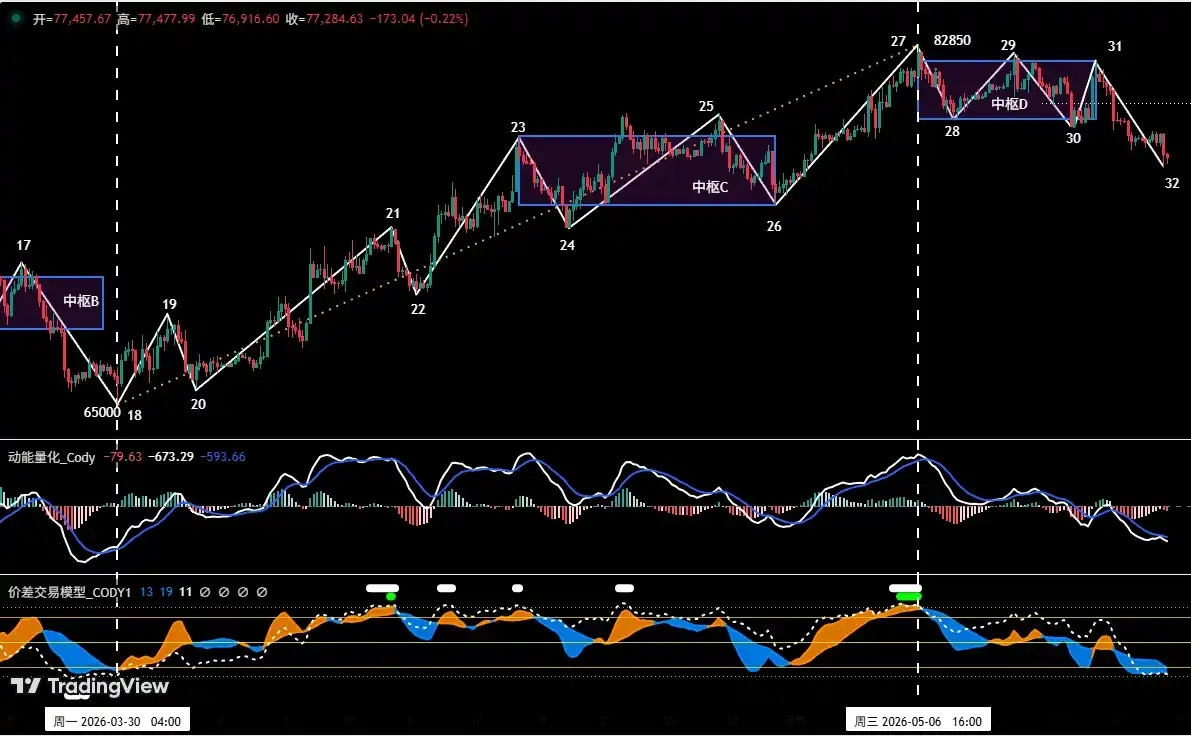
Figure 3

As shown in (Figure 3), since the departure segment from "Central C" (26-27) to present;

• On the 4-hour chart, it can be subdivided into: 26-27, 27-28, 28-29, 29-30, 30-31, 31-32, totaling 6 segments. Among them, because segments 27-28, 28-29, 29-30, and 30-31 overlap, they constitute Central D.

• Currently, the departure segment (31-32) is moving downward and has already broken below the support of the lower boundary of "Central D" ($79,200) and the upper boundary of "Central C" ($78,500). If the price subsequently confirms an effective break below the $78,500~$79,200 region, the daily-level correction structure may initiate.

II. Next, How to Operate

1. BTC Market Trend Forecast for This Week:

Core view for this week: The key lies in observing the outcome of the multi/empty battle over the $78,500~$79,500 region. The gain or loss of this region can serve as an important basis for judging whether the price can maintain high-level fluctuations or turn downward for a correction.

2. Key Resistance Levels:

• First Resistance Zone: $78,500~$79,500 region (around the upper/lower boundaries of the two centers)

• Second Resistance Zone: $83,500~$84,500 region (previous multi/empty concentrated trading area)

3. Key Support Levels:

• First Support Level: $73,500~$75,000 region (previous significant support)

• Second Support Level: $69,500~$70,500 region (previous significant support)

4. Trading Strategy for This Week (excluding impact of sudden news)

1. Medium-term Strategy:

Bitcoin _ Daily Chart: (Position Monitoring Model)
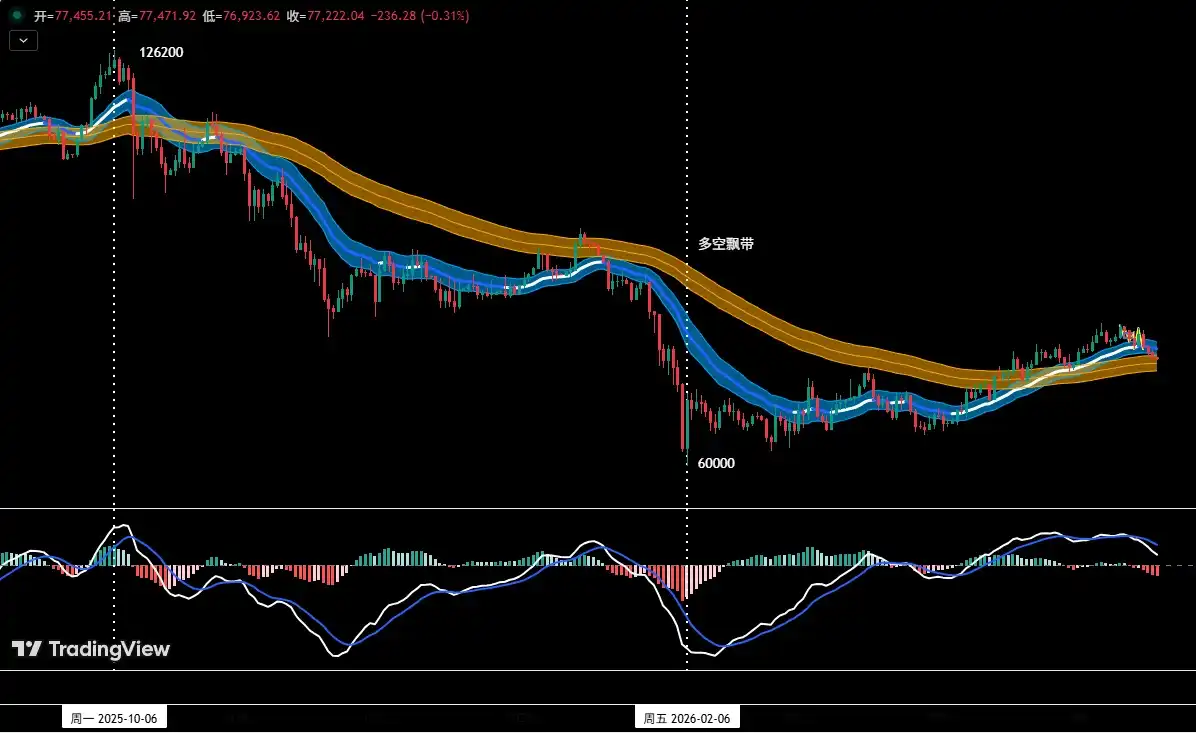
Figure 4

Position Monitoring Model: As shown in (Figure 4), based on trading rules, the medium-term market direction is not yet clear. This week, maintain a no-position observation strategy for medium-term.

2. Short-term Strategy: Use 30% position, set stop-loss points, and look for "price difference" opportunities based on support and resistance levels. (Using 30-minute/60-minute charts as the operation timeframe).

3. In short-term operations, to dynamically cope with the complex evolution of the market, we have pre-formulated A/B two sets of specific operational contingency plans.

Plan A: Rally meets resistance, go short on highs.

• Entry: When the price rallies to the $78,500~$79,500 region and meets resistance, combined with the quantitative model's topping signal, a short position below 30% can be established.

• Risk Control: Initial stop-loss set above $80,600.

• Exit: When adjusting near important resistance levels and combined with model signals, gradually close positions to take profits.

Plan B: Effectively breaks support, follow the trend to go short.

• Entry: When the price effectively breaks below the $73,500~$75,000 support region and combines with the model's topping signal, a short position below 30% can be established.

• Risk Control: Initial stop-loss set above $76,500.

• Exit: When falling to important support levels and combined with model signals, gradually close positions to take profits.

III. After Discussing BTC, Let's Look at HYPE

BTC is still in a tug-of-war within the $78K-$82K range, with neither bulls nor bears gaining much advantage. HYPE, on the other hand, has been hitting new highs independently, rising over 10% this week.

HYPE_ Daily Chart
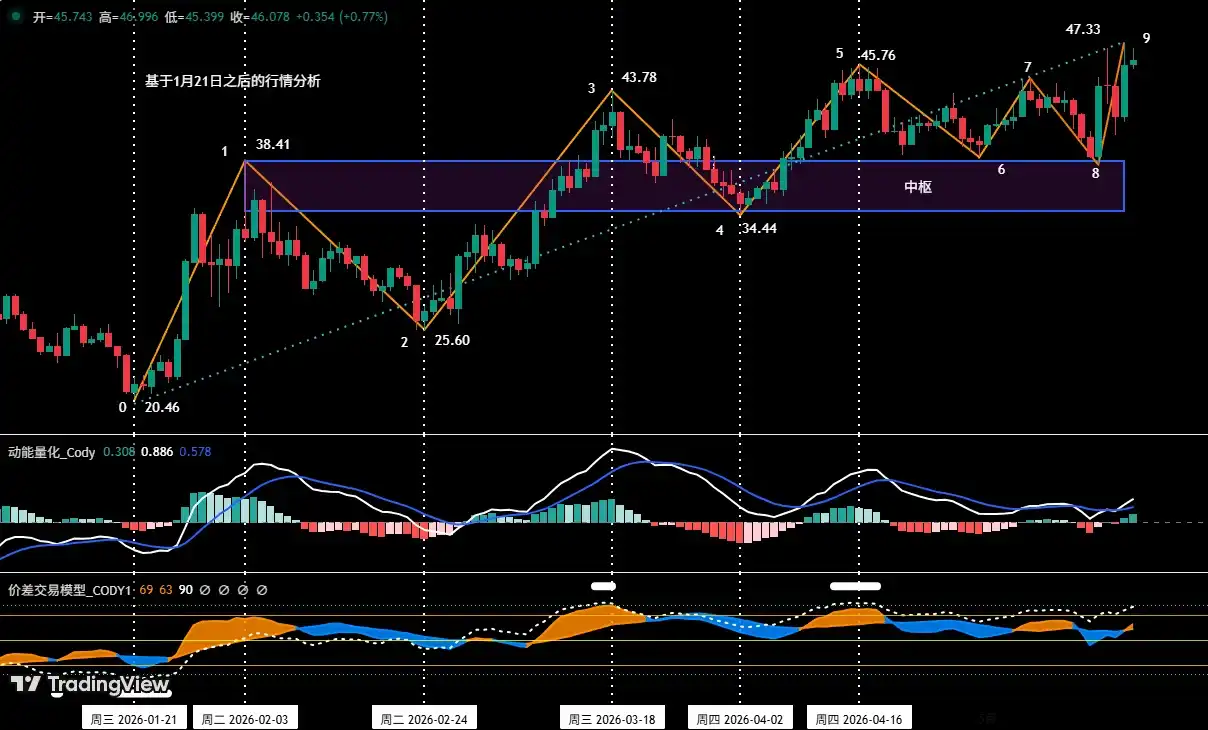
Figure 5

1. As shown in (Figure 5), the rally in HYPE starting from the low of $20.46 on January 21st, on the daily chart, can be divided into segments 0-1, 1-2, 2-3, 3-4, 4-5, 5-6, 6-7, 7-8, 8-9, totaling nine segments. Since the recent price reached a new high of $47.30 (endpoint 9) since the rally from $20.46, the current price structure remains in a daily-level uptrend.

2. As shown in (Figure 5), because segments 1-2, 2-3, and 3-4 overlap, they collectively construct a daily-level "rally central pivot" (or "upward central zone").

3. If the HYPE price can continue to operate above the key point of $38.41 (the upper boundary of the central pivot), the market is expected to maintain a high-level consolidation pattern on the daily chart, to digest previous gains and accumulate directional momentum.

IV. HYPE Trend Judgment and Subsequent Operation Prediction

1. HYPE Market Trend Forecast for This Week:

Core HYPE view for this week: Focus on observing the gain or loss in the multi/empty battle around the central pivot upper boundary ($38.41) and the previous high ($45.76).

2. HYPE Short-term Trading Strategy for This Week:

Combined with the current market structure, the following three sets of short-term operational contingency plans have been optimized and formulated for you, with the core revolving around the battle over the "central pivot upper boundary ($38.41) and the previous high ($45.76)".

• Plan A: Breakout Go Long (Trend Continuation)

If the price effectively breaks through and stabilizes above the $45.76 support, simultaneously combined with bottom signals triggered by the two major models, consider lightly testing a long position. Position must be controlled below 30% and strictly adhere to stop-loss discipline.

• Plan B: Breakdown Turn Short (Trend Reversal)

If the price effectively breaks below the $45.76 support, simultaneously combined with top signals triggered by the two major models, consider lightly testing a short position. Position must be controlled below 30% and strictly adhere to stop-loss discipline.

• Plan C: Support Go Long (Trend Reversal Back Up)

If the price retraces to near $38.41, finds support, shows signs of stabilization, and simultaneously combines with bottom signals triggered by the two major models, consider lightly testing a long position. Position must be controlled below 30% and strictly adhere to stop-loss discipline.

V. Finally, Let's Talk About Results

1. Short-term Operation Review: (See Table 1)

We strictly followed the operational contingency plan. Based on trading signals from our self-constructed Price Difference Trading Model and Momentum Quantitative Model, we completed one short-term (long position) operation last week, achieving a trading profit of 2.02%.

1. Bitcoin Short-term Trade Details Summary: (Leverage*1)
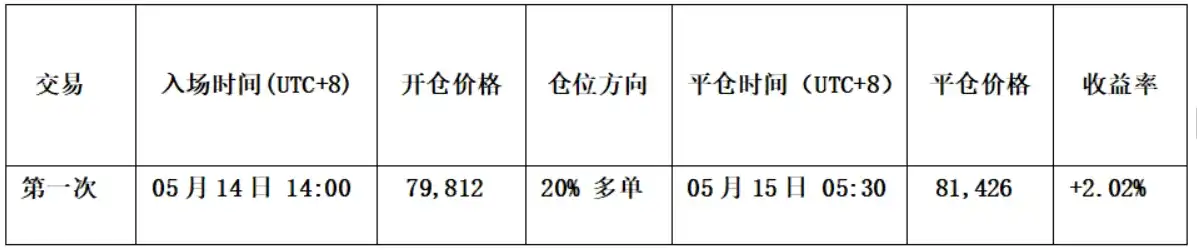
Table 1

2. Short-term Trade Recap: (See Figure 6)

• Entry Strategy:

a. When the price fell near $78,500 and showed signs of stabilization and then broke through the previous consolidation range upper resistance at $79,500;

b. The Price Difference Trading Model triggered a bottom warning signal (white dot + red dot), forming a bottom resonance with the Momentum Quantitative Model.

Therefore, we established a 20% long position at $79,812.

• Exit Strategy:

a. When the price rallied near $82,000 and met resistance, with the K-line forming a top resistance signal;

b. The Price Difference Trading Model triggered a strong top warning signal (green dot + white dot), forming a top selling signal with the Momentum Quantitative Model.

Therefore, we closed all positions near $81,426.

• Summary: This trade successfully profited approximately 2.02%.

HYPE_30-minute Chart: (Momentum Quantitative Model + Price Difference Trading Model)
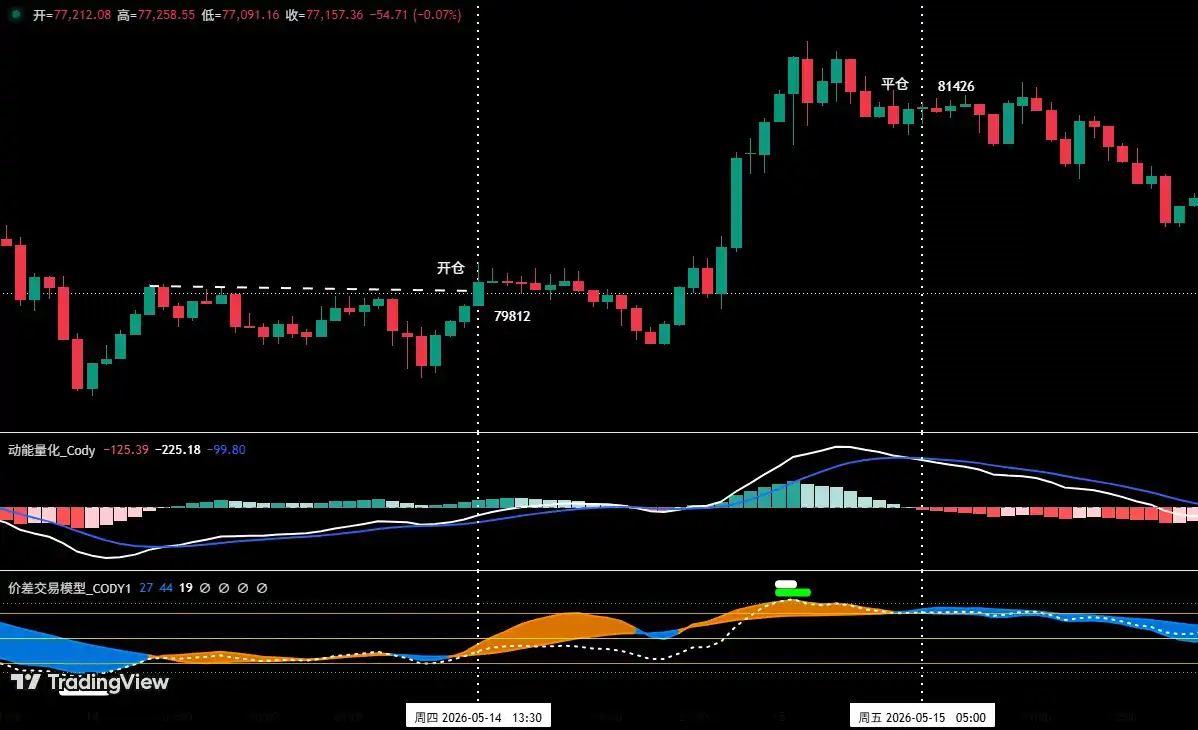
Figure 6 (Short-term Trade Illustration)

VI. Special Notes:

1. When opening a position: Immediately set the initial stop-loss level.

2. When profit reaches 1%: Move the stop-loss to the entry price (breakeven point) to ensure principal safety.

3. When profit reaches 2%: Move the stop-loss to the 1% profit level.

4. Continuous tracking: Thereafter, for every additional 1% profit in price, move the stop-loss level up by 1% accordingly, dynamically protecting and locking in profits.

Financial markets change rapidly. All market analysis and trading strategies require dynamic adjustment. All views, analytical models, and operational strategies involved in this article are derived from personal technical analysis and are for personal trading log purposes only. They do not constitute any investment advice or operational basis. Markets involve risks, investment requires caution. Please do not make decisions based on this.


Perguntas relacionadas

QBased on the article, what are the two main future path scenarios for BTC price movement, and what is the key factor in determining which path is more likely?

AThe two main future path scenarios are Path One (bullish) and Path Two (bearish). Path One posits that the correction from the October 2025 high is over and a new uptrend has started. Path Two suggests the current move is merely a B-wave rebound within a larger, monthly-scale correction. The key factor is the nature of the rebound since the February 6 low. If the rally ends soon, Path Two becomes more likely. If it continues to extend in time and price, especially breaking above the $90,000–$93,100 region, Path One gains significant probability.

QAccording to the analysis, what specific price zone is identified as the most critical short-term battle ground for BTC this week?

AThe most critical short-term battle ground for BTC this week is the $78,500–$79,500 price zone. The outcome of the struggle between buyers and sellers in this area will be a key indicator of whether the price can maintain its high-level consolidation or turn downward into a deeper adjustment.

QWhat are the two short-term trading plans (Plan A and Plan B) proposed for BTC in the article, and what are their respective entry triggers?

AThe two short-term trading plans for BTC are Plan A and Plan B. Plan A is 'Selling on rallies at resistance.' The entry trigger is when the price rebounds to the $78,500–$79,500 zone and encounters resistance, coupled with a top signal from the quantitative models. Plan B is 'Following the trend on a breakdown.' The entry trigger is when the price effectively breaks below the $73,500–$75,000 support zone, combined with a top signal from the models.

QHow does the article characterize the recent performance of HYPE in contrast to BTC?

AThe article states that while BTC has been locked in a tug-of-war within the $78K–$82K range, HYPE has been 'setting new highs on its own,' rising over 10% for the week mentioned. It is portrayed as outperforming and marching to its own beat.

QWhat is the suggested risk management rule (trailing stop method) for locking in profits after a successful trade entry?

AThe suggested trailing stop method is: 1) Set an initial stop-loss immediately upon opening a position. 2) Move the stop-loss to the break-even point (entry price) once a 1% profit is achieved. 3) Move the stop-loss to lock in a 1% profit when the total profit reaches 2%. 4) Continue tracking, moving the stop-loss up by 1% for every additional 1% gain in price, thereby dynamically protecting and locking in profits.

Leituras Relacionadas

Warsh's First Day in Office, Markets Deliver a 'Wake-up Call': Rate Hike Expected This Year

On his first day in office, newly inaugurated Federal Reserve Chairman Warsh received a stark market warning, with expectations now fully pricing in a 25-basis-point interest rate hike this year. The shift was triggered by hawkish remarks from Fed Governor Waller, who stated that inflation is now the key policy "driver" and that the odds of a hike or cut are evenly split. This sent short-term Treasury yields higher. Waller signaled a significant pivot in his stance, citing disappointing inflation and labor data. He suggested removing "easing bias" language from Fed statements and did not rule out future rate increases if inflation fails to recede, though he noted immediate action isn't warranted without signs of unanchored inflation expectations. Chairman Warsh faces immediate pressure at his first FOMC meeting in June. With the preferred inflation gauge at a three-year high, analysts warn that failing to hike could be interpreted as an implicit easing of policy. The geopolitical situation in the Middle East is adding to existing price pressures. The market's expectation for a hike contrasts sharply with earlier forecasts for multiple cuts. While long-term Treasury yields have been contained by lower energy prices recently, analysts note they remain under structural upward pressure. Warsh's swearing-in at the White House highlights political scrutiny over Fed independence. However, the market has made it clear that inflation is the most urgent challenge, leaving the new chairman little time to settle in.

marsbitHá 52m

Warsh's First Day in Office, Markets Deliver a 'Wake-up Call': Rate Hike Expected This Year

marsbitHá 52m

Has Microsoft Lost Its Way in the AI Race, and Can Copilot Bring It Back on Track?

Microsoft, once seen as an early AI frontrunner due to its investment in OpenAI, is navigating a strategic shift amid increased competition. Its initial reliance on OpenAI’s GPT models has been complicated by OpenAI’s growing ambitions as a direct competitor, rapid advancements from rivals like Claude and Gemini, and the disruptive rise of AI agents, which challenge its traditional SaaS business model. These factors contributed to stock declines and slower-than-expected adoption of its flagship Copilot products. In response, CEO Satya Nadella has taken a hands-on role in product development, signaling the urgency of change. Microsoft is pivoting from a model-centric strategy to a "model-agnostic" enterprise platform approach. It aims to become the foundational layer connecting various AI models—from OpenAI, Anthropic, or its own new "Superintelligence" team—with enterprise workflows, data, security, and cloud services. Recent organizational changes merged consumer and enterprise Copilot teams to accelerate innovation, exemplified by new products like Copilot Tasks and Copilot Cowork. However, this transformation comes at a high cost. Microsoft faces massive capital expenditures, potentially reaching ~$190 billion by 2026, to support AI infrastructure. While its platform strategy shows early signs of traction with growing Azure AI revenue, it must balance startup-like agility with the reliability expected by enterprise clients. The core challenge is no longer being the sole AI winner but defending its position as the essential enterprise software entry point amidst rapid technological commoditization and the shift towards always-on AI agents.

marsbitHá 1h

Has Microsoft Lost Its Way in the AI Race, and Can Copilot Bring It Back on Track?

marsbitHá 1h

Why Haven't Forex Stablecoins Taken Off?

Why FX Stablecoins Never Took Off: A Path Forward via Synthetic FX Despite the explosive growth of stablecoin-powered digital banking, which has seen ~$6B in VC investment and a 24x surge in crypto card spending in under a year, a major limitation persists: these banks are essentially dollar-only accounts. This leaves 95-99% of global accounts, which are denominated in non-USD currencies, underserved. Attempts to create native foreign currency (FX) stablecoins (like EURC) have largely failed, with total FX stablecoin TVL at ~$600M compared to $400B for USD stablecoins—a 700x gap. These FX tokens face critical challenges: fragile pegs due to low liquidity, limited exchange/FinTech acceptance, poor on/off-ramps, complex regional compliance, and a chicken-and-egg adoption problem. The article argues that the solution lies not in competing with entrenched USD stablecoin networks (USDT/USDC), but in adopting a synthetic FX model inspired by traditional finance. Specifically, it advocates for Mark-to-Market Non-Deliverable Forwards (NDFs)—cash-settled FX derivatives that allow users to maintain underlying USD stablecoin holdings while having their account balance and P&L denominated in a foreign currency. This approach offers key advantages: strong oracle-based pegs, retention of deep USD stablecoin liquidity and yield, superior on/off-ramps, scalability to any currency with a reliable feed, and capital efficiency. It mirrors how modern institutional FX markets operate. Primary use cases for on-chain NDFs include: 1. **Digital Banks/Wallets:** Enabling multi-currency accounts for international users without leaving the USD stablecoin ecosystem, boosting deposits and retention. 2. **FX Carry Trade Vaults:** Offering access to sovereign interest rate differentials (e.g., earning yield on BRL) in a more stable and scalable format than crypto-native products like Ethena. 3. **Global Enterprise Payments:** Allowing merchants to receive payments in local currency equivalents while settling in USD stablecoins, similar to services offered by Stripe for fiat. The conclusion is that synthetic FX, not native FX stablecoins, is the viable path to integrating foreign exchange into the growing stablecoin digital banking landscape, potentially unlocking the next phase of institutional DeFi and multi-trillion-dollar global adoption.

链捕手Há 2h

Why Haven't Forex Stablecoins Taken Off?

链捕手Há 2h

IOSG Founder: Web3 Is 'Losing Blood,' How Can Practitioners Survive Better?

IOSG Founder: Web3 Is "Bleeding Out" – How Can Practitioners Survive Better? In a candid reflection, the founder of IOSG Ventures voices deep concerns about the current state of Web3, describing an ecosystem experiencing severe "blood loss." Despite the recent MuShanghai event showcasing a successful pivot towards a more diverse, global community, a somber reality persists: many crypto-native attendees were there exploring exits or new labels in biotech, AI, and robotics. The core issue is identified as a breakdown in the ecosystem's positive feedback loop. Alarmingly, underestimated "low-probability bad events" are occurring simultaneously: a significant brain drain of Chinese developers to AI, a lack of breakout applications despite massive funding, and a widening credibility gap for practitioners globally, often stigmatized as scam artists. This has created a dire接班人 (successor) problem, with the next generation seeing little professional prestige or financial upside in crypto compared to fields like AI. A significant portion of the critique focuses on Ethereum and Vitalik Buterin. While not pessimistic about Ethereum's technology, the founder worries that critical development windows were missed by focusing on niche technical narratives like ZK and L2 instead of mass-market applications. A more urgent concern is that Vitalik may be isolated in an "information bubble," shielded from the grassroots community's hardships by layers of intermediaries, preventing crucial feedback from reaching him. The call is for Vitalik to return to a founder's mindset, re-engage directly with the community, and rally efforts for the next decade. The divergence between U.S. and Chinese OG (Original Gangster) ecosystems is stark. While many U.S. builders reinvest their wealth into the ecosystem, the Chinese scene suffers from a severe lack of "造血能力" (blood-making ability), with most market-driven funds struggling and many early success stories cashing out entirely. This threatens the entire Asian Web3 ecosystem's survival. For individual practitioners, survival advice is pragmatic: find your core "why," maintain life balance beyond token prices, continuously learn new skills (like AI), form small, trusted alliances for mutual support, and practice self-compassion. The industry's greatest need is not money or tech, but lighthouses—individuals at all levels who offer mentorship, grants, referrals, and honest reflection to guide others. The piece concludes with a direct appeal: OGs must pay forward the opportunities the industry gave them; founders must not struggle alone; and builders must continue their work, ensuring it remains a viable profession. The survival of Web3's "cathedral" depends not on any single leader but on the collective responsibility of everyone who remains.

marsbitHá 3h

IOSG Founder: Web3 Is 'Losing Blood,' How Can Practitioners Survive Better?

marsbitHá 3h

Trading

Spot
Futuros

Artigos em Destaque

Como comprar HYPE

Bem-vindo à HTX.com!Tornámos a compra de Hyperliquid (HYPE) simples e conveniente.Segue o nosso guia passo a passo para iniciar a tua jornada no mundo das criptos.Passo 1: cria a tua conta HTXUtiliza o teu e-mail ou número de telefone para te inscreveres numa conta gratuita na HTX.Desfruta de um processo de inscrição sem complicações e desbloqueia todas as funcionalidades.Obter a minha contaPasso 2: vai para Comprar Cripto e escolhe o teu método de pagamentoCartão de crédito/débito: usa o teu visa ou mastercard para comprar Hyperliquid (HYPE) instantaneamente.Saldo: usa os fundos da tua conta HTX para transacionar sem problemas.Terceiros: adicionamos métodos de pagamento populares, como Google Pay e Apple Pay, para aumentar a conveniência.P2P: transaciona diretamente com outros utilizadores na HTX.Mercado de balcão (OTC): oferecemos serviços personalizados e taxas de câmbio competitivas para os traders.Passo 3: armazena teu Hyperliquid (HYPE)Depois de comprar o teu Hyperliquid (HYPE), armazena-o na tua conta HTX.Alternativamente, podes enviá-lo para outro lugar através de transferência blockchain ou usá-lo para transacionar outras criptomoedas.Passo 4: transaciona Hyperliquid (HYPE)Transaciona facilmente Hyperliquid (HYPE) no mercado à vista da HTX.Acede simplesmente à tua conta, seleciona o teu par de trading, executa as tuas transações e monitoriza em tempo real.Oferecemos uma experiência de fácil utilização tanto para principiantes como para traders experientes.

286 Visualizações TotaisPublicado em {updateTime}Atualizado em 2026.04.28

Como comprar HYPE

Discussões

Bem-vindo à Comunidade HTX. Aqui, pode manter-se informado sobre os mais recentes desenvolvimentos da plataforma e obter acesso a análises profissionais de mercado. As opiniões dos utilizadores sobre o preço de HYPE (HYPE) são apresentadas abaixo.

活动图片












