BTC Faces Triple Resistance at $80,000 Milestone, HYPE Hits New Highs Signaling Potential | Invited Analysis

Odaily星球日报Publicado em 2026-05-26Última atualização em 2026-05-26

Resumo

This weekly analysis maintains a structured framework, focusing on Bitcoin (BTC) and HYPE, dissecting their multi-timeframe price action to identify key support and resistance zones and formulate actionable trading plans. The previous week's short position on BTC yielded a 2.78% gain, reinforcing the "signal-driven, disciplined" approach. For Bitcoin, the core scenario revolves around the battle between the 78,500–79,500 USD resistance zone and the 73,500–75,000 USD support area. The daily chart shows BTC within a rising channel; a failure to hold support at the channel's midline could lead to a test of the lower boundary. The 4-hour chart details an 8-segment corrective structure from the 82,850 USD high. Two short-term strategies are proposed: (A) Selling on a failed rally into the 78.5k-79.5k zone, with a stop above 80,600, or (B) Selling a confirmed breakdown below the 73.5k-75k support, with a stop above 76,500. Medium-term positioning remains neutral. For HYPE, the 4-hour chart indicates a five-wave advance from the May 14th low, now showing potential exhaustion and a top warning signal near 65 USD. The core view is to watch for a potential short-term peak formation. The recommended strategy is to avoid chasing the rally and instead look for a long setup upon a pullback to the 47.5–50 USD support zone, provided clear stabilization and model confirmation signals appear. The report concludes with a detailed review of the prior BTC short trade, executed based on model s...

Continuing with our structured analytical framework this week, we dissect the current movements of Bitcoin and HYPE from multiple time dimensions, assess the struggle between buyers and sellers around key resistance and support zones, and formulate specific, actionable operational plans accordingly.

Last week's short position successfully yielded a 2.78% profit, once again validating the trading logic of 'signal-driven, strict discipline'. However, a single profitable trade does not necessarily indicate that the market direction is definitively correct – the market always retains the possibility of exceeding expectations.

The core variable for this week remains the battle between the $78,500–$79,500 resistance zone and the $73,500–$75,000 support zone. The outcome will be answered by the market itself.

Summary of Core Trading Views for This Week:

• Analysis of BTC's multi-cycle price structure. (Detailed in Part I)

• BTC price forecast and mid-term, short-term operational strategies for this week. (Detailed in Part II)

• Analysis of HYPE's hourly chart structure. (Detailed in Part III)

• HYPE price forecast and short-term operational strategy for this week. (Detailed in Part IV)

Market Verification of Last Week's Trading Strategies and Core Views:

• BTC Short-term Trading Results: Bitcoin completed one short-term short position (1x leverage) last week, achieving a profit of approximately 2.78%. (Detailed in Table I)

• Market Verification of BTC Price Forecast: In last week's article, we noted: If the price effectively breaks below the support zone of $78,500–$79,500, it will test the support strength near $75,000. The current market movement verifies our previous forecast.

I. Analysis of Bitcoin's Multi-Cycle Price Structure

1. BTC Daily Chart Structure Analysis

Bitcoin _ Daily Chart:
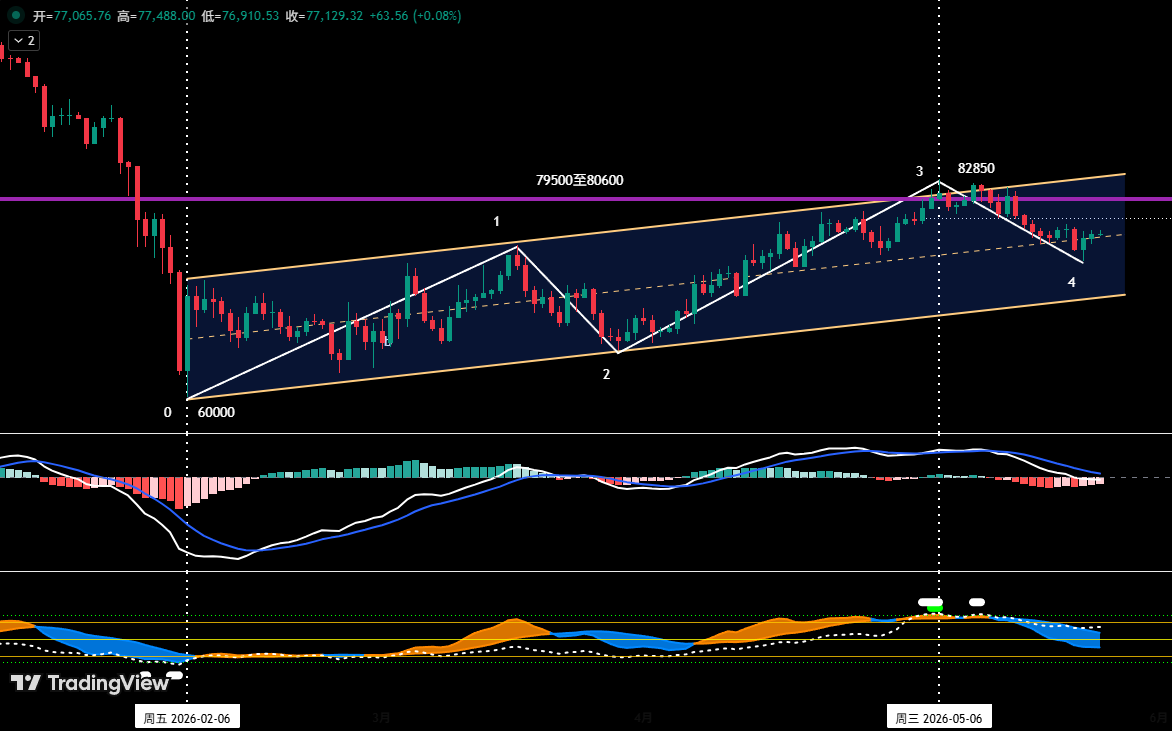
Figure 1

• As shown in (Figure 1), since establishing a stage low near $60,000 on February 6, 2026, Bitcoin's daily chart has constructed and maintained a clearly structured ascending channel: its lower boundary is formed by connecting the lows of February 6 and March 29, while the upper boundary is drawn parallel to the lower boundary through the high of March 17.

• In our April 27th weekly review, we pointed out: "The current price is facing dual pressure from the channel's upper boundary and the $79,500 to $80,600 resistance zone, making a breakthrough likely difficult". Subsequent market action confirmed this assessment. After nearly 20 days of tug-of-war between bulls and bears, although a new rebound high of $82,850 was reached on May 6, it failed to effectively break through this zone's resistance, and the price subsequently began to fluctuate downward.

From the current structure, the price has retraced from near the channel's upper boundary to the mid-channel area. If the price fails to find effective support near the mid-channel and resume its uptrend, the probability of subsequently seeking support at the channel's lower boundary is increasing.

2. In-Depth Analysis of BTC's Hourly Chart Structure

Bitcoin _ 4-Hour Chart
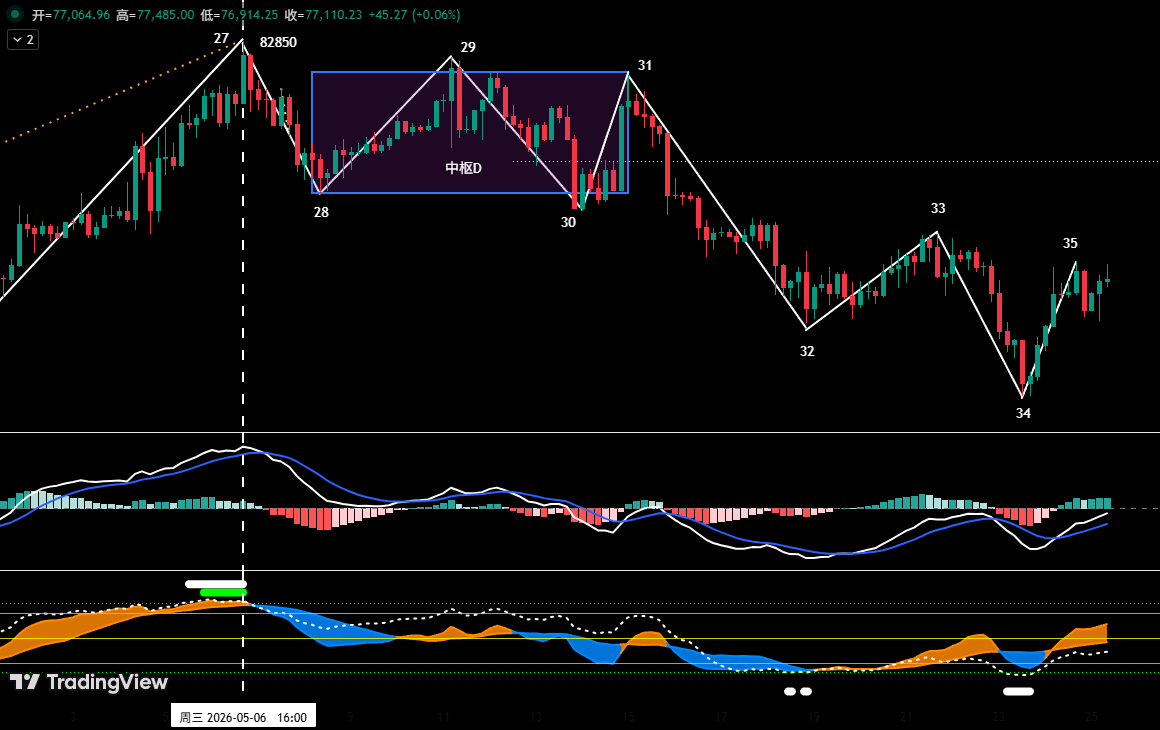
Figure 2

As shown in (Figure 2), from the May 6 high of $82,850 to the ongoing adjustment;

• On the 4-hour chart, it can be subdivided into an 8-segment adjustment structure: from "Segment 27-28" to "Segment 34-35"; Central D: Due to the overlapping of segments 28-29, 29-30, and 30-31, they constitute Central D.

• From the 4-hour chart structure, segment 34-35 is about to rebound to the $78,500–$79,500 zone. If the price faces resistance and falls back after rebounding to this zone, failing to form an effective breakthrough, the market is likely to continue the current fluctuating adjustment pattern and test the core support band of $73,500–$75,000 again.

II. Bitcoin Price Forecast and Operational Strategy for This Week

1. BTC Price Forecast for This Week:

Core View This Week: Focus on the outcome of the battle between bulls and bears for the $78,500–$79,500 resistance zone and the $73,500–$75,000 support zone.

2. Core Resistance Levels:

• First Resistance Zone: $78,500–$79,500 (near the boundaries of two central zones)

• Second Resistance Zone: $83,500–$84,500 (previous dense trading area)

3. Core Support Levels:

• First Support Zone: $73,500–$75,000 (previous key support area)

• Second Support Zone: $69,500–$70,500 (previous key support area)

4. Operational Strategy for This Week (Excluding Impact of Sudden News)

1. Mid-term Strategy:

Bitcoin _ Daily Chart: (Position Monitoring Model)
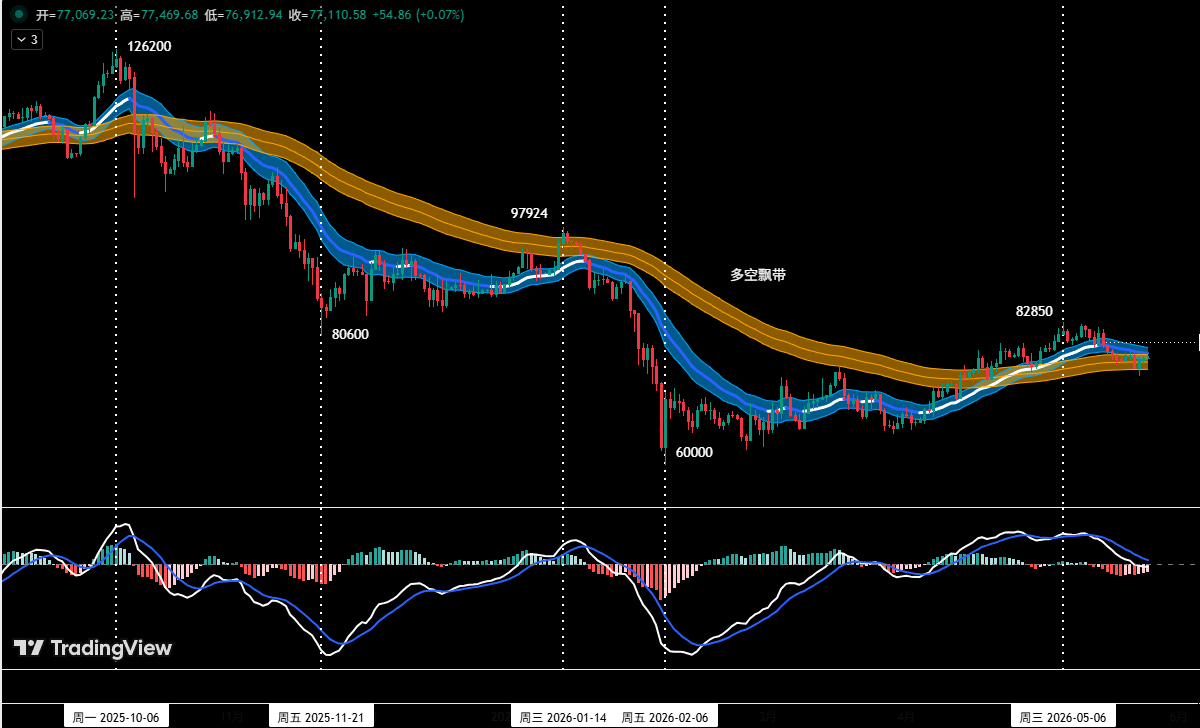
Figure 3

Position Monitoring Model: As shown in (Figure 3), based on trading rules, the market's mid-term direction is not yet clear. This week's mid-term strategy is to maintain a no-position, wait-and-see approach.

2. Short-term Strategy: Utilize 30% of capital, set stop-loss points, and look for "spread" opportunities based on support and resistance levels. (Using 30-minute/60-minute as the operational cycle).

3. In short-term operations, to dynamically respond to complex market developments, we have prepared two specific operational plans in advance: Plan A/B.

Plan A: Rebound Meets Resistance, Sell High.

• Entry: When the price rebounds to the $78,500–$79,500 zone and encounters resistance, combined with a top signal from the quantitative model, a short position below 30% can be established.

• Risk Control: Initial stop-loss set above $80,600.

• Exit: When the price adjusts near important support levels combined with model signals, gradually close the position to take profits.

Plan B: Effectively Breaks Support, Follow the Trend Short.

• Entry: When the price effectively breaks below the $73,500–$75,000 support zone combined with a model top signal, a short position below 30% can be established.

• Risk Control: Initial stop-loss set above $76,500.

• Exit: When the price falls to important support levels combined with model signals, gradually close the position to take profits.

III. HYPE Price Structure Analysis

HYPE_4-Hour Chart
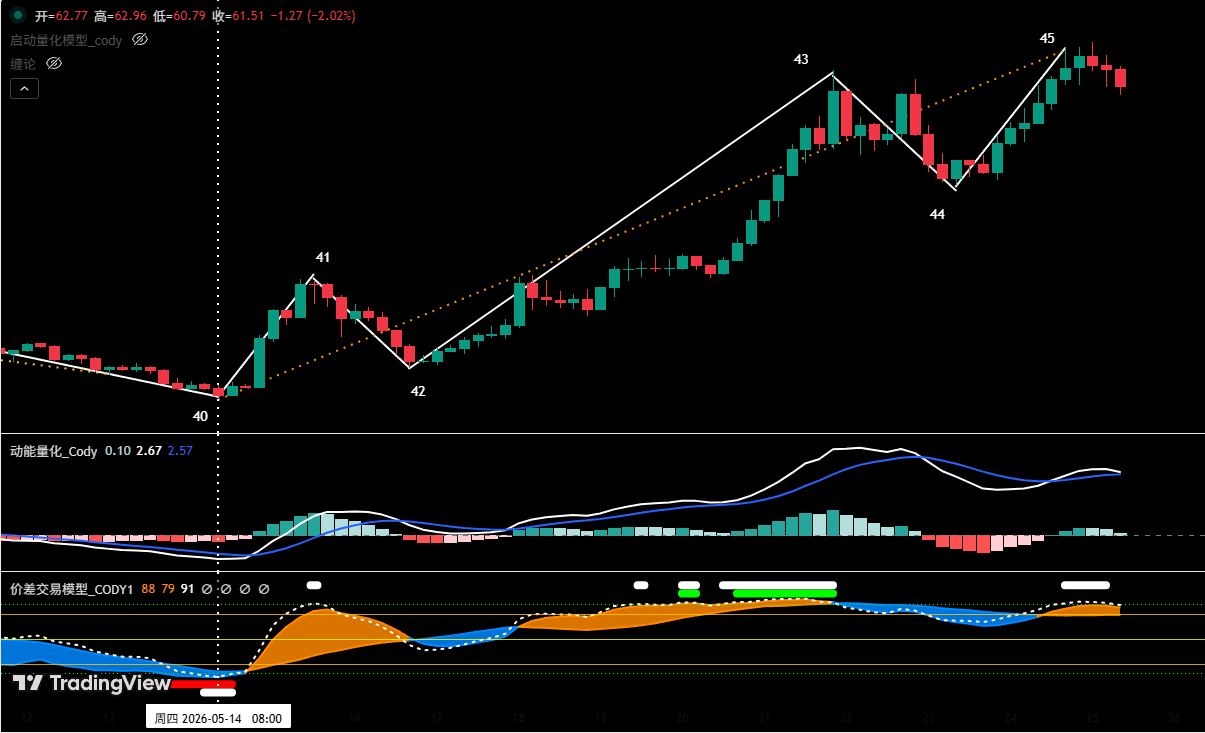
Figure 4

1. As shown in (Figure 4), the uptrend in HYPE starting from the May 14 low of $38.14 can be divided into a five-segment structure on the 4-hour chart: segments 40-41, 41-42, 42-43, 43-44, 44-45.

2. Our proprietary "Spread Trading Model" indicates that near endpoint 45, a top warning signal (white dot) has been triggered.

3. From the "Momentum Quantification Model" perspective, the rising segment (44-45) near $65 has shown signs of weakening upward momentum.

4. If the price forms a momentum bearish divergence state at "endpoint 45" and resonates with the top warning signal from the "Spread Trading Model", the probability of the price forming a short-term high here increases significantly.

IV. HYPE Price Forecast and Short-Term Operational Strategy for This Week

1. HYPE Price Forecast for This Week:

Core View on HYPE This Week:

• Observe whether "endpoint 45" can form a short-term high since the rise began on May 14.

• If a short-term high is formed, subsequently, look for short-term long opportunities when the price retraces to key support areas (e.g., $47.5 to $50) and shows clear signs of stabilization.

2. HYPE Short-Term Operational Strategy for This Week: (Buy on Support)

Currently, the strategy of "avoid blind chasing of highs, buy on dips" should be followed. If the price retraces to the $47.5 to $50 zone, finds support, and shows stabilization signals, combined with bottom signals triggered by both models, consider a light long position. Position size must be controlled below 30%, and strict stop-loss discipline must be maintained.

V. Operational Review

1. Short-Term Operation Review:(See Table I)

We strictly followed the operational plan. Based on trading signals from our proprietary "Spread Trading Model" and "Momentum Quantification Model", we completed one short-term (short) operation last week, achieving a trading profit of 2.78%.

1. Bitcoin Short-Term Trading Details Summary: (Leverage*1x)
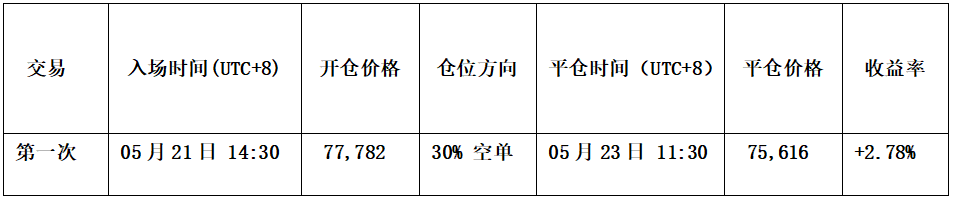
Table I

2. Short-Term Trading Review: (See Figure VI)

• Entry Strategy:

a. When the price rebounded near $78,500, encountered resistance, showed pressure signals, and the candlestick formed a "top reversal" bearish signal;

b. The "Spread Trading Model" triggered a top warning signal (white dot), and the "Momentum Quantification Model" formed a momentum bearish divergence signal.

Therefore, we established a 30% short position at $77,782.

• Exit Strategy:

a. When the price fell near $75,000 and found support, and the candlestick formed a "bottom reversal" signal;

b. The "Spread Trading Model" triggered a strong bottom warning signal (red dot + white dot), resonating with a bottom signal from the "Momentum Quantification Model".

Therefore, we closed all positions near $75,616.

• Summary: This trade successfully yielded a profit of approximately 2.78%.

BTC_30 Minute Chart: (Momentum Quantification Model + Spread Trading Model)
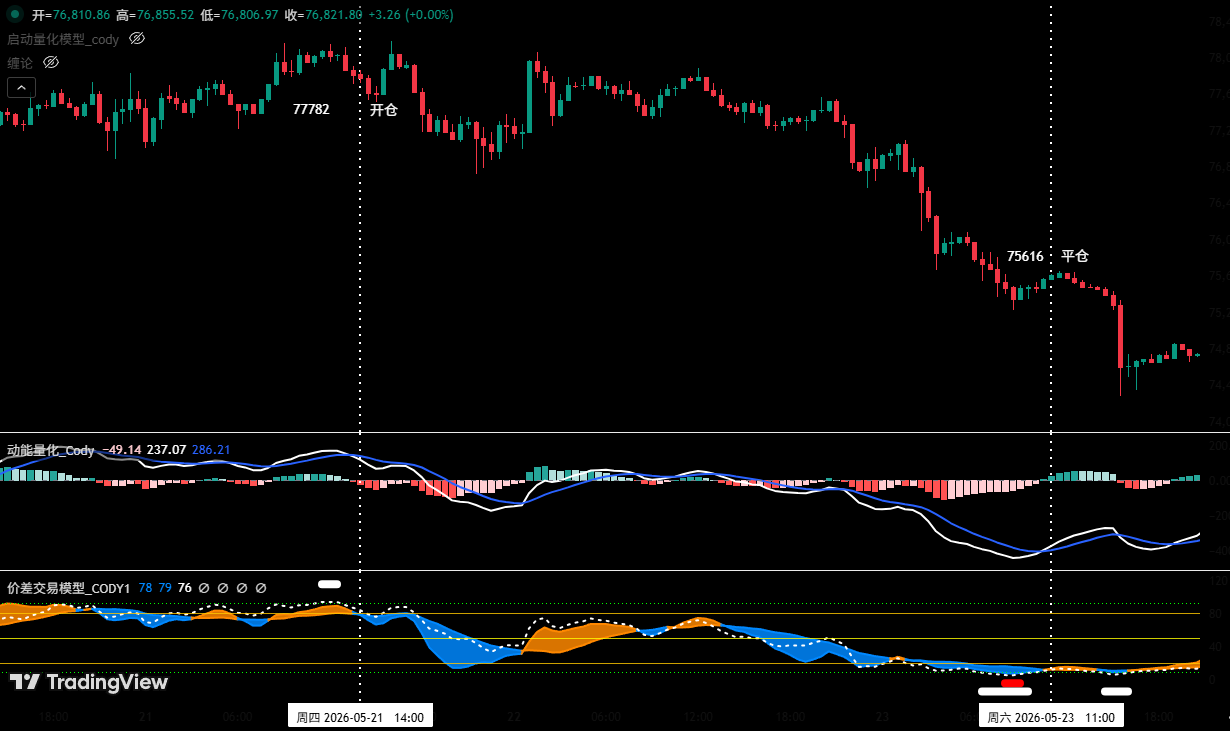
Figure V (Short-Term Trading Illustration)

VI. Special Note:

1. When opening a position: Immediately set the initial stop-loss point.

2. When profit reaches 1%: Move the stop-loss to the entry cost price (break-even point) to ensure capital safety.

3. When profit reaches 2%: Move the stop-loss to the 1% profit level.

4. Continuous Tracking: Thereafter, for every additional 1% profit, move the stop-loss up by 1%, dynamically protecting and locking in profits.

Financial markets are ever-changing; all market analysis and trading strategies require dynamic adjustment. All views, analytical models, and operational strategies mentioned in this article are derived from personal technical analysis, intended solely for personal trading log purposes, and do not constitute any investment advice or operational basis. The market carries risks; investment requires caution. Please do not make decisions based on this.


Perguntas relacionadas

QAccording to the article's analysis, what are the two main resistance and support zones for Bitcoin this week?

AThe core resistance zone is 78,500-79,500 USD, and the core support zone is 73,500-75,000 USD.

QWhat was the primary technical reason for the author's successful short trade on Bitcoin the previous week?

AThe trade was executed based on a confluence of signals: the price encountered resistance near 78,500 USD forming a top reversal candlestick pattern, and both the author's 'Price Difference Trading Model' and 'Dynamic Energy Quantification Model' triggered top warning signals, including momentum divergence.

QBased on the analysis, what is the key condition for HYPE to present a potential short-term buying opportunity?

AA short-term buying opportunity for HYPE may arise if the price pulls back to the 47.5 to 50 USD support zone, shows clear signs of stabilization, and is confirmed by bottom signals from the author's trading models.

QWhat is the author's current medium-term (midline) strategy for Bitcoin, as indicated by their 'Position Monitoring Model'?

AAccording to the 'Position Monitoring Model', the medium-term market direction is not yet clear. Therefore, the author is maintaining a strategy of staying out of the market (holding no medium-term positions) and observing.

QIn the article's proposed short-term trading plans for Bitcoin, what are the two main scenarios (Plan A and Plan B)?

APlan A: Sell short on rallies if the price rebounds to the 78,500-79,500 USD resistance zone and encounters selling pressure. Plan B: Sell short on breakouts if the price effectively breaks below the 73,500-75,000 USD support zone.

Leituras Relacionadas

Trade.xyz's Rebase Refusal Sparks Controversy, On-Chain Pre-IPO Market Faces Major Pricing Test

The debate surrounding Trade.xyz's refusal to adjust its SPCX (SpaceX pre-IPO) perpetual contract pricing amid updated share count revelations highlights a key challenge for on-chain pre-IPO markets. While several centralized exchanges (CEXs) paused and repriced their contracts after SpaceX's filing showed a ~10% increase in total shares, Trade.xyz maintained its market-driven pricing logic, which tracks expected per-share price sentiment rather than fundamental valuation metrics like market cap. This discrepancy triggered cross-platform arbitrage and caused leveraged long positions on Trade.xyz to suffer significant losses, as the platform's HIP-3 architecture lacks a native "Rebase" mechanism to neutrally adjust all user positions following such corporate actions. The incident underscores the difficulty for decentralized perpetual exchanges (Perp DEXs) to implement Rebase—a process CEXs handle by centrally pausing markets and adjusting ledger data. On-chain, this requires complex smart contract modifications, increasing gas costs, complexity, and potential attack surfaces. While some DEXs have managed similar adjustments, Trade.xyz's current design does not natively support it, though the team is reportedly exploring solutions for future events like stock splits. Ultimately, the controversy serves as a critical case study for the nascent on-chain pre-IPO sector, raising questions about price discovery reliability, transparent rule disclosure, and the readiness of DeFi infrastructures to handle traditional corporate actions as real-world assets (RWAs) gain traction.

marsbitHá 7m

Trade.xyz's Rebase Refusal Sparks Controversy, On-Chain Pre-IPO Market Faces Major Pricing Test

marsbitHá 7m

The 'Middle Eastern Prince' Swindles a Wealthy Woman: Renting Planes and Rolls-Royces, Scamming 120 Million Over Three Years

Two brothers who posed as "Middle Eastern princes" have been sentenced in the United States to 24 and 23 years in prison, respectively, and ordered to pay over $21.2 million in restitution and back taxes. Over three years, they fraudulently obtained approximately $21 million, primarily by promoting fictitious investment projects, including a non-existent cryptocurrency mining operation in a former General Electric industrial park in East Cleveland. The brothers, aged 42 and 33, created elaborate personas: one claimed to be a wealthy royal family heir and the city's "International Economic Advisor," while the other posed as a hedge fund manager with expertise from watching the TV show *Billions*. They bolstered their image by renting luxury cars and private jets and cultivating a relationship with a local mayor's chief of staff, who provided official-looking documents and government event access. A significant portion of the victims' funds, about $18 million, came from a single Chinese investor, a woman from Sichuan with experience in Bitcoin mining. The brothers also defrauded several women, including one former girlfriend. Their scheme unraveled when the primary investor discovered her $6 million worth of mining equipment had been sold off. The case highlights a trend of impostors using fabricated "Middle Eastern royal" identities to target wealthy individuals. Similar incidents include a "Dubai prince" who recently promoted a $500 million family office in Hong Kong and a Colombian man who impersonated a Saudi prince for decades in the US before being caught and sentenced in 2019.

marsbitHá 21m

The 'Middle Eastern Prince' Swindles a Wealthy Woman: Renting Planes and Rolls-Royces, Scamming 120 Million Over Three Years

marsbitHá 21m

a16z Partner: Being in the Flow of Capital Is the True Moat

A16z Partner: Standing in the Cash Flow is the True Moat Historically, many of the strongest companies built their moats by positioning themselves within "cash flows"—facilitating value creation and transfer in a network and taking a cut. The more value flows, the larger they grow. Crypto is the first modern technology natively built for this. With open ledgers, programmable settlement, and stablecoins enabling internet-speed global value transfer, it allows startups to inherit network effects from day one. Well-designed tokens align users, developers, and the protocol towards network growth, distributing value to contributors. This model isn't new (e.g., railroads, Visa, Google, AWS) but Crypto democratizes it. It lets entrepreneurs target areas with high inefficiency and profit extraction—like traditional finance's payments, custody, FX, and settlement—to compress costs, increase speed, and redistribute value by standing in the new flow. The opportunity extends beyond finance to emerging markets like GPU/compute, AI training data, energy, and space, where new, programmable infrastructure can be built without legacy constraints. Key questions for founders: Are you already in the cash flow? Does your revenue scale 10x with network activity? Where is profit extraction highest relative to value created in your market? The strategy is clear: compress the old cost structure, position yourself in the new value stream, and let the network compound.

marsbitHá 49m

a16z Partner: Being in the Flow of Capital Is the True Moat

marsbitHá 49m

Capturing 15 Top-Tier Zero-Day Vulnerabilities: A Consensus Protocol Debug Agent Framework Built by 0G Lab in Collaboration with Teams from NUS, PKU, and BUPT

"Agents Capture 15 Critical Zero-Day Bugs: 0G Lab's Multi-Agent Framework Automates Debugging in Consensus Protocols" Distributed consensus protocols are notoriously difficult to debug due to complex, intertwined states. A novel framework, Agora, developed by 0G Labs with researchers from NUS, Peking University, and Beijing University of Posts and Telecommunications, tackles this by fusing deep domain expertise with a collaborative multi-agent LLM architecture. Agora moves beyond the limitations of single LLMs and traditional testing like fuzzing. It employs three specialized agents: an Orchestrator for global state, a Strategy agent for generating attack scenarios using distributed systems knowledge, and a TestGen agent that creates executable tests. A core innovation is its efficient "Succinct Memory & Communication" mechanism and a dynamic test harness. This allows the system to translate abstract hypotheses into concrete tests across languages like Go and Rust, run them, capture failures, and refine the approach in a closed loop—all with minimal token overhead. In rigorous evaluations on production-level protocols including Raft, EPaxos, and components from etcd and Sui, Agora discovered 15 previously unknown deep logic bugs (e.g., execution divergence, liveness violations). In stark contrast, powerful standalone LLMs like GPT-5.2 and Claude 4.5 found zero such bugs. Agora achieved this with a high precision of 73.9% and at an average cost of only about $40 per bug found. The framework demonstrates high generalizability. Its decoupled design allows the "Multi-Agent + Hypothesis-Driven Testing" paradigm to be applied to other complex domains like database concurrency control, OS kernels, and Web3 smart contract auditing. By enabling efficient, automated detection of deep logic flaws, Agora points the way for AI-powered security in critical infrastructure, aligning with the growing trends of agentic systems and automated quality control.

marsbitHá 52m

Capturing 15 Top-Tier Zero-Day Vulnerabilities: A Consensus Protocol Debug Agent Framework Built by 0G Lab in Collaboration with Teams from NUS, PKU, and BUPT

marsbitHá 52m

Trading

Spot
Futuros

Artigos em Destaque

Como comprar HYPE

Bem-vindo à HTX.com!Tornámos a compra de Hyperliquid (HYPE) simples e conveniente.Segue o nosso guia passo a passo para iniciar a tua jornada no mundo das criptos.Passo 1: cria a tua conta HTXUtiliza o teu e-mail ou número de telefone para te inscreveres numa conta gratuita na HTX.Desfruta de um processo de inscrição sem complicações e desbloqueia todas as funcionalidades.Obter a minha contaPasso 2: vai para Comprar Cripto e escolhe o teu método de pagamentoCartão de crédito/débito: usa o teu visa ou mastercard para comprar Hyperliquid (HYPE) instantaneamente.Saldo: usa os fundos da tua conta HTX para transacionar sem problemas.Terceiros: adicionamos métodos de pagamento populares, como Google Pay e Apple Pay, para aumentar a conveniência.P2P: transaciona diretamente com outros utilizadores na HTX.Mercado de balcão (OTC): oferecemos serviços personalizados e taxas de câmbio competitivas para os traders.Passo 3: armazena teu Hyperliquid (HYPE)Depois de comprar o teu Hyperliquid (HYPE), armazena-o na tua conta HTX.Alternativamente, podes enviá-lo para outro lugar através de transferência blockchain ou usá-lo para transacionar outras criptomoedas.Passo 4: transaciona Hyperliquid (HYPE)Transaciona facilmente Hyperliquid (HYPE) no mercado à vista da HTX.Acede simplesmente à tua conta, seleciona o teu par de trading, executa as tuas transações e monitoriza em tempo real.Oferecemos uma experiência de fácil utilização tanto para principiantes como para traders experientes.

297 Visualizações TotaisPublicado em {updateTime}Atualizado em 2026.06.02

Como comprar HYPE

Discussões

Bem-vindo à Comunidade HTX. Aqui, pode manter-se informado sobre os mais recentes desenvolvimentos da plataforma e obter acesso a análises profissionais de mercado. As opiniões dos utilizadores sobre o preço de HYPE (HYPE) são apresentadas abaixo.

活动图片












