Both Suffer Losses Exceeding $9 Billion, Which Is More at Risk: Strategy or Bitmine?

Odaily星球日报Publicado em 2026-06-04Última atualização em 2026-06-04

Resumo

As Bitcoin and Ethereum prices drop significantly, two major corporate treasury holders, Strategy and Bitmine, are facing massive unrealized losses—approximately $100 billion and $90 billion, respectively. The article compares their financial health and underlying risks. Bitmine, holding over 5.4 million ETH, relies primarily on equity financing (like ATM offerings) and has substantial cash reserves, alongside staking income from its ETH holdings. It plans a $300 million perpetual preferred stock offering. In contrast, Strategy, holding Bitcoin, is burdened by significant convertible debt and preferred stock dividends, with cash reserves covering only about six months of its annual dividend obligations. Strategy's leverage is higher, and it faces potential liquidity pressure if BTC prices fall further, possibly forcing asset sales. While both companies are under pressure, Bitmine’s financial structure appears more resilient, whereas Strategy’s high leverage makes it more vulnerable to continued market declines.

Original|Odaily Planet Daily(@OdailyChina)

Author|Wenser(@wenser2010)

Amid the ongoing market decline, Strategy and Bitmine, the "Twin Titans of DAT Treasuries," have both incurred massive floating losses.

This morning, BTC briefly fell below $62,000, currently hovering around $63,800; ETH dropped below $1,800, currently around $1,780. At current prices, Strategy's floating loss has reached a staggering $10 billion; Bitmine's floating loss is also around $9 billion. For now, Michael Saylor and Tom Lee are "fellow sufferers in the same predicament," with Strategy and Bitmine ranking as the top two "DAT companies with the largest losses."

However, compared to Strategy, which requires continuous dividend payments, Bitmine faces less financial pressure and retains flexibility such as raising funds through STRC preferred shares. It is reported that Bitmine plans to raise $300 million by issuing perpetual preferred shares with an annual dividend yield of 9.5%. It seems Bitmine's pace of acquiring ETH continues; meanwhile, the Sword of Damocles hanging over Strategy becomes: Where will the funds for subsequent STRC dividend payments come from? Between the two, who faces greater financial pressure? Odaily Planet Daily will analyze for readers.

Bitmine VS Strategy: The Divergent Paths of DAT Holdings

Following today's BTC plunge, community members used AI to mock Saylor's "promotion" of BTC: "A man in his sixties personally promotes, ancestral BTC price drops to $62,000 per coin."

Returning to Bitmine and Strategy, currently, Bitmine's financial structure appears safer; whereas Strategy's leverage pressure is greater.

Bitmine's Equity Issuance Game: The Debt-Free DAT Financing Play

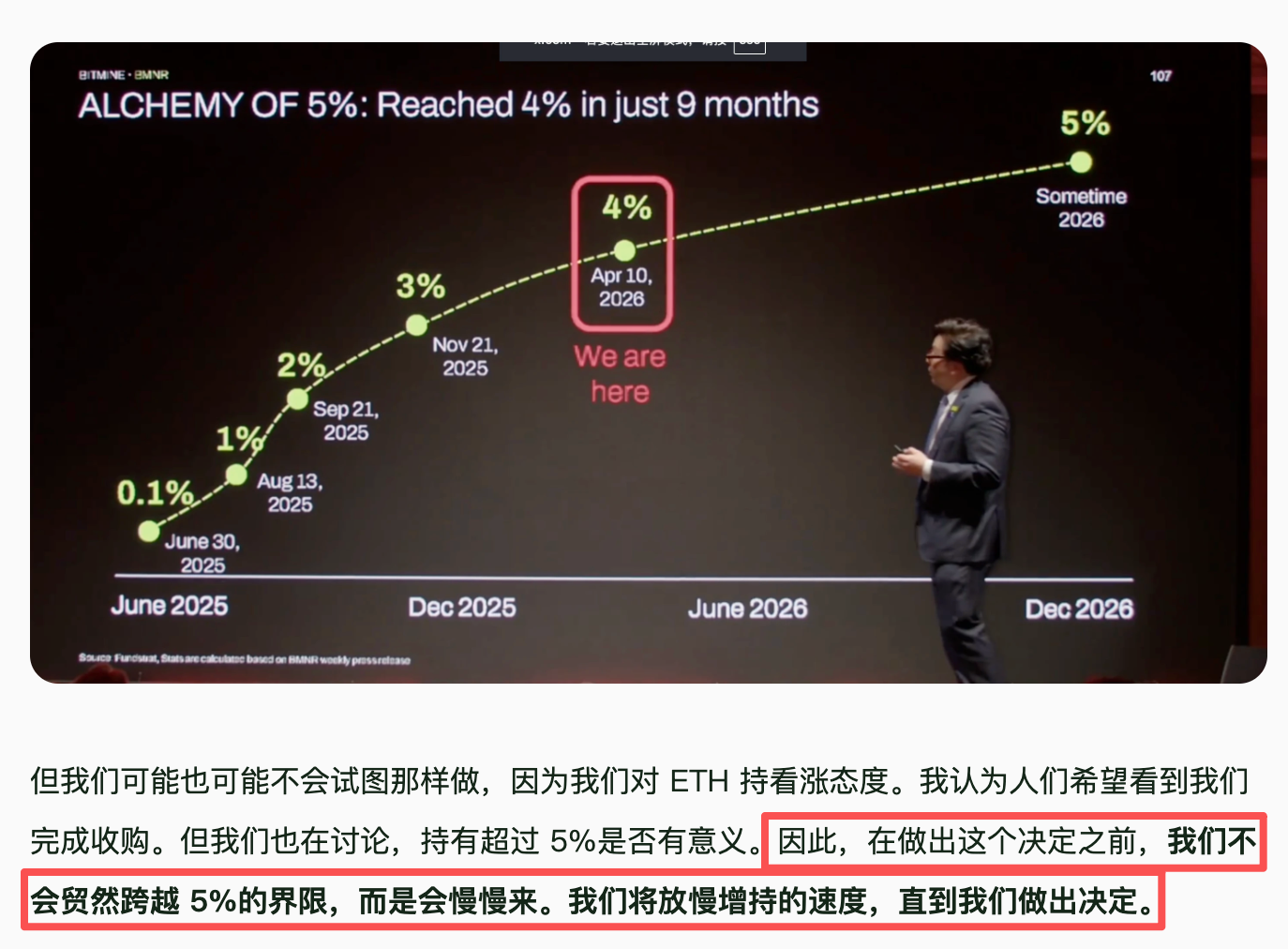
As of June 1, Bitmine holds 5,416,901 ETH; accounting for approximately 4.49% of ETH's total supply, nearing the '5% cap' repeatedly emphasized by Bitmine Chairman Tom Lee. Yesterday, Bitmine once again acquired 25,000 ETH via BitGo, valued at $48 million at the time. Currently, its holdings stand at 5,441,901 ETH.

The reason Bitmine has the confidence to continue accumulating during a market downturn is multifaceted. The primary reason is that Bitmine's funding source is equity issuance:

  • When initiating its ETH treasury and establishing the DAT company in June last year, Bitmine obtained initial seed capital through financing — $250 million, along with a small PIPE financing.
  • After July last year, Bitmine primarily relied on ATM equity issuance, gradually increasing this figure from $2 billion to $24.5 billion.

Sufficient funds give Tom Lee ample confidence, and Bitmine's book cash supports further acquisitions — in its June 1 public announcement, Bitmine also mentioned: The company's stake in Beast Industries is valued at $180 million; its stake in Eightco Holdings is valued at $93 million. The company's total cash amounts to $446 million.

Additionally, Tom Lee has previously boasted that Bitmine's Ethereum treasury generates daily staking rewards of $1 million. This refers to Bitmine staking approximately 87% (about 4.71 million ETH) of its ETH holdings through its MAVAN staking network, with estimated annualized returns of about 2.73%-3% (approximately $250-$300 million), which can also provide relatively stable cash flow.

In summary, Bitmine's financial condition is sound; and the latest preferred share financing with a 9.5% annualized dividend is expected to secure $300 million, further alleviating its financial pressure. For this company, the biggest risk points lie in equity dilution (issuing new shares) and further stock price declines due to book floating losses. If mNVA remains <1, it might trigger stock selling.

Strategy's Debt Leverage Game: Pressure from Convertible Bonds and Preferred Share Dividends

Compared to Bitmine's "using investors' money to buy ETH," Strategy faces greater financial pressure in acquiring BTC because it primarily "borrows money to increase BTC holdings."

According to information on Strategy's official website, currently, Strategy holds approximately $6.7 billion in convertible bond debt, plus about $9.9 billion in STRC preferred shares and market-value-varying amounts of STRD, STRK, STRF, requiring annual massive dividend and interest payments. At the end of May, after repurchasing $1.5 billion in convertible debt, Strategy's cash reserves fell to about $871 million, covering only about 6 months of its estimated $1.7 billion annual preferred dividend obligation.

Moreover, Strategy previously initiated a vote on "proposing to increase STRC dividend payments from monthly to twice monthly." The voting began on April 28 and will conclude on the meeting day of June 8. If approved, the first record date under the new schedule is June 30, and the first payment date is July 15. Eligible voting shareholders (holders of MSTR and STRC shares) must have held shares before April 17.
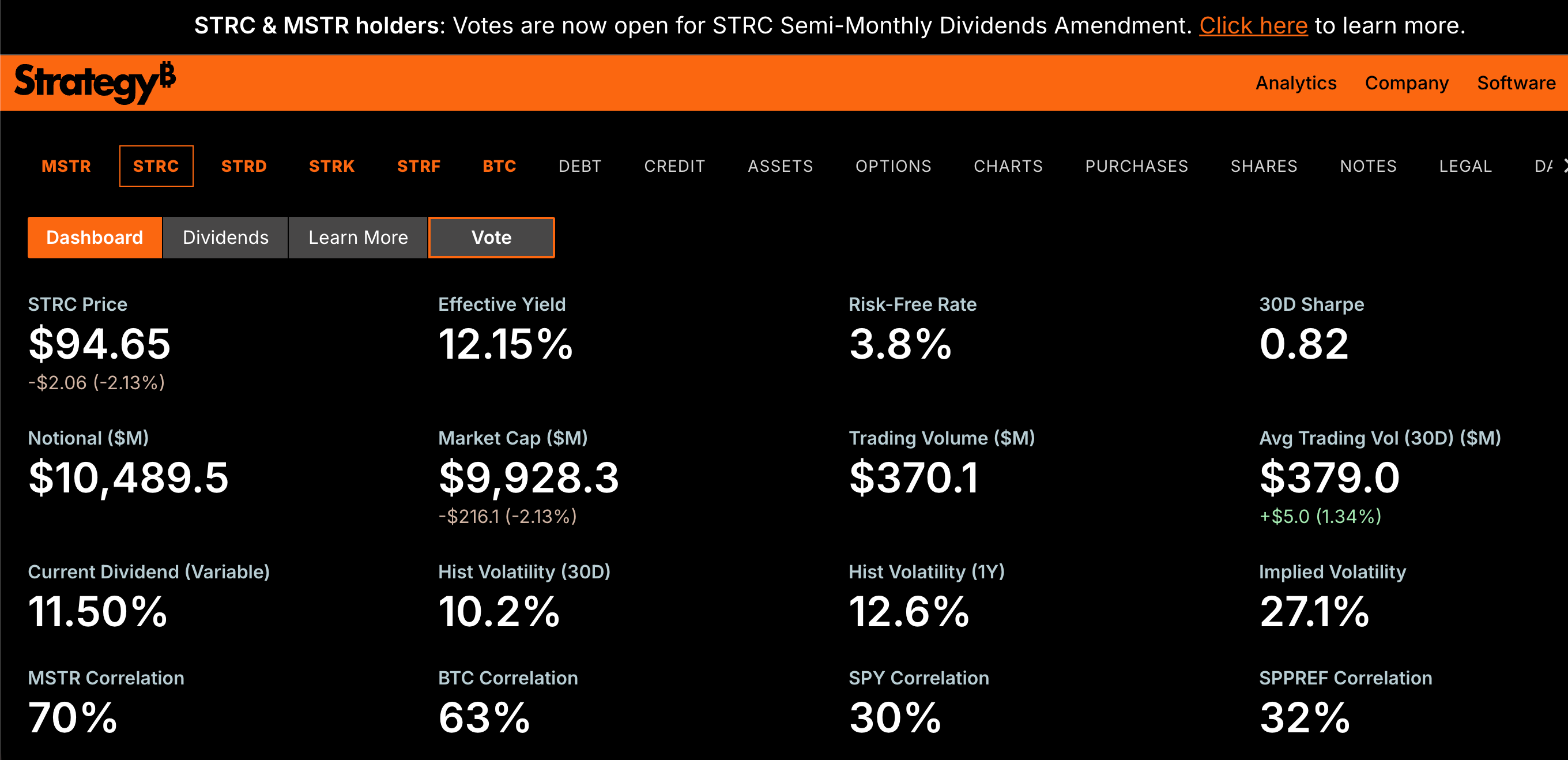
Also worth mentioning is that STRC's authorized issuance cap is approximately $28.3 billion. Possibly affected by BTC's continuous decline and shaken market confidence, STRC fell below $95 this morning, currently at $94.65, "de-pegging" over 5% from the $100 target price.

Compared to Bitmine, Strategy currently faces a significant gap between excessive preferred share financing amounts and dividend payments, exacerbated by BTC's continuous decline. Furthermore, unlike ETH which has a staking ecosystem for additional liquidity, BTC lacks such options.

Therefore, after Strategy sold 32 BTC last month, the market began to doubt the identity of "diamond-handed Strategy that only buys and never sells." Amid BTC's persistent decline, Strategy might face a series of liquidity crises, leading to an inability to repay debts and dividends, thereby selling more BTC and driving down prices. Essentially, Strategy is playing a "high-leverage bet that the BTC price won't fall below a certain level" debt leverage game.

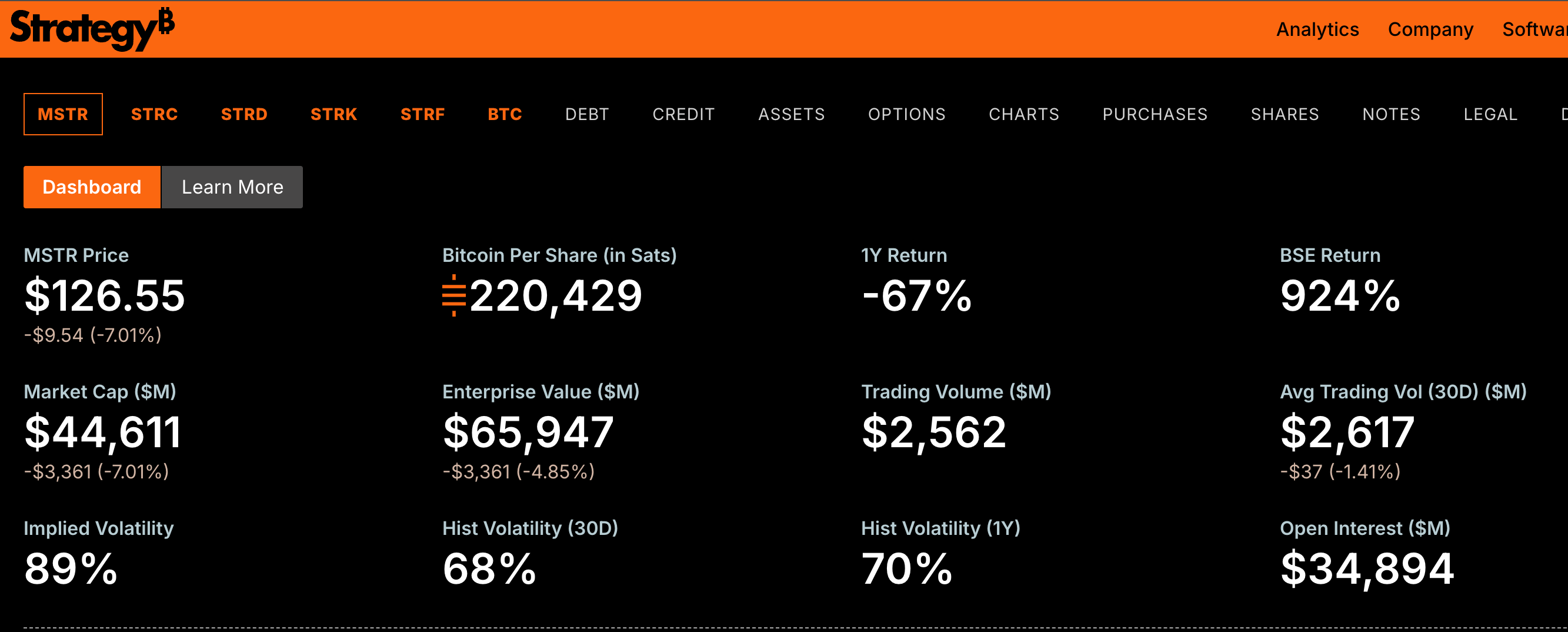
Thus, considering Strategy's current mNAV value of 0.83, the market remains highly skeptical of its future stock performance. Yesterday, its market capitalization already fell out of the top 200 US companies. Currently, Strategy (MSTR) stock is at $126, down 7% in 24 hours; market cap stands at $44.6 billion.
Of course, as a leader among DAT treasury companies, Bitmine Chairman Tom Lee remains quite optimistic about Strategy, previously stating: "Strategy selling Bitcoin and ETF outflows are typical bottoming behavior, not risk signals." At the recent "Proof of Talk 2026" conference at the Louvre in Paris, Tom Lee made bold claims: "With AI and tokenization driving major changes in financial infrastructure, ETH could ultimately reach $250,000." However, when discussing "Bitmine's actions after its ETH holdings reach 5% of the total supply," he also expressed caution about further ETH accumulation. (See "Tom Lee Recharges Faith: Crypto Spring Has Arrived, ETH Will Rise to $250,000")
Currently, Bitmine and Strategy find themselves in highly similar market situations, but Bitmine's financial condition is slightly better; Strategy faces the choice between "selling more BTC to obtain cash flow for dividend payments" and "sitting idle or continuing to borrow for acquisition as BTC keeps falling."


Perguntas relacionadas

QAccording to the article, what is the main difference in how Bitmine and Strategy finance their digital asset acquisitions?

ABitmine primarily funds its ETH acquisitions through equity issuance (ATM offerings and stock sales), which is a debt-free method. In contrast, Strategy primarily uses debt leverage, including convertible notes and preferred stock, to finance its BTC purchases, creating significant interest and dividend obligations.

QWhat specific financial pressure does Strategy face that the article highlights as its 'sword of Damocles'?

AStrategy faces significant pressure to cover its substantial annual dividend payments for its preferred stock (like STRC), estimated at $1.7 billion. With its cash reserves dwindling, the core question is where the funds for these ongoing dividend payments will come from.

QHow does Bitmine generate an additional income stream from its ETH holdings, as mentioned in the article?

ABitmine stakes approximately 87% of its ETH holdings (around 4.71 million ETH) through the MAVAN staking network. This generates daily staking rewards estimated at $1 million, providing a stable annualized cash flow of approximately $250-300 million.

QWhat are the key risk factors mentioned for Bitmine and Strategy's stock prices respectively?

AFor Bitmine, the main risk is equity dilution from issuing new shares and a declining stock price if its mNVA (market value to net asset value) falls below 1. For Strategy, the key risk is its high leverage and liquidity crisis if BTC prices fall further, potentially forcing asset sales and causing its mNAV to drop (currently 0.83), which could severely impact its stock price.

QWhat recent action by Strategy has caused market doubts about its 'diamond hands' reputation, and what potential consequence does the article suggest?

AStrategy recently sold 32 BTC. This action has led the market to doubt its long-held 'diamond hands' (never selling) policy. The article suggests that if BTC continues to fall, Strategy might face a liquidity crisis, forcing it to sell more BTC to meet its debt and dividend obligations, which could further depress the market.

Leituras Relacionadas

Single-Day Plunge of 30%, Arthur Hayes Suddenly Liquidates: Why Did ZEC Get Exploded by Security Issues?

On June 5th, Zcash founder Zooko Wilcox disclosed a critical soundness vulnerability in the project's latest Orchard privacy pool. This flaw, found in the elliptic curve multiplication constraints, could allow an attacker to create unlimited counterfeit ZEC within the shielded pool, with transactions appearing valid. The vulnerability was discovered in late May by security researcher Taylor Hornby, who utilized Anthropic's new Opus 4.8 AI model for a targeted audit. The Zcash ecosystem had already performed an emergency network upgrade to patch the issue. However, the detailed disclosure triggered severe market panic, causing ZEC's price to plummet over 30% in a single day. Notably, prominent investor Arthur Hayes announced he had sold his entire ZEC position following the news. The incident starkly challenges the "technological trust" narrative central to privacy coins. Despite years of top-tier cryptographic audits, the bug persisted until uncovered with advanced AI-assisted research. This highlights the growing gap between theoretical perfection and practical implementation in privacy technology. The event serves as a industry-wide warning: in an AI-driven security landscape, the assumption that "undiscovered equals safe" is obsolete. It underscores the urgent need for continuous, proactive security practices combining AI audits, formal verification, and rapid response mechanisms.

foresightnews_apiHá 15m

Single-Day Plunge of 30%, Arthur Hayes Suddenly Liquidates: Why Did ZEC Get Exploded by Security Issues?

foresightnews_apiHá 15m

Breaking the Curse of DeFi Cascading Liquidations, Vitalik Proposes a New Solution

**Vitalik Buterin Proposes New DeFi Design to Eliminate Forced Liquidations** Ethereum co-founder Vitalik Buterin has published a proposal for a new decentralized finance (DeFi) architecture aimed at removing the automatic liquidation mechanisms prevalent in current lending protocols. The core idea involves creating synthetic assets using options as building blocks, fundamentally avoiding the抵押借贷结构 that triggers forced sell-offs. The proposal responds to a recurring flaw in DeFi: during sharp market downturns, mass自动清算 of under-collateralized positions can exacerbate price declines, creating systemic selling pressure and market instability, as evidenced by recent crypto market volatility. Buterin's model would split an asset like 1 ETH into two option-like derivatives, P and N, pegged to a price index with a set strike price and expiration. At expiry, an oracle determines the settlement price to allocate the underlying ETH between P and N holders. This design eliminates the "cliff" of instant liquidation. Instead, a position's value would gradually drift from its target peg if not actively rebalanced by the user, transferring the rebalancing decision from the protocol to the user or automated tools. A key advantage is the reduced reliance on high-frequency, real-time oracle price feeds, which are vulnerable to manipulation and errors in current systems. The delayed settlement in the options model allows for more robust, fault-tolerant oracle designs. However, significant challenges remain for practical adoption. High transaction costs (slippage) from frequent rebalancing on automated market makers (AMMs) could erode user funds. The model may not be suitable for stablecoins requiring a strict 1:1 dollar peg, as it inherently allows for value drift. Success would depend on developing new liquidity provisioning models and deep markets for these synthetic assets. The proposal represents a fundamental rethinking of DeFi risk management, challenging the industry to explore alternatives to被动集中平仓 rather than merely optimizing existing liquidation processes. It remains a theoretical framework awaiting implementation and testing by development teams.

foresightnews_apiHá 17m

Breaking the Curse of DeFi Cascading Liquidations, Vitalik Proposes a New Solution

foresightnews_apiHá 17m

Bitcoin's Decline Marks the Transformation of Crypto

Title: The Decline of Bitcoin Marks the Transformation of Crypto While Bitcoin's price recently fell below $70,000, down approximately 45% from its peak, the broader crypto industry is not following it into decline. Instead, crypto is maturing and evolving beyond its dependence on Bitcoin's price movements. Two of Bitcoin's core functions are being usurped. First, AI has captured its role as the primary speculative asset. AI, with its tangible revenue, explosive demand, and massive capital inflows ($700-830 billion in 2024), is siphoning off the speculative "hot money" that once drove Bitcoin. It also contributes to a sustained high-interest-rate environment, further tightening liquidity for assets like Bitcoin. Second, dollar-pegged stablecoins like USDC and USDT have replaced Bitcoin as the crypto market's foundational currency and primary on/off-ramp. Most trading pairs and on-chain transactions are now settled in stablecoins, severing the historical link where all capital inflows had to pass through Bitcoin first. This decoupling allows projects to thrive based on their own fundamentals rather than Bitcoin's price. Examples include Hyperliquid, an on-chain derivatives exchange with annual revenues of $8-13 billion, and prediction market platform Polymarket, valued at $200 billion with $3.65 billion in annual fees. These projects are evaluated on traditional metrics like revenue and user growth. New opportunities are emerging, particularly around privacy. Privacy coins like Zcash (ZEC) are seeing surging demand, while infrastructure like NEAR enables private, cross-chain asset transfers without requiring users to hold a specific token—privacy becomes a universal service layer. In this new paradigm, stablecoins are the universal cash, various project tokens represent equity, and privacy-enabled cross-chain coordination layers (like NEAR) act as the critical infrastructure connecting a fragmented, multi-chain ecosystem. Bitcoin is now just one asset among many. The era where the entire crypto market moved in lockstep with Bitcoin is over. The industry's health should now be judged by project fundamentals—real revenue, active users, and tokenomics that capture value—and the development of the underlying infrastructure enabling a mature, dollar-denominated crypto economy.

foresightnews_apiHá 20m

Bitcoin's Decline Marks the Transformation of Crypto

foresightnews_apiHá 20m

Lightspark CEO: In Ten Years, Bitcoin Will Be as Invisible as TCP/IP, Yet Power Trillions in Daily Transactions

A decade from now, Bitcoin will function like TCP/IP — invisible yet foundational, supporting trillions in daily transactions globally, according to Lightspark CEO David Marcus. In this future, a coffee shop in Lagos receives instant payment, a manufacturer in São Paulo settles an invoice with a supplier in Ho Chi Minh City, and a freelancer in Bangalore gets paid weekly from an Austin startup — all via Bitcoin's settlement layer, with none of the parties consciously interacting with it. This vision parallels the adoption of open protocols: first driven by necessity where existing systems fail, then scaling rapidly as tools mature and economic benefits become clear. The structural shift begins with wallets. Modern non-custodial wallets, like Spark, allow users to hold dollars, local currency, and Bitcoin in a single address, seamlessly switching between them. This eliminates friction and revolutionizes global custody, moving significant deposits to user-controlled keys not by ideology, but by superior utility. As a result, Bitcoin becomes the default savings layer for billions, as its fixed supply and appreciating value make it a rational choice for savers holding it alongside stablecoins in their everyday wallets. Businesses follow a similar path, from small companies in emerging markets to multinational corporations, holding Bitcoin alongside operational stablecoins. The latest trend is direct Bitcoin transactions for commerce. When both parties hold Bitcoin, transacting in it becomes the simplest option — no conversions, no intermediary currency. This starts in niche areas like high-value B2B settlements but grows as infrastructure makes sending Bitcoin as easy as stablecoins. An accelerating force is AI agents. By 2036, AI agents conducting commerce on behalf of individuals and firms will increasingly choose Bitcoin for settlement. Optimizing for speed, finality, and minimal counterparty risk across jurisdictions, they find Bitcoin's global, neutral, and programmable network ideal for netting and settling obligations. Thus, Bitcoin is becoming the native currency for machine commerce, just as it has become a native savings asset for humans. The global monetary system is being rebuilt from the protocol layer: open infrastructure, default self-custody, Bitcoin settling everything underneath, with stablecoins as the interface. Most users won't think about Bitcoin when they transact — and they won't need to.

foresightnews_apiHá 25m

Lightspark CEO: In Ten Years, Bitcoin Will Be as Invisible as TCP/IP, Yet Power Trillions in Daily Transactions

foresightnews_apiHá 25m

Trading

Spot
Futuros
活动图片




