BofA Research Report Analysis: Marvell Takes TPU Peripherals, Broadcom Holds Core Value of $250 Billion

marsbitPublicado em 2026-08-20Última atualização em 2026-08-20

Resumo

Bank of America's report analyzes the impact of Google's new custom chip agreement with Marvell on the TPU supply chain. While Marvell secured a deal for "XPU-attach" chips (like AI inference accelerators and memory controllers), corresponding to a potential $120B in cumulative purchases, BofA argues the core high-value components remain with Broadcom. Broadcom retains design and supply for the core ASIC, advanced packaging, HBM integration, high-speed SerDes, and network switching/physical layer connectivity. These form the highest Bill-of-Materials (BOM) value in TPU systems. BofA estimates Google's 5-year capex could reach $1.5-$2T, with TPU systems representing 25-30% ($400B-$600B TAM). Within this, Broadcom is projected to hold a 55-60% value share ($250B-$350B), Marvell 10-20% ($50B-$100B), and MediaTek 20-30% in lower-value, cost-optimized chips. The report emphasizes Broadcom's entrenched position through long-term agreements locked until CY31, increasing silicon content per TPU generation, and high unit value creating a competitive barrier. It sets a $530 price target for Broadcom (30x CY27 P/E), viewing current valuation as attractive given growth certainty from AI and locked leadership. Downsides include semiconductor cycles, customer concentration, and debt. In conclusion, while competition reshapes the supply chain for peripheral chips, the core high-value structure and Broadcom's dominance in compute silicon remain intact.

Author: Rita

A new custom chip agreement from Google has redrawn the division of labor between Marvell and Broadcom in the TPU supply chain.

On August 19, Bank of America (BofA) released a quick industry comment report. Marvell has entered into a new warrant agreement with Google, establishing a custom chip partnership. This corresponds to a maximum cumulative purchase volume of $120 billion from Google, and Marvell will receive approximately 60 million shares.

Investors are concerned that Broadcom's share in Google's TPU supply may be eroded. BofA offers a different assessment: Marvell is securing chips for the XPU peripherals, while the core computing chips remain under Broadcom's control.

Value Concentration Tilts Towards Broadcom's Core Chips

The supply chain for Google's TPU systems is undergoing differentiation, but the core computing chips are not part of this shift.

BofA breaks down the division of labor in its report. Broadcom is responsible for the core ASIC and advanced packaging design, HBM integration, high-speed SerDes, as well as network switching and physical layer connectivity around the chip. These four components constitute the highest-value parts of the TPU system's Bill of Materials (BOM).

Marvell's role is XPU-attach, meaning custom chips connected to the TPU ecosystem, including AI inference accelerators, storage controllers, NICs, memory interface controllers, and near-memory computing. Specific details are not yet clear. BofA judges that Marvell's value content within the TPU is confined to the XPU-attach items, with the core computing chips still belonging to Broadcom.

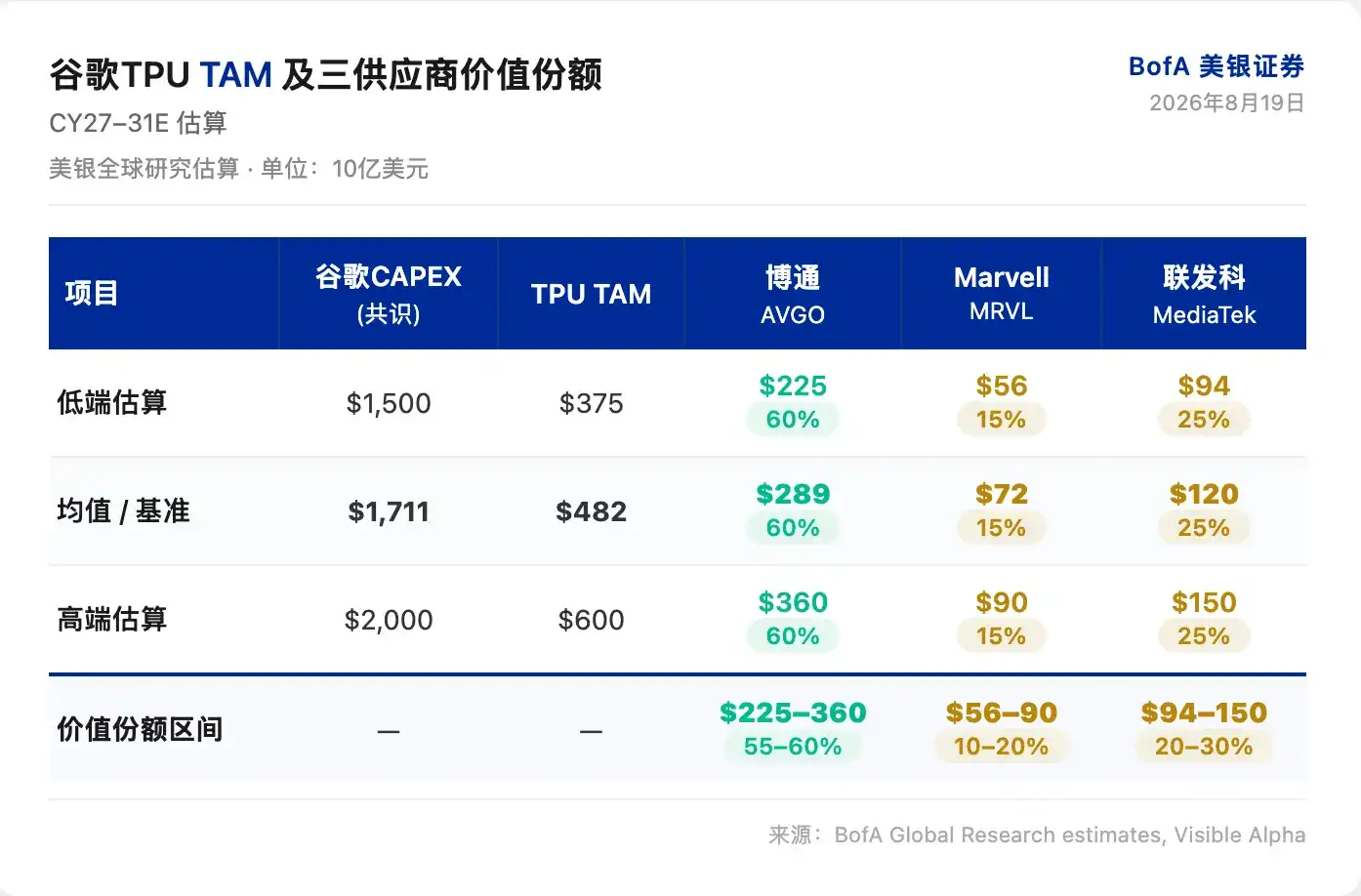
BofA estimates Google's total capital expenditure over the next 5 years will be in the range of $1.5 trillion to $2 trillion, with TPU systems accounting for 25% to 30%, corresponding to a Total Addressable Market (TAM) of $400 billion to $600 billion. Broadcom holds a 55% to 60% value share, amounting to $250 billion to $350 billion. Marvell captures a 10% to 20% share through XPU-attach, corresponding to $50 billion to $100 billion. MediaTek takes 20% to 30% for cost-optimized chips. The three suppliers each have their share, with the value center clearly tilted towards Broadcom.
High BOM Content of Core Chips Forms a Value Barrier

Broadcom's value advantage in TPUs stems from high unit value, not merely share proportion.

These four areas are locked in through long-term agreements until CY31, making it difficult for competitors to break through in the short term. Marvell's XPU-attach also holds value, but its program is more fragmented with lower unit value, and design partnerships are subject to change.

MediaTek's entry validates BofA's judgment. BofA expects MediaTek to hold a 20% to 30% share in cost-optimized chips, which have lower unit value and fall into the "low-value inference/peripheral content" category. The landscape among the three suppliers redistributes the low-value peripheral content, while the high-value core chips remain with Broadcom.

Another easily overlooked variable is silicon content expansion. BofA believes that as system complexity continues to increase, Broadcom's silicon content in each generation of TPU is growing, similar to the path of Nvidia's GPUs. This means absolute revenue continues to grow even if the share proportion remains unchanged.

Valuation Remains Attractive Amid Competitive Pressure

BofA sets a $530 price target for Broadcom, based on a 30x CY27 expected P/E ratio. This multiple sits in the mid-range of Broadcom's historical range (11x to 41x) and aligns with the 0.5x to 2x PEG (Price/Earnings to Growth ratio) framework for high-growth computing chips.

The valuation's attractiveness comes from growth certainty. Broadcom's current stock price corresponds to a CY27 expected P/E ratio of about 21x and a CY28 expected P/E ratio of about 16x, with a PEG of -0.5x, reflecting earnings growth significantly outpacing the valuation multiple. With AI revenue expansion and TPU content leadership locked until CY31, this valuation is not aggressive.

Downside risks listed by BofA include a semiconductor cycle reversal, customer concentration on Apple and Google, competitive pressures across markets, and the financial risk of approximately $60 billion in net debt. TPU demand remains strong, management is expected to reaffirm the custom chip growth trajectory in the September 2 earnings call, and new projects from Meta and OpenAI (each about 1GW) are set to commence in CY27.

The competitive narrative is changing the landscape of the TPU supply chain, but the core structure of value distribution remains unshaken. The impact of Marvell and MediaTek on Broadcom is overestimated, while customer stickiness and BOM depth of core chips are underestimated. Competition in peripheral chips intensifies, highlighting the scarcity of the computing core.

Disclaimer

This article is a collation and interpretation by Chaoxiang Research of a third-party brokerage research report (Bank of America Securities, August 19, 2026), combined with the organization of publicly available market information. The ratings, price targets, earnings forecasts, and related judgments cited in the article are the views of that brokerage's analyst, representing only the position of their affiliated institution. They do not represent the views of Chaoxiang Research and do not constitute any investment advice.

The market carries risks, and investment decisions should be made independently. This article should not be used as the basis for trading any securities.


Perguntas relacionadas

QAccording to the Bank of America report, what is the main difference between Broadcom's and Marvell's roles in the Google TPU supply chain following the new agreement?

ABroadcom retains the high-value core compute chip business (including core ASIC and advanced packaging design, HBM integration, high-speed SerDes, and network/physical layer connectivity), while Marvell takes on the 'XPU-attach' role, supplying peripheral chips like AI inference accelerators, storage controllers, NICs, memory interface controllers, and near-memory compute.

QWhat is Bank of America's estimate for Google's total capital expenditure over the next 5 years, and what portion is allocated to TPU systems?

ABank of America estimates Google's total capital expenditure over the next 5 years to be in the range of $1.5 trillion to $2 trillion. They estimate that TPU systems will account for 25% to 30% of this, corresponding to a Total Addressable Market (TAM) of $400 billion to $600 billion.

QHow does Bank of America assess the competitive threat posed by Marvell and MediaTek to Broadcom's position in the TPU supply chain?

ABank of America believes the threat from Marvell and MediaTek is overestimated. They argue that the competition is primarily intensifying in lower-value peripheral chips. Broadcom's position in the high-value core compute chips remains secure due to long-term agreements locked until CY31, deep BOM integration, high unit value, and strong customer stickiness.

QWhat is Bank of America's price target for Broadcom and the key valuation metric supporting it?

ABank of America sets a price target of $530 for Broadcom. This is based on a 30x multiple on the CY27 estimated earnings per share (P/E ratio). They consider this multiple reasonable as it falls in the middle of Broadcom's historical range and is consistent with the PEG (Price/Earnings to Growth) framework for high-growth compute chip stocks.

QWhat are the key downstream risks for Broadcom identified in the Bank of America report?

AThe key downstream risks identified are: a reversal of the semiconductor cycle, high customer concentration (Apple and Google), competitive pressures across various markets, and financial risk from approximately $60 billion in net debt.

Leituras Relacionadas

Just Now, For the First Time in Human History, AI Cures Cancer

A Historic Leap: First AI-Designed, Personalized mRNA Cancer Therapy Succeeds in Phase 3 Trial In a landmark achievement for oncology, Moderna and Merck announced that their personalized mRNA cancer vaccine, intismeran autogene, has met its primary and key secondary endpoints in a global Phase 3 trial for high-risk melanoma. This marks the first successful Phase 3 result for an mRNA cancer therapy and a pioneering example of AI-driven, individualized medicine. The trial involved 1,137 patients with surgically resected stage IIB-IV melanoma. Participants received either the personalized mRNA vaccine combined with Merck's PD-1 inhibitor Keytruda or Keytruda alone. The combination therapy demonstrated a statistically significant and clinically meaningful improvement in recurrence-free survival (RFS) and distant metastasis-free survival (DMFS). The breakthrough lies in the "one-patient, one-therapy" approach. After tumor removal, AI algorithms analyze the patient's tumor DNA to identify up to 34 unique neoantigens—protein fragments specific to their cancer cells. Moderna's automated platform then designs and manufactures a custom mRNA vaccine encoding these targets. When administered, the vaccine trains the patient's immune system to recognize and destroy residual cancer cells expressing those neoantigens, while Keytruda helps activate the immune response. This success validates a powerful platform technology. Moderna and Merck are already expanding trials to other solid tumors, including non-small cell lung cancer and pancreatic cancer. With regulatory submissions planned, the therapy could be available for patients as early as 2027. The achievement signifies a new era where AI and mRNA technology converge to create highly targeted, effective cancer treatments.

marsbitHá 18m

Just Now, For the First Time in Human History, AI Cures Cancer

marsbitHá 18m

AI Debt Flood Peaks: September is the True Test for U.S. Treasuries

As U.S. Treasury yields show temporary signs of stabilizing, a more significant stress test looms. Following the Treasury's recent announcement to expand its buyback program for long-term bonds, easing market concerns, analysts warn the relief may be short-lived. The core challenge is a massive wave of investment-grade corporate bond issuance—estimated to reach $200 billion in September alone after the Labor Day holiday—driven primarily by Big Tech firms financing AI infrastructure. Companies like Microsoft, Alphabet, and Amazon are aggressively raising long-term debt to fund data centers, advanced chips, and AI services. This AI-related issuance is reaching record levels, competing directly with long-term Treasury bonds due to the tech firms' strong credit ratings and extended maturities. While Treasury buybacks provided a psychological boost, their scale remains small relative to overall debt. The AI financing surge, combined with persistent U.S. fiscal deficits, sticky inflation, and Federal Reserve uncertainty, is reshaping fixed-income supply and demand dynamics. Risks are building. Analysts caution that if Treasury yields stabilize, corporate bond spreads could widen, increasing market volatility. Some investors see parallels with the pre-2008 era of off-balance-sheet financing, raising concerns about capital deployment outpacing business model viability. With inflation pressures lingering globally and the total U.S. debt exceeding $40 trillion, the delicate balance between supply and demand in bond markets will face a true test in September.

marsbitHá 19m

AI Debt Flood Peaks: September is the True Test for U.S. Treasuries

marsbitHá 19m

Trading

Spot
活动图片