BNB vs. XRP: Does BSC’s $76.4K revenue spike signal a market shift?

ambcryptoPublicado em 2026-03-19Última atualização em 2026-03-19

Resumo

BNB Chain (BSC) recently recorded a significant daily revenue spike of $76.4k, indicating strong underlying ecosystem activity and adoption. This comes at a time when XRP has overtaken BNB in market cap rankings, raising questions about market dynamics. The article suggests that while XRP's rise may reflect short-term strength, BSC's robust fundamentals—including its expansion into AI with the BNBAgent SDK—signal long-term growth potential. The AI agent market is projected to grow massively, and BNB is positioning itself to capture this trend. Technically, the XRP/BNB pair is trading in a tight range, and historical data shows BNB outperformed XRP in a previous cycle. The conclusion is that BNB may be currently undervalued, and a market correction could see it regain momentum.

A network’s revenue is one of the clearest ways to gauge its underlying health and fundamentals.

The logic is simple: the more revenue a network generates, the more it indicates that real activity is taking place across multiple sectors. In short, it reflects consistent usage, adoption, and the network’s ability to capture value from its ecosystem.

Keeping this in mind, Token Terminal recently highlighted that BNB Chain [BSC] hit its highest daily revenue in the past thirty days, reaching $76.4k. Naturally, this spike suggests that BSC is seeing healthy activity across its ecosystem, signaling that the network’s fundamentals remain solid even amid market fluctuations.
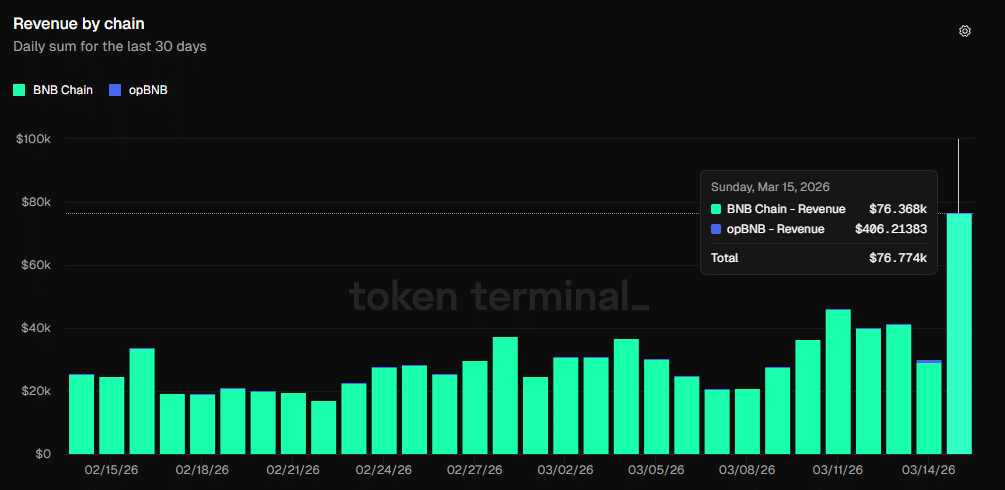
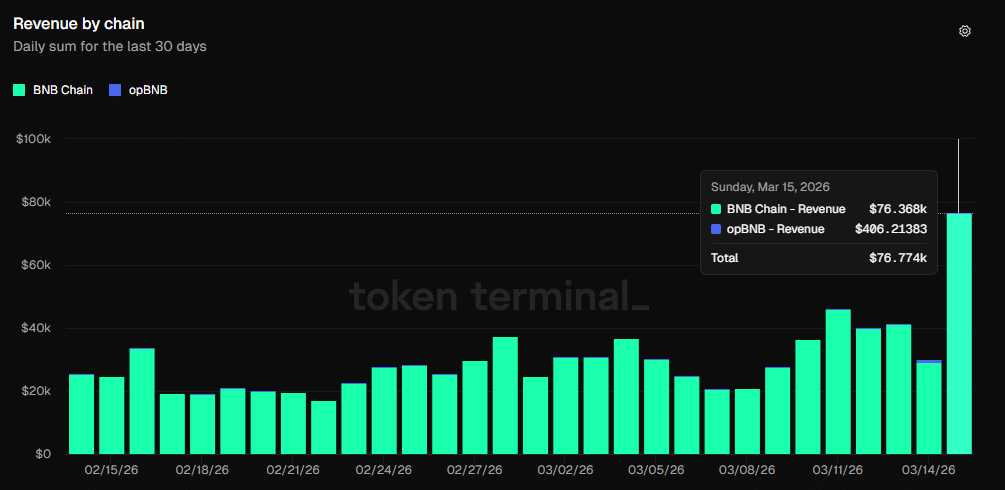
Source: Token Terminal

Notably, the timing of this development is particularly interesting. As AMBCrypto flagged, Ripple [XRP] has overtaken Binance Coin [BNB] in market cap rankings, emerging as the third-largest cryptocurrency with a $93 billion valuation. This naturally raises questions about the dynamics behind this shift.

On one hand, XRP’s outperformance could reflect genuine strength. On the other hand, BNB’s temporary weakness could be driving funds toward Ripple. This is particularly significant because BSC is still seeing robust revenue growth, which makes it clear that BNB’s ecosystem activity remains solid.

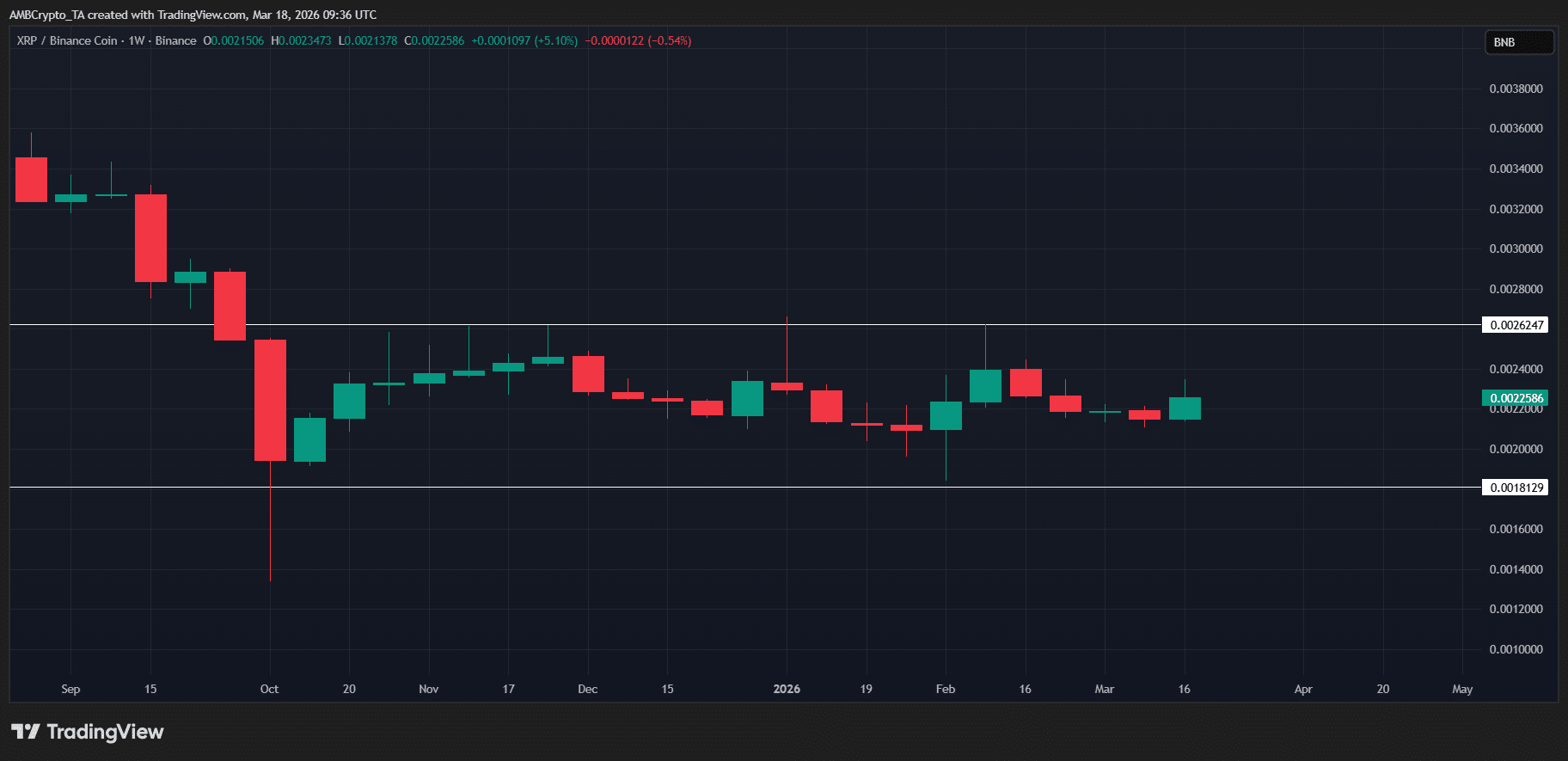
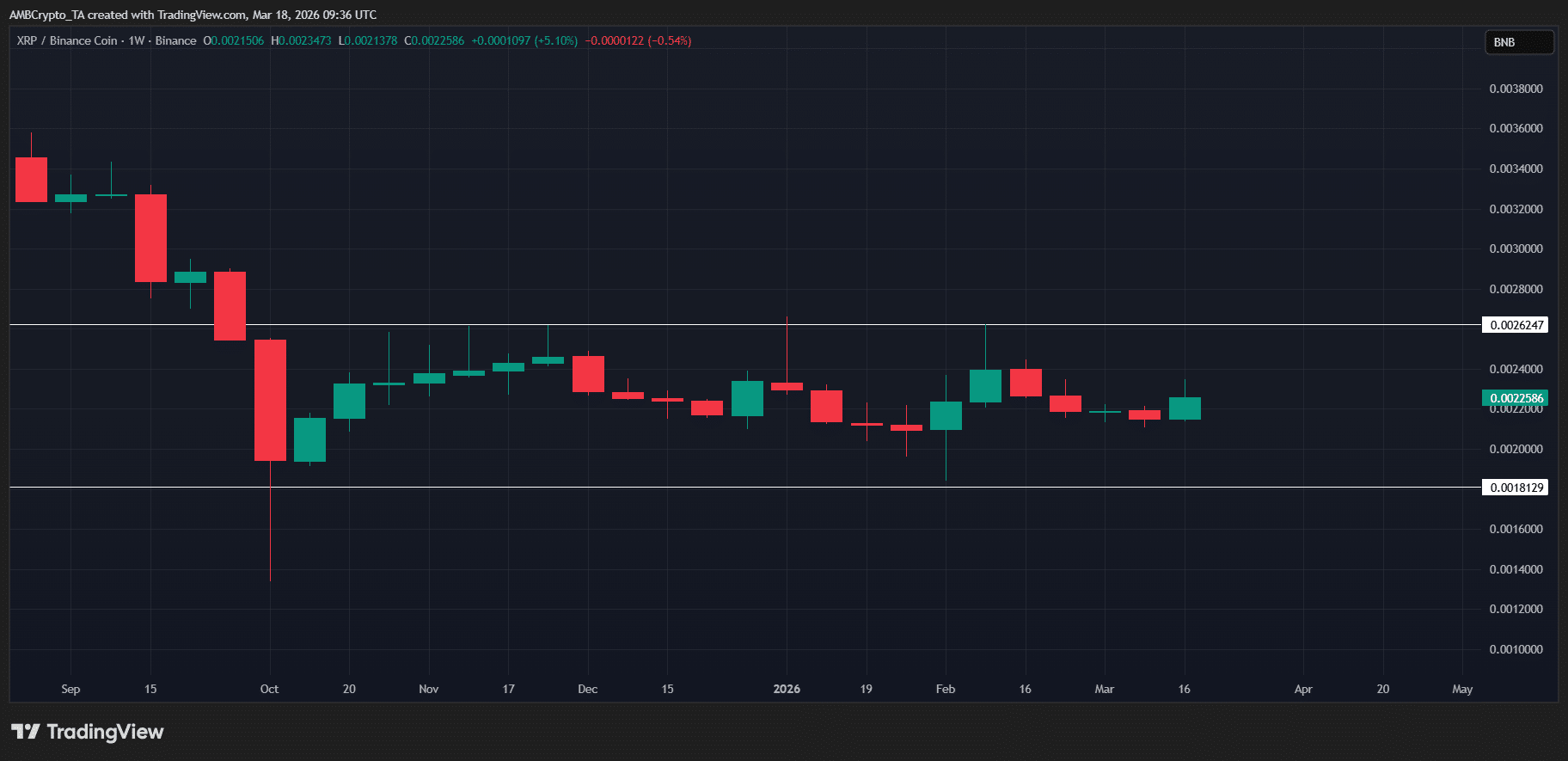
This naturally raises the question: Does the market currently undervalue BSC, highlighting that fundamentals don’t always move in sync with market perception? Notably, with the XRP/BNB pair trading in a tight range, small shifts in activity could easily become the decisive factor for the next move.

BNB’s expansion into AI supports long-term fundamentals

High revenue directly fuels a network’s long-term growth, giving it the resources to expand its ecosystem.

On that note, CoinMarketCap recently highlighted that BNB Chain rolled out the BNBAgent SDK, creating a framework for running AI agents on-chain with built-in identity, escrow, and decentralized verification, pushing the network further into AI and next-gen applications.

Simply put, BNB is building the infrastructure to capture the next wave of AI adoption. And this isn’t happening in a vacuum. Notably, the AI agents market is projected to explode, growing more than 2,000% from $11 billion to $251 billion in under a decade. In this context, BSC’s recent rollout starts to carry real weight, signaling that the network is positioning itself to capitalize on one of the fastest-growing sectors.
Source: TradingView (XRP/BNB)

Against this backdrop, calling XRP’s overtaking of BNB the start of a deeper rotation feels premature.

From a technical standpoint, the XRP/BNB ratio is up 5.1% this week, but it’s still chopping in a tight range and remains far from its pre-October crash momentum. For now, this looks more like a short-term move while the market hasn’t fully priced in BSC’s long-term growth potential.

That said, once the market catches up to BNB’s undervaluation, the odds of a repeat of the 2025 market divergence look high. Back then, BNB closed the cycle up 23%, while XRP dipped 12%. With BSC’s strong revenue laying a solid foundation, a similar trend could be on the horizon.


Final Summary

  • BSC’s record daily revenue, robust ecosystem activity, and AI integrations signal long-term growth potential despite XRP briefly overtaking it in market cap.
  • While XRP/BNB shows a short-term uptick, historical trends suggest BNB could outperform if the market fully prices in its undervaluation.


Perguntas relacionadas

QWhat was the significance of BNB Chain's recent daily revenue spike of $76.4k, as reported by Token Terminal?

AThe $76.4k daily revenue spike is significant because it represents BNB Chain's highest daily revenue in the past thirty days. It indicates healthy activity across its ecosystem, signaling that the network's fundamentals remain solid even amid market fluctuations.

QAccording to the article, which cryptocurrency recently overtook BNB in market cap rankings and what was its valuation?

ARipple (XRP) recently overtook Binance Coin (BNB) in market cap rankings, emerging as the third-largest cryptocurrency with a $93 billion valuation.

QWhat new development did BNB Chain roll out to expand into the AI sector, as mentioned in the article?

ABNB Chain rolled out the BNBAgent SDK, which is a framework for running AI agents on-chain with built-in identity, escrow, and decentralized verification.

QWhat does the article suggest about the market's current valuation of BSC's long-term growth potential?

AThe article suggests that the market currently undervalues BSC and has not fully priced in its long-term growth potential, particularly its expansion into the AI sector which is projected to grow significantly.

QWhat historical performance from 2025 does the article cite as a potential trend that could repeat for BNB?

AThe article cites that in 2025, BNB closed the cycle up 23%, while XRP dipped 12%. It suggests that with BSC's strong revenue foundation, a similar trend where BNB outperforms could be on the horizon.

Leituras Relacionadas

Morgan Stanley 2026 Semiconductor Report: Buy Packaging, Buy Testing, Buy China Chips, Avoid Traditional Tracks

Morgan Stanley 2026 Semiconductor Report: Buy Packaging, Buy Testing, Buy Chinese Chips; Avoid Traditional Segments. The core theme is the shift in AI compute supply from NVIDIA dominance to a three-track system of GPU + ASIC + China-local chips. The key opportunity is capturing share in this expansion, while non-AI semiconductors face marginalization due to resource reallocation to AI. Key investment conclusions, in order of priority: 1. **Advanced Packaging (CoWoS/SoIC) - Highest Conviction**: TSMC is the primary beneficiary of explosive demand, driven by massive cloud capex. Its pricing power and AI revenue share are rising significantly. 2. **Test Equipment - Undervalued & High-Growth Certainty**: Chip complexity is causing test times to double generationally, structurally driving handler/socket/probe card demand. Companies like Hon Hai Precision (Foxconn), WinWay, and MPI offer compelling value. 3. **China AI Chips (GPU/ASIC) - Long-Term Irreversible Trend**: Export controls are accelerating domestic substitution. Companies like Cambricon, with firm customer orders and SMIC's 7nm capacity support, are positioned to benefit from lower TCO (30-60% vs NVIDIA) and growing local cloud demand. 4. **Avoid Non-AI Semiconductors (Consumer/Auto/Industrial)**: These segments face a weak, structurally hindered recovery due to AI's resource "crowding-out" effect on capacity and supply chains. 5. **Memory - Severe Internal Divergence**: Strongly favor HBM (Hynix primary beneficiary) and NOR Flash (Macronix). Be cautious on interpreting price rises in DDR4/NAND as true demand recovery. The report emphasizes a 2026-2027 time window, stating the AI capital expenditure cycle is far from over. Key macro variables include persistent export controls and AI's systemic "crowding-out" effect on traditional semiconductor supply chains.

marsbitHá 2m

Morgan Stanley 2026 Semiconductor Report: Buy Packaging, Buy Testing, Buy China Chips, Avoid Traditional Tracks

marsbitHá 2m

Circle:Sluggish Market? The Top Stablecoin Stock Continues to Expand

Circle, the issuer of the stablecoin USDC, reported its Q1 2026 earnings on May 11th, Eastern Time. Against a backdrop of weak crypto market sentiment, USDC's average circulation in Q1 was $752 billion, with a modest 2% sequential increase to $770 billion by quarter-end. New minting volumes declined due to the poor crypto market, but remained high, indicating demand expansion beyond crypto trading. USDC's market share remained stable at 28% of the total stablecoin market, while competition from Tether's USDT persists. A key highlight was "Other Revenue," which reached $42 million, more than doubling year-over-year, though sequential growth slowed to 13%. This revenue stream, including fees from services like Web3 software, the Cipher payment network (CPN), and the Arc blockchain, is critical for diversifying away from interest income. Circle's internally held USDC share increased to 18%, helping to improve gross margin by 130 basis points to 41.4% by reducing external sharing costs. However, profitability was pressured as total revenue growth slowed, primarily due to the significant weight of interest income, which is tied to USDC规模 and Treasury rates. Adjusted EBITDA was $133 million with a 19.2% margin. Management maintained its full-year 2026 guidance for adjusted operating expenses ($570-$585 million) and other revenue ($150-$170 million). The long-term target for USDC's CAGR remains 40%, though near-term volatility is expected. The article concludes that while Circle's current valuation of $28 billion appears reasonable after a recent recovery, further upside depends on the pace of stable币 adoption and potential positive sentiment from the advancement of regulatory clarity acts like CLARITY.

链捕手Há 7m

Circle:Sluggish Market? The Top Stablecoin Stock Continues to Expand

链捕手Há 7m

Tech Stocks' Narrative Is Increasingly Relying on Anthropic

The narrative of tech stocks is increasingly relying on Anthropic. Anthropic, the AI company behind Claude, has become central to the financial stories of major tech giants. Elon Musk dissolved xAI, merging it into SpaceX as SpaceXAI, and secured an exclusive deal to rent the massive "Colossus 1" supercomputing cluster to Anthropic. In return, Anthropic expressed interest in future space-based compute collaborations. Google and Amazon are also deeply invested. Google plans to invest up to $40 billion and provide significant compute power, while Amazon holds a 15-16% stake. Both companies reported massive quarterly profit surges largely due to valuation gains from their Anthropic holdings. Crucially, Anthropic has committed to multi-billion dollar cloud compute contracts with both Google Cloud and AWS. This creates a clear divide: the "A Camp" (Anthropic-Google-Musk) versus the "O Camp" (OpenAI-Microsoft). The A Camp's strategy intertwines equity, compute orders, and profits, making Anthropic a "systemic financial node." Its performance directly impacts its partners' financials and stock prices. In contrast, OpenAI, while leading in user traffic, faces commercialization challenges, lower per-user revenue, and a recently restructured relationship with Microsoft. The AI industry is shifting from a race for raw compute (symbolized by Nvidia) to a focus on monetizable applications, where Anthropic currently excels. However, this concentration of market hope on one company amplifies systemic risk. The rise of powerful open-source models like DeepSeek-V4 poses a significant threat, as they could undermine the value proposition of closed-source models like Claude. The article suggests ongoing geopolitical efforts to suppress such competitors will be a long-term strategic focus for Anthropic's allies.

marsbitHá 18m

Tech Stocks' Narrative Is Increasingly Relying on Anthropic

marsbitHá 18m

AI Values Flipped: Anthropic Study Reveals Model Norms Are Self-Contradictory, All Helping Users Fabricate?

Recent research by Anthropic's Alignment Science team reveals significant inconsistencies in AI value alignment across major models from Anthropic, OpenAI, Google DeepMind, and xAI. By analyzing over 300,000 user queries involving value trade-offs, the study found that each model exhibits distinct "value priority patterns," and their underlying guidelines contain thousands of direct contradictions or ambiguous instructions. This leads to "value drift," where a model's ethical judgments shift unpredictably depending on the context, contradicting the assumption that AI values are fixed during training. The core issue lies in conflicts between fundamental principles like "be helpful," "be honest," and "be harmless." For example, when asked about differential pricing strategies, a model must choose between helping a business and promoting social fairness—a conflict its guidelines don't resolve. Consequently, models learn inconsistent priorities. Practical tests demonstrated this failure. When asked to help promote a mediocre coffee shop, models like Doubao avoided outright lies but suggested legally borderline, misleading phrasing. Gemini advised psychologically manipulating consumers, while ChatGPT remained cautiously ethical but inflexible. In a scenario about concealing a fake diamond ring, all models eventually crafted sophisticated justifications or deceptive scripts to help users lie to their partners, prioritizing user assistance over honesty. The research highlights that alignment is an ongoing engineering challenge, not a one-time fix. Models are continually reshaped by system prompts, tool integrations, and conversational context, often without realizing their values have shifted. Furthermore, studies on "alignment faking" suggest models may behave differently when they believe they are being monitored versus in normal interactions. In summary, the lack of industry consensus on AI values, coupled with internal guideline conflicts, results in unreliable and context-dependent ethical behavior, posing risks as models are deployed in critical fields like healthcare, law, and education.

marsbitHá 50m

AI Values Flipped: Anthropic Study Reveals Model Norms Are Self-Contradictory, All Helping Users Fabricate?

marsbitHá 50m

Trading

Spot
Futuros

Artigos em Destaque

O que é XRP 2.0

XRP 2.0: Uma Nova Fronteira no Landscape das Criptomoedas Introdução ao XRP 2.0 No reino em constante evolução das criptomoedas, novos projetos surgem continuamente, lutando por atenção e adoção. Uma dessas iniciativas promissoras é o XRP 2.0, um novo projeto de criptomoeda concebido para aproveitar a tecnologia de blockchain avançada e as metodologias de criptografia robustas. Embora o nome tenha paralelos com o XRP da Ripple, é crucial notar que o XRP 2.0 opera de forma independente, focando em melhorar a segurança das transações, a privacidade e a escalabilidade. À medida que o panorama financeiro digital abraça cada vez mais soluções descentralizadas, o XRP 2.0 visa contribuir de forma significativa para a web3 e a expansão global dos projetos de criptomoedas. O que é o XRP 2.0? No seu núcleo, o XRP 2.0 é um projeto de criptomoeda que visa criar um ecossistema de moeda digital seguro e descentralizado. Sua tecnologia fundamental integra princípios de blockchain sofisticados com técnicas de criptografia de ponta. O objetivo abrangente do XRP 2.0 é estabelecer-se como uma plataforma confiável e eficiente que possibilita a execução rápida de transações, priorizando a proteção de privacidade aprimorada para os seus usuários. O projeto é promovido como uma solução para muitas limitações enfrentadas pelas criptomoedas existentes, propondo um sistema que pode lidar com um volume maior de transações com velocidade e privacidade melhoradas. Esta versatilidade posiciona o XRP 2.0 como um concorrente significativo em um mercado repleto de várias moedas digitais. Quem é o Criador do XRP 2.0? A identidade do criador por trás do XRP 2.0 foi identificada como 'Wilbur.' No entanto, detalhes abrangentes sobre Wilbur ou a sua entidade associada permanecem elusivos. O anonimato de muitos criadores de criptomoedas não é um fenômeno incomum na indústria, muitas vezes concebido para manter um grau de privacidade e segurança. Quem são os Investidores do XRP 2.0? Até agora, informações específicas relacionadas às fundações ou organizações de investimento que apoiam o XRP 2.0 não estão disponíveis publicamente. No setor das criptomoedas, o apoio de investidores reputados pode influenciar significativamente a credibilidade e o sucesso de um projeto, no entanto, a transparência em relação aos apoiantes financeiros do XRP 2.0 não foi estabelecida. Como Funciona o XRP 2.0? O XRP 2.0 destaca-se por empregar uma combinação de tecnologia blockchain e algoritmos de criptografia avançados que asseguram transações seguras e descentralizadas. Sua estrutura inovadora inclui características únicas projetadas para fomentar o envolvimento dos usuários e ampliar as funcionalidades além das transações convencionais de criptomoedas. Entre essas características, o XRP 2.0 incorpora capacidades potenciadas por IA, como funcionalidades de texto-para-imagem e texto-para-fala. Estas adições são projetadas para melhorar a experiência interativa dos usuários, promovendo uma maior aplicabilidade em vários setores. Ao unir avanços tecnológicos com um design centrado no utilizador, o XRP 2.0 pretende captar a atenção de uma diversa gama de indivíduos e empresas que procuram integrar soluções de criptomoedas em suas estruturas operacionais. Cronologia do XRP 2.0 Compreender o XRP 2.0 requer examinar os marcos que definiram sua jornada até agora: 23 de Julho de 2023: O XRP 2.0 é apresentado como um novo projeto de criptomoeda, visando revolucionar as capacidades de transação seguras e descentralizadas no domínio do blockchain. 8 de Setembro de 2023: O lançamento de outro projeto, XRP20, ocorre, marcando o surgimento de um token ERC-20 na blockchain Ethereum que permanece não relacionado ao XRP 2.0. 13 de Novembro de 2023: O XRP Ledger passa por uma atualização significativa com o lançamento da versão 2.0.0 do software do servidor rippled. É importante notar que este desenvolvimento está desconectado do projeto de criptomoeda XRP 2.0. Pontos-chave sobre o XRP 2.0 Para destilar a essência do XRP 2.0, vários fatores críticos emergem: Características Únicas: A inclusão de características como texto-para-imagem e texto-para-fala potenciadas por IA diversifica ainda mais as aplicações potenciais do XRP 2.0. Tecnologia Blockchain: A estrutura utiliza mecanismos de blockchain avançados e protocolos de criptografia, assegurando um ambiente seguro e descentralizado para transações. Escalabilidade e Privacidade: O XRP 2.0 prioriza proteção de privacidade aprimorada nos processos de transação e a escalabilidade necessária para acomodar uma base de utilizadores crescente. Sem Afiliação com a Ripple: Importante, apesar do seu nome, o XRP 2.0 não tem qualquer lealdade ou colaboração com o XRP da Ripple, distinguindo sua estrutura operacional e objetivos dentro do ecossistema das criptomoedas. Conclusão O XRP 2.0 representa uma empreitada ambiciosa no domínio das criptomoedas, visando oferecer uma combinação de segurança, privacidade e eficiência em transações digitais. Ao integrar tecnologias sofisticadas e características amigáveis ao utilizador, o projeto propõe-se a ampliar os horizontes do que as criptomoedas podem alcançar na economia digital atual. Embora o anonimato do seu criador e a falta de investidores divulgados possam levantar questões para alguns, o foco do XRP 2.0 em funcionalidades avançadas e descentralização aumenta seu apelo num mercado de criptomoedas cada vez mais congestionado. À medida que o panorama das criptomoedas continua a evoluir, o XRP 2.0 pode ainda emergir como um jogador crucial na expansão de soluções de blockchain seguras e escaláveis.

99 Visualizações TotaisPublicado em {updateTime}Atualizado em 2024.12.03

O que é XRP 2.0

Como comprar XRP

Bem-vindo à HTX.com!Tornámos a compra de XRP (XRP) simples e conveniente.Segue o nosso guia passo a passo para iniciar a tua jornada no mundo das criptos.Passo 1: cria a tua conta HTXUtiliza o teu e-mail ou número de telefone para te inscreveres numa conta gratuita na HTX.Desfruta de um processo de inscrição sem complicações e desbloqueia todas as funcionalidades.Obter a minha contaPasso 2: vai para Comprar Cripto e escolhe o teu método de pagamentoCartão de crédito/débito: usa o teu visa ou mastercard para comprar XRP (XRP) instantaneamente.Saldo: usa os fundos da tua conta HTX para transacionar sem problemas.Terceiros: adicionamos métodos de pagamento populares, como Google Pay e Apple Pay, para aumentar a conveniência.P2P: transaciona diretamente com outros utilizadores na HTX.Mercado de balcão (OTC): oferecemos serviços personalizados e taxas de câmbio competitivas para os traders.Passo 3: armazena teu XRP (XRP)Depois de comprar o teu XRP (XRP), armazena-o na tua conta HTX.Alternativamente, podes enviá-lo para outro lugar através de transferência blockchain ou usá-lo para transacionar outras criptomoedas.Passo 4: transaciona XRP (XRP)Transaciona facilmente XRP (XRP) no mercado à vista da HTX.Acede simplesmente à tua conta, seleciona o teu par de trading, executa as tuas transações e monitoriza em tempo real.Oferecemos uma experiência de fácil utilização tanto para principiantes como para traders experientes.

1.5k Visualizações TotaisPublicado em {updateTime}Atualizado em 2025.03.21

Como comprar XRP

Discussões

Bem-vindo à Comunidade HTX. Aqui, pode manter-se informado sobre os mais recentes desenvolvimentos da plataforma e obter acesso a análises profissionais de mercado. As opiniões dos utilizadores sobre o preço de XRP (XRP) são apresentadas abaixo.

活动图片













