BlockFills Suspends Withdrawals: Is the First Domino About to Fall?

比推Publicado em 2026-02-12Última atualização em 2026-02-12

Resumo

BlockFills, a major institutional crypto lending platform backed by traditional finance giants like CME Ventures and Susquehanna International Group (SIG), has temporarily suspended withdrawals, citing "temporary liquidity adjustments" to protect client and company interests. The move echoes language used by Celsius before its collapse in 2022, raising concerns about a potential repeat of past crypto lending failures. Founded in Chicago in 2018, BlockFills serves over 2,000 institutional clients—including miners, hedge funds, and payment processors—and processed over $61.1 billion in trading volume in 2025. Its sudden pause on withdrawals has triggered market anxiety, especially amid Bitcoin’s sharp decline from $120,000 to around $60,000, which has pressured mining operations reliant on financing. While BlockFills emphasizes its institutional risk management and strong backing, analysts note that prolonged suspension could signal systemic risk in the crypto credit sector. If resolved quickly, it may demonstrate resilience of institutional infrastructure; if not, it could become the first major domino to fall in a new wave of crypto financial stress.

The day Celsius halted operations, it also used the phrase "temporary liquidity adjustment." Four years later, BlockFills has turned to the exact same page in the same playbook.

This lending platform, which claims to serve over 2,000 institutional clients and processed over $61.1 billion in trading volume in 2025, has initiated an internal circuit breaker. The official statement was measured in its wording: not a default, not bankruptcy, but a "temporary measure taken to protect the interests of clients and the company." Clients can still open and close positions, but funds cannot be withdrawn.
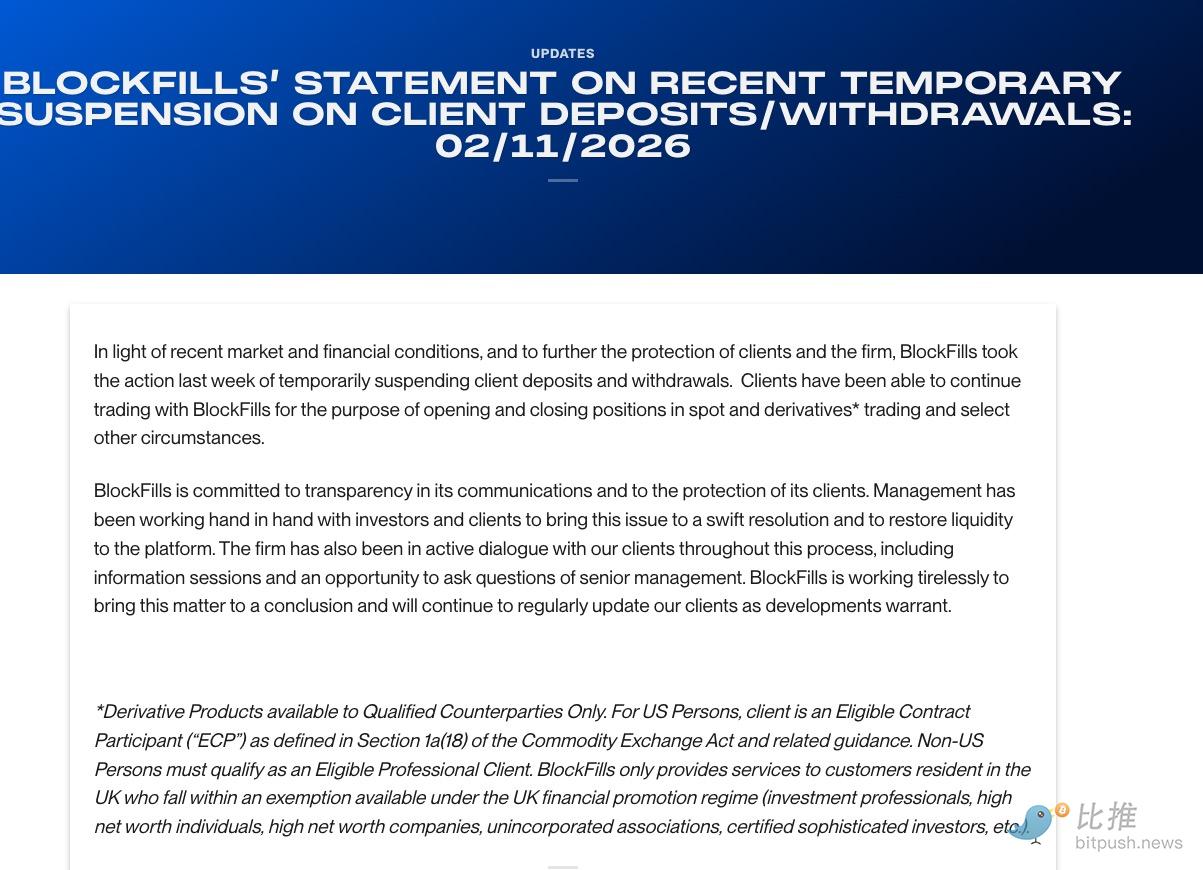
How familiar it smells. When Celsius collapsed in 2022, its opening line was also "temporary liquidity adjustment."

BlockFills' move immediately triggered collective market anxiety: Are we about to witness a repeat of the 2022 tragedies of Celsius and Genesis?

Who is BlockFills?

Founded in Chicago in 2018, this company is not a grassroots project, nor a Dubai-based exile exchange. It's based in Chicago—the Jerusalem of derivatives markets, home to the CME. Its core team comes from traditional finance market making and trading backends. Two names are written on its early investor list: CME Ventures and Susquehanna International Group (SIG).

What caliber of player is Susquehanna? A top-tier Wall Street market maker, accounting for over 30% of annual US options trading volume, and also an early investor in TikTok's parent company, ByteDance. It's not the kind of Crypto VC that chases hot trends and sprays money around; it's old money that stations actuaries upstairs at the exchange.

In 2021, BlockFills completed a $6 million seed round; on the eve of FTX's collapse in 2022, it counter-trend completed a $37 million Series A round. The lead investor was again Susquehanna Capital, with the follow-on list including CME Ventures, Simplex, C6 Ventures, and even Nexo.

Therefore, BlockFills is a "regular army" piece placed by traditional financial giants in the crypto lending arena. Its clients aren't the retail investors who rushed in during 2021, but miners, hedge funds, family offices, market makers, payment processors—over 2,000 institutions across 95 countries. Last year, the payment processor C14 alone processed billions of dollars in onboarding business through it.

Such a company initiating a "voluntary circuit breaker" is more worrying than the blow-up of any retail lending platform in 2022.

Who is BlockFills' largest client group?

Most likely, miners.

According to the official company disclosure, as of 2025, BlockFills provided approximately $150 million in financing and asset management solutions for global miners. As for which specific mining companies received this money, BlockFills did not say. As a platform serving 2,000 institutional clients, publicly disclosing a client list violates both commercial惯例 and privacy red lines. We can only find some clues from scattered public information: it has partnered with payment processor C14, integrated with Fireblocks and Zodia Custody, but those are ecosystem partners, not the borrowers.

The borrowers are silent, but their balance sheets don't lie.

Bitcoin fell from $120,000 to just over $60,000 in less than four months. In early February, "shutdown" warnings began circulating in mining circles. The breakeven line for Antminer S19 series models is around $70,000, and the coin price had been lying below that number for two weeks.

When an industry benchmark like MARA was monitored transferring over 1,300 BTC to an exchange—when the industry benchmark chooses to cut its losses and exit at the $60,000 mark—how many within BlockFills' miner client group were already in technical default?

Is it a "Protective Mechanism" or a "Precursor to Collapse"?

Fintech consultant Dr. Anya Sharma points out that such suspensions are essentially an extension of the "circuit breaker" mechanism in traditional finance. In the digital asset space, the lag of blockchain settlement and potential price flash crashes can lead to collateral valuation failures. Suspending services allows the system to recalibrate, preventing a complete meltdown caused by asset-liability mismatches.

Furthermore, compared to the retail platforms that failed in the 2022 bankruptcy wave, BlockFills has two significant "moats":

  1. Top-Tier "Blue-Blood" Background:

    BlockFills is backed by CME (Chicago Mercantile Exchange) and Susquehanna (SIG). These traditional financial giants not only provide credit endorsement but are also more likely to provide liquidity support (bailout) at critical moments.

  2. Institutionalized Risk Control:

    Celsius/BlockFi (Retail High-Yield Model): They attracted funds by promising high interest rates (10%-20% APY) to ordinary retail investors, then invested in high-risk projects (like Three Arrows Capital). This is a typical "high-cost liability" model, extremely fragile. BlockFills is more like a "cryptocurrency bank trading desk." Its funding sources are primarily institutional clients, and its business focus is providing hedging for miners and trading liquidity for hedge funds. BlockFills' business logic is closer to traditional finance, and its accounts are theoretically more transparent than the more Ponzi-esque model of Celsius.

Therefore, if BlockFills can resume services shortly (e.g., within 72 hours or a week) and transparently disclose its asset status, it will become a model of "risk management," proving that institutional-grade infrastructure is indeed more resilient than the previous generation of platforms. Conversely, if the suspension is prolonged, it will inevitably become the first giant domino to fall in this bear market, triggering a credit collapse in the institutional lending space.

Author: Little Bear Biscuit | Bitpush


Twitter:https://twitter.com/BitpushNewsCN

Bitpush TG Discussion:https://t.me/BitPushCommunity

Bitpush TG Subscription: https://t.me/bitpush

Original link:https://www.bitpush.news/articles/7611258

Perguntas relacionadas

QWhat is the main reason BlockFills has suspended withdrawals, according to its official statement?

AAccording to its official statement, BlockFills suspended withdrawals as a 'temporary measure to protect the interests and the company', not due to default or bankruptcy. It described the action as an internal circuit breaker.

QWhich major traditional financial institutions are key investors in BlockFills?

AThe key investors in BlockFills are CME Ventures and Susquehanna International Group (SIG), which are major players in traditional finance.

QWhat is the primary customer base that BlockFills serves, and why are they particularly vulnerable currently?

ABlockFills primarily serves institutional clients such as miners, hedge funds, and family offices. Miners are particularly vulnerable because the price of Bitcoin has fallen below the breakeven point for many mining rigs, potentially leading to defaults on loans.

QHow does BlockFills' business model differ from that of failed retail lending platforms like Celsius?

ABlockFills operates as a 'cryptocurrency bank trading desk' with institutional clients and focuses on hedging for miners and providing liquidity for hedge funds. In contrast, Celsius used a high-yield model targeting retail customers, which was more fragile and prone to collapse.

QWhat are the potential outcomes if BlockFills fails to resume services quickly, as suggested in the article?

AIf BlockFills fails to resume services quickly and transparently, it could become the first major domino to fall in this bear market, triggering a credit collapse in the institutional lending sector.

Leituras Relacionadas

North Korean Hackers Loot $500 Million in a Single Month, Becoming the Top Threat to Crypto Security

North Korean hackers, particularly the notorious Lazarus Group and its subgroup TraderTraitor, have stolen over $500 million from cryptocurrency DeFi platforms in less than three weeks, bringing their total theft for the year to over $700 million. Recent major attacks on Drift Protocol and KelpDAO, resulting in losses of approximately $286 million and $290 million respectively, highlight a strategic shift: instead of targeting core smart contracts, attackers are now exploiting vulnerabilities in peripheral infrastructure. For instance, the KelpDAO attack involved compromising downstream RPC infrastructure used by LayerZero's decentralized validation network (DVN), allowing manipulation without breaching core cryptography. This sophisticated approach mirrors advanced corporate cyber-espionage. Additionally, North Korea has systematically infiltrated the global crypto workforce, with an estimated 100 operatives using fake identities to gain employment at blockchain companies, enabling long-term access to sensitive systems and facilitating large-scale thefts. According to Chainalysis, North Korean-linked hackers stole a record $2 billion in 2025, accounting for 60% of all global crypto theft that year. Their total historical crypto theft has reached $6.75 billion. Post-theft, they employ specialized money laundering methods, heavily relying on Chinese OTC brokers and cross-chain mixing services rather than standard decentralized exchanges. Security experts, while acknowledging the increased sophistication, emphasize that many attacks still exploit fundamental weaknesses like poor access controls and centralized operational risks. Strengthening private key management, limiting privileged access, and enhancing coordination among exchanges, analysts, and law enforcement immediately after an attack are critical to improving defense and fund recovery chances. The industry's challenge now extends beyond secure smart contracts to safeguarding operational security at the infrastructure level.

marsbitHá 14m

North Korean Hackers Loot $500 Million in a Single Month, Becoming the Top Threat to Crypto Security

marsbitHá 14m

Circle CEO's Seoul Visit: No Korean Won Stablecoin Issuance, But Met All Major Korean Banks

Circle CEO Jeremy Allaire's recent activities in Seoul indicate a strategic shift for the company, moving away from issuing a Korean won-backed stablecoin and instead focusing on embedding itself as a key infrastructure provider within Korea’s financial and crypto ecosystem. Despite Korea accounting for nearly 30% of global crypto trading volume—with a market characterized by high retail participation and altcoin dominance—Circle has chosen not to compete for the role of stablecoin issuer. Instead, Allaire met with major Korean banks (including Shinhan, KB, and Woori), financial groups, leading exchanges (Upbit, Bithumb, Coinone), and tech firms like Kakao. This approach reflects a broader industry transition: the core of stablecoin competition is shifting from issuance rights to systemic positioning. With Korean regulators still debating whether banks or tech companies should issue stablecoins, Circle is avoiding regulatory uncertainty by strengthening its role as a service and technology partner. The company is deepening integration with trading platforms, building connections, and promoting stablecoin infrastructure. This positions Circle to benefit regardless of which entity eventually issues a won stablecoin. Allaire also noted the potential for a Chinese yuan stablecoin in the next 3–5 years, underscoring a regional trend of stablecoins becoming more regulated and integrated with traditional finance. Ultimately, Circle’s strategy highlights that future influence in the stablecoin market will belong not necessarily to the issuers, but to the foundational infrastructure layers that enable cross-system transactions.

marsbitHá 42m

Circle CEO's Seoul Visit: No Korean Won Stablecoin Issuance, But Met All Major Korean Banks

marsbitHá 42m

SpaceX Ties Up with Cursor: A High-Stakes AI Gambit of 'Lock First, Acquire Later'

SpaceX has secured an option to acquire AI programming company Cursor for $60 billion, with an alternative clause requiring a $10 billion collaboration fee if the acquisition does not proceed. This structure is not merely a potential acquisition but a strategic move to control core access points in the AI era. The deal is designed as a flexible, dual-path arrangement, allowing SpaceX to either fully acquire Cursor or maintain a binding partnership through high-cost collaboration. This "option-style" approach minimizes immediate regulatory and integration risks while ensuring long-term alignment between the two companies. At its core, the transaction exchanges critical AI-era resources: SpaceX provides its Colossus supercomputing cluster—one of the world’s most powerful AI training infrastructures—while Cursor contributes its AI-native developer environment and strong product adoption. This synergy connects compute power, models, and application layers, forming a closed-loop AI capability stack. Cursor, founded in 2022, has achieved rapid growth with over $1 billion in annual revenue and widespread enterprise adoption. Its value lies in transforming software development through AI agents capable of coding, debugging, and system design—positioning it as a gateway to future software production. For SpaceX, this move is part of a broader strategy to evolve from a aerospace company into an AI infrastructure empire, integrating xAI, supercomputing, and chip manufacturing. Controlling Cursor fills a gap in its developer tooling layer, strengthening its AI narrative ahead of a potential IPO. The deal reflects a shift in AI competition from model superiority to ecosystem and entry-point control. With programming tools as a key battleground, securing developer loyalty becomes crucial for dominating the software production landscape. Risks include questions around Cursor’s valuation, technical integration challenges, and potential regulatory scrutiny. Nevertheless, the deal underscores a strategic bet: controlling both compute and software development access may redefine power dynamics in the AI-driven future.

marsbitHá 1h

SpaceX Ties Up with Cursor: A High-Stakes AI Gambit of 'Lock First, Acquire Later'

marsbitHá 1h

Trading

Spot
Futuros
活动图片