Blockchain and no-code tools challenge AWS' dominance: Crypto exec

cointelegraphPublicado em 2025-12-20Última atualização em 2025-12-20

Resumo

The rise of AI-powered no-code tools and blockchain technology is challenging Amazon Web Services' dominance in cloud computing, according to Lomesh Dutta of the Dfinity Foundation. These tools democratize app creation and enable AI-driven, continuously updated user experiences without relying on centralized servers. Blockchain provides a secure, tamper-resistant infrastructure that operates without constant human intervention. Despite promoting decentralization, many crypto and Web3 projects still depend on AWS, as seen in multiple 2025 outages that disrupted major platforms like Binance, Coinbase, and MetaMask. Industry executives argue that true decentralization must extend beyond the ledger to infrastructure to avoid reliance on centralized providers.

The rise of AI-powered no-code tools that allow users to create applications through linguistic prompts rather than computer code, decentralized through blockchain technology, will challenge Amazon Web Services’ (AWS) dominance of the cloud computing market.

No-code tools will democratize access to app creation and custom-tailored user experiences that will require constant updates and maintenance from AI, Lomesh Dutta, vice president of growth at the Dfinity Foundation, a non-profit organization that guides development of the Internet Computer Protocol (ICP) ecosystem, told Cointelegraph.

This rise of user-created applications eliminates the need for centrally managed software solutions stored on centralized servers.
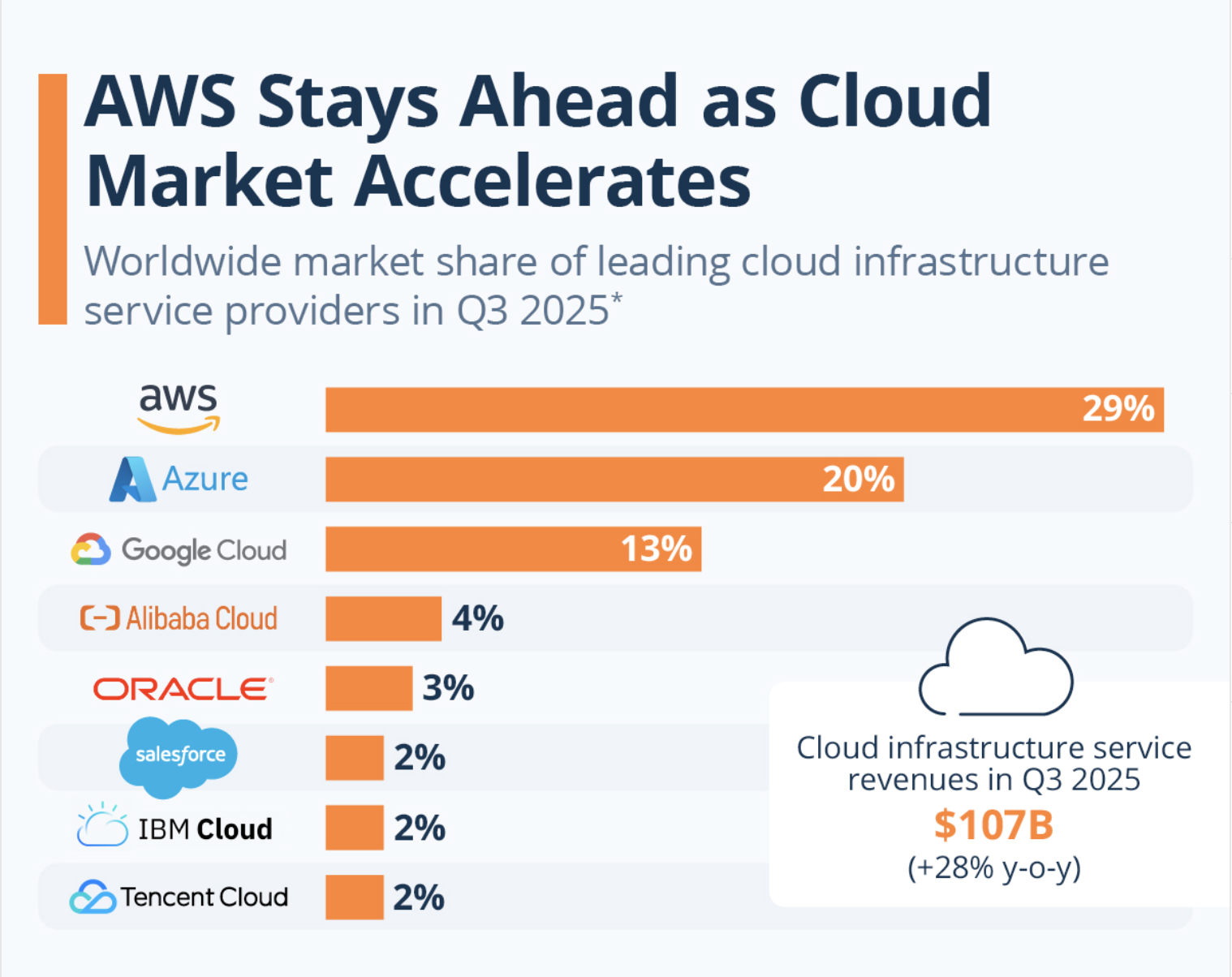
AWS continues to dominate the cloud-computing market in 2025. Source: Statista

“When applications are continuously generated and evolved by AI, you need infrastructure that is secure, tamper-resistant, and able to stay online without constant human intervention,” he said. Lomesh added:

“Decentralized blockchain networks introduced a revolutionary computing paradigm: by eliminating central points of control, they enable the creation of secure, reliable, and fault-tolerant software.”

A significant portion of crypto companies and Web3 projects rely on centralized AWS infrastructure to power their consumer-facing applications and websites, Internet Computer founder Dominic Williams told Cointelegraph.

Related: Cloudflare outage shows why crypto needs end-to-end decentralization

AWS outages rock the crypto industry in 2025

Several AWS outages occurred in 2025, impacting multiple crypto platforms and exchanges using AWS servers and data centers to host their applications.

The first outage occurred in April, causing disruptions to centralized crypto exchanges, including Binance, KuCoin and MEXC. At the time, Binance temporarily paused withdrawals until normal service was restored.

AWS experienced another outage in October, causing disruptions in crypto exchange Coinbase’s mobile application, with users reporting login problems, slowdowns and withdrawal issues.
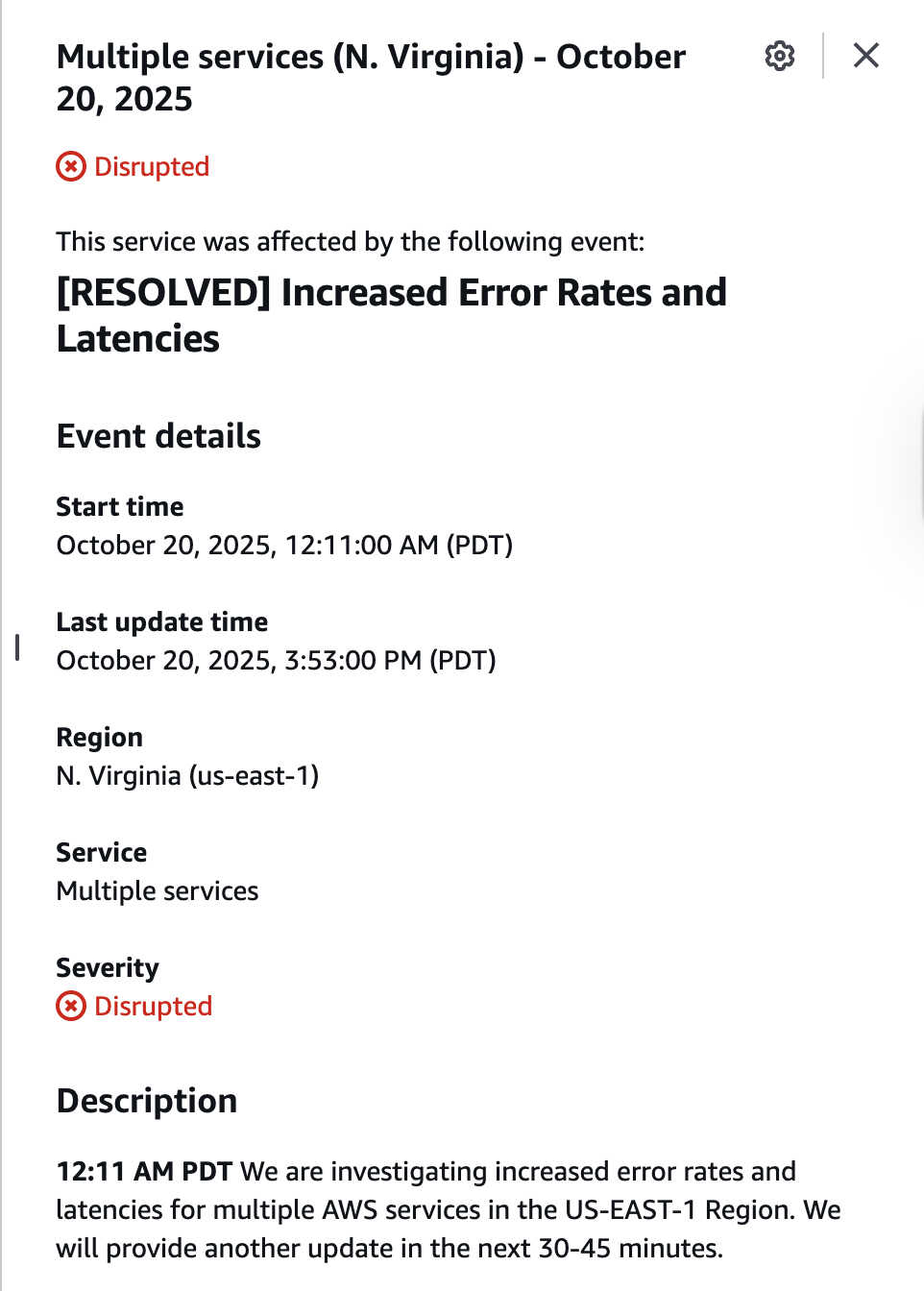
AWS reports an outage on October 20. Source: AWS Health Dashboard

Other financial applications were impacted by the outage, including the mixed-asset brokerage platform Robinhood and Web3 wallet MetaMask.

The October AWS outage lasted for about 15 hours and underscored the level of reliance crypto and Web3 projects, which market themselves as decentralized alternatives, have on centralized cloud infrastructure providers.

Crypto’s reliance on centralized infrastructure has drawn criticism from several crypto industry executives, including Jamie Elkaleh, chief marketing officer at crypto wallet company Bitget Wallet, and Carlos Lei, co-founder of decentralized physical infrastructure network (DePIN) marketplace Uplink.

“Decentralization has succeeded at the ledger layer but not yet at the infrastructure layer,” Elkaleh told Cointelegraph in October.

Magazine: Meet the onchain crypto detectives fighting crime better than the cops

Perguntas relacionadas

QAccording to the article, how will no-code tools and blockchain technology challenge AWS' dominance in cloud computing?

ANo-code tools democratize app creation through AI-powered linguistic interfaces, while blockchain provides decentralized, secure, and tamper-resistant infrastructure that eliminates reliance on centralized servers and reduces need for constant human maintenance.

QWhat specific problems did AWS outages cause for crypto platforms in 2025 as mentioned in the article?

AAWS outages in April and October 2025 caused disruptions including Binance pausing withdrawals, Coinbase experiencing login problems and withdrawal issues, and affecting platforms like KuCoin, MEXC, Robinhood, and MetaMask.

QWhat criticism did crypto executives have regarding the industry's infrastructure according to the article?

AExecutives like Jamie Elkaleh criticized that 'decentralization has succeeded at the ledger layer but not yet at the infrastructure layer,' highlighting the contradiction between Web3's decentralized ideals and its reliance on centralized cloud providers like AWS.

QWhat advantages does Lomesh Dutta attribute to decentralized blockchain networks for AI-generated applications?

AHe stated decentralized blockchain networks provide 'a revolutionary computing paradigm' by eliminating central points of control, enabling the creation of secure, reliable, and fault-tolerant software that can stay online without constant human intervention.

QWhich major companies and projects were mentioned as being affected by the AWS outages in the article?

AThe affected entities included crypto exchanges Binance, KuCoin, MEXC, and Coinbase; mixed-asset brokerage Robinhood; and Web3 wallet MetaMask.

Leituras Relacionadas

Where Is the AI Infrastructure Industry Chain Stuck?

The AI infrastructure (AI Infra) industry chain is facing unprecedented systemic bottlenecks, despite the rapid emergence of applications like DeepSeek and Seedance 2.0. The surge in global computing demand has exposed critical constraints across multiple layers of the supply chain—from core manufacturing equipment and data center cabling to specialty materials and cleanroom facilities. Key challenges include four major "walls": - **Memory Wall**: High-bandwidth memory (HBM) and DRAM face structural shortages as AI inference demand outpaces training, with new capacity not expected until 2027. - **Bandwidth Wall**: Data transfer speeds lag behind computing power, causing multi-level bottlenecks in-chip, between chips, and across data centers. - **Compute Wall**: Advanced chip manufacturing, reliant on EUV lithography and monopolized by ASML, remains the fundamental constraint, with supply chain fragility affecting production. - **Power Wall**: While energy demand from data centers is rising, power supply is a solvable near-term challenge through diversified energy infrastructure. Expansion is further hindered by shortages in testing equipment, IC substrates (critical for GPUs and seeing price hikes over 30%), specialty materials like low-CTE glass fiber, and high-end cleanroom facilities. Connection technologies are evolving, with copper cables resurging for short-range links due to cost and latency advantages, while optical solutions dominate long-range scenarios. Innovations like hollow-core fiber and advanced PCB technologies (e.g., glass substrates, mSAP) are emerging to meet bandwidth needs. In summary, AI Infra bottlenecks are multidimensional, spanning compute, memory, bandwidth, power, and supply chain logistics. Advanced chip manufacturing remains the core constraint, while substrate, material, and equipment shortages present immediate challenges. The industry is moving toward hybrid copper-optical solutions and accelerated domestic supply chain development.

marsbitHá 13m

Where Is the AI Infrastructure Industry Chain Stuck?

marsbitHá 13m

Autonomy or Compatibility: The Choice Facing China's AI Ecosystem Behind the Delay of DeepSeek V4

DeepSeek V4's repeated delay in early 2026 has sparked global discussions on "de-CUDA-ization" in AI. The highly anticipated trillion-parameter open-source model is undergoing deep adaptation to Huawei’s Ascend chips using the CANN framework, representing China’s first systematic attempt to run a core AI model outside the CUDA ecosystem. This shift, however, comes with significant engineering challenges. While the model uses a MoE architecture to reduce computational load, it places extreme demands on memory bandwidth, chip interconnects, and system scheduling—areas where NVIDIA’s mature CUDA ecosystem currently excels. Migrating to Ascend introduces complexities in hardware topology, communication latency, and software optimization due to CANN’s relative immaturity compared to CUDA. The move highlights a broader strategic dilemma: short-term compatibility with CUDA offers practical benefits and faster adoption, as seen in CANN’s efforts to emulate CUDA interfaces. Yet, long-term over-reliance on compatibility risks inheriting CUDA’s limitations and stifling native innovation. If global AI shifts away from transformer-based architectures, strict compatibility could lead to technological obsolescence. Despite these challenges, DeepSeek V4’s eventual release could demonstrate the viability of a full domestic AI stack and accelerate CANN’s ecosystem growth. However, true technological independence will require building an original software-hardware paradigm beyond compatibility—a critical task for China’s AI ambitions in the next 3-5 years.

marsbitHá 31m

Autonomy or Compatibility: The Choice Facing China's AI Ecosystem Behind the Delay of DeepSeek V4

marsbitHá 31m

How Blockchain Fills the Identity, Payment, and Trust Gaps for AI Agents?

AI Agents are rapidly evolving into autonomous economic participants, but they face critical gaps in identity, payment, and trust infrastructure. They currently lack standardized ways to prove who they are, what they are authorized to do, and how they should be compensated across different environments. Blockchain technology is emerging as a solution to these challenges by providing a neutral coordination layer. Public ledgers offer auditable credentials, wallets enable portable identities, and stablecoins serve as a programmable settlement layer. A key bottleneck is the absence of a universal identity standard for non-human entities—akin to "Know Your Agent" (KYA)—which would allow Agents to operate with verifiable, cryptographically signed credentials. Without this, Agents remain fragmented and face barriers to interoperability. Additionally, as AI systems take on governance roles, there is a risk that centralized control over models could undermine decentralized governance in practice. Cryptographic guarantees on training data, prompts, and behavior logs are essential to ensure Agents act in users' interests. Stablecoins and crypto-native payment rails are becoming the default for Agent-to-Agent commerce, enabling seamless, low-cost transactions for AI-native services. These systems support permissionless, programmable payments without traditional merchant onboarding. Finally, as AI scales, human oversight becomes impractical. Trust must be built into system architecture through verifiable provenance, on-chain attestations, and decentralized identity systems. The future of Agent economies depends on cryptographically enforced accountability, allowing users to delegate tasks with clearly defined constraints and transparent operation logs.

marsbitHá 1h

How Blockchain Fills the Identity, Payment, and Trust Gaps for AI Agents?

marsbitHá 1h

Trading

Spot
Futuros
活动图片