‘Block and find out’ – White House warns Coinbase on CLARITY Act fallout

ambcryptoPublicado em 2026-03-28Última atualização em 2026-03-28

Resumo

The White House issued a veiled warning to Coinbase over its opposition to the CLARITY Act, suggesting a future Democratic administration could impose harsher regulations on stablecoin yields, DeFi, and crypto overall. This marks a shift from earlier statements downplaying the exchange's stance. Coinbase confirmed it is working on a counterproposal to preserve stablecoin rewards, drawing both support and criticism. Broader industry concerns include weakened DeFi developer protections and the exclusion of Bitcoin from tax exemptions, which only apply to stablecoins. Despite the standoff, Coinbase anticipates the bill could be resolved and passed by early May.

The latest CLARITY Act standoff has now devolved into subtle threats between the White House and Coinbase.

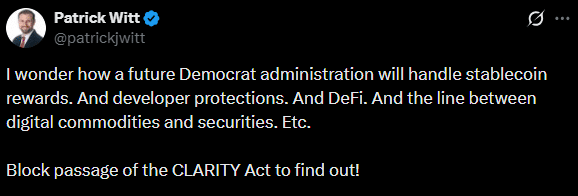
In a social media post on the 28th of March, Patrick Witt, the executive director of the President’s Council on Digital Assets, issued a veiled warning that seemed aimed at a recent Coinbase holdout.
Source: X/Witt

According to Witt, the future Democratic administration will likely treat stablecoin yield, DeFi, and overall crypto way worse than the current compromise in the CLARITY Act draft. The Trump crypto advisor dared Coinbase to block the bill and find out Democrats’ plans.

This was a complete U-turn from an earlier White House statement that downplayed Coinbase’s alleged opposition to the new stablecoin restrictions.

But the stalemate is now public, and the crypto exchange confirmed it. In a separate statement, David Duong, Coinbase’s head of global investment research, said the industry was “working on a coordinated counterproposal” to “preserve sustainable stablecoin rewards.”

Some supported Coinbase’s fight for stablecoin yield. But critics wondered when the exchange’s CEO became a “crypto industry CEO” and a de facto spokesperson, decrying that he was holding the entire sector hostage.

However, the contentions on the latest CLARITY Act draft go beyond stablecoin rewards.

Developer protections and Bitcoin tax exemption concerns

Industry’s policy chiefs also raised concerns about the draft rules’ treatment of DeFi developer protections and the crypto double taxation issue.

For his part, Jake Chervinsky, CEO of Hyperliquid Policy Center, said the draft rules undermine developer protections and cautioned,

Those sections must be fixed, or the bill doesn’t work for DeFi. If the bill doesn’t work for DeFi, it doesn’t work at all.

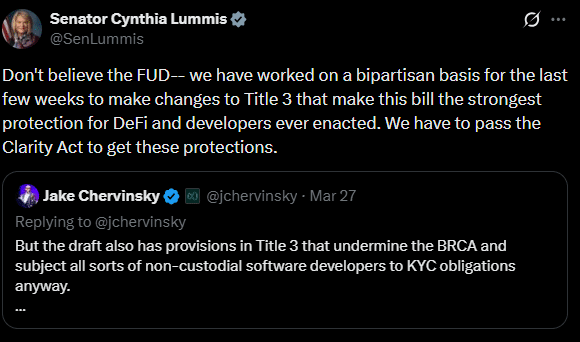
However, Senator Cynthia Lummis assured that there was bipartisan support to include changes that protect developers.
Source: X/Lummis

Separately, legal experts had issues with a new draft proposal that only offered a tax exemption for stablecoin transfers, but not BTC. Again, Coinbase was blamed for blocking the BTC tax exemption.

Notably, the proposal fixed the double taxation of crypto staking but not Bitcoin mining. This elicited a strong opposition from the advocacy group Bitcoin Policy Institute (BPI). BPI added,

Today’s new draft leaves the double taxation on Bitcoin mining in place and only provides relief to staking. We need a strong community push back to show that this language sets America and Bitcoin back.

Coinbase eyes May for final bill passage

That said, Coinbase’s Duong projected that the stablecoin yield issue could be resolved in the next three weeks.

According to him, a Senate Banking markup could then happen in H2 April with a potential final passage of the bill in early May if “floor time allows.”


Final Summary

  • White House warned Coinbase of the dire future consequences if it blocks the CLARITY Act again.
  • The exchange sought a new stablecoin yield deal and expected the bill could be passed in May.

Criptomoedas em alta

Perguntas relacionadas

QWhat was the White House's warning to Coinbase regarding the CLARITY Act?

AThe White House, through Patrick Witt, issued a veiled warning that a future Democratic administration would likely treat stablecoin yield, DeFi, and crypto much worse than the current compromise in the CLARITY Act draft if Coinbase blocks the bill.

QWhat specific issue is Coinbase seeking to address with a coordinated counterproposal?

ACoinbase is working on a coordinated counterproposal to 'preserve sustainable stablecoin rewards' in response to the new stablecoin restrictions in the CLARITY Act draft.

QBeyond stablecoins, what other major concerns did industry experts raise about the CLARITY Act draft?

AIndustry experts raised concerns about the draft's undermining of DeFi developer protections and its failure to provide a tax exemption for Bitcoin, only offering one for stablecoin transfers and fixing double taxation for staking but not for Bitcoin mining.

QWhat was the projected timeline for the bill's passage according to Coinbase's David Duong?

ADavid Duong projected that the stablecoin yield issue could be resolved in three weeks, with a Senate Banking markup in the second half of April and a potential final passage of the bill in early May.

QWhich advocacy group strongly opposed the draft's treatment of Bitcoin mining taxation?

AThe Bitcoin Policy Institute (BPI) strongly opposed the draft, stating it leaves the double taxation on Bitcoin mining in place and only provides relief to staking, which sets America and Bitcoin back.

Leituras Relacionadas

Bitcoin Withdrawals Continue: 8 Years of Storage in a Coldcard Cold Wallet Ended in Zero

Coldcard Hardware Wallet Hacked: Losses Mount Due to Vulnerable Seed Generation A critical vulnerability in Coldcard hardware wallets has led to a continued wave of fund thefts. According to Galaxy Research, the total stolen has reached 1,367.05 BTC (approx. $88.6 million) from 4,585 addresses, a significant increase from the initial 594.5 BTC reported on July 30, 2026. Most of the stolen funds remain on the attackers' addresses. The issue is not with the current firmware, which Coinkite has updated, but with seed phrases generated on vulnerable devices between March 2021 and the release of fixed firmware versions. Due to a programmer error, devices switched from using a hardware random number generator to the software-based Yasmarang generator, which was initialized with publicly accessible data like the chip's serial number. This made the seed phrases predictable through offline brute-force attacks, meaning wallets remain at risk until funds are moved to a new wallet generated with the patched firmware. Affected devices include Mk2/Mk3 with firmware 4.0.1–4.1.9 (and up to 5.0.3), Mk4/Mk5 up to version 5.6.0, and Q models up to 1.5.0Q. The only exceptions are seeds created with a high-entropy method like at least 50 independent dice rolls or a strong unique BIP-39 passphrase. All other owners must generate a new seed on the fixed firmware and transfer their assets. A case highlighting the human impact involves a 39-year-old long-term investor who lost 2 BTC (approx. $130,000) in minutes. He had accumulated the Bitcoin over eight years through physical labor, viewing it as a financial lifeline and a retirement plan in a country suffering from hyperinflation. His story underscores that even conservative "buy and hold in cold storage" strategies can be compromised by such underlying technical flaws. From a technical perspective, this incident echoes historical failures where weak random number generators undermined cryptographic security, challenging the assumption that offline storage is automatically foolproof.

cryptonews.ruHá 4h

Bitcoin Withdrawals Continue: 8 Years of Storage in a Coldcard Cold Wallet Ended in Zero

cryptonews.ruHá 4h

Trading

Spot

Artigos em Destaque

Como comprar HOUSE

Bem-vindo à HTX.com!Tornámos a compra de Housecoin (HOUSE) simples e conveniente.Segue o nosso guia passo a passo para iniciar a tua jornada no mundo das criptos.Passo 1: cria a tua conta HTXUtiliza o teu e-mail ou número de telefone para te inscreveres numa conta gratuita na HTX.Desfruta de um processo de inscrição sem complicações e desbloqueia todas as funcionalidades.Obter a minha contaPasso 2: vai para Comprar Cripto e escolhe o teu método de pagamentoCartão de crédito/débito: usa o teu visa ou mastercard para comprar Housecoin (HOUSE) instantaneamente.Saldo: usa os fundos da tua conta HTX para transacionar sem problemas.Terceiros: adicionamos métodos de pagamento populares, como Google Pay e Apple Pay, para aumentar a conveniência.P2P: transaciona diretamente com outros utilizadores na HTX.Mercado de balcão (OTC): oferecemos serviços personalizados e taxas de câmbio competitivas para os traders.Passo 3: armazena teu Housecoin (HOUSE)Depois de comprar o teu Housecoin (HOUSE), armazena-o na tua conta HTX.Alternativamente, podes enviá-lo para outro lugar através de transferência blockchain ou usá-lo para transacionar outras criptomoedas.Passo 4: transaciona Housecoin (HOUSE)Transaciona facilmente Housecoin (HOUSE) no mercado à vista da HTX.Acede simplesmente à tua conta, seleciona o teu par de trading, executa as tuas transações e monitoriza em tempo real.Oferecemos uma experiência de fácil utilização tanto para principiantes como para traders experientes.

443 Visualizações TotaisPublicado em {updateTime}Atualizado em 2026.06.02

Como comprar HOUSE

Discussões

Bem-vindo à Comunidade HTX. Aqui, pode manter-se informado sobre os mais recentes desenvolvimentos da plataforma e obter acesso a análises profissionais de mercado. As opiniões dos utilizadores sobre o preço de HOUSE (HOUSE) são apresentadas abaixo.

活动图片













