BiyaPay Market Observation|US Stocks Pull Back, Intel and AMD Surge Against the Trend, Has the AI Chip Rally Shifted Focus?

marsbitPublished on 2026-09-10Last updated on 2026-09-10

Abstract

BiyaPay Market Observations: US stocks experienced a general pullback, with major indices closing lower on September 8th. However, a notable divergence emerged within the semiconductor sector: Intel surged around 9% and AMD rose nearly 6%, while NVIDIA declined about 2%. This suggests capital is not exiting the AI and chip theme but rotating within the sector. The rotation comes amid macro pressures from rising oil prices and Treasury yields, which increase inflation concerns and pressure equity valuations. In this environment, investors are becoming more selective, shifting focus from high-flying pure-play AI stocks towards companies with clearer near-term profit recovery or new growth narratives. Intel's rally was sparked by reports of potential CPU price hikes, signaling a reassessment of its pricing power and potential profitability recovery within the broader AI infrastructure build-out. Qualcomm gained after announcing a multi-generational collaboration with Amazon for AI data center chips, opening a potential new growth avenue beyond mobile. AMD's rise appears tied to the overall positive sentiment towards alternative AI chip plays. This movement indicates the AI investment theme is maturing. The narrative is evolving from a singular focus on market leaders to a more nuanced, multi-faceted evaluation of the entire supply chain. Key factors to watch include upcoming US CPI data, the Federal Reserve's policy meeting, and further validation of order momentum and financ...

US stocks reopened after the holiday, and the market did not directly continue its previous risk appetite.

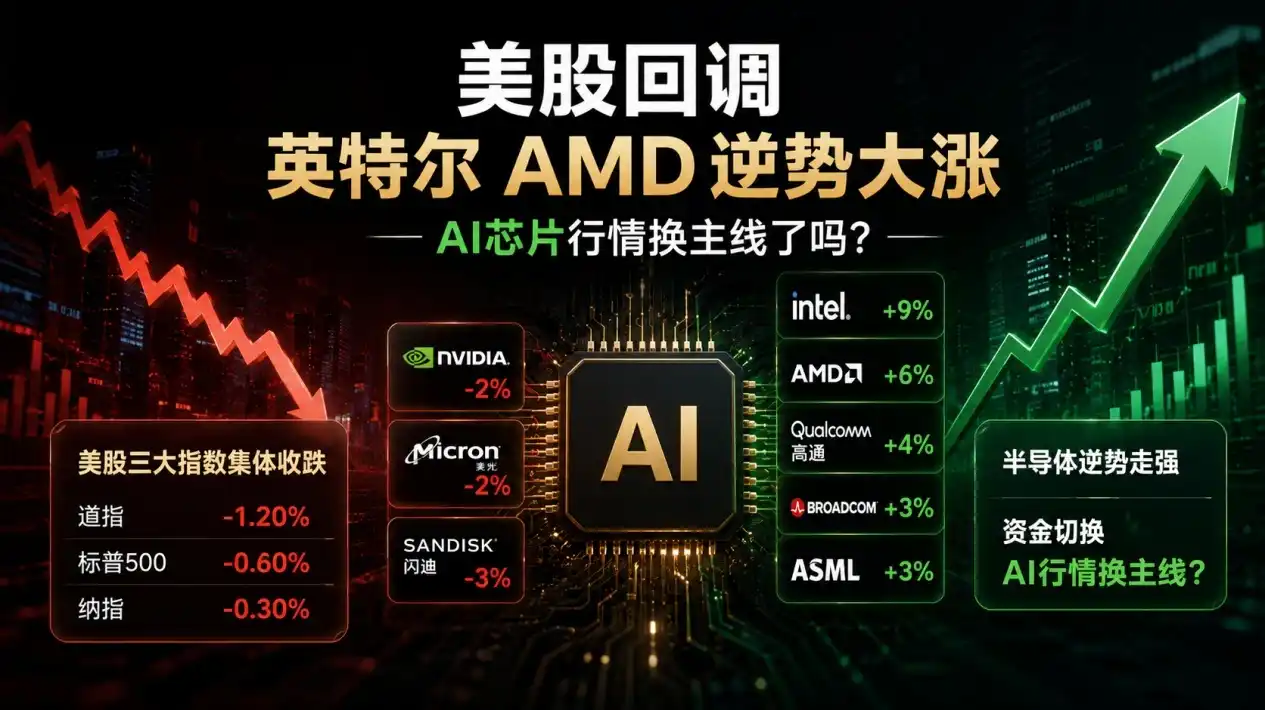
On September 8, BiyaPay market data showed that the three major US stock indices closed lower collectively, with the Dow Jones falling 1.2%, the S&P 500 Index falling 0.6%, and the Nasdaq falling 0.3%. On the surface, this appears to be a normal pullback, but the truly interesting part is that while the indices weakened, there was a clear divergence within the semiconductor sector. Intel surged approximately 9%, AMD rose nearly 6%, while Qualcomm, Broadcom, and ASML also saw varying degrees of gains. On the other hand, Nvidia fell about 2%, and storage-focused companies like Micron and SanDisk showed relative weakness.
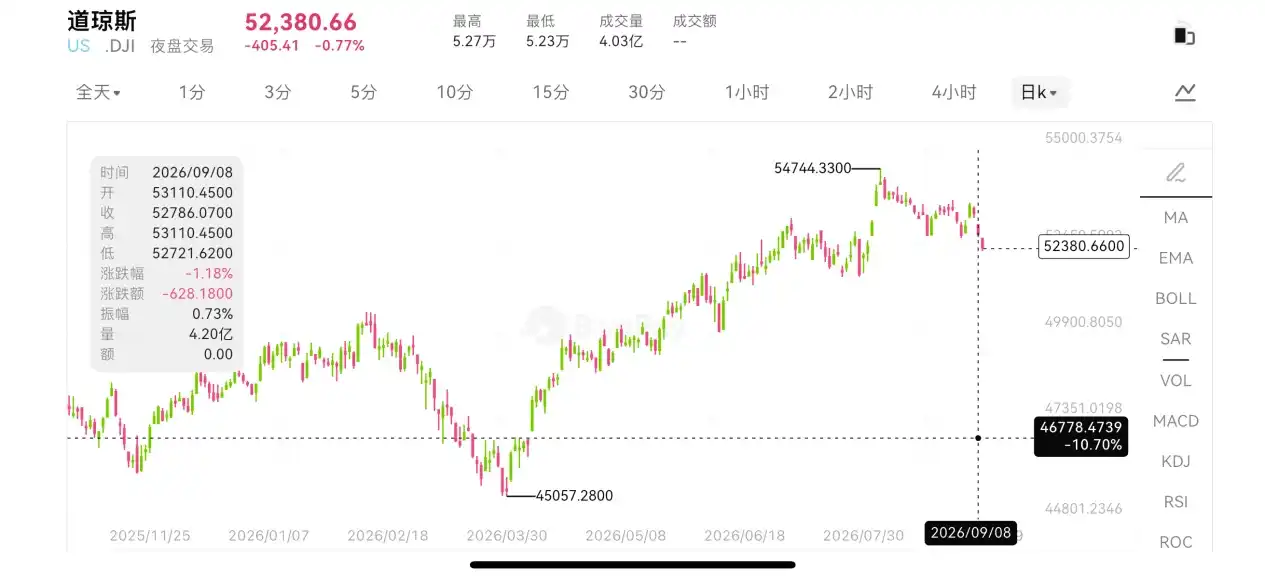
This kind of market movement is most likely to create illusions. Looking solely at the indices, one might think tech stocks are cooling down; looking only at individual stocks, one finds that capital hasn't left AI and chips but is rapidly switching between different directions. Especially when oil prices, US Treasury yields, Federal Reserve expectations, and the AI industrial chain are simultaneously impacting the market, focusing on just one market can easily cause one to miss the real signal.

When observing such market movements, it is more useful to look at several assets together. For example, within the BiyaPay App, one can simultaneously follow US stocks like Intel, AMD, Qualcomm, and Nvidia, while also monitoring changes in assets like Hong Kong stocks, BTC, ETH, gold, and crude oil. As a global all-in-one asset allocation platform, BiyaPay covers multiple asset scenarios including digital assets, US stocks, Hong Kong stocks, and fiat currency exchange, making it more suitable for observing price changes across different markets. For such high-volatility markets, the key is not to chase daily price fluctuations, but to understand what exactly the capital is trading—whether it's interest rates, inflation, AI orders, or risk appetite.

This indicates that capital has not simply withdrawn from AI and chips, but is rather choosing new directions.

Over the past period, trading in US tech stocks has been highly concentrated on keywords like Nvidia, AI servers, memory chips, and computing power capital expenditures. However, as oil prices surge again, US Treasury yields rise, and the Federal Reserve's September meeting approaches, market tolerance for high-valuation assets decreases. At such times, capital is more inclined to seek out two types of companies: those with clear orders or customer validation, and those with clearer profit recovery logic.

Intel, Qualcomm, and AMD being pulled back into the spotlight by capital this time precisely follows this logic.
Why Did Chip Stocks Rise Amid Broader Market Pressure?

The pressure on US stocks this round first came from the macro environment.

Brent crude oil once approached and briefly broke through the $100 per barrel mark, while WTI also rose above $90. Rising oil prices rekindle inflation expectations, and once inflation becomes more persistent, it becomes harder for the Fed to quickly pivot to easing. Meanwhile, the 10-year US Treasury yield rose to around 4.8%, with the 30-year yield also remaining high. For US stocks, the combined pressure from oil prices, inflation, and interest rates initially impacts valuations.

In theory, tech stocks should be more sensitive, as the valuations of many high-growth companies are based on future cash flows. The higher the interest rate, the less attractive the discounted present value of future profits becomes. However, this time the Nasdaq's decline was smaller than the Dow's, and semiconductors even strengthened against the trend, indicating the market is not broadly selling off tech, but rather undergoing a structural shift.

What capital is truly trading is which companies can continue to articulate their growth story clearly in a high-interest-rate environment, and whose price increases, orders, customers, and product roadmaps can more easily translate into profits.

Intel's Rise Is More Than Just a Sentiment Recovery

Intel's surge this time was superficially triggered by pricing and profit expectations.

DigiTimes reported that Intel may raise PC CPU prices again in October by about 10%. This news drove Intel's stock price higher, making it one of the top performers in the S&P 500 that day. It's important to note that Intel has not officially commented on this, so it cannot yet be considered confirmed company guidance. However, the market's willingness to buy in suggests that capital is paying attention to whether Intel's pricing power is returning.

This point is crucial.

Over the past few years, Intel's biggest problem wasn't a lack of revenue, but rather that profit margins, manufacturing investments, and competitive pressures have consistently weighed on its valuation. If CPU prices are now increasing, server-side demand is improving, and cost pressures are gradually being passed on, the market will reassess its profit recovery potential. Combined with AI data center demand for server CPUs, interconnects, and infrastructure, Intel is no longer just a traditional PC cyclical stock but is being re-priced within the AI infrastructure chain.

Of course, Intel's narrative hasn't completely reversed yet. What will ultimately determine how far the valuation recovery goes is not a single-day 9% gain, but whether it can prove in the coming quarters that price hikes won't significantly suppress demand, whether its data center business can continue to improve, and whether its advanced processes and foundry business can alleviate market concerns.

Qualcomm's Appeal: Transitioning from Phones to AI Data Centers

Qualcomm's strength this time leans more towards industry growth potential.

On September 8, Qualcomm officially announced a multi-generational product collaboration with Amazon, focusing on custom chips and optical interconnect solutions for large-scale AI data centers, with an emphasis on AI inference and optical connectivity capabilities up to 1.6T. The market's focus isn't just on the client name 'Amazon,' but also on whether Qualcomm can use this to open a second growth curve beyond mobile phone chips.

Qualcomm's core identity in the past has been mobile phones, basebands, and mobile computing. However, as AI enters the inference phase, data centers need not only GPUs but also more efficient inference chips, low-power computing, and high-speed interconnects. If Qualcomm can leverage the energy efficiency advantages accumulated in the mobile domain for data centers, it has an opportunity to break free from the traditional mobile phone cycle.

But here it's also necessary to see clearly that the so-called potential scale of up to $600 billion does not equate to confirmed order revenue. Some reports mention this being related to Amazon warrants and future purchasing conditions. Whether it can fully translate into Qualcomm's revenue depends on subsequent product delivery, customer purchasing cadence, and competitive landscape. The short-term market reaction—a price increase—is re-pricing Qualcomm's entry into the AI data center space, not fully confirming revenue for the next decade.

Why Was AMD Also Lifted?

AMD's rise was more driven by sentiment within the AI chip and server chain.

AMD has always occupied a nuanced position. It is not the absolute AI leader like Nvidia, but it's not without presence either. The market's focus on AMD essentially boils down to two points: first, whether its MI series AI accelerators can continue to secure orders from major customers, and second, whether its server CPU and data center business can maintain its share gains.

When Qualcomm secures a collaboration with Amazon and Intel is being re-traded for its pricing power, AMD will also be placed into the same comparative framework. Besides Nvidia, who else can capture a sufficiently large slice of the pie in the AI infrastructure expansion? This is the source of AMD's potential upside.

But AMD's challenge lies precisely here. The market is not giving it a premium for certainty, but rather a 'challenger' premium. Challenger rallies often rise quickly but are also prone to pullbacks due to order cadence, gross margins, supply chain issues, and software ecosystem concerns. Therefore, AMD's rise shouldn't be judged solely by a single-day gain; more importantly, it's about whether subsequent AI revenue share, customer expansion, and product iteration continue to materialize.

This Isn't an AI Downturn, but AI Pricing Becoming More Discerning

In this round of semiconductor divergence, the most noteworthy aspect isn't which stocks rose or fell, but that AI trading is shifting from a single-leader narrative to more granular industrial chain pricing.

In the earlier phase, the market preferred companies with the strongest certainty, hence Nvidia, TSMC, memory chips, and AI servers were the main theme. However, as valuations rise, capital begins to search for new explanatory frameworks. For instance, Intel is being traded for price and profit recovery, Qualcomm for AI inference and a new entry point into data centers, AMD for alternative potential outside of Nvidia, and ASML and semiconductor equipment for the advanced process capacity expansion cycle.

It's still AI, but the positioning is different.

This also explains why semiconductors can rise against the trend even as the broader market falls. The market isn't unconcerned about interest rates, but is seeking tech assets within the high-rate environment that can better prove their own value. As long as AI capital expenditure isn't disproven, chip stocks won't simply exit the stage; they will only rotate between different segments.

What to Really Watch Next?

In the short term, semiconductors rising against the trend have sent a signal to the market: the AI and chip theme hasn't disappeared; capital is simply seeking new pivot points away from crowded trades. Nvidia falling doesn't mean AI is receding; Intel, Qualcomm, and AMD rising don't mean the market theme has completely shifted. More accurately, the market is reallocating pricing power within the AI industrial chain.

Several variables are crucial going forward.

First is the US August CPI. According to the US Bureau of Labor Statistics schedule, the August CPI will be released on September 11. With oil prices having risen significantly, if inflation data also comes in strong, pressure on the Federal Reserve's September meeting will intensify. Second is the FOMC meeting on September 15-16. The market currently prices in a high probability of a September rate hike; the interest rate path will directly impact tech stock valuations. Third is subsequent orders within the AI industrial chain. The collaborations like Qualcomm-Amazon, Intel's price hike expectations, and AMD's server demand all need further validation in upcoming earnings reports and guidance.

Therefore, this round of semiconductor gains resembles a structural re-rating more than a simple sentiment-driven rebound.

Soaring oil prices and rising US Treasury yields should, in theory, pressure risk assets; but semiconductors strengthening against the trend indicates capital is still willing to pay for AI infrastructure, just more selectively. The companies that can continue to outperform in the future may not be the ones telling the most sensational stories, but those that can convincingly link customers, orders, pricing, and profit margins together.

The broader US stock market remains under pressure, yet AI chips show no signs of cooling down. The real question isn't whether chip stocks can still rise, but rather who in this rally will next prove that AI investments can ultimately translate into cash flow.

Trending Cryptos

Related Questions

QAccording to the article, why did major US stock indices decline while semiconductor stocks like Intel and AMD rose on September 8th?

AThe major indices declined due to macro pressures including rising oil prices, elevated US Treasury yields, and related inflation concerns ahead of the Fed's September meeting. Meanwhile, semiconductor stocks like Intel and AMD rose because capital rotated within the AI and chip sector, shifting from the previously crowded trade in names like Nvidia to companies with clearer near-term profitability, pricing power, or new AI data center growth stories.

QWhat was the specific catalyst mentioned for Intel's significant stock price increase?

AThe specific catalyst mentioned was a report from DigiTimes indicating that Intel may raise PC CPU prices by about 10% in October. While Intel did not officially confirm this, the market interpreted it as a sign of returning pricing power and potential profit margin improvement, leading to a significant re-rating of the stock.

QWhat new growth opportunity for Qualcomm is highlighted in the article?

AThe article highlights Qualcomm's multi-generational product collaboration with Amazon focusing on custom chips and optical interconnect solutions for large-scale AI data centers, including AI inference and high-speed optical connectivity up to 1.6T. This partnership represents a potential new growth avenue for Qualcomm beyond its traditional mobile phone chip business, entering the AI data center infrastructure market.

QHow does the article characterize the nature of the current AI and semiconductor market rally compared to the earlier phase?

AThe article characterizes the current phase as a shift from a broad, single-narrative (like the focus on Nvidia) to a more nuanced and selective 'structural repricing' within the AI supply chain. Capital is becoming more挑剔 (picky), focusing on specific company fundamentals like order validation, pricing power, profit recovery, and the ability to translate AI investment into cash flow, rather than just the overall AI theme.

QWhat are the three key upcoming variables mentioned in the article that could impact the market and AI chip stocks?

AThe three key upcoming variables are: 1) The release of US August CPI data on September 11th, which will provide insight into inflation trends. 2) The Federal Open Market Committee (FOMC) meeting on September 15th-16th, which will set the tone for interest rate policy. 3) Subsequent order validation and guidance from AI industry players like Qualcomm (with Amazon), Intel (price hike impact), and AMD (server demand), to see if their growth stories materialize.

Related Reads

Overseas viral tracking robot now available for immediate purchase in China

Beni, a compact follow-cam robot from Shenzhen startup Mondo Tech, has officially launched in China at 4,999 yuan. Founded in early 2025 by former DJI executives—CEO Gao Jianrong (ex-head of DJI RoboMaster) and CTO Yang Shuo (former DJI technical director and Tesla Optimus control/algorithms engineer)—the company blends DJI-style hardware polish with consumer-friendly design. Roughly the size of a lunchbox and weighing 1.75 kg, Beni can run, jump, flip upright after falling, and hit speeds up to 28.8 km/h, all while shooting stabilized 4K video. Its core selling point is autonomous tracking: press a button and Beni follows you during runs, skateboarding, cycling, or family outings, adjusting its angle as you move, functioning like a "DJI Pocket 3 with legs." A bundled smartwatch-like controller enables blind operation and motion-based mini-games such as "find the coins" and tug-of-war. Visual processing runs on-device with 32GB storage plus microSD support, and footage is not uploaded to servers unless cloud templates are used. An app called MondoCut auto-edits highlights. Battery life is about 1.5 hours, with an 800-yuan "Explorer Edition" adding two spare batteries. Reviewers note minor flaws: obstacle avoidance isn't foolproof (glass doors), it can lose track in crowded places, and there's a learning curve. The article frames Beni as a pragmatic entry into embodied AI for consumers—positioned at the intersection of utility, emotional value, and cost—and suggests emotional connection, not just labor, may be embodied AI's fastest path into ordinary life.

marsbit17m ago

Overseas viral tracking robot now available for immediate purchase in China

marsbit17m ago

Where 95% of Pump.fun's Revenue Comes From: Making Money Off Tokens That Go to Zero, Turning the Meme Ecosystem Into a Zero-Sum Game

Pump.fun dominates meme coin issuance, capturing 92% of tokens and 84% of trading volume, but its revenue model depends on failure. About 95% of protocol income comes from tokens still on the bonding curve or below $250K market cap, and 87% comes from tokens less than a day old. A 1.25% fee applies to each trade, with 0.95% going to the platform. Fifteen top tokens with combined peak valuations of $1.4B generated only about $1.5M in fees, while small tokens below $250K produced $506M—meaning 1,000 tokens that die at $20K earn more than one token reaching $100M. This incentive structure encourages bundling, mass token issuance, paid KOL promotions, and PvP trading—all of which generate fees. The top 25 issuer addresses launched 761,000 tokens with under 1% graduating, earning $128M. Pump.fun has paid $29.6M in promotion rewards to 51,115 wallets, with the top 10 taking 16%; most promoted tokens have market caps under $100K, and followers of 14 tracked promoters lost $926K in a single day. Promoted tokens typically fall 48% within an hour and 74% within a day. The result is infinite supply against shrinking demand. Of 24.4 million tokens ever launched, only 312 still hold a market cap above $100K—a 0.0013% survival rate. Quarterly launches match 2024 levels, but tokens reaching $10M fell from 207 to 24. The author urges traders to hold quality tokens longer, judge KOLs by follower profitability, and shift volume to platforms rewarding longevity. Proposed reforms include higher initial market caps, deeper liquidity, fees shared with holders and LPs, creator fees vesting over time, and promotion rewards tied to sustained follower holdings rather than volume. A more radical model would abandon bonding curves for uniform-price fundraising with refunds on failure and wallet caps, charging fees only on successful raises.

marsbit27m ago

Where 95% of Pump.fun's Revenue Comes From: Making Money Off Tokens That Go to Zero, Turning the Meme Ecosystem Into a Zero-Sum Game

marsbit27m ago

BiyaPay Research Institute Observation | U.S. Stocks Rebound, Hong Kong Tech Pulls Back: Can Nvidia and Platform Earnings Stabilize Expectations?

U.S. stocks rebounded last week, with the S&P 500 up 2.51% and the semis ETF SOXX up 9.35%, though Nvidia fell 12.75% after its board accepted Jensen Huang's resignation, with CFO Colette Kress serving as interim CEO. AMD, Broadcom and Micron rallied, showing that sector recovery does not mean every leader is endorsed. CoreWeave rose 14.50% on strong revenue and financing clarity, but cash returns remain unproven. Cisco beat on revenue yet fell 6.24% as gross margin slipped, highlighting that profit quality and expectations matter. Hong Kong tech pulled back, with the Hang Seng Tech Index down 6.50%; Alibaba, Meituan and Tencent all fell despite southbound net buying of HK$11.87 billion, showing that one source of demand cannot set the overall price. SMIC rose 6.45% on better quarterly results but faces margin pressure ahead. U.S. October CPI rose 0.4% month-on-month, with core CPI up 0.3%, while PPI reached 6.5% year-on-year and long-term Treasury yields exceeded 5%, so rate constraints persist. Investors should distinguish gains backed by operating improvement from mere rebound after sharp declines. Key catalysts in the coming two weeks include Nvidia's earnings on Nov 17, results from JD.com, Tencent and Alibaba, U.S. retail sales data, and the FOMC minutes, followed by PCE data and Thanksgiving trading arrangements.

marsbit28m ago

BiyaPay Research Institute Observation | U.S. Stocks Rebound, Hong Kong Tech Pulls Back: Can Nvidia and Platform Earnings Stabilize Expectations?

marsbit28m ago

Open power struggle! Jensen Huang discusses return as CEO with allies, while Bessent urges Nvidia to pick an 'outsider'

Nvidia is embroiled in a public battle over its CEO position following Jensen Huang's resignation. Huang has discussed returning with confidants, and allies are forming a Silicon Valley "war room" to lobby the board and seek White House support. A petition demanding his reinstatement has gathered over 100,000 signatures, including from Elon Musk, Tim Sweeney, and other tech leaders. Musk argued that many Nvidia supply chain deals are handshake agreements with Huang that could be lost without him. Major shareholders Altimeter Capital and Atreides Management also urged the board to consider Huang's return. Meanwhile, Treasury Secretary Bessent publicly pressured the board on Fox News to seek an outside successor and pursue "drastic leadership change." He also questioned whether Nvidia knowingly violated high-end chip export controls, citing the company's decision to stop separately disclosing Singapore revenue after direct sales fell and Singapore billings surged, with only 1% of chips reportedly remaining there. He demanded answers from the board and outside counsel within 10 days. Huang's return faces obstacles: his affair with a subordinate is a fireable offense, he holds no controlling stake, and he faces congressional scrutiny, having agreed to closed-door interviews with three House committees. Arm CEO Rene Haas has been approached as a potential successor, though no formal process has begun. Interim CEO Colette Kress is leading the company ahead of Tuesday's quarterly earnings.

marsbit48m ago

Open power struggle! Jensen Huang discusses return as CEO with allies, while Bessent urges Nvidia to pick an 'outsider'

marsbit48m ago

Panoramic Market Weekly: Circle Native Payment Network, Real AI Calls, and Prediction Market Shifts

This week's earnings season highlights stablecoin payments moving from concept to real commercial deployment, with Circle's Payment Network at the forefront. Circle CEO Jeremy Allaire argues that on-chain settlement will dramatically lower marginal costs for value transfer, with transaction fees needing to fall below 10 basis points to fulfill the network's promise. Artemis estimates that by 2032, Circle's Payment Network could process around $1 trillion in stablecoin volume—about 1.5% of global non-commodity cross-border flows—generating roughly $755 million in annual revenue at a 7 bps fee and valuing the business at about $3.5 billion, or 20% of Circle's market cap. However, competition is intensifying as Mastercard acquires BVNK and Visa reportedly considers integrating Fireblocks. Using AI to analyze 1,343 earnings calls and 17,721 analyst questions, Artemis ranked the sharpest exchanges, including tough questions on mining capex returns and a Barclays call where management deflected a buyout question by citing a dropped signal. Prediction markets are structurally disrupting traditional sports betting. Card-spend data shows triple-digit growth in deposits to Polymarket and Kalshi from Q1 to Q3 2026, while legacy sportsbooks decline. Notably, nearly 90% of Kalshi depositors and 72% of Polymarket users never used cards on traditional betting platforms, indicating new incremental audiences. States without legal sports betting account for 55% of Kalshi's volume despite holding only a third of the U.S. adult population. DraftKings has cut profit guidance and is boosting marketing and R&D spending to defend its turf. Finally, AI infrastructure remains severely supply-constrained. CoreWeave says confirmed demand through 2027 exceeds its available capacity by more than 10x, with 2028 reservations oversubscribed before opening. TSMC confirms insatiable demand for advanced chips, and Ramp data shows enterprise token consumption still growing steeply.

marsbit53m ago

Panoramic Market Weekly: Circle Native Payment Network, Real AI Calls, and Prediction Market Shifts

marsbit53m ago

Trading

Spot

Hot Articles

How to Buy CHIP

Welcome to HTX.com! We've made purchasing USD.AI (CHIP) simple and convenient. Follow our step-by-step guide to embark on your crypto journey.Step 1: Create Your HTX AccountUse your email or phone number to sign up for a free account on HTX. Experience a hassle-free registration journey and unlock all features.Get My AccountStep 2: Go to Buy Crypto and Choose Your Payment MethodCredit/Debit Card: Use your Visa or Mastercard to buy USD.AI (CHIP) instantly.Balance: Use funds from your HTX account balance to trade seamlessly.Third Parties: We've added popular payment methods such as Google Pay and Apple Pay to enhance convenience.P2P: Trade directly with other users on HTX.Over-the-Counter (OTC): We offer tailor-made services and competitive exchange rates for traders.Step 3: Store Your USD.AI (CHIP)After purchasing your USD.AI (CHIP), store it in your HTX account. Alternatively, you can send it elsewhere via blockchain transfer or use it to trade other cryptocurrencies.Step 4: Trade USD.AI (CHIP)Easily trade USD.AI (CHIP) on HTX's spot market. Simply access your account, select your trading pair, execute your trades, and monitor in real-time. We offer a user-friendly experience for both beginners and seasoned traders.

9.2k Total ViewsPublished 2026.04.21Updated 2026.06.02

How to Buy CHIP

Discussions

Welcome to the HTX Community. Here, you can stay informed about the latest platform developments and gain access to professional market insights. Users' opinions on the price of CHIP (CHIP) are presented below.

活动图片