Bitwise: The Institutional Wave Has Arrived, Why Is the Market Still Asleep?

marsbitPublicado em 2026-02-25Última atualização em 2026-02-25

Resumo

The biggest alpha opportunities in financial markets come from behavioral biases like anchoring, where investors cling to initial impressions. This is why the crypto market is currently mispriced: traditional investors still anchor crypto to its early, counterculture image, while crypto natives suffer from "crying wolf" fatigue after years of promised institutional adoption. Yet, the institutional wave is already here. Wall Street is loudly announcing its move on-chain. SEC Chair Paul Atkins has initiated a commission-wide project to modernize securities regulation for blockchain. BlackRock’s Larry Fink declared we are at the beginning of asset tokenization, evidenced by the firm’s $2+ billion BUIDL tokenized treasury fund on Uniswap and an investment in UNI. Apollo is tokenizing a credit fund on six blockchains and acquiring a stake in Morpho. JPMorgan, Bank of America, Citi, and Wells Fargo are collaborating on a stablecoin. JPMorgan has issued a deposit token on Base, and Fidelity is hiring for a DeFi treasury role. The potential market is enormous: a $30 trillion ETF market, $110 trillion in equities, and $145 trillion in bonds. In contrast, the entire tokenized market is just $20 billion, suggesting potential for exponential growth. The chart of tokenized real-world assets (RWA) value shows a near-vertical growth trajectory, yet this reality is disconnected from market perception. The key challenge is determining how to capture this opportunity, as unanswered question...

Author: Matt Hougan, Chief Investment Officer of Bitwise

Compiled by: Saoirse, Foresight News

The greatest excess returns (Alpha) in financial markets often come from behavioral biases. Investors always make mistakes, and if you can exploit these mistakes, you can achieve substantial returns.

One of my favorite behavioral biases to exploit is anchoring: people cling to the first piece of information they receive and are reluctant to change. This is why retailers price items at $9.99 instead of $10.00—you remember the '9' first, and your brain struggles to let go.

Anchoring was one of the reasons I decided to dive into the crypto industry full-time in 2018.

At that time, most people still viewed cryptocurrency as a joke. They first learned about it through the 2013 Silk Road scandal, the 2014 Mt. Gox exchange collapse, and witnessed its extreme boom-and-bust cycles.

Fortunately, a few people I trusted urged me to take crypto seriously.

When I looked beyond the surface, to see it for what it truly is rather than what people thought it was, I was completely astonished. The technology was far more mature than most people realized, and the opportunities were much greater. Yet people were still stuck with the old impressions from 2014.

Right now, I feel like I'm back in that moment.

The Whole World Is Shouting at You

Look around, Wall Street is loudly proclaiming: the financial industry is moving on-chain. Not just a small part, but all of it.

Last July, SEC Chairman Paul Atkins launched the 'Crypto Project,' a committee-wide initiative aimed at modernizing securities regulation. In his words, it's about enabling the U.S. financial markets to 'run on-chain.' And indeed, the markets have already started moving on-chain:

  • In October, BlackRock CEO Larry Fink publicly stated that we are at the starting point of tokenizing all assets. Two weeks ago, BlackRock launched the BUIDL tokenized treasury fund on Uniswap, the world's largest decentralized exchange; it has already grown to over $2 billion in size. As part of the collaboration, BlackRock also invested in Uniswap's native token, UNI.
  • Apollo, a credit institution managing $700 billion, partnered with Securitize to tokenize its diversified credit fund and list it on six public blockchains. Since January 2025, the product has attracted over $100 million. The company recently also announced plans to acquire a 9% stake in the leading global decentralized lending protocol, Morpho.
  • JPMorgan Chase, Bank of America, Citigroup, and Wells Fargo are in talks to jointly launch a stablecoin.

At the same time, JPMorgan issued a deposit token on Coinbase's Base network; Fidelity is hiring a head of decentralized finance treasury... Similar moves are emerging one after another.

The scale of the related markets is enormous: the ETF market is $30 trillion, the stock market is $110 trillion, and the bond market is $145 trillion.

In contrast, the current total global tokenized market is only $20 billion.

If Larry Fink is right—'every stock, every bond... will eventually be tokenized'—this means the market has tens of thousands of times more room to grow.

The Disconnect in Perception

Yet traditional investors just can't hear it.

They can't hear it because of anchoring.

When they think of cryptocurrency, the image that comes to mind is still that of the tattooed, punk, skateboarding figure. They don't realize that this person has long shaved his beard, put on a suit, and is building the infrastructure that will support the next generation of capital markets.

Amusingly, crypto investors themselves also seem unable to hear it.

They suffer from 'wolf cry' syndrome. Having heard promises of 'institutions are coming' for so long, now that they are actually here, they feel numb and unresponsive.

But the data doesn't lie.

Look at the growth curve of tokenized real-world assets (RWAs)—it's as steep as Mount Everest.

Value of Tokenized Real-World Assets (RWAs):
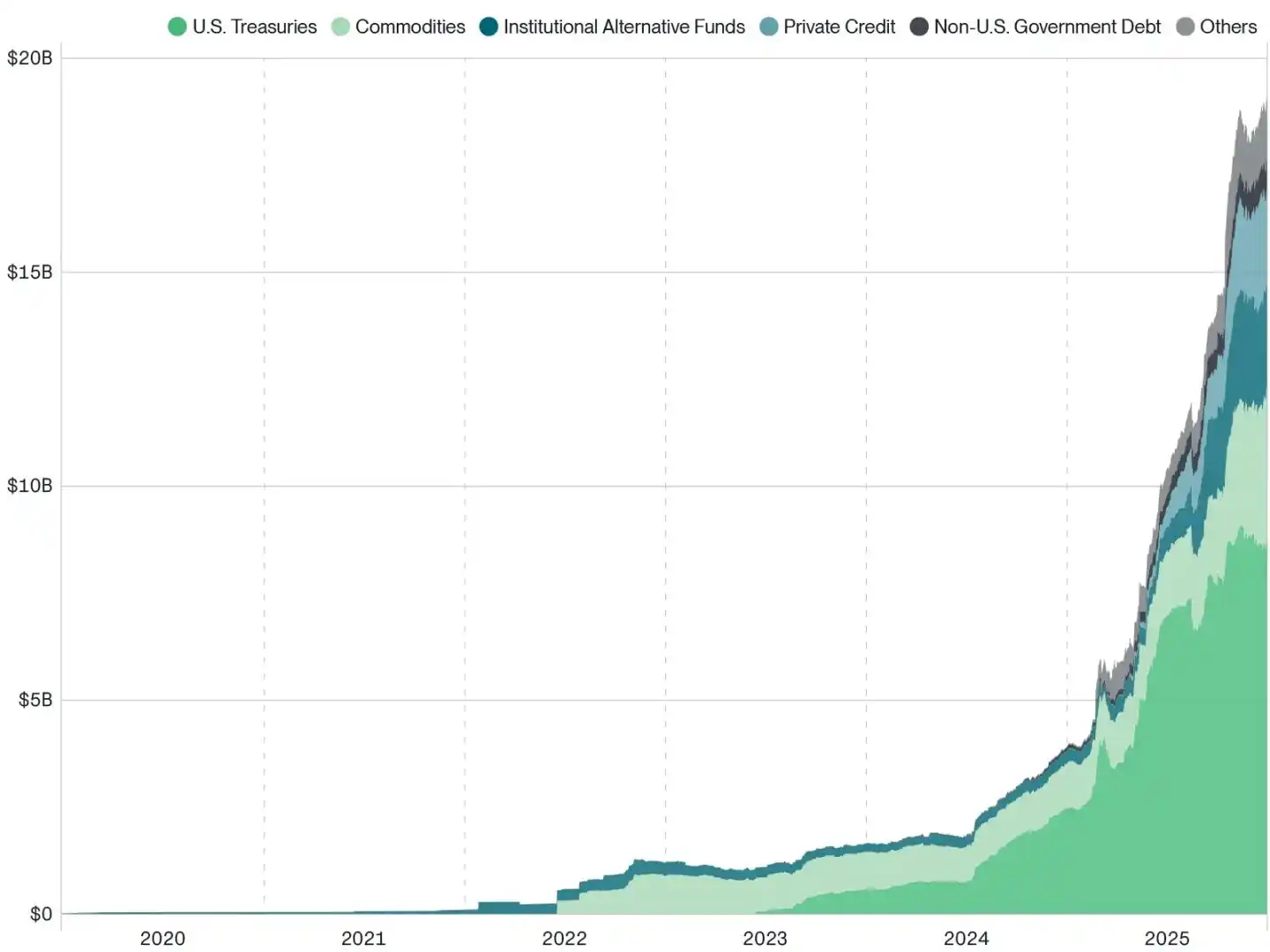
Source: Bitwise Asset Management, data from RWA.xyz. Data timeframe is from January 1, 2020, to December 31, 2025.

Note: Stablecoin issuers like Circle and Tether are intentionally omitted.

Seizing the Opportunity

The challenge is that it's difficult to know precisely how to profit from this.

Because the crypto industry still has a series of key questions unanswered, such as:

  • Will the value created by tokenization flow to underlying protocols like Ethereum and Solana, or is the underlying block space becoming commoditized?
  • If value settles on the underlying public chains, will new quasi-private chains like Canton Network and Tempo outperform public chains?
  • As institutions like BlackRock and Apollo embrace DeFi en masse, will DeFi tokens explode, or will the economic model challenges of DeFi tokens themselves be difficult to overcome?
  • If the value ultimately flows to the builder companies rather than the blockchain itself, will the beneficiaries be traditional giants like BlackRock and JPMorgan, or crypto-native institutions?

I have my own judgments on these questions and will share them in articles over the coming months. But honestly, for most of these questions, the answer right now is: no one knows.

The only thing I am certain of is:

There is a huge gap between what people think the crypto market is and what the crypto market actually is.

In my view, this gap represents a major opportunity—not to rush to pick winners in advance, but to broadly position across the entire sector while the market is still mispricing this structural shift.

The greatest opportunities for alpha often arise when market consensus is outdated, reality has moved forward, and investors are still anchored to the old narrative.

The crypto industry is at that point right now.

If you can see it for what it is, opportunities abound.

Perguntas relacionadas

QWhat behavioral bias does the author identify as a key source of alpha in financial markets, and how does it relate to the current state of crypto?

AThe author identifies anchoring bias as a key source of alpha. Investors are anchored to their initial impressions of crypto from events like the Silk Road scandal and Mt. Gox bankruptcy, failing to see that it has matured into a technology building the infrastructure for the next generation of capital markets.

QAccording to the article, what major Wall Street developments signal that the entire financial industry is moving on-chain?

AMajor developments include: the SEC's 'Crypto Project' to modernize securities regulation; BlackRock's CEO stating all assets will be tokenized and the launch of their BUIDL fund on Uniswap; Apollo tokenizing a credit fund and investing in Morpho; and major banks like JPMorgan, Bank of America, Citi, and Wells Fargo planning to launch a joint stablecoin.

QWhat is the current size of the tokenized market compared to the potential market, illustrating the growth opportunity?

AThe current global tokenized market is valued at only $20 billion. In contrast, the potential market for tokenizing ETFs, stocks, and bonds is massive, with the ETF market at $30 trillion, the stock market at $110 trillion, and the bond market at $145 trillion, representing a potential growth of thousands of times.

QWhy are both traditional investors and crypto investors failing to recognize the current institutional adoption of crypto, according to the author?

ATraditional investors are held back by anchoring bias, clinging to old stereotypes of crypto. Crypto investors suffer from a 'boy who cried wolf' syndrome, having heard promises of institutional adoption for so long that they have become numb to it now that it is actually happening.

QWhat is the author's recommended investment strategy to capitalize on the current disconnect between perception and reality in crypto?

AThe author recommends not trying to pick individual winners prematurely, but instead taking a broad-based approach to invest across the entire sector while the market is still mispricing this structural shift, as the greatest alpha is found when consensus is outdated.

Leituras Relacionadas

Bitcoin's 'Rally Ends,' Officially Entering the Later Stage of a Bear Market?

Bitcoin prices declined 13% this week, reversing the recent rebound and signaling a likely transition into the later stages of a bear market. Key on-chain metrics deteriorated, with the short-term holder cost basis falling below the Realized Price—a pattern last seen in early 2022, characteristic of bear market maturity. The rally to ~$82k proved to be a bear market bounce, as evidenced by the 90-day realized profit/loss ratio failing to sustain above the bullish threshold of 2. Daily realized losses surged to $1.35B, including significant selling from long-term holders who accumulated near cycle tops, indicating ongoing supply redistribution. Price was rejected almost precisely at the aggregate US spot ETF cost basis of ~$83k, turning that level into resistance and leaving the average ETF investor underwater again. Spot market selling pressure intensified, with the 7-day volume delta turning significantly negative to its weakest level since February. While a major long liquidation event cleared over $400M in leverage, spot demand has not yet stepped in to absorb the resulting supply. Options markets continue pricing in higher future volatility (elevated volatility risk premium) and maintain a skew toward put options, reflecting persistent demand for downside protection, though not yet panic. Overall, market structure remains fragile. Sustained recovery likely requires a reclaim of the ETF cost basis, a shift back to positive spot demand, and a slowdown in realized loss-taking. Until then, the market risks further downside or extended consolidation within the broader bear trend.

Foresight NewsHá 4m

Bitcoin's 'Rally Ends,' Officially Entering the Later Stage of a Bear Market?

Foresight NewsHá 4m

How Risky is the "Death Spiral" of MSTR and STRC?

Summary: This article explores the perceived "death spiral" risk between MicroStrategy (MSTR), its Bitcoin holdings, and its perpetual preferred stock (STRC), drawing comparisons to the LUNA-UST collapse. While both systems feature price anchors, high yields for holders, and potential feedback loops, their core mechanisms differ fundamentally. The MSTR-STRC structure relies on continuous financing to sustain its high dividend payouts, primarily through stock ATM offerings. A negative feedback cycle could occur: falling MSTR stock price makes raising equity capital harder, increasing pressure to sell Bitcoin, which undermines STRC confidence and further depresses MSTR. However, unlike LUNA-UST's automated, direct linkage, the MSTR-STRC loop is weaker and has brakes: STRC dividends can be deferred or rates lowered, and STRC holders have a $100/share liquidation preference in bankruptcy, providing a price floor. The company's sustainability hinges on its ability to continue financing. Its current ~$900 million USD reserves cover only about 6.3 months of its ~$1.71 billion annual interest/dividend burden. The next six months are critical, aligning with both the potential bottom in Bitcoin's four-year cycle and the depletion timeline of its reserves. While a LUNA-style catastrophic collapse is deemed highly unlikely due to structural differences, the key question is whether MicroStrategy can navigate this period through healthy deleveraging to restart its capital engine.

Foresight NewsHá 22m

How Risky is the "Death Spiral" of MSTR and STRC?

Foresight NewsHá 22m

How Much Debt Does Strategy Really Have? Is There a Risk of Implosion?

MicroStrategy's Debt Risk: A Turning Point in the "Never Sell" Strategy As of June 3, 2026, MicroStrategy holds 843,706 bitcoins (valued at ~$53.1B) but faces significant financial obligations. Its capital structure includes $6.75B in convertible notes and $15.48B in perpetual preferred stock (led by the $8.5B STRC series), creating an annual payout burden of ~$1.71B. With software revenue at only ~$500M, interest and dividend obligations far exceed operating income. A critical shift occurred in late May 2026 when the company sold 32 bitcoins for ~$2.5M to cover dividends, breaking CEO Michael Saylor's long-standing "never sell" pledge. This symbolic move triggered a sharp decline in both Bitcoin's price and MSTR stock, reflecting market fears about cash flow sustainability. The core of the strain is the STRC perpetual preferred stock, designed as a "permanent loan" with no maturity date but requiring high monthly dividends (currently 11.5%). Its business model relies on a three-part cycle: issuing new STRC shares, using proceeds to buy more Bitcoin and fund a USD reserve, and using that reserve to pay dividends. This cycle depends on continuous investor demand for STRC and Bitcoin's price appreciation. Analysis shows Bitcoin needs to appreciate at least 2.3% annually to cover the $1.71B in yearly obligations at current holdings. With Bitcoin price down ~22% from March 2026 highs, this pressure has intensified. The company's $900M USD reserve can only cover about 7 months of payments if STRC issuance stalls. Key risks are not immediate bankruptcy or forced Bitcoin liquidation (as BTC is not collateral), but rather: 1) The erosion of MSTR's premium to its Bitcoin holdings (mNAV), which would cripple its ability to raise cheap capital; 2) A vicious cycle where stagnant Bitcoin prices reduce STRC demand, draining the USD reserve and forcing BTC sales, further depressing prices. The period from February 2027 to September 2028 is a crucial test, with over $5.9B in convertible notes facing put options or maturity. In essence, MicroStrategy has evolved from a simple Bitcoin holder into a complex financial entity acting like a "private Bitcoin bank," leveraging its BTC holdings to create layered financial products. Its survival depends on maintaining Bitcoin's price trend, its stock premium, and market appetite for its preferred shares. The recent token sale marks not a betrayal of its Bitcoin thesis, but an admission that the leveraged strategy must eventually be paid for.

marsbitHá 33m

How Much Debt Does Strategy Really Have? Is There a Risk of Implosion?

marsbitHá 33m

Anthropic Cries Wolf: Is the AGI Threat Real, or Just an IPO Story?

Anthropic has published an article titled "When AI builds itself," discussing the emerging concept of "recursive self-improvement," where AI begins to actively participate in designing, training, testing, and optimizing its own subsequent versions. The company presents internal data showing that by May 2026, over 80% of code merged into its codebase was written by Claude, its AI model. Claude's capabilities have expanded to handling complex, open-ended engineering tasks, achieving a 76% success rate in such areas, and even contributing to research processes, such as optimizing code performance and conducting AI safety experiments. Anthropic outlines an evolution from human-driven development to AI-assisted workflows, culminating in the current stage where AI agents can autonomously write, run, and delegate code. The company cautions that the path toward a "closed loop," where AI continuously improves itself, is becoming visible. It calls for coordinated global mechanisms to potentially slow or pause frontier AI development to allow safety research and societal structures to catch up. However, the timing of this warning coincides with Anthropic's preparations for an IPO, framing the narrative not just as a safety concern but also as a demonstration of Claude's advanced capabilities and its integral role in accelerating Anthropic's own R&D—creating a potential "flywheel" effect for competitive advantage. This contrasts with OpenAI's recent, more policy-oriented discussion of the same risks, highlighting the competitive dynamics in the AI industry as companies position themselves in both the technological and regulatory landscape.

marsbitHá 1h

Anthropic Cries Wolf: Is the AGI Threat Real, or Just an IPO Story?

marsbitHá 1h

Trading

Spot
Futuros

Artigos em Destaque

Como comprar F

Bem-vindo à HTX.com!Tornámos a compra de Synfutures (F) simples e conveniente.Segue o nosso guia passo a passo para iniciar a tua jornada no mundo das criptos.Passo 1: cria a tua conta HTXUtiliza o teu e-mail ou número de telefone para te inscreveres numa conta gratuita na HTX.Desfruta de um processo de inscrição sem complicações e desbloqueia todas as funcionalidades.Obter a minha contaPasso 2: vai para Comprar Cripto e escolhe o teu método de pagamentoCartão de crédito/débito: usa o teu visa ou mastercard para comprar Synfutures (F) instantaneamente.Saldo: usa os fundos da tua conta HTX para transacionar sem problemas.Terceiros: adicionamos métodos de pagamento populares, como Google Pay e Apple Pay, para aumentar a conveniência.P2P: transaciona diretamente com outros utilizadores na HTX.Mercado de balcão (OTC): oferecemos serviços personalizados e taxas de câmbio competitivas para os traders.Passo 3: armazena teu Synfutures (F)Depois de comprar o teu Synfutures (F), armazena-o na tua conta HTX.Alternativamente, podes enviá-lo para outro lugar através de transferência blockchain ou usá-lo para transacionar outras criptomoedas.Passo 4: transaciona Synfutures (F)Transaciona facilmente Synfutures (F) no mercado à vista da HTX.Acede simplesmente à tua conta, seleciona o teu par de trading, executa as tuas transações e monitoriza em tempo real.Oferecemos uma experiência de fácil utilização tanto para principiantes como para traders experientes.

260 Visualizações TotaisPublicado em {updateTime}Atualizado em 2026.06.02

Como comprar F

Discussões

Bem-vindo à Comunidade HTX. Aqui, pode manter-se informado sobre os mais recentes desenvolvimentos da plataforma e obter acesso a análises profissionais de mercado. As opiniões dos utilizadores sobre o preço de F (F) são apresentadas abaixo.

活动图片













