Bitwise files with SEC to offer spot SUI ETF

cointelegraphPublicado em 2025-12-19Última atualização em 2025-12-19

Resumo

Bitwise has filed with the SEC to launch a spot SUI ETF, tracking the native token of the Sui Network. The firm submitted a Form S-1 registration, though a ticker symbol has not yet been announced. Coinbase Custody will serve as the custodian. This would be the first spot SUI ETF in the U.S., following earlier filings from Canary Capital and 21Shares, the latter of which recently received approval for a leveraged SUI ETF. SUI, launched in 2023, is the 31st-largest cryptocurrency with a $4.98 billion market cap. Bitwise recently added SUI to its existing crypto index fund and has also launched spot Bitcoin, Ether, and XRP ETFs. The firm anticipates rapid growth in the crypto ETF market in 2026.

Crypto asset manager Bitwise has filed with the US Securities and Exchange Commission to launch an exchange-traded fund tracking the Sui token.

The firm submitted a Form S-1 filing on Thursday to offer the “Bitwise Sui ETF,” initially registering the product with the SEC and taking the first step toward launching the fund.

Bitwise outlined that the fund would track the spot price of Sui (SUI), the native token of the layer 1 blockchain, the Sui Network.

Bitwise is yet to indicate what the ETF's ticker will be. Coinbase Custody will serve as the custodian for the product.
Bitwise had recently added Sui to its crypto index fund. Source: Bitwise

Amid the flood of crypto ETFs being greenlit by the SEC in 2025, a spot SUI ETF is yet to hit the market in the US. Canary Capital and 21Shares both submitted filings in March and April this year, with the review deadline for the latter coming next month.

The SEC recently approved a 2x leveraged SUI ETF from 21Shares earlier this month, and has passed generic listing standards that make it easier for crypto ETFs to come to market.

Related: XRP’s familiarity helps push ETFs past $1B assets: Exec

The SUI token launched back in mid-2023 and is the 31st largest cryptocurrency in terms of market cap at $4.98 billion.

An ETF for the asset would likely be seen as a boon by the SUI community, with publicly traded ETFs tracking the asset driving significant demand if successful.

Bitwise keeps upping ETF exposure

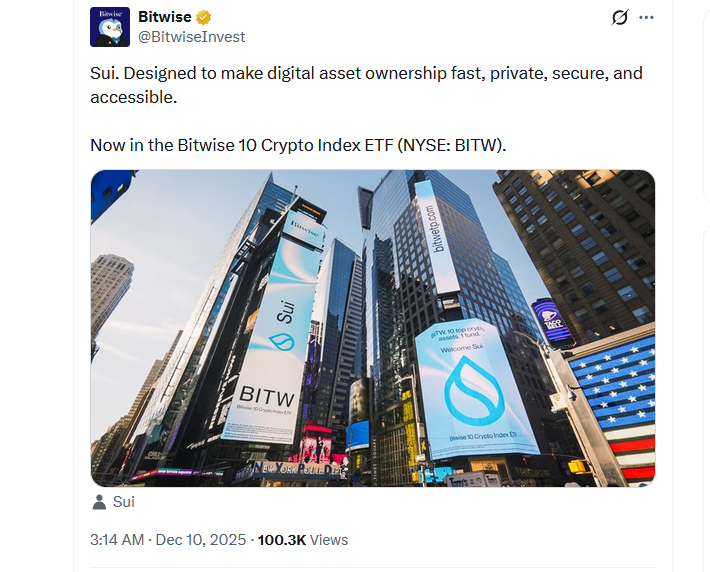
Earlier this month, Bitwise also added SUI to its 10 Crypto Index ETF on the New York Stock Exchange, highlighting that the blockchain is “designed to make digital asset ownership fast, private, secure, and accessible.”

Aside from a potential spot SUI ETF, Bitwise also launched a spot XRP ETF this year, adding to its spot Bitcoin ETF and Ether ETFs.

The firm expects the crypto ETF market to explode in 2026, Bitwise researcher Ryan Rasmussen stating during an interview with the Bankless podcast on Tuesday that he expects to see more than 100 products launch in a rapid fashion next year.

“From here we are going to accelerate forward at ridiculous speed,” he said.

Magazine: Meet the onchain crypto detectives fighting crime better than the cops


Criptomoedas em alta

Perguntas relacionadas

QWhat is Bitwise filing with the SEC to launch?

ABitwise is filing with the SEC to launch a spot exchange-traded fund (ETF) that tracks the Sui token (SUI).

QWhich company will serve as the custodian for the Bitwise Sui ETF?

ACoinbase Custody will serve as the custodian for the Bitwise Sui ETF.

QWhat is the market cap ranking of the SUI token among cryptocurrencies?

AThe SUI token is the 31st largest cryptocurrency by market cap, valued at $4.98 billion.

QBesides the potential SUI ETF, what other crypto ETFs has Bitwise launched this year?

ABesides the potential SUI ETF, Bitwise has launched a spot XRP ETF, a spot Bitcoin ETF, and Ether ETFs this year.

QWhat does Bitwise researcher Ryan Rasmussen predict about the crypto ETF market in 2026?

ARyan Rasmussen predicts that more than 100 crypto ETF products will launch rapidly in 2026, accelerating the market at a 'ridiculous speed'.

Leituras Relacionadas

Analysis of the Latest Portfolio Adjustment by the "Top Player" in the U.S. Stock Market: $9 Billion Short on NVIDIA, Shifting Focus to Power and Memory Sectors

AI investor Leopold Aschenbrenner has made a significant portfolio shift, taking a $9 billion nominal short position against top AI infrastructure stocks like NVIDIA, ASML, and Oracle. Simultaneously, he is redirecting capital towards what he sees as the next critical bottlenecks in the AI boom: power, memory, and data center networking, alongside private investments in AI model companies like Anthropic. This move is interpreted not as a call that the AI bubble has burst, but as a rotation within the infrastructure stack. The analysis highlights NVIDIA's recent $25 billion bond issuance as a potential signal, questioning why a cash-rich company would seek external debt despite high profits and increased dividends/buybacks. The core investment thesis is that the initial, crowded "picks and shovels" trade in semiconductors is maturing. The next wave of capital is expected to flow into the physical and logistical constraints of AI expansion: electricity supply, memory chip capacity, data center construction, and enabling technologies like optical networking (fiber) for high-bandwidth communication, where copper remains crucial for short distances. Aschenbrenner's substantial (approx. 20% of fund) private stake in Anthropic is noted as a key part of his strategy—investing directly in the "mine" (AI models) rather than just the "shovels." The discussion concludes that while certain segments may be overvalued, the overarching AI infrastructure demand driven by real product usage remains robust. The most promising long-term investments are seen in essential, non-sexy infrastructure—particularly energy and power companies—whose demand is viewed as a global constant irrespective of AI's cyclicality.

marsbitHá 2m

Analysis of the Latest Portfolio Adjustment by the "Top Player" in the U.S. Stock Market: $9 Billion Short on NVIDIA, Shifting Focus to Power and Memory Sectors

marsbitHá 2m

BIT Research: Liquidity is Disappearing, Will Bitcoin Replay the Bottoming Pattern of 2022?

The crypto market is currently in an adjustment phase driven by policy expectations and liquidity shifts. Despite a brief rebound fueled by geopolitical easing and SpaceX's strong IPO performance, unexpectedly hawkish signals from new Fed Chair Kevin Warsh have removed anticipated easing support. Concurrently, stablecoin liquidity is shrinking, with insufficient new capital inflows, pushing the market into a typically quiet summer period. Pricing lacks catalysts for a sustained rally. Daily trading volume has significantly contracted, stablecoin growth has slowed markedly, and the supportive effect of Strategy's (formerly MicroStrategy) STRC preferred stock-financed Bitcoin purchases is fading. Amid policy uncertainty, seasonal weakness, and liquidity contraction, Bitcoin faces near-term downward pressure. Warsh's hawkish pivot and refusal to provide a clear policy outlook have increased risk premiums, historically unfavorable for Bitcoin. Technically, the trend remains bearish below $73,700, with $62,446 as critical support. A break below could accelerate declines, though a prolonged consolidation phase, similar to 2022's bottoming process, is possible. Liquidity is a core constraint. Current daily volume is around $500 billion, roughly 25% of the peak during the July-Oct 2025 rally. The 12-month growth rates for USDT and USDC have fallen to ~20%, with 6-month growth near zero, indicating weak new inflows. Bitcoin ETF and Strategy-driven inflows have also weakened, with a 30-day rolling net outflow. With inflation at 4.2% above the Fed's target, combined hawkish policy, seasonal factors, and liquidity shortages challenge Bitcoin's ability to hold above $60,000. However, this adjustment phase may be forming a cyclical low this summer, potentially setting the stage for the next bull cycle.

marsbitHá 30m

BIT Research: Liquidity is Disappearing, Will Bitcoin Replay the Bottoming Pattern of 2022?

marsbitHá 30m

Who Makes the Best Use of Claude Code? The Answer Might Not Be Programmers

Claude Code Usage Report Summary (Based on ~400k sessions) Core Finding: In agentic programming with Claude Code, a clear division of labor has emerged: humans primarily decide *what* to build (planning decisions), while Claude decides *how* to build it (execution decisions). Key Insights: 1. **Effectiveness is not limited to programmers.** In code-generation tasks, success rates for users in non-technical fields (law, finance, management, research) are nearing those of software engineers. What matters most is the user's domain expertise and understanding of the problem to be solved. 2. **Domain expertise drives success and efficiency.** Sessions where users exhibited "expert" proficiency in the task's domain saw verified success rates double compared to "novice" sessions. Experts also delegated more work per instruction, with Claude executing more actions and producing more output. 3. **AI is amplifying, not replacing, domain knowledge.** Claude Code lowers the *implementation* barrier, not the *judgment* barrier. The value of knowing the "what" and "why" is increasing relative to just knowing the "how" to code. 4. **Usage is evolving.** Over a 7-month period (Oct '25 - Apr '26), the share of sessions for debugging halved, while use for software operations, data analysis, and non-code writing roughly doubled. The estimated economic value of typical tasks increased by ~25%. Conclusion: The data suggests coding agents are making programming background less critical for completing technical tasks. However, they reward and amplify deep domain understanding. The ability to successfully direct an AI agent stems more from mastery of a specific field than from coding skill itself. The primary gains come from being competent in a domain; deep specialization adds only marginal additional advantage. This may signal a shift where software creation becomes integrated into various professions.

marsbitHá 1h

Who Makes the Best Use of Claude Code? The Answer Might Not Be Programmers

marsbitHá 1h

Trading

Spot
Futuros

Artigos em Destaque

Como comprar SUI

Bem-vindo à HTX.com!Tornámos a compra de SUI Network (SUI) simples e conveniente.Segue o nosso guia passo a passo para iniciar a tua jornada no mundo das criptos.Passo 1: cria a tua conta HTXUtiliza o teu e-mail ou número de telefone para te inscreveres numa conta gratuita na HTX.Desfruta de um processo de inscrição sem complicações e desbloqueia todas as funcionalidades.Obter a minha contaPasso 2: vai para Comprar Cripto e escolhe o teu método de pagamentoCartão de crédito/débito: usa o teu visa ou mastercard para comprar SUI Network (SUI) instantaneamente.Saldo: usa os fundos da tua conta HTX para transacionar sem problemas.Terceiros: adicionamos métodos de pagamento populares, como Google Pay e Apple Pay, para aumentar a conveniência.P2P: transaciona diretamente com outros utilizadores na HTX.Mercado de balcão (OTC): oferecemos serviços personalizados e taxas de câmbio competitivas para os traders.Passo 3: armazena teu SUI Network (SUI)Depois de comprar o teu SUI Network (SUI), armazena-o na tua conta HTX.Alternativamente, podes enviá-lo para outro lugar através de transferência blockchain ou usá-lo para transacionar outras criptomoedas.Passo 4: transaciona SUI Network (SUI)Transaciona facilmente SUI Network (SUI) no mercado à vista da HTX.Acede simplesmente à tua conta, seleciona o teu par de trading, executa as tuas transações e monitoriza em tempo real.Oferecemos uma experiência de fácil utilização tanto para principiantes como para traders experientes.

598 Visualizações TotaisPublicado em {updateTime}Atualizado em 2026.06.02

Como comprar SUI

Discussões

Bem-vindo à Comunidade HTX. Aqui, pode manter-se informado sobre os mais recentes desenvolvimentos da plataforma e obter acesso a análises profissionais de mercado. As opiniões dos utilizadores sobre o preço de SUI (SUI) são apresentadas abaixo.

活动图片