Bithumb's First Half Report: Net Loss Exceeds $76 Million, Where Did the Profits Go?

marsbitPublicado em 2026-08-18Última atualização em 2026-08-18

Resumo

**Title: Bithumb H1 2026 Report: Net Loss Exceeds $76M – Where Did the Profits Go?** Despite a headline net loss of approximately 108.7 billion KRW (~$76.44 million) for the first half of 2026, a detailed breakdown reveals Bithumb's core exchange business remained profitable. The significant loss was primarily driven by two major non-operating items: substantial losses on the disposal and valuation of the company's own cryptocurrency holdings (net loss ~$48.21 million) and a sharp increase in litigation provisions (~$25.93 million), largely linked to a regulatory fine. Operating revenue fell 48.7% year-on-year to ~$119 million, almost entirely from transaction fees, as market activity cooled. While the company drastically cut marketing and subsidy expenses by ~70% to protect margins, more rigid costs like payment processing and salaries declined only modestly. This highlights the vulnerability of its highly fee-dependent revenue model in a down market. Total assets decreased by ~$584 million, but this was largely attributable to an ~86% drop in client KRW deposits. The market value of client crypto assets under custody also fell (~32.7%), partly influenced by declining cryptocurrency prices rather than solely client withdrawals. In summary, the report indicates underlying exchange profitability was eroded by significant crypto asset losses and mounting regulatory/legal costs, against a backdrop of declining trading revenue. Future focus should be on revenue recovery, mana...

Author: KarenZ, Foresight News

What's most deceptive in financial statements is often not the numbers themselves, but focusing solely on the net profit figure.

Bithumb recorded a net loss of 108.691 billion KRW (approximately $76.44 million) in the first half of this year. At first glance, this might seem to indicate the exchange has lost its profitability, but the reality is not that simple.

A breakdown of the income statement reveals that Bithumb's exchange business remained profitable. What truly altered the profit statement were mainly losses from crypto asset disposals, valuation losses, and litigation provisions.

In other words, to properly understand Bithumb's financial report, one must distinguish at least four things: how much the exchange business earned, how much the company's own crypto assets lost, how much was set aside for regulatory and litigation risks, and what was the impact of client fund flows on cash changes.

Core Business Still Profitable, But Net Profit Devoured by Two Types of Non-operating Losses

In the first half of 2026, Bithumb achieved operating revenue of 168.77 billion KRW (approximately $119 million), a year-on-year decrease of 48.7%; operating profit was 14.93 billion KRW (approximately $10.5 million), a year-on-year decrease of 83.4%.
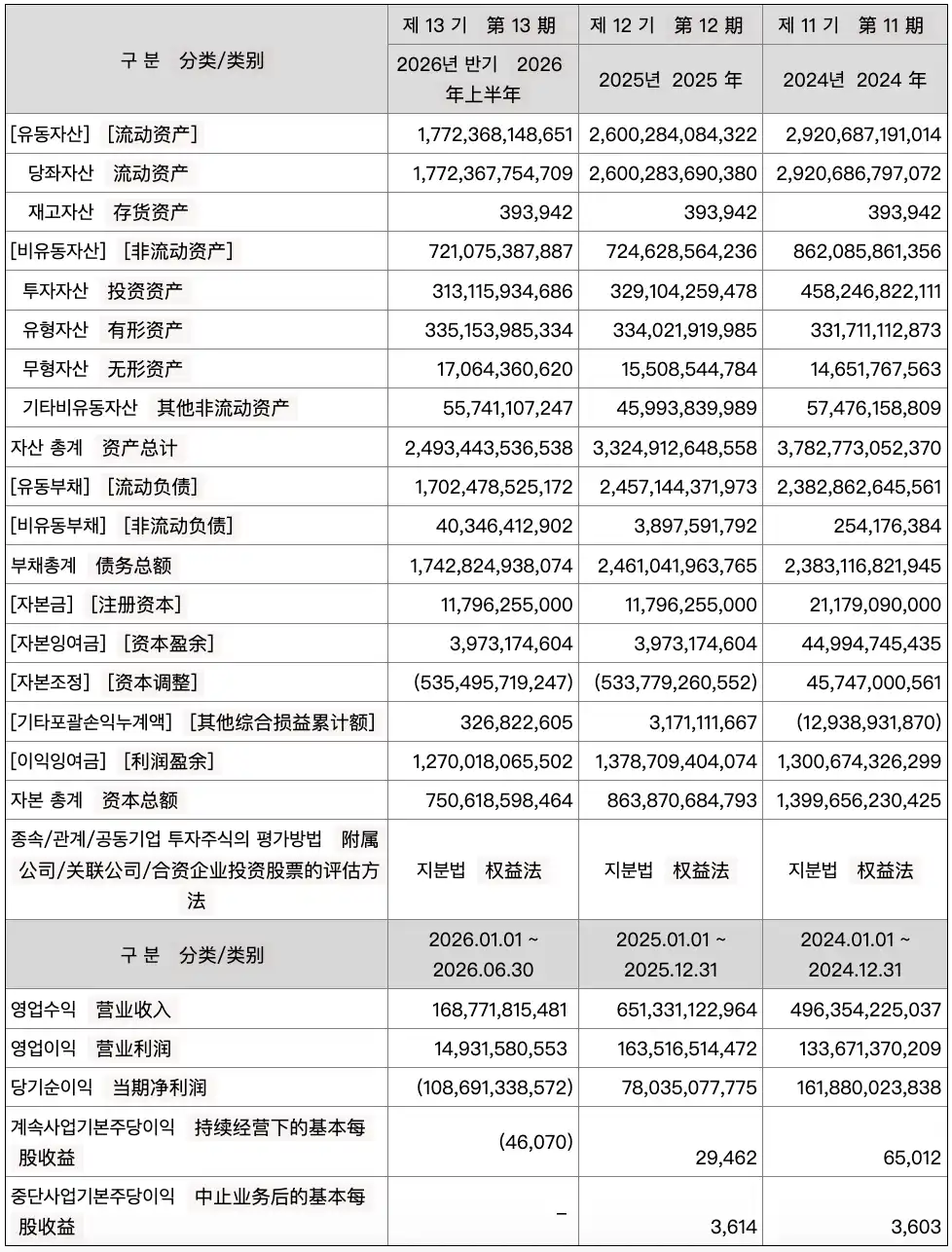
What dragged the company into a loss were non-operating items. During the reporting period, Bithumb's non-operating expenses amounted to 155.05 billion KRW (approximately $109 million), resulting in a final net loss of 108.69 billion KRW (approximately $76.44 million). In comparison, the company's net profit for the same period in 2025 was 55.04 billion KRW (approximately $38.71 million).

The first major loss came from Bithumb's own crypto asset holdings and crypto asset disposal losses.

In the first half, the company recognized crypto asset disposal gains of 11.99 billion KRW (approximately $8.43 million), while recognizing disposal losses of 73.36 billion KRW (approximately $51.59 million). After offsetting these two items, the net disposal loss was approximately 61.37 billion KRW (approximately $43.16 million).

The financial report stated that these crypto asset disposals were mainly related to business purposes such as user activity rewards and blockchain network fees. It is noteworthy that the disposal loss for the same period in 2025 was only about $4.18 million, but in the first half of 2026, it increased to about $51.59 million, more than 12 times the previous year's figure.

Worth mentioning is that on February 6th, Bithumb experienced a Bitcoin mis-delivery incident. Bithumb later disclosed that the incident involved erroneous Bitcoin distributions to 695 users, with a subsequent recovery rate exceeding 99%. However, the company did not separately disclose the final financial loss caused by this event in the semi-annual report.

Additionally, the company recognized a crypto asset valuation loss of 7.19 billion KRW (approximately $5.05 million). Combining the net disposal loss with the valuation loss, the net loss related to crypto assets is approximately 68.55 billion KRW (approximately $48.21 million).

The second impact came from litigation provisions.

As of the end of 2025, Bithumb's litigation provision was 2.68 billion KRW (approximately $1.88 million); by the end of June 2026, this figure had increased to 39.55 billion KRW (approximately $27.81 million), an increase of 36.87 billion KRW (approximately $25.93 million) in half a year.

This increase closely matches the approximately 36.8 billion KRW fine decision imposed on Bithumb by the Korean Financial Services Commission in March. The regulatory authority determined that Bithumb violated obligations regarding anti-money laundering for virtual asset service providers, customer identity verification, and transaction restrictions.

Adding the approximately 68.55 billion KRW (approximately $48.21 million) net loss from crypto assets to the approximately 36.87 billion KRW (approximately $25.93 million) increase in litigation provisions gives a total of approximately 105.42 billion KRW (approximately $74.14 million), which is already very close to the company's half-year net loss of 108.69 billion KRW (approximately $76.44 million).

Of course, this is only an approximate comparison to help understand the profit sources and cannot be directly taken as a complete articulation of the income statement, as tax items, interest income, and other non-operating items also affect the final outcome.

Revenue Still Nearly Halved After Drastically Cutting Subsidies

Bithumb's first-half operating revenue was approximately $119 million, a year-on-year decrease of 48.7%.

First, market cooling has indeed directly impacted Bithumb's core business. Its revenue comes almost entirely from transaction fees: first-half fee income was 168.763 billion KRW, accounting for 99.995% of operating revenue, rounded to 100% in the financial report. In 2025, other exchange revenue was still $10.6 million, but by the first half of this year, it had fallen to less than $6,000.
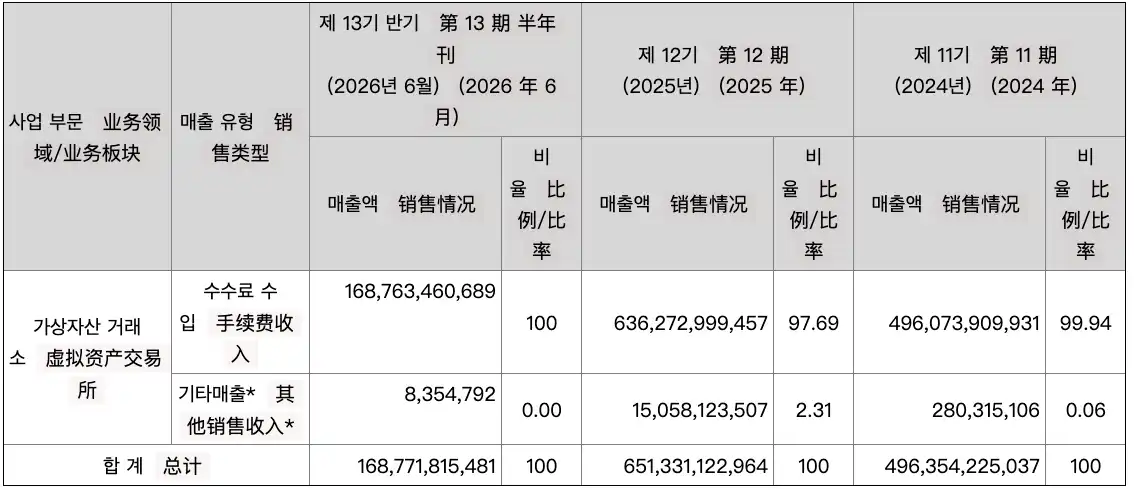
The financial report explains this portion of income as loan service fees, market data query fees, etc., but does not disclose the specific reasons for its significant decline, making further inference impossible.

Operating costs and selling, general, and administrative expenses (SG&A) combined decreased by 35.6% year-on-year, but the cost reduction rate still lagged behind the revenue decline rate.

The result was that the company's operating profit margin dropped from 27.4% in the same period of 2025 to 8.8% in the first half of 2026.

The most obvious change is in marketing expenses. Bithumb's sales promotion expenses decreased from 117.07 billion KRW (approximately $82.33 million) in the same period of 2025 to 34.89 billion KRW (approximately $24.54 million), a reduction of about 70%. The company has clearly significantly reduced its efforts to attract users through rewards and subsidies.

However, several relatively rigid costs did not see a simultaneous major decline. Payment processing fees still amounted to 46.26 billion KRW (approximately $32.53 million), down only about 2% year-on-year; salary expenses were 30.91 billion KRW (approximately $21.74 million), down about 6.5% year-on-year.

These numbers reveal a problem that is easily overlooked: exchanges can quickly cut activity rewards, but find it much harder to compress payment, technology, compliance, and personnel costs at the same pace.

When market trading volume declines, this highly fee-dependent structure is directly reflected in the revenue side. Cutting marketing investment can protect some profits but cannot solve the problem of concentrated revenue sources.

Total Assets Shrink by $584 Million, Where Did the Money Go?

As of the end of June 2026, Bithumb's total assets decreased from 3.32 trillion KRW (approximately $2.337 billion) at the beginning of the year to 2.49 trillion KRW (approximately $1.752 billion), a reduction of 831.469 billion KRW (approximately $584.3 million) in half a year.

At first glance, this asset decline appears even more startling than the net loss. However, an exchange's balance sheet cannot be understood entirely like that of an ordinary company, as a significant portion of assets and liabilities come from client deposits.

Compared to the end of 2025, Bithumb's on-book KRW member deposits decreased from 2.04 trillion KRW (approximately $1.430 billion) to 1.32 trillion KRW (approximately $927.3 million), a reduction of 715.581 billion KRW (approximately $502.9 million), accounting for about 86% of the total asset decline in the same period.

Cash and cash equivalents decreased by 773.428 billion KRW (approximately $543.5 million), but the company simultaneously increased its short-term financial products by 80 billion KRW (approximately $56.22 million).

Therefore, a large portion of the total asset decline corresponds to the decrease in client KRW deposits and the company's allocation adjustments between cash and short-term financial products.

Another area prone to confusion is Bithumb's own crypto assets versus client-custodied crypto assets.

As of the end of June, Bithumb's on-book own crypto assets were approximately 194.099 billion KRW (approximately $136.4 million); client-custodied crypto assets were approximately 12.05 trillion KRW (approximately $846.8 million).

The market value of client-custodied crypto assets decreased from 17.90 trillion KRW (approximately $1.2581 billion) at the beginning of the year to 12.05 trillion KRW (approximately $846.8 million), a decline of about 32.7%. However, a market value decline cannot be directly equated to clients withdrawing a large amount of assets. During the same period, the quantity of BTC, ETH, and XRP held in custody by Bithumb increased; for example, the price per BTC decreased about 30.5% at the end of the reporting period. This indicates that the shrinkage in custodied asset market value was at least partially affected by price declines; client fund flows cannot be judged solely based on total market value changes.

Summary

This financial report conveys a more complex signal: the core trading business is still profitable, but revenue has declined significantly, and non-operating losses and regulatory costs have amplified the final loss.

What is truly worth watching next is not just whether net profit can turn positive, but also whether trading revenue can recover, whether virtual asset-related gains and losses can narrow, and how much subsequent cost regulatory matters will leave for the company.


Perguntas relacionadas

QAccording to the article, what are the two main factors that caused Bithumb's net loss of approximately $76.44 million in the first half of 2026, despite its core exchange business remaining profitable?

AThe two main factors were losses related to its own crypto assets and significant litigation provisions. Specifically, the net loss from crypto asset disposals and valuation was approximately $48.21 million, and the increase in litigation provisions (primarily related to a regulatory fine) was approximately $25.93 million.

QHow did Bithumb's operating revenue and operating profit change in H1 2026 compared to the same period in 2025?

AIn the first half of 2026, Bithumb's operating revenue was approximately $119 million, a decrease of 48.7% compared to H1 2025. Its operating profit was approximately $10.5 million, a decrease of 83.4%.

QWhat significant change did Bithumb make in its sales promotion expenses, and what does this indicate about its business strategy?

ABithumb drastically reduced its sales promotion expenses by approximately 70%, from about $82.33 million in H1 2025 to about $24.54 million in H1 2026. This indicates the company significantly scaled back its strategy of using rewards and subsidies to compete for users.

QWhy did Bithumb's total assets decrease by approximately $584.3 million in the first half of 2026, and what was the primary component of this decrease?

AThe primary reason for the decrease in total assets was a reduction in member KRW deposits (customer fiat holdings). These deposits decreased by approximately $502.9 million, which accounted for about 86% of the total asset decrease. The article clarifies that this asset contraction is largely tied to changes in customer funds, not just company performance.

QWhat key distinction does the article make regarding the decline in the market value of Bithumb's customer custodial crypto assets?

AThe article clarifies that the 32.7% decline in the market value of customer custodial crypto assets (from ~$12.58 billion to ~$8.47 billion) cannot be solely interpreted as customers withdrawing assets. It notes that the actual quantities of major coins like BTC, ETH, and XRP under custody increased, suggesting the value drop was significantly influenced by falling cryptocurrency prices during the period.

Leituras Relacionadas

Crypto Funding Halves in Q1, Why Is Stablecoin Payment Still Attracting Money Against the Trend?

Crypto venture capital funding fell roughly 50% quarter-over-quarter in Q1 2026, yet the stablecoin payments sector was a notable exception, continuing to secure significant funding rounds. This shift signals that capital is moving away from speculative "token narratives" toward companies generating real revenue, as stablecoins evolve from a trading tool into payment infrastructure. Despite the overall funding slowdown, companies like Rain, OpenFX, and RedotPay completed major raises, focusing on areas such as card issuance, cross-border payments, and banking connectivity. Investors are attracted to the sector's potential to address long-standing inefficiencies in traditional cross-border payments through 24/7 settlement and clearer revenue models like transaction fees and FX spreads. However, the momentum may be overstated. On-chain stablecoin transaction volume does not equate to real-world payments for goods and services, and funding is concentrated in a few leading firms with reported volumes and customers. Key challenges remain, including compliance, fiat on/off-ramps, local banking relationships, and the risk of core services becoming commoditized. Looking ahead, capital is likely to flow into areas like cross-border B2B payments, bank-to-stablecoin connectivity, stablecoin-linked cards, multi-chain payment orchestration, and payments for AI agents. Ultimately, the investor interest reflects a bet on the necessary infrastructure to integrate stablecoins into the traditional financial system, with future valuations hinging on demonstrable payment volume, real revenue, and profitable market expansion.

marsbitHá 6m

Crypto Funding Halves in Q1, Why Is Stablecoin Payment Still Attracting Money Against the Trend?

marsbitHá 6m

South Korean Retail Investors 'Move from Seoul to Wall Street': Buying SK Hynix ADR, Betting on Triple-Leverage ETF

A surge of Korean retail investors is shifting funds from the volatile Seoul market to Wall Street, intensifying their bets on the AI theme through unconventional and high-risk instruments. Data shows Korean investors were net buyers of about $4.5 billion in US stocks in July, nearing a yearly peak. A notable trend is their purchase of approximately $840 million worth of SK Hynix American Depositary Receipts (ADRs), despite a significant 10% premium over the company's domestic shares, leading analysts to label the move as speculative and irrational. Simultaneously, Korean traders are heavily favoring leveraged ETFs. The triple-leveraged semiconductor ETF SOXL was the most-bought US product in July, with leveraged products occupying four of the top ten spots. Experts note that this shift in geography does not represent a diversification of risk; instead, investors are merely expressing the same concentrated bet on AI hardware through different, often riskier, US-listed vehicles. Analysts warn that while this capital inflow is unlikely to systemically impact the vast US institutional market, it risks creating localized distortions and amplifying volatility, particularly in the targeted sectors and instruments. The move follows a sharp correction in the Korean market, where high leverage in semiconductor stocks and related ETFs had previously led to significant losses, prompting this search for alternative avenues to chase the AI narrative.

marsbitHá 1h

South Korean Retail Investors 'Move from Seoul to Wall Street': Buying SK Hynix ADR, Betting on Triple-Leverage ETF

marsbitHá 1h

BitMart's Final 9 Days: A True Exchange Crisis Is Never About Shutting Down

BitMart's Final 9 Days: A True Exchange Crisis Is Not About Shutting Down On August 17, 2026, with just 9 days until BitMart's scheduled cessation of trading, the focus shifted from the platform's orderly closure to serious questions about user withdrawals, platform solvency, employee payments, and reserve transparency. Stakeholders, claiming to represent users and staff, publicly demanded asset/liability disclosures, explanations for withdrawal delays, a user repayment plan, and an independent audit, setting an August 19 deadline. While BitMart CEO Sheldon Lee denied allegations of insolvency or wrongdoing, the controversy highlighted a core vulnerability of centralized exchanges (CEXs). When an exchange announces its shutdown, normal user behavior changes dramatically, triggering a mass withdrawal event—the ultimate stress test for its liquidity and custodial integrity. The key question becomes not whether the platform has assets, but whether it holds sufficient *liquid* assets to cover all user liabilities on demand. The article argues that the trust placed in CEXs is based on the convenience they provide, abstracting users from direct control of their private keys. This trust is rarely questioned during normal operations but becomes critically exposed during a wind-down. The situation underscores the limitations of simple Proof of Reserves, which shows "what we have" but not the crucial "what we owe." True financial credibility requires transparent, auditable data on assets, liabilities, and segregated user funds. BitMart's situation reflects a broader, often overlooked issue in the crypto industry: while there is extensive focus on growth mechanisms for exchanges, there is little discussion or established protocol for a safe and transparent "exit mechanism." The final measure of an exchange's integrity, the article concludes, is not its user count or trading volume during a bull market, but its ability to ensure every last user can successfully withdraw their assets when the doors are closing. The outcome will be determined not by statements, but by whether the final user's funds securely leave the platform.

marsbitHá 2h

BitMart's Final 9 Days: A True Exchange Crisis Is Never About Shutting Down

marsbitHá 2h

Don't Speculate on 100x Coins, Just Bet on 'Cash Cows': Which Projects Are Worth Dollar-Cost Averaging in the Bear Market?

In a bearish crypto market, finding sustainable investments is more prudent than chasing speculative meme coins. This article analyzes projects generating consistent revenue, highlighting them as potential "cash cows" for long-term dollar-cost averaging (DCA). The top performers are "picks-and-shovels" plays. **Pump.fun**, a Solana-based meme coin launchpad, leads with $415.3M in monthly revenue, profiting from a 1.25% fee on token transactions. Despite market volatility, it has averaged tens of millions in monthly income in 2024. Perpetual DEX **Hyperliquid** stands out as a "bear market star," accumulating ~$352M in revenue over seven months. Its model funnels ~99% of fees into buying back and permanently burning its HYPE token. Established giants are also adapting. **Uniswap**, after enabling its fee switch, now earns protocol revenue (e.g., $5.6M recently), which is used to buy back and burn UNI, giving the token direct value accrual. Similarly, oracle provider **Chainlink** generates stable monthly revenue (~$4.57M recently) from its essential data, cross-chain, and automation services. Its new Payment Abstraction feature automatically converts service fees into LINK, accruing value in its treasury. The core thesis is clear: in a downturn, focus on projects with proven, resilient business models—those acting as essential infrastructure or capturing consistent transaction fees—rather than speculative narratives.

marsbitHá 2h

Don't Speculate on 100x Coins, Just Bet on 'Cash Cows': Which Projects Are Worth Dollar-Cost Averaging in the Bear Market?

marsbitHá 2h

Trading

Spot
活动图片