Bitcoin's Pursuit of a Monetary Standard

marsbitPublicado em 2026-02-04Última atualização em 2026-02-04

Resumo

The article "Bitcoin's Pursuit of a Monetary Standard" by Thejaswini M A, based on a reading of Saifedean Ammous' "The Bitcoin Standard," explores the concept of money as a technology for transferring value across time, space, and scale. It emphasizes "salability" and introduces the critical idea of "hardness"—money whose supply is difficult to increase. The author reviews historical examples of money, such as Yap's Rai Stones, African Aggry beads, and wampum, which all lost value when their supply was easily expanded by new technology or trade. Precious metals, particularly gold, emerged as superior due to their scarcity and high stock-to-flow ratio. The critique then shifts to government-issued fiat currency, arguing it represents an unbacked, easily inflated system that erodes savings and leads to economic instability. While acknowledging the book's persuasive framework and its effective use of historical anecdotes, the author remains unconvinced by its one-sided, Austrian economics-influenced narrative that blames fiat for modern societal ills. The key takeaway is a new perspective on evaluating any asset: to critically ask how easily new units can be created and to be wary of anyone who can print money faster than one can earn it.

Written by: Thejaswini M A

Compiled by: Block unicorn

I've always wanted to slowly study "The Bitcoin Standard"—read it from start to finish and see how it affects my thinking. It often appears in the background of many Bitcoin discussions, revered as a foundational work. People would say, "As Saifedean explained..." and then you realize that everything they're referencing is based on a meme or a cover screenshot.
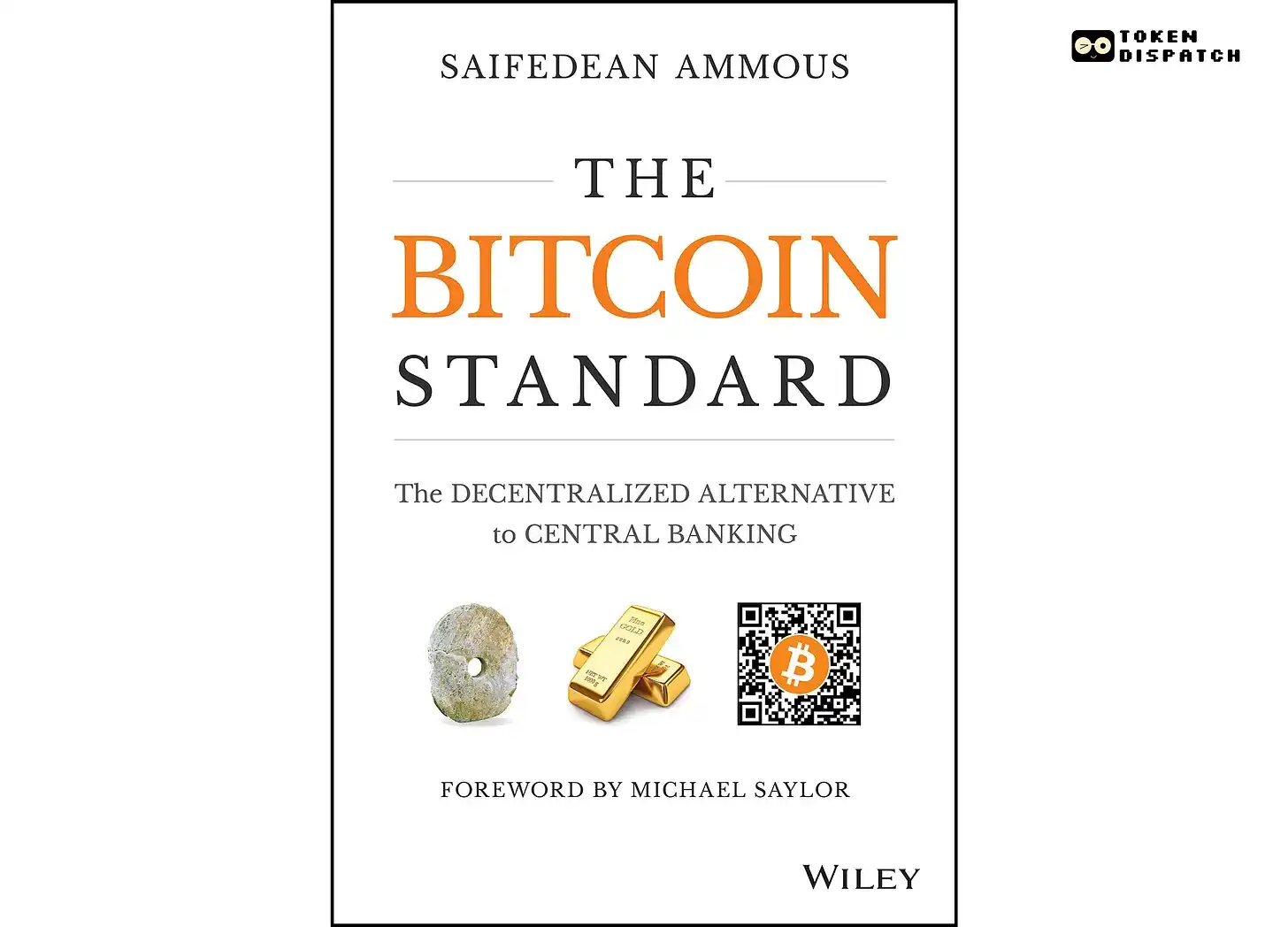
So, I will read this book in its entirety, divided into three parts. This is the first part.

We are still in the early chapters and haven't reached the later sections that fully critique fiat money for ruining everything from architecture to waistlines. For now, Saifedean Ammous is laying the groundwork, trying to convince you that money is a technology, that some forms of money are "harder" than others, and that history is essentially a process of continuous selection, with the harder options ultimately prevailing. If he can make you understand this, Bitcoin will then emerge as the "hardest money to date," and you'll feel it's inevitable.

I'm not entirely convinced yet, but I must admit it's a tricky framework.

The book begins by stripping money of its romanticized veneer, revealing its core essence. It is not a "social contract," nor a "product of the state," but simply a tool for transferring value across time and space, something people don't need to think too much about every day.

Ammous repeatedly emphasizes the concept of "Salability." A good monetary asset should be easily sold anytime, anywhere, without significant loss. To be salable, it must meet three conditions: across space—so you can carry it with you and use it to exchange for what you need; across time—so it doesn't rot or collapse in value; and across scale—so it can be used for any purpose, from a cup of tea to a house, without needing a calculator or a large bag of change.
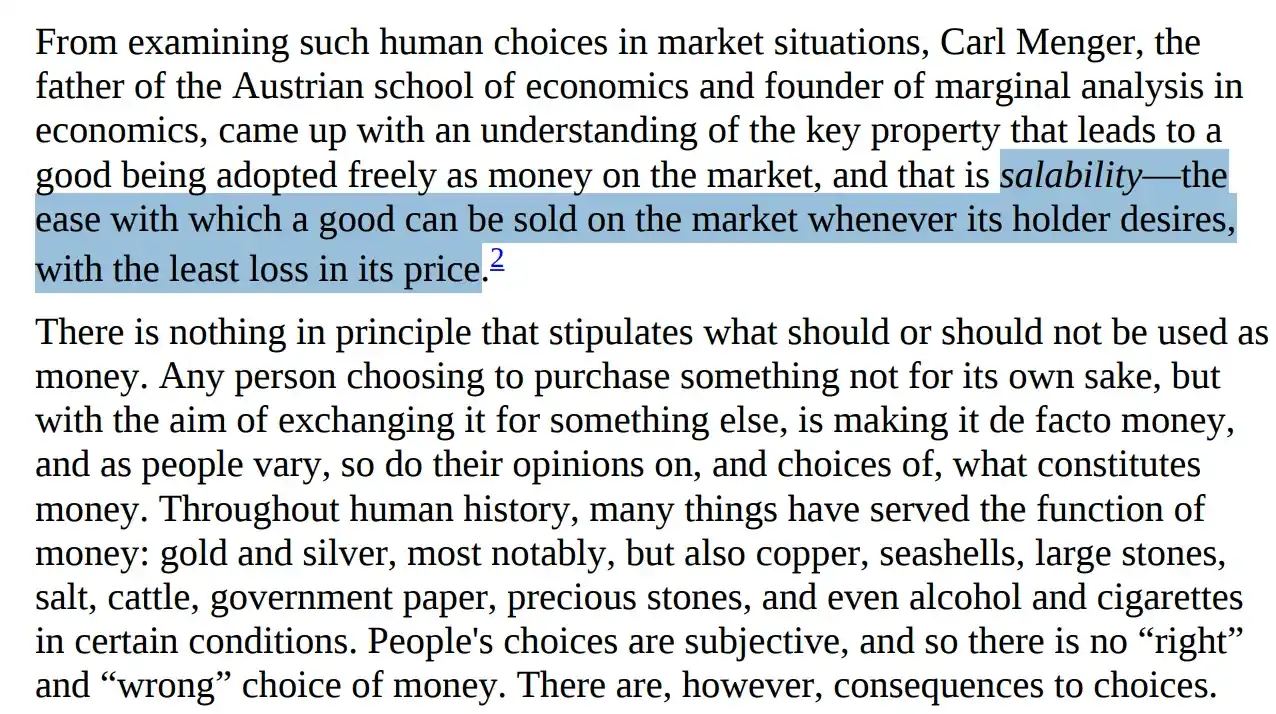
Next, the book's truly decisive word appears: hardness. Hard money is money whose supply is difficult to increase. Soft money is easy to print. This is the essence. The core logic is simple: Why would you store your life's work in something that others can easily create?
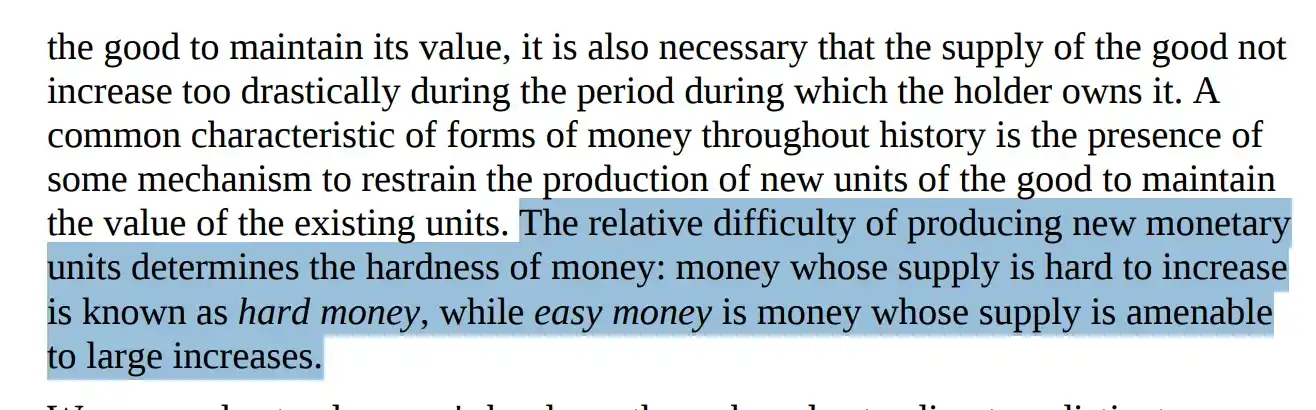
You can feel the influence of the Austrian School of Economics in every sentence, but once you strip away the ideology, the book leaves you with a very useful question: If I invest my savings in X, how easy is it for others to earn more X?

Once you view your life through this lens—whether it's rupees, dollars, stablecoins, Bitcoin, or any other monetary combination—it's hard to ignore.

After setting up this framework, the book takes you on a tour of a small "Museum of Broken Money."

The first exhibit is Yap Island and its Rai Stones. These huge circular limestone discs, some weighing up to four tons, were quarried from other islands and arduously transported to Yap. Ammous writes that this worked surprisingly well for centuries. The stones were bulky and difficult to move or steal. Everyone in the village knew which stone belonged to whom. Payment was made by announcing the change of ownership to the community. The stones were "easily salable anywhere on the island" because they were known everywhere on the island; they also stood the test of time because the cost of obtaining new stones was so high that the existing stock was always far greater than the new supply that could be produced in a given period... The stock-to-flow ratio of Rai stones was very high."

Then, technology arrived.

In 1871, an Irish-American captain named David O'Keefe was shipwrecked on Yap Island. After recovering, he left and later returned with a large ship and explosives, realizing he could quarry Rai stones in large quantities using modern tools. The villagers were divided. The chief deemed his stones "too easy" to produce, banned their quarrying, and insisted that only traditional stones counted. Others disagreed and began quarrying the newly discovered stones. Conflict ensued. The stones' use as money gradually faded. Today, they are mostly used for ceremonial purposes.

It's a neat, perhaps overly neat, parable. But it makes a point: once a monetary commodity loses its hardness (once someone can produce it cheaply and in large quantities), those who once held it end up subsidizing later arrivals.

Beads and shells followed the same pattern. West Africa's Aggry Beads were valuable because they were scarce and time-consuming to make. Later, European merchants began importing them in large quantities from glass factories. Ammous describes how this importation "slowly but surely" turned them from "hard money" into "cheap money," "undermining their salability and causing the purchasing power of these beads in the hands of African owners to decline over time, ultimately impoverishing them as their wealth was transferred to the Europeans, who could now easily obtain the beads."
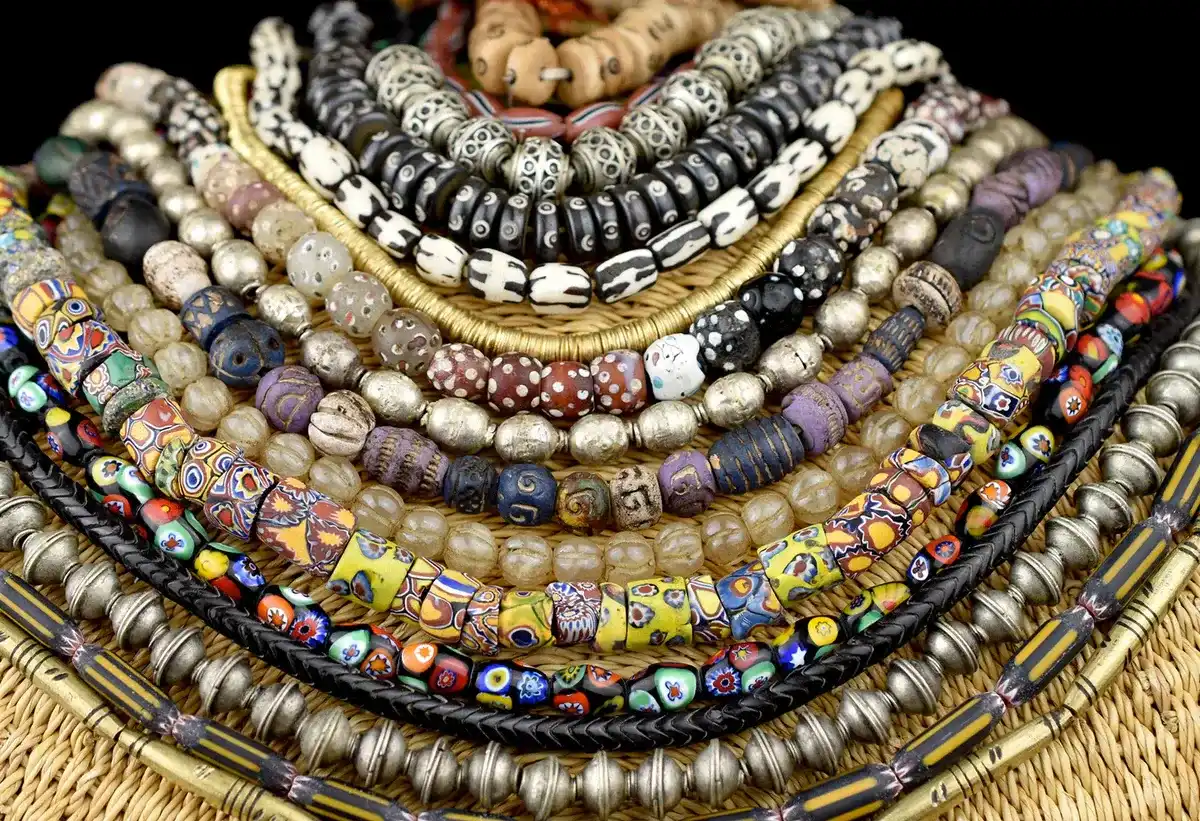
Cowrie shells and wampum experienced similar trajectories. They were initially scarce hard money, difficult to obtain, with high stock-to-flow ratios. Later, with the advent of industrial ships, "their supply expanded dramatically, causing their value to decline and their salability to be lost over time." and by 1661, they had lost their status as legal tender.

You'll find stories of cattle, salt, tally sticks, and cigarettes in prisoner-of-war camps. Each story does the same thing: trains your intuition to feel that if the supply of new units can suddenly be greatly increased at very low cost, then the stock held by savers is essentially making a donation.

You could criticize these historical narratives as being too tidy. There's little mention of violence, politics, or culture in these small stories. Everyone acts like a hyper-rational economic actor with perfect memory. But as a means of making you suspicious of easily printed money, it works.

After you're thoroughly horrified by shells and beads, metals emerge as the mature solution.

Metals solved many salability problems. They didn't spoil like grain. They were more portable than巨石. They could be minted into uniform coins, making pricing and accounting easier. Over time, gold and silver ultimately prevailed because they were the most resistant to inflation. The annual mining output only increased the existing stock by a small fraction, so no single miner could devalue everyone's savings.

Thus began the long era of metallic money, and later, gold-backed paper money. The book doesn't dwell too much on these details. Its purpose is to make you feel that once humans discovered gold, they found a near-perfect money: portable, durable, divisible, and most importantly, expensive to produce.

You'll later see how this sets the stage for Bitcoin's emergence. If you fully accept the notion that "given the physical and metallurgical conditions of the time, gold was the best substance we could make," then "Bitcoin is digital gold with even greater hardness" sounds logical.

What interests me is that in this section, gold is portrayed less as a mystical object and more as a clever workaround to physical limitations. If you imagine ancient societies as constantly trying to answer the question, "How do we preserve the fruits of a harvest or a voyage in a form that can be passed down to future generations?" then gold is a relatively clever, albeit imperfect, yet reasonable answer.

This framework also benefits Bitcoin. It is no longer "magic internet money," but rather "another attempt to solve the same problem with new tools."

The book hasn't reached that point yet, but you can feel the runway being laid.

Then, government money enters the scene as the villain.

So far, monetary collapses have stemmed from external factors. New technology emerged, breaking the rigidity of the monetary system, leaving savers with nothing. Now, the villain comes from within: governments and central banks have the legal authority to print money without any scarce commodity to back it.

In this narrative, fiat money is the product of governments realizing they could completely separate monetary symbols from real assets. The monetary unit was retained, but the constraints were removed. Governments told people their paper money had value because the law said so, because taxes had to be paid with it, not because it was backed by any physical asset.
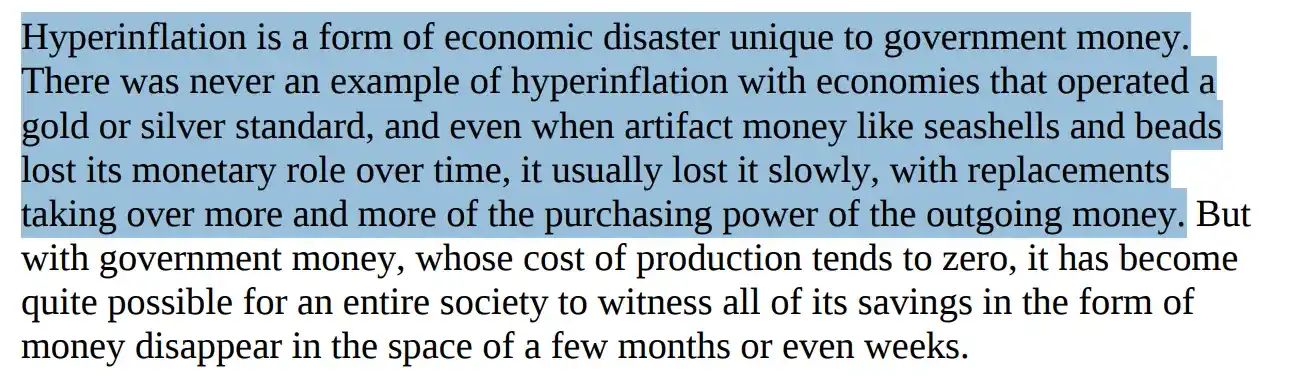
Under a gold or silver standard, money could be devalued or debased, but you didn't get Zimbabwe-style collapses where wages became worthless within months. But under a fiat system, this can happen. And some governments have indeed done it repeatedly.

Ammous spends considerable time explaining the social consequences of this phenomenon. To survive, people are forced to sell capital, and productive activity is eroded. Long-term contracts break down because no one trusts them. Political extremism thrives amidst anger and chaos. Weimar Germany is a prime example. Monetary collapse is just the precursor to worse things.

It's not wrong that most fiat currencies depreciate against physical goods over the long term. This is somewhat by design of the monetary system.

Where my mind starts to push back against the book is not the facts themselves, but its framing. Almost all the ills of modern society are blamed on the fiat monetary system. Central banks are portrayed almost entirely as tools that secretly tax savers to subsidize borrowers. Any benefits of having a flexible lender of last resort are downplayed as "but they will abuse it," which has some truth, but it's not the only question society must answer.

Even if you don't like central banks, the idea that "the entire twentieth century was a mistake from the moment we abandoned the full metal standard" feels a bit extreme.

What impressed me

So, beyond adding more quotable classics to the timeline, what practical impact did Part One actually have on me?

Strangely, it didn't make me more convinced about Bitcoin. It just clarified a question I hadn't asked carefully enough before.

I rarely look at my money the way Ammous does. I consider risk and returns, volatility, how much time I'm willing to put into crypto versus boring things. I don't systematically sit down and scrutinize who can print how much of each crypto I handle and under what rules.

Then I saw a Bloomberg chart showing the S&P 500 not priced in dollars, but in gold. It's so unfair. Priced in gold, the US stock market is back to where it was over a decade ago, in the post-global financial crisis era. All those dollar-denominated all-time highs, all the post-pandemic frenzy, are just noise on a flat line.
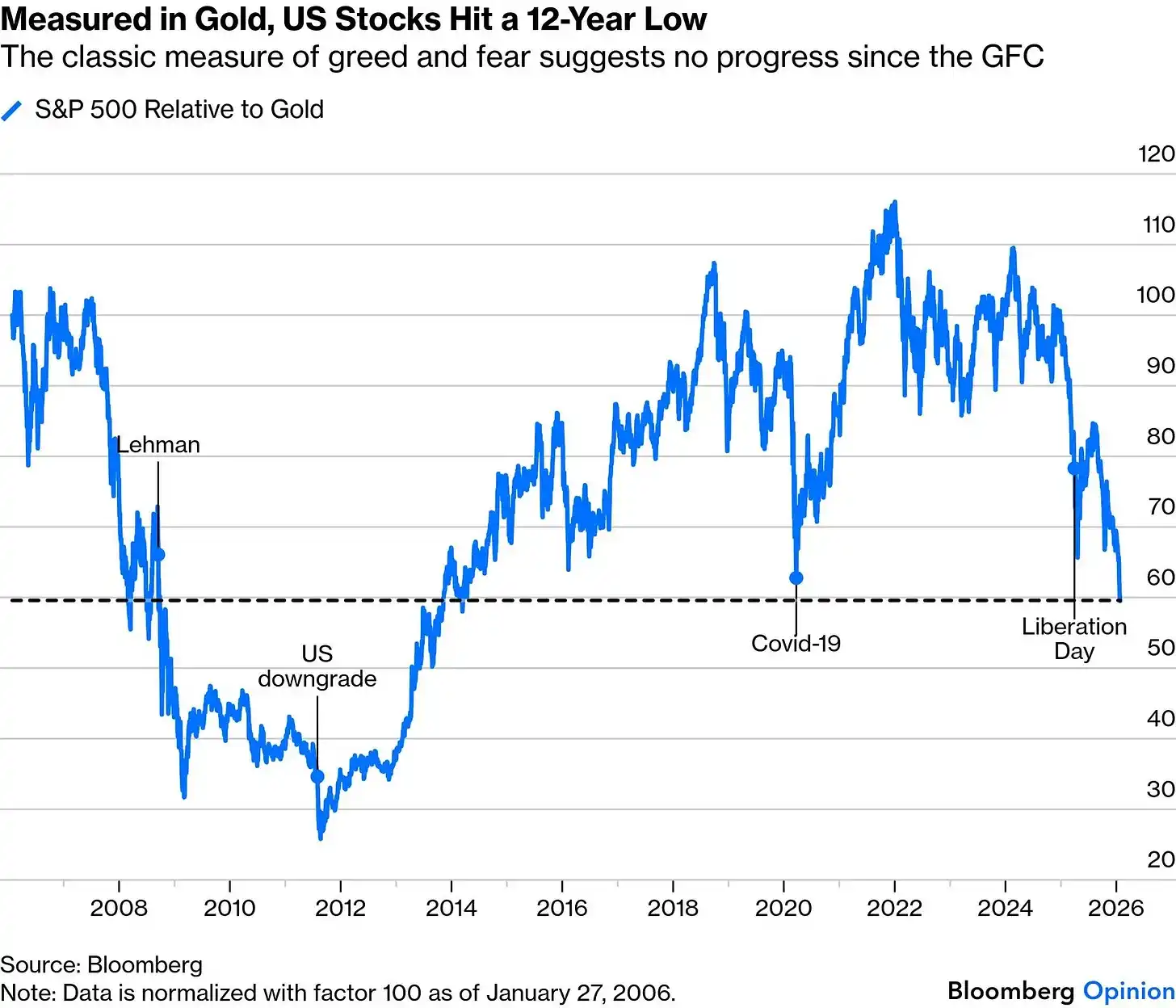
Once you understand this, it's hard to ignore the simple truth Ammous has been hammering home: performance is always "performance relative to what?" If your base unit is slowly depreciating, even if your index hits new highs, your performance in harder units might still be stagnant.

I realize the book leaves out a lot. It barely seriously discusses credit as a social tool, nor does it mention that states don't just destroy money; they also create the legal and military environments that allow markets to flourish. It doesn't delve into the idea that some groups might sacrifice some economic strength for greater resilience to shocks. Everything revolves around one core: are the savers' interests being diluted?

Maybe that's the point. It's a polemic, not a textbook. But I don't want to pretend it's the whole truth.

For now, I'm happy to treat it as a perspective, not a creed. Whenever I see a central bank's balance sheet, a new secondary bond issuance plan, or some "stable yield" product promising 18% returns in dollars, a Saifedean-esque voice echoes in my ear: How hard is this money really? And how many O'Keefes are already in the water with dynamite?

For now, I just want to remember this: money stores our future choices. Choose your monetary unit carefully, and be wary of anyone who can print more than you earn.


Perguntas relacionadas

QWhat is the core concept of 'hard money' as described in the book 'The Bitcoin Standard'?

AHard money refers to a form of currency that is difficult to increase in supply, making it resistant to inflation and devaluation. It contrasts with 'soft money,' which can be easily created or printed.

QHow did the introduction of modern technology disrupt the Rai Stone monetary system on Yap Island?

AModern technology, such as ships and explosives brought by David O'Keefe, made it easier to mine and transport Rai Stones. This led to an oversupply, devaluing the existing stones and ultimately causing the collapse of their use as money.

QWhat is 'salability' in the context of money, and what are its three dimensions?

ASalability refers to the ease with which a monetary asset can be sold without significant loss. Its three dimensions are: across space (portability), across time (durability and resistance to decay), and across scale (divisibility for transactions of any size).

QWhy does the author argue that fiat money is problematic compared to commodity-based money like gold?

AFiat money is problematic because it can be easily printed by governments and central banks without any backing by scarce commodities. This leads to devaluation, loss of purchasing power, and economic instability, as seen in historical hyperinflation episodes like Weimar Germany.

QWhat historical examples does the book use to illustrate the downfall of previously 'hard' currencies?

AThe book uses examples like Rai Stones on Yap Island, Aggry beads in West Africa, and wampum shells, which were initially scarce and hard to produce but lost their value when technological advances or industrial methods made them easy to mass-produce.

Leituras Relacionadas

From Theft to Re-entry: How Was $292 Million "Laundered"?

A sophisticated crypto laundering operation was executed following the $292 million hack of Kelp DAO on April 18. The attack, attributed to the North Korean Lazarus group, began with anonymous infrastructure preparation using Tornado Cash to fund wallets untraceably. The hacker exploited a vulnerability in Kelp’s cross-chain bridge, stealing 116,500 rsETH. To avoid crashing the market, the attacker used Aave and Compound as laundering tools—depositing the stolen rsETH as collateral to borrow $190 million in clean, liquid ETH. This move triggered a bank run on Aave, causing an $8 billion drop in TVL. After consolidating funds, the attacker fragmented them across hundreds of wallets to evade detection. A major breakpoint was THORChain, where over $460 million in volume—30 times its usual activity—was processed in 24 hours, converting ETH into Bitcoin. This shift to Bitcoin’s UTXO model exponentially increased tracing complexity by shattering funds into countless untraceable fragments. The final destination was Tron-based USDT, the primary channel for illicit crypto flows. From there, funds were cashed out via OTC brokers in China and Southeast Asia, using unlicensed underground banks and UnionPay networks outside Western sanctions scope. Ultimately, the laundered money supports North Korea’s weapons programs, which rely heavily on crypto hacking for foreign currency. The incident underscores structural challenges in DeFi: its openness, composability, and lack of central control make such laundering not just possible, but inherently difficult to prevent.

marsbitHá 3h

From Theft to Re-entry: How Was $292 Million "Laundered"?

marsbitHá 3h

Trading

Spot
Futuros

Artigos em Destaque

O que é BITCOIN

Compreender o HarryPotterObamaSonic10Inu (ERC-20) e a Sua Posição no Espaço Cripto Nos últimos anos, o mercado de criptomoedas assistiu a um aumento na popularidade das moedas meme, cativando não apenas os traders, mas também aqueles que procuram envolvimento comunitário e valor de entretenimento. Entre estes tokens únicos está o HarryPotterObamaSonic10Inu (ERC-20), um projeto intrigante que mistura referências culturais no tecido das criptomoedas. Este artigo explora os principais aspetos do HarryPotterObamaSonic10Inu, examinando os seus mecanismos, a sua ética orientada pela comunidade e o seu envolvimento com o vasto panorama cripto. O que é o HarryPotterObamaSonic10Inu (ERC-20)? Como o nome sugere, o HarryPotterObamaSonic10Inu é uma moeda meme construída na blockchain Ethereum, classificada sob o padrão ERC-20. Ao contrário das criptomoedas tradicionais, que podem enfatizar a utilidade prática ou o potencial de investimento, este token prospera no valor de entretenimento e na força da sua comunidade. O projeto visa promover um ambiente onde utilizadores envolvidos possam reunir-se, partilhar ideias e participar em atividades inspiradas por diversos fenómenos culturais. Uma característica notável do HarryPotterObamaSonic10Inu é a zero taxa sobre transações. Este elemento atraente visa encorajar a negociação e o envolvimento da comunidade, isento de encargos adicionais que podem desencorajar os traders de pequena escala. A oferta total da moeda está fixada em mil milhões de tokens, uma cifra que marca a sua intenção de manter uma circulação substancial dentro da comunidade. Criador do HarryPotterObamaSonic10Inu (ERC-20) As origens do HarryPotterObamaSonic10Inu estão um pouco envoltas em mistério; os detalhes sobre o criador permanecem desconhecidos. O desenvolvimento deste token carece de uma equipa identificável ou de um plano explícito, o que não é raro no setor das moedas meme. Em vez disso, o projeto surgiu de forma orgânica, com o seu progresso a depender fortemente do entusiasmo e da participação da sua comunidade. Investidores do HarryPotterObamaSonic10Inu (ERC-20) No que diz respeito a investimentos externos e apoios, o HarryPotterObamaSonic10Inu também permanece ambíguo. O token não lista quaisquer fundações de investimento conhecidas ou apoio organizacional significativo. Em vez disso, o “sangue vital” do projeto é a sua comunidade de base, que informa o seu crescimento e sustentabilidade através da ação coletiva e do envolvimento no espaço cripto. Como Funciona o HarryPotterObamaSonic10Inu (ERC-20)? Como uma moeda meme, o HarryPotterObamaSonic10Inu opera principalmente fora dos quadros tradicionais que muitas vezes governam o valor dos ativos. Existem vários aspetos distintivos que definem como o projeto funciona: Transações Sem Taxas: Sem taxas sobre transações, os utilizadores podem comprar e vender o token livremente, sem a preocupação de custos ocultos. Envolvimento da Comunidade: O projeto prospera na interação da comunidade, aproveitando plataformas de redes sociais para criar entusiasmo e facilitar a participação. Discussões, partilha de conteúdo e envolvimento são elementos cruciais que ajudam a expandir o seu alcance e a fomentar a lealdade entre os apoiantes. Sem Utilidade Prática: Deve ser notado que o HarryPotterObamaSonic10Inu não oferece utilidade concreta dentro do ecossistema financeiro. Em vez disso, é classificado como um token principalmente para entretenimento e atividades comunitárias. Referência Cultural: O token incorpora de forma inteligente elementos da cultura popular para atrair interesse, conectando-se tanto com entusiastas de memes como com seguidores de criptomoedas. HarryPotterObamaSonic10Inu exemplifica como as moedas meme operam de forma diferente de projetos de criptomoedas mais tradicionais, entrando no mercado como construções sociais inovadoras em vez de ativos utilitários. Linha do Tempo do HarryPotterObamaSonic10Inu (ERC-20) A história do HarryPotterObamaSonic10Inu é marcada por vários marcos notáveis: Criação: O token surgiu de um meme viral, capturando a imaginação de muitos entusiastas de criptomoedas. Datas específicas de criação não estão disponíveis, sublinhando a sua ascensão orgânica. Listagem em Exchanges: O HarryPotterObamaSonic10Inu conseguiu entrar em várias exchanges, permitindo um acesso e negociação mais fáceis pela comunidade. Iniciativas de Envolvimento da Comunidade: Atividades contínuas direcionadas a melhorar a interação comunitária, incluindo concursos, campanhas em redes sociais e geração de conteúdo por fãs e defensores. Planos de Expansão Futura: O roteiro do projeto inclui o lançamento de uma coleção de NFTs, mercadorias e um site de eCommerce relacionado aos seus temas culturais, envolvendo ainda mais a comunidade e tentando adicionar mais dimensões ao seu ecossistema. Pontos-Chave sobre o HarryPotterObamaSonic10Inu (ERC-20) Natureza Orientada pela Comunidade: O projeto prioriza a contribuição coletiva e a criatividade, assegurando que o envolvimento dos utilizadores está na vanguarda do seu desenvolvimento. Classificação como Moeda Meme: Representa o epítome da criptomoeda baseada em entretenimento, destacando-se dos veículos de investimento tradicionais. Sem Afiliação Direta com o Bitcoin: Apesar da semelhança no nome do ticker, o HarryPotterObamaSonic10Inu é distinto e não tem qualquer relação com o Bitcoin ou outras criptomoedas estabelecidas. Foco na Colaboração: O HarryPotterObamaSonic10Inu é projetado para criar um espaço de colaboração e partilha de histórias entre os seus detentores, proporcionando uma via para a criatividade e o fortalecimento da comunidade. Perspectivas Futuras: A ambição de expandir além da sua premissa inicial para NFTs e mercadorias delineia um caminho para o projeto potencialmente entrar em avenidas mais mainstream dentro da cultura digital. À medida que as moedas meme continuam a capturar a imaginação da comunidade cripto, HarryPotterObamaSonic10Inu (ERC-20) destaca-se devido aos seus laços culturais e abordagem centrada na comunidade. Embora possa não se encaixar no molde típico de um token orientado para utilidade, a sua essência reside na alegria e camaradagem fomentadas entre os seus apoiantes, destacando a natureza em evolução das criptomoedas em uma era cada vez mais digital. À medida que o projeto continua a desenvolver-se, será importante observar como as dinâmicas comunitárias influenciam a sua trajetória no panorama em constante mudança da tecnologia blockchain.

1.2k Visualizações TotaisPublicado em {updateTime}Atualizado em 2024.12.03

O que é BITCOIN

Como comprar BTC

Bem-vindo à HTX.com!Tornámos a compra de Bitcoin (BTC) simples e conveniente.Segue o nosso guia passo a passo para iniciar a tua jornada no mundo das criptos.Passo 1: cria a tua conta HTXUtiliza o teu e-mail ou número de telefone para te inscreveres numa conta gratuita na HTX.Desfruta de um processo de inscrição sem complicações e desbloqueia todas as funcionalidades.Obter a minha contaPasso 2: vai para Comprar Cripto e escolhe o teu método de pagamentoCartão de crédito/débito: usa o teu visa ou mastercard para comprar Bitcoin (BTC) instantaneamente.Saldo: usa os fundos da tua conta HTX para transacionar sem problemas.Terceiros: adicionamos métodos de pagamento populares, como Google Pay e Apple Pay, para aumentar a conveniência.P2P: transaciona diretamente com outros utilizadores na HTX.Mercado de balcão (OTC): oferecemos serviços personalizados e taxas de câmbio competitivas para os traders.Passo 3: armazena teu Bitcoin (BTC)Depois de comprar o teu Bitcoin (BTC), armazena-o na tua conta HTX.Alternativamente, podes enviá-lo para outro lugar através de transferência blockchain ou usá-lo para transacionar outras criptomoedas.Passo 4: transaciona Bitcoin (BTC)Transaciona facilmente Bitcoin (BTC) no mercado à vista da HTX.Acede simplesmente à tua conta, seleciona o teu par de trading, executa as tuas transações e monitoriza em tempo real.Oferecemos uma experiência de fácil utilização tanto para principiantes como para traders experientes.

3.9k Visualizações TotaisPublicado em {updateTime}Atualizado em 2025.03.21

Como comprar BTC

O que é $BITCOIN

OURO DIGITAL ($BITCOIN): Uma Análise Abrangente Introdução ao OURO DIGITAL ($BITCOIN) OURO DIGITAL ($BITCOIN) é um projeto baseado em blockchain que opera na rede Solana, com o objetivo de combinar as características dos metais preciosos tradicionais com a inovação das tecnologias descentralizadas. Embora partilhe um nome com o Bitcoin, frequentemente referido como “ouro digital” devido à sua percepção como uma reserva de valor, o OURO DIGITAL é um token separado projetado para criar um ecossistema único dentro da paisagem Web3. O seu objetivo é posicionar-se como um ativo digital alternativo viável, embora os detalhes sobre as suas aplicações e funcionalidades ainda estejam em desenvolvimento. O que é o OURO DIGITAL ($BITCOIN)? OURO DIGITAL ($BITCOIN) é um token de criptomoeda explicitamente projetado para uso na blockchain Solana. Em contraste com o Bitcoin, que fornece um papel amplamente reconhecido como armazenamento de valor, este token parece focar em aplicações e características mais amplas. Aspectos notáveis incluem: Infraestrutura Blockchain: O token é construído na blockchain Solana, conhecida pela sua capacidade de lidar com transações de alta velocidade e baixo custo. Dinâmicas de Oferta: O OURO DIGITAL tem um fornecimento máximo limitado a 100 quatrilhões de tokens (100P $BITCOIN), embora os detalhes sobre o seu fornecimento circulante ainda não tenham sido divulgados. Utilidade: Embora as funcionalidades precisas não estejam explicitamente delineadas, existem indicações de que o token poderia ser utilizado para várias aplicações, potencialmente envolvendo aplicações descentralizadas (dApps) ou estratégias de tokenização de ativos. Quem é o Criador do OURO DIGITAL ($BITCOIN)? Neste momento, a identidade dos criadores e da equipa de desenvolvimento por trás do OURO DIGITAL ($BITCOIN) permanece desconhecida. Esta situação é típica entre muitos projetos inovadores no espaço da blockchain, particularmente aqueles alinhados com finanças descentralizadas e fenómenos de moedas meme. Embora tal anonimato possa fomentar uma cultura orientada pela comunidade, intensifica as preocupações sobre governança e responsabilidade. Quem são os Investidores do OURO DIGITAL ($BITCOIN)? As informações disponíveis indicam que o OURO DIGITAL ($BITCOIN) não tem apoiantes institucionais conhecidos ou investimentos proeminentes de capital de risco. O projeto parece operar num modelo peer-to-peer focado no apoio e adoção da comunidade, em vez de rotas de financiamento tradicionais. A sua atividade e liquidez estão principalmente situadas em exchanges descentralizadas (DEXs), como a PumpSwap, em vez de plataformas de negociação centralizadas estabelecidas, destacando ainda mais a sua abordagem de base. Como Funciona o OURO DIGITAL ($BITCOIN) A mecânica operacional do OURO DIGITAL ($BITCOIN) pode ser elaborada com base no seu design de blockchain e nas características da rede: Mecanismo de Consenso: Ao aproveitar o exclusivo proof-of-history (PoH) da Solana combinado com um modelo de proof-of-stake (PoS), o projeto assegura uma validação eficiente das transações, contribuindo para o alto desempenho da rede. Tokenomics: Embora mecanismos deflacionários específicos não tenham sido extensivamente detalhados, o vasto fornecimento máximo de tokens implica que pode atender a microtransações ou casos de uso de nicho que ainda estão por definir. Interoperabilidade: Existe o potencial para integração com o ecossistema mais amplo da Solana, incluindo várias plataformas de finanças descentralizadas (DeFi). No entanto, os detalhes sobre integrações específicas permanecem não especificados. Cronologia de Eventos Chave Aqui está uma cronologia que destaca marcos significativos relacionados ao OURO DIGITAL ($BITCOIN): 2023: O lançamento inicial do token ocorre na blockchain Solana, marcado pelo seu endereço de contrato. 2024: O OURO DIGITAL ganha visibilidade ao tornar-se disponível para negociação em exchanges descentralizadas como a PumpSwap, permitindo que os utilizadores o negociem contra SOL. 2025: O projeto testemunha atividade de negociação esporádica e potencial interesse em envolvimentos liderados pela comunidade, embora não tenham sido documentadas parcerias ou avanços técnicos notáveis até ao momento. Análise Crítica Forças Escalabilidade: A infraestrutura subjacente da Solana suporta altos volumes de transações, o que pode aumentar a utilidade do $BITCOIN em vários cenários de transação. Acessibilidade: O potencial preço de negociação baixo por token pode atrair investidores de retalho, facilitando uma participação mais ampla devido a oportunidades de propriedade fracionada. Riscos Falta de Transparência: A ausência de apoiantes, desenvolvedores ou um processo de auditoria publicamente conhecidos pode gerar ceticismo em relação à sustentabilidade e confiabilidade do projeto. Volatilidade do Mercado: A atividade de negociação depende fortemente do comportamento especulativo, o que pode resultar em volatilidade significativa dos preços e incerteza para os investidores. Conclusão O OURO DIGITAL ($BITCOIN) surge como um projeto intrigante, mas ambíguo, dentro do ecossistema em rápida evolução da Solana. Embora tente aproveitar a narrativa do “ouro digital”, a sua divergência do papel estabelecido do Bitcoin como reserva de valor sublinha a necessidade de uma diferenciação mais clara da sua utilidade pretendida e estrutura de governança. A aceitação e adoção futuras dependerão provavelmente da abordagem da atual opacidade e da definição mais explícita das suas estratégias operacionais e económicas. Nota: Este relatório abrange informações sintetizadas disponíveis até outubro de 2023, e desenvolvimentos podem ter ocorrido além do período de pesquisa.

92 Visualizações TotaisPublicado em {updateTime}Atualizado em 2025.05.13

O que é $BITCOIN

Discussões

Bem-vindo à Comunidade HTX. Aqui, pode manter-se informado sobre os mais recentes desenvolvimentos da plataforma e obter acesso a análises profissionais de mercado. As opiniões dos utilizadores sobre o preço de BTC (BTC) são apresentadas abaixo.

活动图片













