Bitcoin’s 23% rally sends beaten-down miners soaring past AI stocks

cointelegraphPublicado em 2026-08-27Última atualização em 2026-08-27

Resumo

Bitcoin's 23% rally in August has revitalized stocks of dedicated Bitcoin mining companies like Canaan, American Bitcoin, and Cango, which surged 41-67%. This significantly outpaced gains for AI-focused infrastructure stocks such as CoreWeave, Nebius, and IREN. According to BlocksBridge Consulting, the rally was driven by three key catalysts: the US Treasury's plan to increase liquidity-support buybacks, renewed regulatory optimism following a White House crypto meeting, and a massive short squeeze that liquidated over $1.6 billion in crypto positions. The performance reversal suggests investors are once again rewarding direct Bitcoin exposure, highlighting that mining stock valuations remain strongly tied to BTC's price. This occurs even as many miners have pivoted heavily toward AI and high-performance computing (HPC). Separate analysis reveals public miners have spent roughly $15 on AI data center investments for every $1 in AI-related revenue generated in 2026, underscoring the capital-intensive nature of this strategic shift.

Bitcoin’s August rally has revived some of the mining sector’s most beaten-down stocks, reversing a trend that has favored miners pivoting toward artificial intelligence and high-performance computing and suggesting investors may once again be rewarding direct exposure to Bitcoin.

In its latest Miner Weekly newsletter, BlocksBridge Consulting reported that Bitcoin’s (BTC) roughly 23% rally over the past week outpaced most AI-linked infrastructure stocks.

Three beaten-down Bitcoin mining companies — Canaan, American Bitcoin and Cango — gained between 41% and 67%. By comparison, CoreWeave rose about 21%, Nebius gained 17% and IREN advanced 15%, while some miners with heavier exposure to AI and HPC were flat or declined.

Blocksbridge pointed to three catalysts behind Bitcoin’s rally. The first was the US Treasury Department’s Aug. 19 announcement that it would at least double the size of its liquidity-support buybacks for longer-dated Treasury securities.

The second was renewed regulatory optimism following a White House meeting with crypto executives, where US President Donald Trump urged Congress to pass a “fair version” of the CLARITY Act, a stalled crypto market structure bill.

The third was a sharp short squeeze following Bitcoin’s breakout, with more than $1.6 billion in crypto positions liquidated over 24 hours.
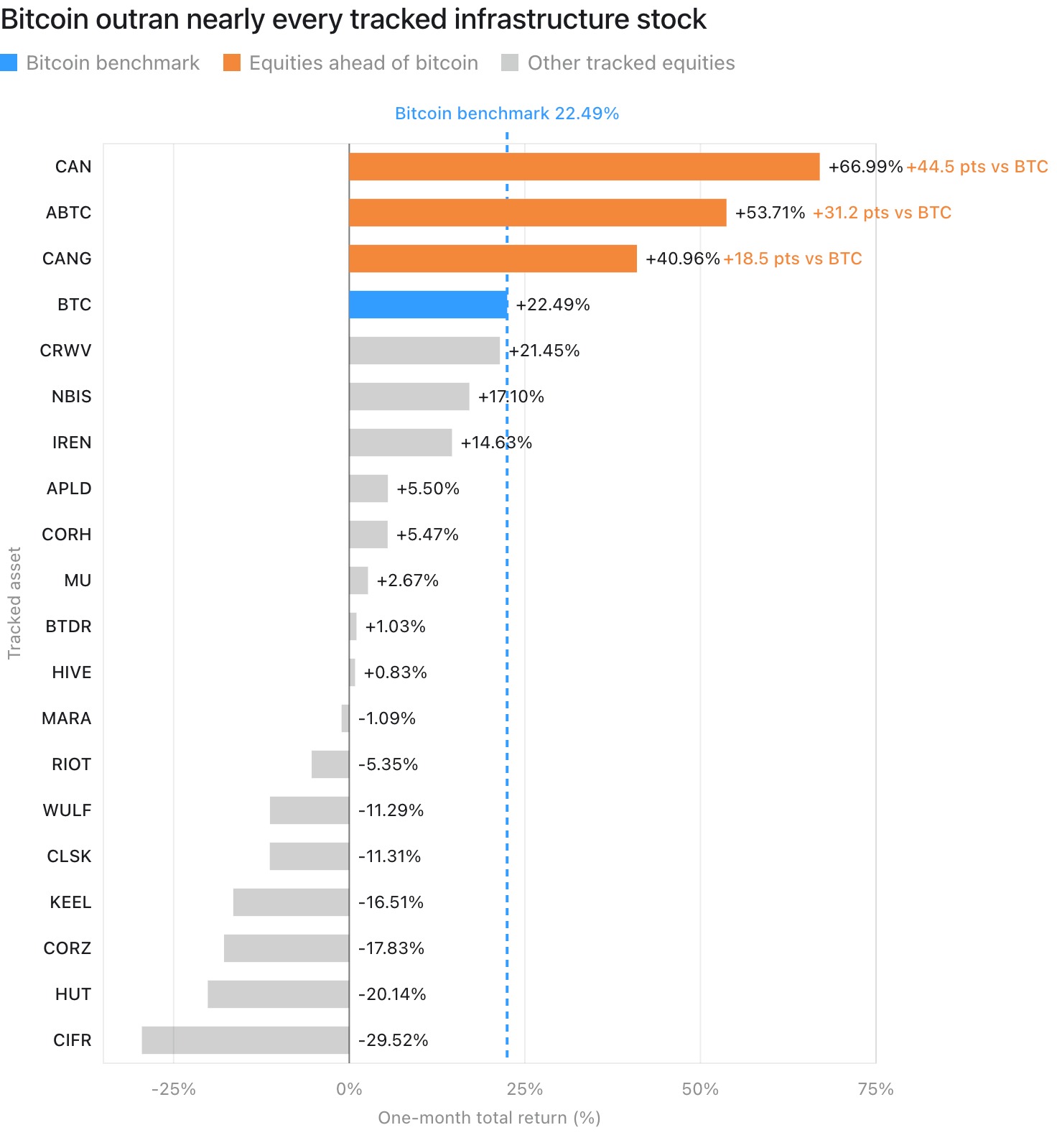
Bitcoin mining-focused stocks outperformed companies that pivoted toward AI and HPC. Source: Miner Weekly

Related: Strategy’s $66B Bitcoin machine hinges on capital markets, not BTC price: Report

BTC price still drives miners despite AI pivot

BlocksBridge’s findings echoed earlier Cointelegraph reporting that Bitcoin’s rally had lifted crypto-related stocks, including Bitcoin miners. The gains underscore how strongly Bitcoin’s price can still influence mining stocks, even as many miners have increasingly shifted their focus toward AI and HPC infrastructure in recent years.

Separate recent BlocksBridge analysis found that publicly traded Bitcoin miners have invested roughly $15 in AI data centers for every $1 in AI-related revenue generated. Nine public miners generated $341.2 million in AI and HPC revenue so far in 2026, compared with $5.11 billion in capital expenditures on the technology.

Related: Bitcoin breaks above 200-day moving average for first time since November


Perguntas relacionadas

QWhat is the main finding of the BlocksBridge Consulting report mentioned in the article regarding Bitcoin mining stocks and AI stocks?

AThe report found that during Bitcoin's recent rally, the stocks of beaten-down Bitcoin mining companies significantly outperformed most AI-linked infrastructure stocks.

QAccording to the article, what were the three catalysts behind Bitcoin's recent rally?

AThe three catalysts were: 1) The US Treasury's announcement to increase liquidity-support buybacks for longer-dated securities, 2) Renewed regulatory optimism from a White House meeting with crypto executives, and 3) A sharp short squeeze following Bitcoin's breakout, which liquidated over $1.6 billion in crypto positions.

QHow much have some of the most beaten-down Bitcoin mining companies gained during the rally, according to the article?

ADuring the rally, Canaan, American Bitcoin, and Cango gained between 41% and 67%.

QWhat does the data from BlocksBridge analysis reveal about Bitcoin miners' investment in AI data centers versus the revenue it generates?

AThe analysis found that publicly traded Bitcoin miners have invested roughly $15 in AI data centers for every $1 in AI-related revenue generated. So far in 2026, they generated $341.2 million in AI/HPC revenue compared to $5.11 billion in capital expenditures on the technology.

QWhat does the article suggest about the primary driver for Bitcoin mining stock performance, despite the industry's pivot towards AI?

AThe article suggests that Bitcoin's price is still the primary driver for mining stock performance, as evidenced by their strong gains during Bitcoin's rally, even though many miners have shifted focus toward AI and HPC infrastructure.

Leituras Relacionadas

Solana Proposals Could Lead to Reduction in Staking Yields to 2.25% and Cut Emissions by $1.5 Billion

Solana is moving towards a stricter monetary model that could lead to a SOL deficit and significantly reduce staking rewards for holders. Two governance proposals drive these changes. SIMD-550, currently under vote, would double Solana's annual disinflation rate from 15% to 30%, accelerating the timeline to reach a final inflation rate of ~1.5% to the first half of 2029. The second, SIMD-553 (already approved), introduces additional token burning tied to computational units used on the network. Together, these measures could reduce SOL emission by an estimated $1.4-$1.5 billion over six years. The immediate impact would be lower staking yields, potentially falling from the current ~5.25% to approximately 4.34% in year one, 3% in year two, and 2.25% by year three. Analyst Matt Mena from 21Shares suggests inflation should be tied to economic metrics to help offset this decline. The changes also raise concerns for validator economics, with some potentially becoming unprofitable as inflation rewards decrease and voting costs may rise. However, the lower passive yield might push a significant portion of the 67.9% staked SOL into Solana's DeFi ecosystem for activities like lending and trading. This shift could boost network fee revenue to compensate for lower inflation rewards. The proposals aim to trade lower yield today for less dilution tomorrow, betting that network growth and usage will make this a worthwhile trade-off for SOL holders.

cryptonews.ruHá 2h

Solana Proposals Could Lead to Reduction in Staking Yields to 2.25% and Cut Emissions by $1.5 Billion

cryptonews.ruHá 2h

Trading

Spot
活动图片