Bitcoin: The End of 'Faith-Based Trading'

华尔街日报Publicado em 2026-02-05Última atualização em 2026-02-05

Resumo

Bitcoin is undergoing a painful transition from a purely speculative asset to an institutional one, marked by a 40% decline from its October 2025 peak of around $125,000 to approximately $73,000. This signals the end of the "Tinkerbell Effect," where prices were sustained by belief rather than fundamentals. Key drivers include hawkish signals from the Fed, sustained institutional outflows—with U.S. spot Bitcoin ETFs seeing over $30 billion in outflows in January 2026 alone—and stalled regulatory progress, such as the delayed CLARITY Act. Bitcoin has decoupled from traditional assets, falling 11% in January while gold rose 13%, breaking its "digital gold" narrative. Correlation with equities has also dropped significantly. It is testing key technical levels, having broken below the average ETF entry price of $81,600 and approaching the psychologically critical $70,000 mark. Despite a 370% gain since early 2023, the current pullback reflects a withdrawal of speculative excess rather than a fundamental breakdown. The market is shifting from faith-based trading to value anchoring, though Bitcoin’s high volatility remains inherent. Concerns about a potential "crypto winter" persist if declines deepen, especially given Bitcoin’s sensitivity to Federal Reserve liquidity changes. The long-term outlook points to a complex maturation beyond pure speculation.

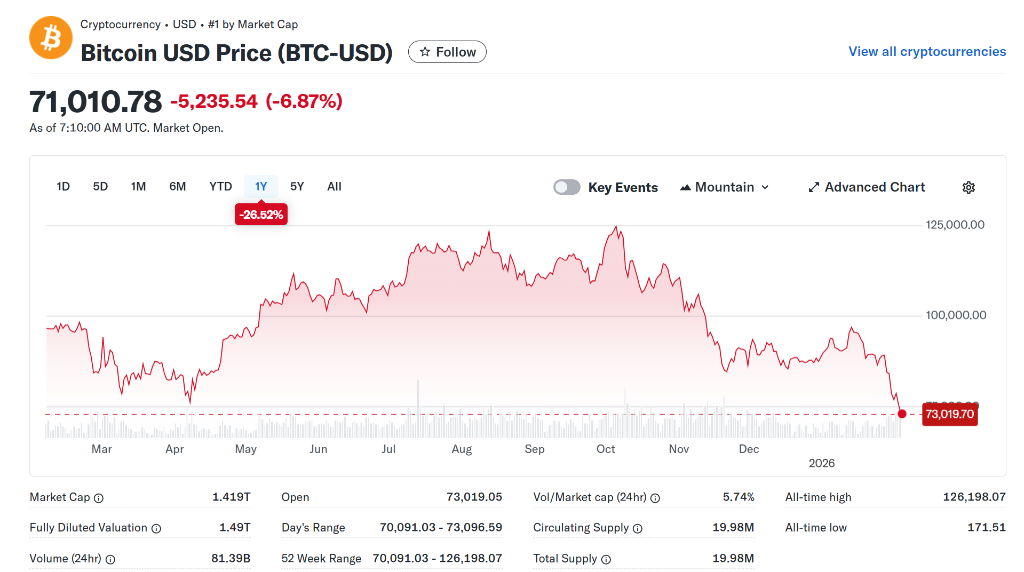
Bitcoin is undergoing a painful transition from a purely speculative asset to an institutionalized asset. The world's largest cryptocurrency fell to around $73,000 on February 3rd, down more than 40% from its peak of approximately $125,000 in October of last year. This marks the end of the so-called "Tinkerbell Effect" phase—a speculative frenzy sustained solely by belief is now receding.

According to Zhui Feng Trading Desk, a report released on the 4th by Deutsche Bank's Marion Laboure team identified three main drivers of this decline: multiple hawkish signals from the Fed, sustained institutional outflows, and stalled regulatory progress. News of Trump nominating Warsh as the next Fed Chair on January 29th triggered a 5.5% single-day drop in Bitcoin, followed by its largest single-day decline since January 2018 of 7.1% on January 31st. Warsh is known for supporting higher real interest rates and reducing the balance sheet.

The price is approaching key technical levels. According to research by Citi analyst Alex Saunders on the 3rd, Bitcoin has fallen below the average entry price of $81,600 for US spot ETFs and is nearing the pre-US election level of around $70,000. Given the current administration's promise to strengthen US leadership in the digital asset space, the $70,000 level is seen as a significant psychological barrier.

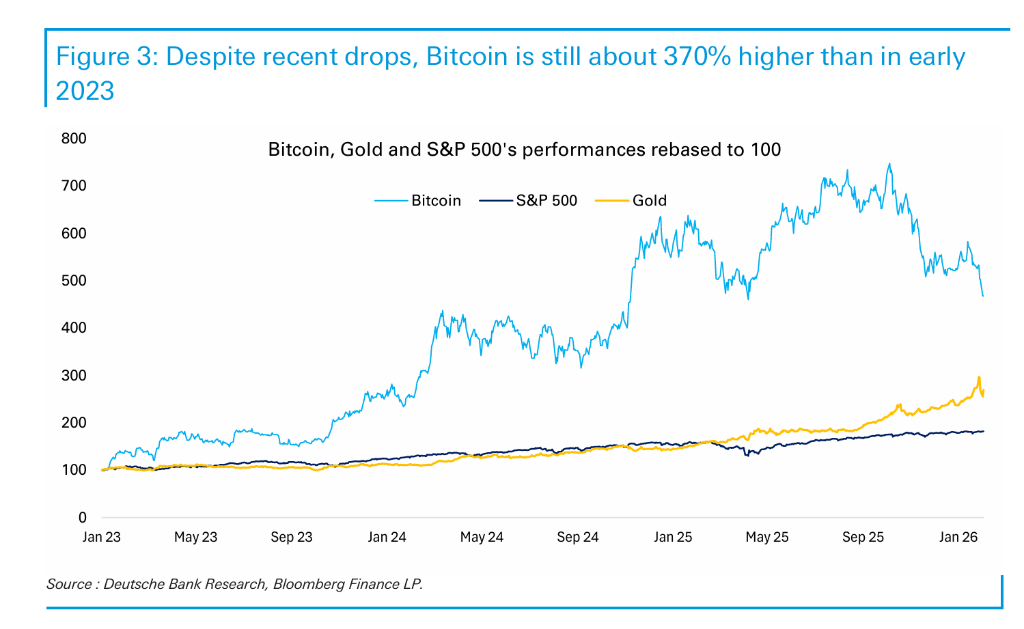
Despite the recent significant drop, Bitcoin is still up about 370% since the beginning of 2023. Deutsche Bank points out that the current adjustment reflects more of a pullback from the speculative gains of the past two years rather than a collapse in fundamentals. However, the crypto market is facing a difficult transition from being "faith-driven" to being "value-anchored".
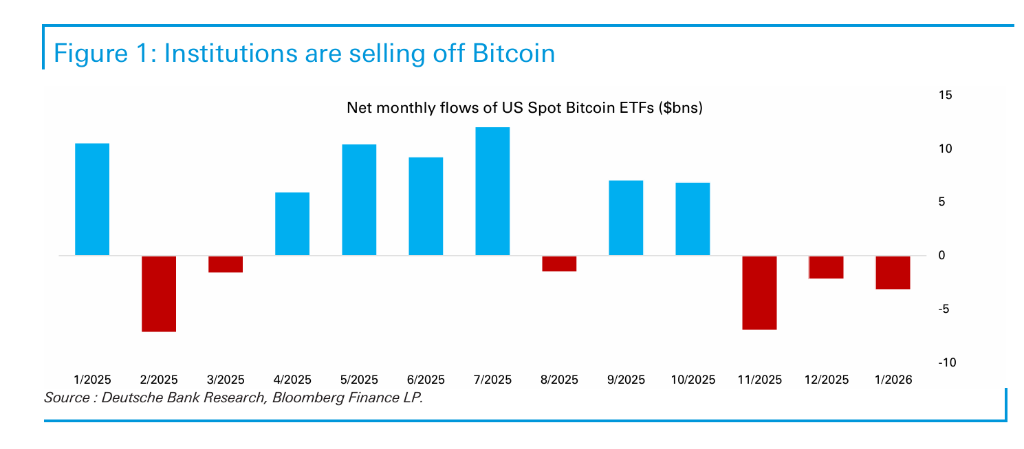
Sustained Institutional Outflows

US spot Bitcoin ETFs experiencing large-scale redemptions have become a core factor putting pressure on the price. According to Deutsche Bank data, these funds recorded outflows of over $3 billion in January 2026, approximately $2 billion in December 2025, and around $7 billion in November 2025.

Since the market turned in October 2025, institutional investors have been selling billions of dollars in Bitcoin exposure every month. This sustained selling pressure indicates that traditional investors are losing interest, and overall pessimism towards cryptocurrencies is intensifying. The Crypto Fear & Greed Index has fallen back to around 15 points, indicating "Extreme Fear," nearing the low of 10 points seen in November 2025.

Retail participation is declining simultaneously. Deutsche Bank's own dbDatainsights survey shows that cryptocurrency adoption among US consumers is currently about 12%, down from 17% in July 2025, indicating a broad waning of interest.

Institutions reducing their Bitcoin exposure has led to decreased trading volume, which in turn exacerbates the price decline. Thinner liquidity makes the market react more violently to negative news, creating a vicious cycle.
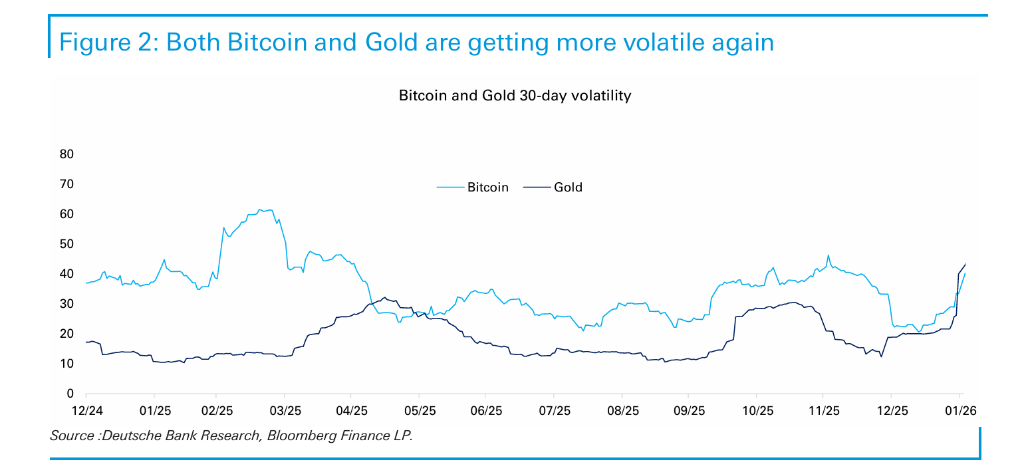
Decoupling from Traditional Assets

Bitcoin's price movement has significantly diverged from gold's, highlighting the breakdown of its "digital gold" narrative. In January 2026, Bitcoin was one of the few major assets to close lower, falling 11% to $78,197. In contrast, gold rose 13%, and the S&P 500 index gained 1.4%. This was Bitcoin's fourth consecutive monthly decline, its longest losing streak since before the pandemic.

The full-year performance is even starker. Gold recorded a 65% return in 2025, while Bitcoin fell 6.5%. This indicates Bitcoin is no longer serving its role as "digital gold." Notably, although gold has recently shown volatility similar to cryptocurrencies, the fundamental drivers supporting gold demand remain strong—central bank purchases, geopolitical risks, and demand for safe-haven assets.
Correlations with the stock market are also changing. Bitcoin's 30-day correlation with both the Nasdaq and the S&P 500 has fallen to around 15%. In contrast, during the market sell-off in October 2025, Bitcoin's correlation with the Nasdaq was about 57% and with the S&P 500 about 52%—typical levels during previous macro-driven adjustments.

Previously, Bitcoin, due to its 24/7 trading and higher beta, often led equity market weakness. But in this recent decline, particularly in January 2026, Bitcoin performed weakly while equities performed well, indicating its risk-asset属性 is being repriced.
Stalled Regulatory Progress

Despite early legislative progress, regulatory uncertainty has weighed on Bitcoin's performance. The bipartisan-supported Clarity for Digital Asset Markets Act (CLARITY Act) has been stalled in Congress for months. This bill aims to establish a framework for digital asset classification and designate the Commodity Futures Trading Commission (CFTC) as the primary regulator for the industry.

The delay stems from disagreements between cryptocurrency and lobbying groups over how to handle stablecoin rewards. The Senate Finance Committee released a draft but it hasn't gained widespread acceptance, and committee votes have been postponed. The Senate Agriculture Committee has also advanced its version of the bill. According to Bloomberg, the White House has urged relevant lobbying groups to reach an agreement by the end of February.

The loss of regulatory momentum has hindered the portfolio integration and liquidity deepening that Bitcoin showed earlier in 2025. According to a previous Deutsche Bank report, early regulatory progress helped lower Bitcoin's volatility in early 2025. Now, Bitcoin's 30-day volatility has rebounded to 40.72, climbing to levels seen in late October, compared to just 26 a week ago.

Citi Research believes the passage of a US market structure bill is a potential catalyst that could change market sentiment and restore inflows. History shows that positive news on regulation is an important factor in boosting investor confidence—ETF inflows increased following both the November 2024 election and the passage of the GENIUS Act in July 2025.

Key Price Levels Approaching

Bitcoin is testing two technical levels closely watched by the market. Citi Research points out that the first is the ETF average entry price of $81,600—calculated as the average based on the largest ETF's daily closing prices. Bitcoin has now fallen below this level, meaning the average holder is at a loss.

The second key level is the pre-US election price of around $70,000. This level holds political and psychological significance. Crypto advocates were enthusiastic donors in the US election, and the current administration has promised to strengthen US leadership in digital assets and established a Bitcoin strategic reserve. This reserve, funded by seized Bitcoin, can only be increased in a "budget-neutral" manner.

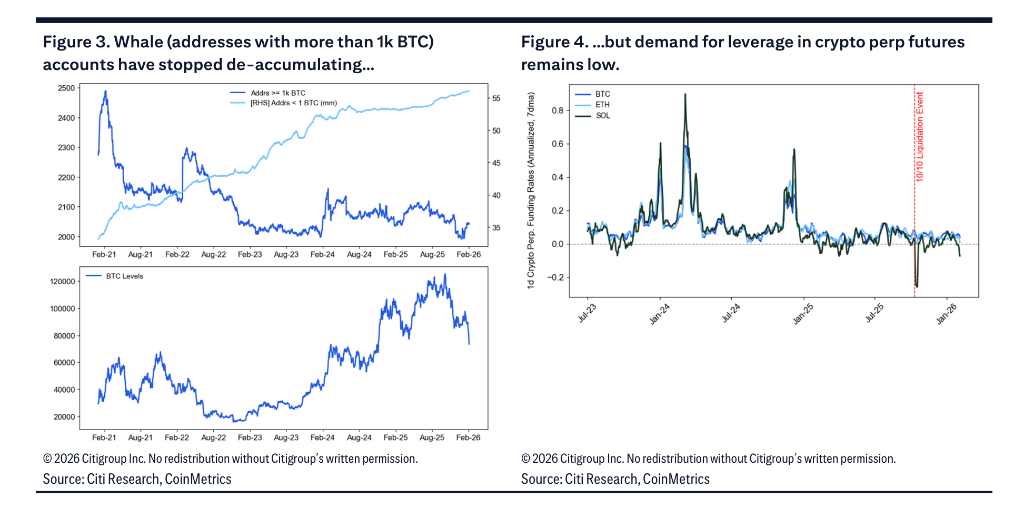
There is still room for long liquidations in the futures market. Although multiple rounds of liquidations have occurred since the sharp rise last October, Citi data shows exchanges are still seeing long positions being closed. Demand for leverage in crypto perpetual futures remains subdued.

It is worth noting that "whale" addresses holding over 1000 Bitcoin have recently stopped reducing their holdings. Citi data shows that these long-term holders, who showed concern about Bitcoin's cyclical weakness in November, have recently halted their selling behavior.
Fed Balance Sheet and "Winter" Concerns

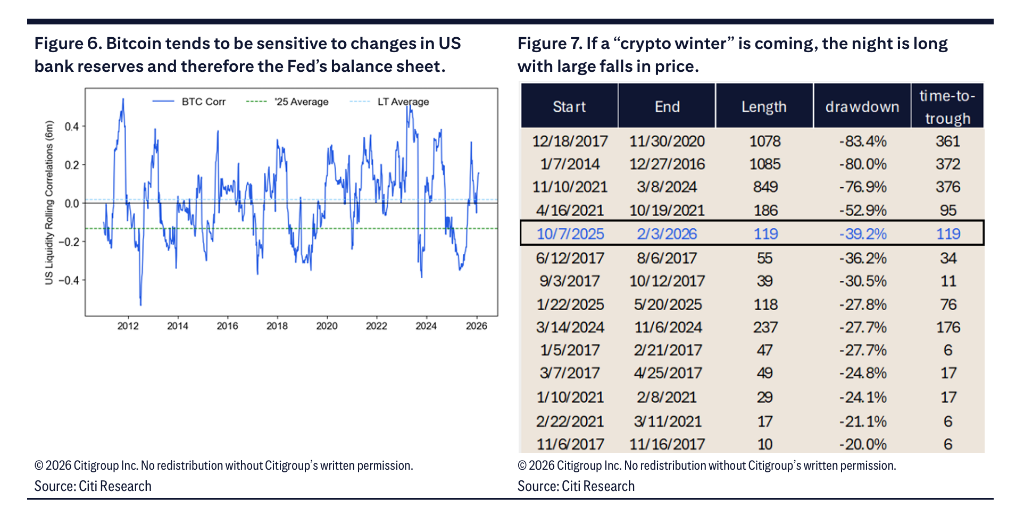
Bitcoin is highly sensitive to US bank liquidity, and a potential reduction of the Fed's balance sheet under Warsh's leadership adds an extra layer of concern. Citi Research shows that Bitcoin tends to be very sensitive to changes in US bank reserves, and therefore to changes in the Fed's balance sheet.

The possibility of a "crypto winter" is also heightening market anxiety. Citi's previous research found that while 20% corrections are common in Bitcoin, the current 40% drop from the all-time high is approaching a critical level—beyond which cryptocurrency bear markets have historically been prolonged and deep "winters".

Citi emphasizes this is not its base case scenario, but historical precedents keep investors vigilant. Past "crypto winters" were characterized by long duration and deep drawdowns, distinct from common 20% corrections.

Deutsche Bank's rates strategists believe a reduction in reserve management purchases is possible. Given the sensitivity of Bitcoin and other digital assets to US bank liquidity, this could constitute an additional headwind.
Long-Term Transition from Speculation to Maturity

Looking back, both 2024 and 2025 were extraordinary years for Bitcoin, but they also raised questions about whether the price had detached from fundamentals. Bitcoin started around $16,000 at the beginning of 2023. 2024 saw strong performance, with the price doubling, driven mainly by: ETF approval (January), the Bitcoin halving (April), positive comments from Trump's campaign on the crypto industry (July-August), and Trump's election (November).

In 2025, Bitcoin's value surged again, reaching $101,000 in January. It was another record year, driven by Trump's continued support and statements (like the Bitcoin reserve) and the GENIUS Act targeting stablecoins, reaching a record $125,000 in October.

While crypto-specific events were key, Bitcoin's price rose about 370% between 2023 and 2025. Deutsche Bank believes this indicates a possible decoupling from its fundamental value. A "bubble" forms when asset prices rise持续快速ly, driven by the hope of even higher prices rather than actual fundamental value, and are often followed by a sharp crash.

Deutsche Bank's conclusion is that Bitcoin is experiencing the end of the so-called "Tinkerbell Effect" phase, transitioning from a purely speculative asset to a more realistic positioning. Bitcoin is not a true means of payment or currency because it lacks the essential characteristics of a medium of exchange, unit of account, or store of value. Therefore, it is unlikely to replace established assets like gold or traditional currencies. Bitcoin's volatility is not a flaw but may be an inherent feature.

~~~~~~~~~~~~~~~~~~~~~~~~

The above精彩 content comes from Zhui Feng Trading Desk.

For more detailed interpretation, including real-time analysis, frontline research, and other content, please join the 【Zhui Feng Trading Desk ▪ Annual Membership

Perguntas relacionadas

QWhat are the three main drivers behind Bitcoin's recent price decline according to Deutsche Bank's report?

AThe three main drivers are hawkish signals from the Federal Reserve, persistent institutional outflows, and stalled regulatory progress.

QHow has the relationship between Bitcoin and traditional assets like gold changed recently?

ABitcoin's price movement has decoupled from gold, with Bitcoin falling 11% in January 2026 while gold rose 13%, breaking the 'digital gold' narrative. Bitcoin also showed weak performance while equities performed well.

QWhat is the significance of the $70,000 price level for Bitcoin mentioned in the article?

AThe $70,000 level is a key psychological and political support level, representing the price before the U.S. election. The current administration had promised to strengthen U.S. leadership in digital assets and established a Bitcoin strategic reserve.

QWhat does the term 'Tinkerbell Effect' refer to in the context of Bitcoin's market behavior?

AThe 'Tinkerbell Effect' refers to a phase where Bitcoin's price was sustained purely by speculative belief and faith rather than fundamental value, which is now coming to an end as the market transitions to a more institutionalized asset.

QHow have U.S. spot Bitcoin ETFs performed in terms of fund flows in recent months?

AU.S. spot Bitcoin ETFs experienced significant outflows, with over $3 billion in January 2026, approximately $2 billion in December 2025, and about $7 billion in November 2025, indicating sustained selling pressure from institutional investors.

Leituras Relacionadas

How Many Tokens Away Is Yang Zhilin from the 'Moon Chasing the Light'?

The article explores the intense competition between two leading Chinese AI companies, DeepSeek and Kimi (Moon Dark Side), and the mounting pressure on Yang Zhilin, the founder of Kimi. While DeepSeek re-emerged after 15 months of silence with its powerful V4 model—boasting 1.6 trillion parameters and low-cost, long-context capabilities—Kimi has been focusing on long-context processing and multi-agent systems with its K2.6 model. Yang faces a threefold challenge: technological rivalry, commercialization pressure, and investor expectations. Despite Kimi’s high valuation (reaching $18 billion), its revenue heavily relies on a single product with low paid conversion rates, while DeepSeek’s strategic silence and open-source influence have strengthened its market position and valuation prospects, now targeting over $20 billion. Both companies reflect broader trends in China’s AI ecosystem: Kimi aims for global influence through open-source contributions and agent-based advancements, while DeepSeek prioritizes foundational innovation and hardware independence, notably shifting to Huawei’s chips. Their competition is seen as vital for China’s AI progress, with the gap between top Chinese and U.S. models narrowing to just 2.7% on the Elo rating scale. Ultimately, the article argues that this rivalry, though anxiety-inducing for leaders like Zhilin, is essential for driving innovation and solidifying China’s role in the global AI landscape.

marsbitHá 4h

How Many Tokens Away Is Yang Zhilin from the 'Moon Chasing the Light'?

marsbitHá 4h

TechFlow Intelligence Bureau: ChatGPT Helps Amateur Mathematician Crack 60-Year-Old Problem, CFTC Sues New York Regulator Over Coinbase and Gemini

An amateur mathematician, with the assistance of ChatGPT, has solved a combinatorial mathematics puzzle originally proposed by Hungarian mathematician Paul Erdős in the 1960s. This marks another milestone in AI-aided mathematical research, demonstrating the evolving capabilities of large language models in formal reasoning. In other AI developments, OpenAI introduced a new privacy filter tool for enterprise API usage, automatically screening sensitive data. Meanwhile, the Qwen3.6-27B model achieved 100 tokens per second on a single RTX 5090 GPU using quantization, significantly lowering the cost barrier for local AI deployment. In crypto and Web3, the U.S. CFTC sued New York’s financial regulator, challenging its oversight of Coinbase and Gemini—a first-of-its-kind federal-state regulatory clash. Following a vulnerability, KelpDAO and major DeFi protocols established a recovery fund. Tether froze $344 million in assets linked to Iran’s central bank upon U.S. Treasury request, highlighting the centralized control risks in stablecoins. Separately, Litecoin underwent a 3-hour chain reorganization to undo a privacy-layer exploit. In the U.S., former President Trump invoked the Defense Production Act to address power grid bottlenecks affecting AI data centers and dismissed the entire National Science Board, raising concerns over research independence. A retail trader gained 250% on a $600k Intel options bet amid AI-related speculation. Xiaomi announced its first performance electric vehicle, targeting rivals like Tesla. Meanwhile, iPhone users reported devices automatically reinstalling a hidden app daily, suspected to be MDM-related. A Chinese securities report noted that A-share institutional crowding has reached its second-longest streak since 2007, signaling high valuations and potential style rotation. The day’s developments reflect a dual narrative: AI is enabling unprecedented individual breakthroughs, while centralized power structures—whether governmental or corporate—are becoming more assertive, underscoring that decentralization is as much a political-economic challenge as a technical one.

marsbitHá 4h

TechFlow Intelligence Bureau: ChatGPT Helps Amateur Mathematician Crack 60-Year-Old Problem, CFTC Sues New York Regulator Over Coinbase and Gemini

marsbitHá 4h

Trading

Spot
Futuros

Artigos em Destaque

O que é BITCOIN

Compreender o HarryPotterObamaSonic10Inu (ERC-20) e a Sua Posição no Espaço Cripto Nos últimos anos, o mercado de criptomoedas assistiu a um aumento na popularidade das moedas meme, cativando não apenas os traders, mas também aqueles que procuram envolvimento comunitário e valor de entretenimento. Entre estes tokens únicos está o HarryPotterObamaSonic10Inu (ERC-20), um projeto intrigante que mistura referências culturais no tecido das criptomoedas. Este artigo explora os principais aspetos do HarryPotterObamaSonic10Inu, examinando os seus mecanismos, a sua ética orientada pela comunidade e o seu envolvimento com o vasto panorama cripto. O que é o HarryPotterObamaSonic10Inu (ERC-20)? Como o nome sugere, o HarryPotterObamaSonic10Inu é uma moeda meme construída na blockchain Ethereum, classificada sob o padrão ERC-20. Ao contrário das criptomoedas tradicionais, que podem enfatizar a utilidade prática ou o potencial de investimento, este token prospera no valor de entretenimento e na força da sua comunidade. O projeto visa promover um ambiente onde utilizadores envolvidos possam reunir-se, partilhar ideias e participar em atividades inspiradas por diversos fenómenos culturais. Uma característica notável do HarryPotterObamaSonic10Inu é a zero taxa sobre transações. Este elemento atraente visa encorajar a negociação e o envolvimento da comunidade, isento de encargos adicionais que podem desencorajar os traders de pequena escala. A oferta total da moeda está fixada em mil milhões de tokens, uma cifra que marca a sua intenção de manter uma circulação substancial dentro da comunidade. Criador do HarryPotterObamaSonic10Inu (ERC-20) As origens do HarryPotterObamaSonic10Inu estão um pouco envoltas em mistério; os detalhes sobre o criador permanecem desconhecidos. O desenvolvimento deste token carece de uma equipa identificável ou de um plano explícito, o que não é raro no setor das moedas meme. Em vez disso, o projeto surgiu de forma orgânica, com o seu progresso a depender fortemente do entusiasmo e da participação da sua comunidade. Investidores do HarryPotterObamaSonic10Inu (ERC-20) No que diz respeito a investimentos externos e apoios, o HarryPotterObamaSonic10Inu também permanece ambíguo. O token não lista quaisquer fundações de investimento conhecidas ou apoio organizacional significativo. Em vez disso, o “sangue vital” do projeto é a sua comunidade de base, que informa o seu crescimento e sustentabilidade através da ação coletiva e do envolvimento no espaço cripto. Como Funciona o HarryPotterObamaSonic10Inu (ERC-20)? Como uma moeda meme, o HarryPotterObamaSonic10Inu opera principalmente fora dos quadros tradicionais que muitas vezes governam o valor dos ativos. Existem vários aspetos distintivos que definem como o projeto funciona: Transações Sem Taxas: Sem taxas sobre transações, os utilizadores podem comprar e vender o token livremente, sem a preocupação de custos ocultos. Envolvimento da Comunidade: O projeto prospera na interação da comunidade, aproveitando plataformas de redes sociais para criar entusiasmo e facilitar a participação. Discussões, partilha de conteúdo e envolvimento são elementos cruciais que ajudam a expandir o seu alcance e a fomentar a lealdade entre os apoiantes. Sem Utilidade Prática: Deve ser notado que o HarryPotterObamaSonic10Inu não oferece utilidade concreta dentro do ecossistema financeiro. Em vez disso, é classificado como um token principalmente para entretenimento e atividades comunitárias. Referência Cultural: O token incorpora de forma inteligente elementos da cultura popular para atrair interesse, conectando-se tanto com entusiastas de memes como com seguidores de criptomoedas. HarryPotterObamaSonic10Inu exemplifica como as moedas meme operam de forma diferente de projetos de criptomoedas mais tradicionais, entrando no mercado como construções sociais inovadoras em vez de ativos utilitários. Linha do Tempo do HarryPotterObamaSonic10Inu (ERC-20) A história do HarryPotterObamaSonic10Inu é marcada por vários marcos notáveis: Criação: O token surgiu de um meme viral, capturando a imaginação de muitos entusiastas de criptomoedas. Datas específicas de criação não estão disponíveis, sublinhando a sua ascensão orgânica. Listagem em Exchanges: O HarryPotterObamaSonic10Inu conseguiu entrar em várias exchanges, permitindo um acesso e negociação mais fáceis pela comunidade. Iniciativas de Envolvimento da Comunidade: Atividades contínuas direcionadas a melhorar a interação comunitária, incluindo concursos, campanhas em redes sociais e geração de conteúdo por fãs e defensores. Planos de Expansão Futura: O roteiro do projeto inclui o lançamento de uma coleção de NFTs, mercadorias e um site de eCommerce relacionado aos seus temas culturais, envolvendo ainda mais a comunidade e tentando adicionar mais dimensões ao seu ecossistema. Pontos-Chave sobre o HarryPotterObamaSonic10Inu (ERC-20) Natureza Orientada pela Comunidade: O projeto prioriza a contribuição coletiva e a criatividade, assegurando que o envolvimento dos utilizadores está na vanguarda do seu desenvolvimento. Classificação como Moeda Meme: Representa o epítome da criptomoeda baseada em entretenimento, destacando-se dos veículos de investimento tradicionais. Sem Afiliação Direta com o Bitcoin: Apesar da semelhança no nome do ticker, o HarryPotterObamaSonic10Inu é distinto e não tem qualquer relação com o Bitcoin ou outras criptomoedas estabelecidas. Foco na Colaboração: O HarryPotterObamaSonic10Inu é projetado para criar um espaço de colaboração e partilha de histórias entre os seus detentores, proporcionando uma via para a criatividade e o fortalecimento da comunidade. Perspectivas Futuras: A ambição de expandir além da sua premissa inicial para NFTs e mercadorias delineia um caminho para o projeto potencialmente entrar em avenidas mais mainstream dentro da cultura digital. À medida que as moedas meme continuam a capturar a imaginação da comunidade cripto, HarryPotterObamaSonic10Inu (ERC-20) destaca-se devido aos seus laços culturais e abordagem centrada na comunidade. Embora possa não se encaixar no molde típico de um token orientado para utilidade, a sua essência reside na alegria e camaradagem fomentadas entre os seus apoiantes, destacando a natureza em evolução das criptomoedas em uma era cada vez mais digital. À medida que o projeto continua a desenvolver-se, será importante observar como as dinâmicas comunitárias influenciam a sua trajetória no panorama em constante mudança da tecnologia blockchain.

1.2k Visualizações TotaisPublicado em {updateTime}Atualizado em 2024.12.03

O que é BITCOIN

Como comprar BTC

Bem-vindo à HTX.com!Tornámos a compra de Bitcoin (BTC) simples e conveniente.Segue o nosso guia passo a passo para iniciar a tua jornada no mundo das criptos.Passo 1: cria a tua conta HTXUtiliza o teu e-mail ou número de telefone para te inscreveres numa conta gratuita na HTX.Desfruta de um processo de inscrição sem complicações e desbloqueia todas as funcionalidades.Obter a minha contaPasso 2: vai para Comprar Cripto e escolhe o teu método de pagamentoCartão de crédito/débito: usa o teu visa ou mastercard para comprar Bitcoin (BTC) instantaneamente.Saldo: usa os fundos da tua conta HTX para transacionar sem problemas.Terceiros: adicionamos métodos de pagamento populares, como Google Pay e Apple Pay, para aumentar a conveniência.P2P: transaciona diretamente com outros utilizadores na HTX.Mercado de balcão (OTC): oferecemos serviços personalizados e taxas de câmbio competitivas para os traders.Passo 3: armazena teu Bitcoin (BTC)Depois de comprar o teu Bitcoin (BTC), armazena-o na tua conta HTX.Alternativamente, podes enviá-lo para outro lugar através de transferência blockchain ou usá-lo para transacionar outras criptomoedas.Passo 4: transaciona Bitcoin (BTC)Transaciona facilmente Bitcoin (BTC) no mercado à vista da HTX.Acede simplesmente à tua conta, seleciona o teu par de trading, executa as tuas transações e monitoriza em tempo real.Oferecemos uma experiência de fácil utilização tanto para principiantes como para traders experientes.

3.9k Visualizações TotaisPublicado em {updateTime}Atualizado em 2025.03.21

Como comprar BTC

O que é $BITCOIN

OURO DIGITAL ($BITCOIN): Uma Análise Abrangente Introdução ao OURO DIGITAL ($BITCOIN) OURO DIGITAL ($BITCOIN) é um projeto baseado em blockchain que opera na rede Solana, com o objetivo de combinar as características dos metais preciosos tradicionais com a inovação das tecnologias descentralizadas. Embora partilhe um nome com o Bitcoin, frequentemente referido como “ouro digital” devido à sua percepção como uma reserva de valor, o OURO DIGITAL é um token separado projetado para criar um ecossistema único dentro da paisagem Web3. O seu objetivo é posicionar-se como um ativo digital alternativo viável, embora os detalhes sobre as suas aplicações e funcionalidades ainda estejam em desenvolvimento. O que é o OURO DIGITAL ($BITCOIN)? OURO DIGITAL ($BITCOIN) é um token de criptomoeda explicitamente projetado para uso na blockchain Solana. Em contraste com o Bitcoin, que fornece um papel amplamente reconhecido como armazenamento de valor, este token parece focar em aplicações e características mais amplas. Aspectos notáveis incluem: Infraestrutura Blockchain: O token é construído na blockchain Solana, conhecida pela sua capacidade de lidar com transações de alta velocidade e baixo custo. Dinâmicas de Oferta: O OURO DIGITAL tem um fornecimento máximo limitado a 100 quatrilhões de tokens (100P $BITCOIN), embora os detalhes sobre o seu fornecimento circulante ainda não tenham sido divulgados. Utilidade: Embora as funcionalidades precisas não estejam explicitamente delineadas, existem indicações de que o token poderia ser utilizado para várias aplicações, potencialmente envolvendo aplicações descentralizadas (dApps) ou estratégias de tokenização de ativos. Quem é o Criador do OURO DIGITAL ($BITCOIN)? Neste momento, a identidade dos criadores e da equipa de desenvolvimento por trás do OURO DIGITAL ($BITCOIN) permanece desconhecida. Esta situação é típica entre muitos projetos inovadores no espaço da blockchain, particularmente aqueles alinhados com finanças descentralizadas e fenómenos de moedas meme. Embora tal anonimato possa fomentar uma cultura orientada pela comunidade, intensifica as preocupações sobre governança e responsabilidade. Quem são os Investidores do OURO DIGITAL ($BITCOIN)? As informações disponíveis indicam que o OURO DIGITAL ($BITCOIN) não tem apoiantes institucionais conhecidos ou investimentos proeminentes de capital de risco. O projeto parece operar num modelo peer-to-peer focado no apoio e adoção da comunidade, em vez de rotas de financiamento tradicionais. A sua atividade e liquidez estão principalmente situadas em exchanges descentralizadas (DEXs), como a PumpSwap, em vez de plataformas de negociação centralizadas estabelecidas, destacando ainda mais a sua abordagem de base. Como Funciona o OURO DIGITAL ($BITCOIN) A mecânica operacional do OURO DIGITAL ($BITCOIN) pode ser elaborada com base no seu design de blockchain e nas características da rede: Mecanismo de Consenso: Ao aproveitar o exclusivo proof-of-history (PoH) da Solana combinado com um modelo de proof-of-stake (PoS), o projeto assegura uma validação eficiente das transações, contribuindo para o alto desempenho da rede. Tokenomics: Embora mecanismos deflacionários específicos não tenham sido extensivamente detalhados, o vasto fornecimento máximo de tokens implica que pode atender a microtransações ou casos de uso de nicho que ainda estão por definir. Interoperabilidade: Existe o potencial para integração com o ecossistema mais amplo da Solana, incluindo várias plataformas de finanças descentralizadas (DeFi). No entanto, os detalhes sobre integrações específicas permanecem não especificados. Cronologia de Eventos Chave Aqui está uma cronologia que destaca marcos significativos relacionados ao OURO DIGITAL ($BITCOIN): 2023: O lançamento inicial do token ocorre na blockchain Solana, marcado pelo seu endereço de contrato. 2024: O OURO DIGITAL ganha visibilidade ao tornar-se disponível para negociação em exchanges descentralizadas como a PumpSwap, permitindo que os utilizadores o negociem contra SOL. 2025: O projeto testemunha atividade de negociação esporádica e potencial interesse em envolvimentos liderados pela comunidade, embora não tenham sido documentadas parcerias ou avanços técnicos notáveis até ao momento. Análise Crítica Forças Escalabilidade: A infraestrutura subjacente da Solana suporta altos volumes de transações, o que pode aumentar a utilidade do $BITCOIN em vários cenários de transação. Acessibilidade: O potencial preço de negociação baixo por token pode atrair investidores de retalho, facilitando uma participação mais ampla devido a oportunidades de propriedade fracionada. Riscos Falta de Transparência: A ausência de apoiantes, desenvolvedores ou um processo de auditoria publicamente conhecidos pode gerar ceticismo em relação à sustentabilidade e confiabilidade do projeto. Volatilidade do Mercado: A atividade de negociação depende fortemente do comportamento especulativo, o que pode resultar em volatilidade significativa dos preços e incerteza para os investidores. Conclusão O OURO DIGITAL ($BITCOIN) surge como um projeto intrigante, mas ambíguo, dentro do ecossistema em rápida evolução da Solana. Embora tente aproveitar a narrativa do “ouro digital”, a sua divergência do papel estabelecido do Bitcoin como reserva de valor sublinha a necessidade de uma diferenciação mais clara da sua utilidade pretendida e estrutura de governança. A aceitação e adoção futuras dependerão provavelmente da abordagem da atual opacidade e da definição mais explícita das suas estratégias operacionais e económicas. Nota: Este relatório abrange informações sintetizadas disponíveis até outubro de 2023, e desenvolvimentos podem ter ocorrido além do período de pesquisa.

92 Visualizações TotaisPublicado em {updateTime}Atualizado em 2025.05.13

O que é $BITCOIN

Discussões

Bem-vindo à Comunidade HTX. Aqui, pode manter-se informado sobre os mais recentes desenvolvimentos da plataforma e obter acesso a análises profissionais de mercado. As opiniões dos utilizadores sobre o preço de BTC (BTC) são apresentadas abaixo.

活动图片