Bitcoin Price Surpasses Open Interest Following FOMC

bitcoinistPublicado em 2025-12-11Última atualização em 2025-12-11

Resumo

Following Bitcoin Price Surpasses Open Interest After FOMC Following the FOMC announcement, Bitcoin's price demonstrated the instability of leverage in the current market cycle, fluctuating between $92,000 and $89,500. This volatility liquidated billions in open positions on major derivatives markets. Despite the extreme swings, capital continued flowing into high-conviction crypto projects like Bitcoin Hyper ($HYPER), a Bitcoin Layer-2 solution combining Solana-level transaction speeds with Bitcoin's security. U.S. traders added over $38 million in new Bitcoin exposure ahead of key macroeconomic data. The sentiment remains cautiously optimistic, with analysts viewing the $90,000 level as a critical psychological and structural support. A sustained break above $92,000 could open a path toward the $100,000–$110,000 resistance range. Post-FOMC, the market saw a healthy reset with open interest dropping and funding rates normalizing. U.S. institutional flows via ETFs remained strong, indicating long-term investor confidence. Analysts from Bernstein project a potential long-term move to $200,000, while others like Matrixport forecast a mid-cycle consolidation around $120,000–$150,000. Concurrently, Bitcoin Hyper is gaining attention as an ambitious L2 project, having raised over $29 million in its presale. It aims to solve Bitcoin's scalability issues by enabling seamless cross-chain movement with instant, low-fee transactions. Its architecture and staking rewards position it...

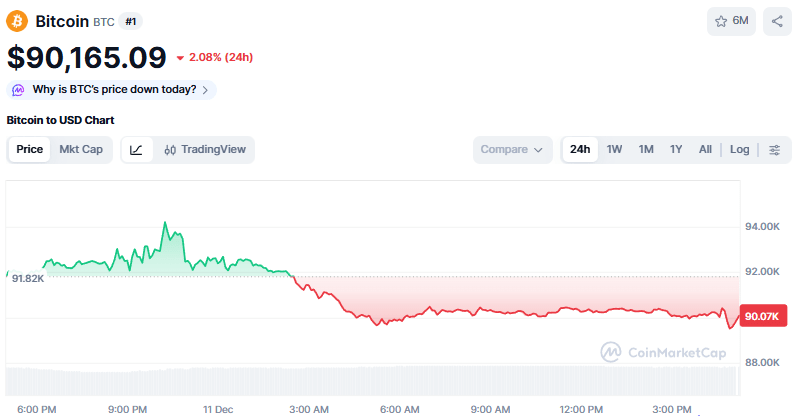
Bitcoin's price after the FOMC has once again demonstrated how unstable leverage is at this stage of the cycle. The world's largest cryptocurrency fluctuated between $92,000 and $89,500 hours after the Federal Reserve's announcement, liquidating billions in open positions on major derivatives markets. However, despite volatility reaching extreme levels, capital continued to flow into compelling cryptocurrency projects like Bitcoin Hyper ($HYPER)—a Bitcoin Layer-2 solution that combines Solana-level transaction speeds with BTC-backed security.

US traders added over $38 million in new Bitcoin exposure ahead of this week's macroeconomic catalysts—the Producer Price Index (PPI) and unemployment claims data. Both indicators could determine whether the Federal Reserve maintains its current policy or begins a more moderate approach to interest rate cuts.

The sentiment remains cautiously optimistic. BTC has managed to hold the $90,000 level, which analysts consider a critical psychological and structural support. A sustained close above $92,000 would reopen the path to the $100,000–$110,000 resistance range, while a drop below $89,000 could trigger a new wave of liquidations.

Visit Bitcoin Hyper

Bitcoin Price Dynamics and Market Forecasts

Following the FOMC meeting, Bitcoin's price fluctuations liquidated long and short positions, effectively resetting the derivatives market. Open interest plummeted as leveraged traders were wiped out. Funding rates normalized, returning to nearly neutral levels, indicating a healthier environment for spot accumulation.
American institutional flows remain strong. ETFs continued to register moderate inflows, indicating that long-term investors are not abandoning the market despite short-term volatility. Meanwhile, macro traders are preparing for another potential breakout when inflation data confirms the disinflation trend. Historically, Bitcoin performs best when real yields begin to fall, liquidity increases, and the dollar weakens—a scenario that could partially unfold in 2026.

Several analysts believe Bitcoin could still reach new all-time highs this cycle. Bernstein analysts project a potential move to $200,000 in a prolonged upward phase continuing into 2026 if ETF inflows maintain their pace. Others, like Matrixport, remain more conservative, predicting a mid-cycle consolidation around $120,000–$150,000 before the next growth wave.

Bitcoin Hyper: A Layer-2 Solution Leveraging Bitcoin's Strengths

Alongside the broader BTC narrative, Bitcoin Hyper ($HYPER) is gaining attention as one of the cycle's most ambitious Layer-2 projects. It aims to combine Bitcoin's security with Solana-level throughput, enabling instant transactions with low fees for decentralized applications. The whitepaper outlines a vision for a Bitcoin-based ecosystem supporting payments, DeFi protocols, and cross-chain liquidity via a canonical BTC bridge.

The presale has already attracted over $29 million, driven by investors seeking early exposure to infrastructure that expands Bitcoin's real-world utility. Token buyers are also attracted by the 40% staking reward, allowing for passive income during the project's rollout phase. The current token price is $0.013405, making it accessible to both private and institutional participants.

Beyond monetary appeal, Bitcoin Hyper's architecture represents a technical response to one of Bitcoin's oldest problems—scalability. By enabling BTC to move seamlessly between chains using a verified bridge mechanism, Hyper unlocks transaction speeds and composability previously unavailable on the Bitcoin base layer.

Any investor can purchase Bitcoin Hyper by visiting the project's official presale portal, connecting their crypto wallet (e.g., Best Wallet or MetaMask), and exchanging ETH, USDT, or BNB for HYPER tokens.

Why Bitcoin Hyper is Relevant Post-FOMC Decision

Post-FOMC market turmoil has forced traders to reassess their risk allocation. Due to increased Bitcoin volatility and the underperformance of traditional "altcoins," capital has begun rotating into infrastructure projects directly tied to the BTC ecosystem rather than speculative meme coins. In this context, Bitcoin Hyper positions itself as a "high-beta play on Bitcoin's success"—leveraging BTC's adoption benefits while building independent technical utility.

Bitcoin Hyper Key Advantages:

These features make Bitcoin Hyper one of the most progressive Bitcoin-oriented projects this cycle.

Perguntas relacionadas

QWhat was the price range of Bitcoin in the hours following the FOMC announcement?

ABitcoin fluctuated between $92,000 and $89,500 in the hours following the FOMC announcement.

QWhat is Bitcoin Hyper ($HYPER) and what does it aim to combine?

ABitcoin Hyper ($HYPER) is a Bitcoin Layer-2 solution that aims to combine Solana-level transaction speeds with Bitcoin's security.

QHow much new Bitcoin exposure did U.S. traders add ahead of the week's macroeconomic catalysts?

AU.S. traders added over $38 million in new Bitcoin exposure ahead of the week's macroeconomic catalysts.

QWhat is the current price of a Bitcoin Hyper token during its presale?

AThe current price of a Bitcoin Hyper token during its presale is $0.013405.

QAccording to analysts, what is a critical psychological and structural support level for Bitcoin to hold?

AAnalysts consider the $90,000 level a critical psychological and structural support level for Bitcoin to hold.

Leituras Relacionadas

Oracle Plunges 40%, Will Excessive AI Infrastructure Overbuild Drag Down Giants?

Oracle's stock has plummeted 40% from its September peak, despite securing over $500 billion in AI infrastructure orders, signaling that massive backlogs alone no longer assure investor confidence. Similarly, Broadcom, with a $73 billion AI order backlog, and CoreWeave, which recently landed $36 billion in deals with OpenAI and Meta, have also faced stock declines. The market is growing skeptical of the AI infrastructure boom, concerned not only about suppliers' ability to fund and deliver these projects but also about the financial health and commitment of their major clients—primarily tech giants like Meta, Alphabet, Microsoft, Amazon, Apple, and Nvidia, alongside AI startups like OpenAI and Anthropic. While giants have robust finances, they are increasingly relying on debt to fuel AI capex, with soaring expenditures on data centers straining cash reserves and free cash flow. For instance, Microsoft, Alphabet, and Amazon are projected to collectively invest $1 trillion over four years. However, AI still contributes minimally to their overall revenue, raising questions about the sustainability of using profits from core businesses to fund speculative AI expansions. Execution challenges—such as power grid limitations, cooling issues, and community opposition—further complicate timely deployment. The critical uncertainty remains: if exponential AI demand fails to materialize and monetize quickly enough, these vast investments could lead to underutilized infrastructure, massive losses, and a fundamental weakening of these tech titans. The race between AI infrastructure build-out and actual market payoff will determine whether this bet becomes a triumph or a disastrous overreach.

marsbitHá 12m

Oracle Plunges 40%, Will Excessive AI Infrastructure Overbuild Drag Down Giants?

marsbitHá 12m

a16z Bets on Energy Tokenization Experiment: How Will DayFi Use DeFi to Restructure the Power Grid? Jae 2025/12/13 12:00

a16z Backs Energy Tokenization Experiment: How DayFi Aims to Restructure the Grid with DeFi As global tech giants compete for computing power, electricity has become a critical resource. DayFi, a decentralized energy capital markets protocol under the Daylight ecosystem, is launching a $50 million pre-deposit event on December 16. Backed by a16z Crypto and Framework Ventures, DayFi tokenizes future electricity revenue into tradable crypto assets. The protocol allows users to deposit stablecoins to mint GRID—a fully collateralized stablecoin—and then stake it to receive sGRID, a yield-bearing token representing a share in energy asset revenue. This creates a flywheel effect: liquidity funds distributed energy projects, which generate tokenized returns for holders. However, DayFi faces significant regulatory challenges. sGRID may be classified as a security by the SEC, requiring strict disclosures. Additionally, FERC’s restrictions on disclosing critical energy infrastructure data conflict with DeFi’s transparency requirements. Technical solutions like zero-knowledge proofs may be needed to verify收益 without exposing sensitive data. Valuation of the underlying energy assets—solar panels, batteries—also remains uncertain, with risks of depreciation and potential manipulation. Despite these hurdles, DayFi represents an ambitious attempt to bridge DeFi with physical energy grids, transforming electricity into a dynamic, tradable asset amid growing AI-driven power demand.

marsbitHá 34m

a16z Bets on Energy Tokenization Experiment: How Will DayFi Use DeFi to Restructure the Power Grid? Jae 2025/12/13 12:00

marsbitHá 34m

Trading

Spot
Futuros
活动图片