Bitcoin price recovers – But ONE hurdle keeps BTC bulls on edge

ambcryptoPublicado em 2026-07-10Última atualização em 2026-07-10

Resumo

Bitcoin is showing signs of demand recovery after weeks of selling pressure, with the 30-day cumulative demand rebounding sharply. However, the recovery is uneven: futures market demand has recovered to neutral levels, while spot market demand remains weak, indicating long-term investors are still hesitant. This divergence suggests traders are positioning for price increases before significant capital enters the spot market. Downside fears in the options market have eased compared to previous sell-offs, indicating expectations are shifting from a sharp capitulation to a slower bottoming process. Despite this calmer sentiment, the recovery faces headwinds from long-term holders distributing coins and taking profits. Data shows supply is rotating from experienced holders to newer participants, and until this selling pressure subsides and spot accumulation strengthens, Bitcoin's recovery is likely to remain gradual rather than accelerating into a sustained bullish trend.

Bitcoin [BTC] is beginning to regain demand. This comes after weeks of persistent selling pressure weakened participation across both spot and derivatives markets.

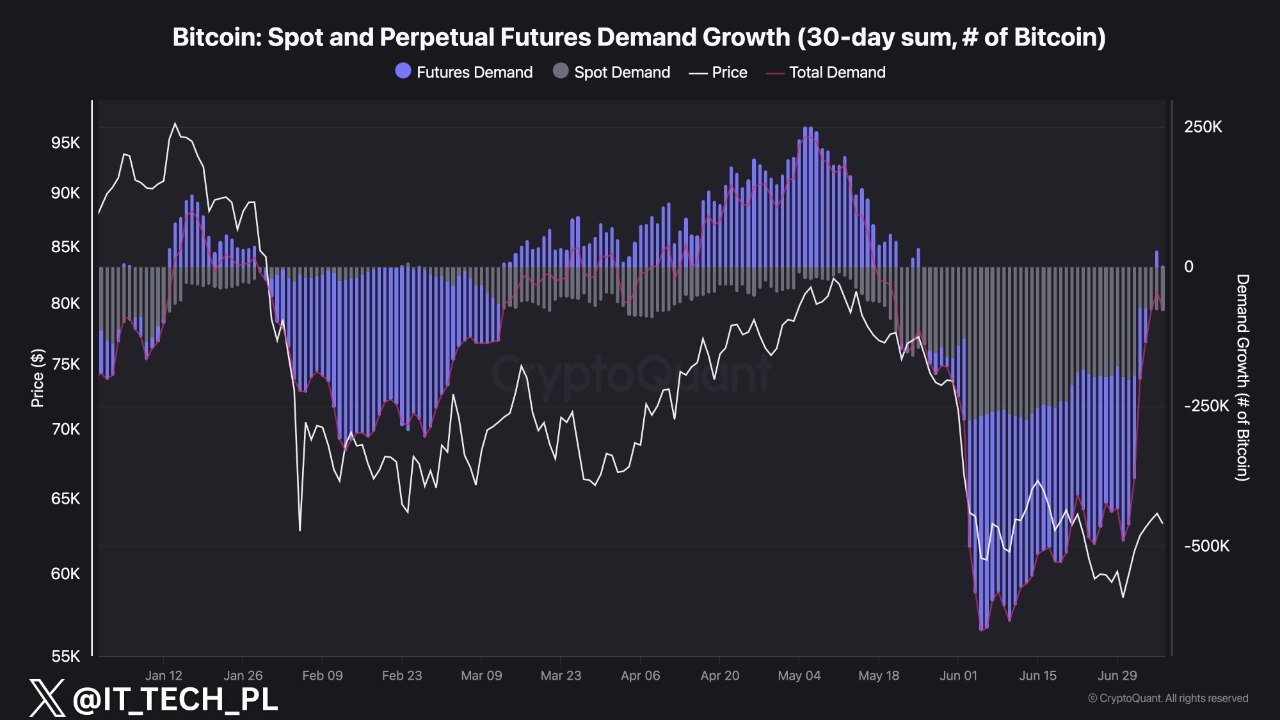
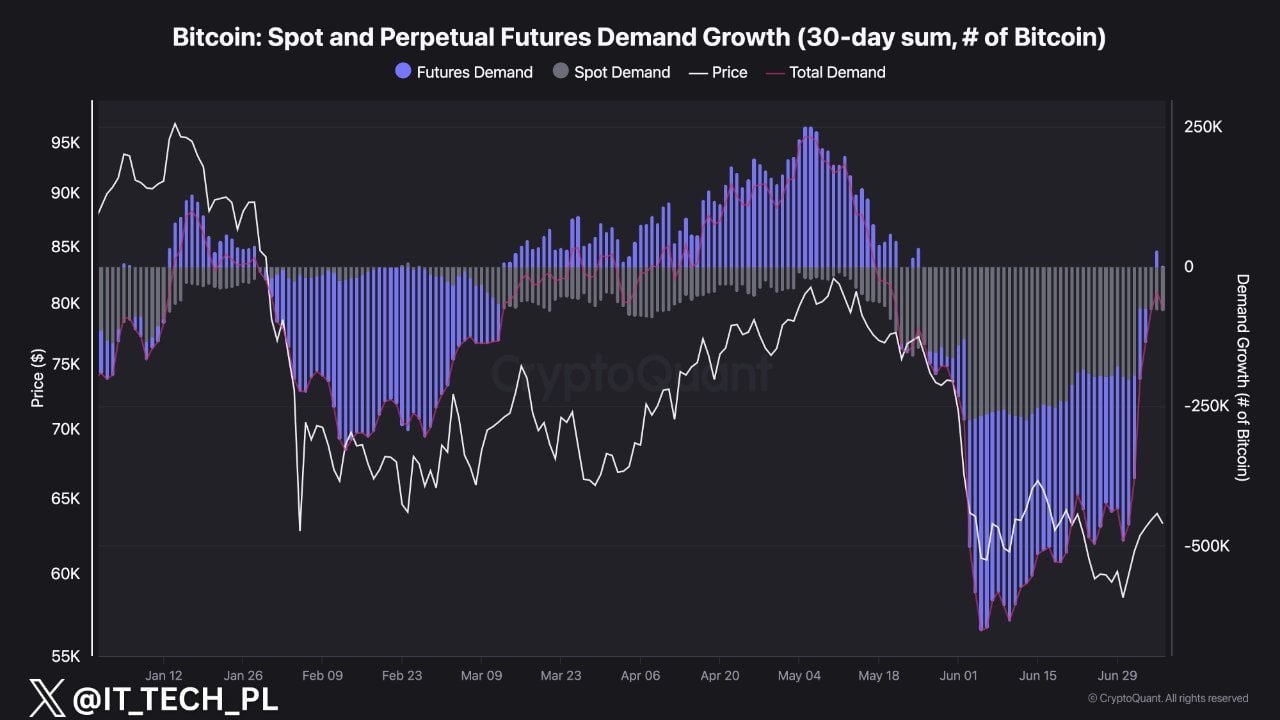
Over the past week, the 30-day cumulative demand rebounded sharply from nearly -500,000 BTC to around -75,000 BTC. This shift signaled that risk appetite is gradually returning.
Source: CryptoQuant

Notably, futures demand recovered from roughly -295,000 BTC to slightly above neutral. Despite that, spot demand remained weak near -78,000 BTC, showing long-term investors are still waiting for stronger confirmation. Moreover, that divergence suggests traders are positioning for higher prices before meaningful capital enters the spot market.

Although sentiment has clearly improved, Bitcoin’s recovery will remain vulnerable until spot accumulation strengthens, reinforcing derivatives-driven momentum with broader investor conviction.

Downside fears begin to ease

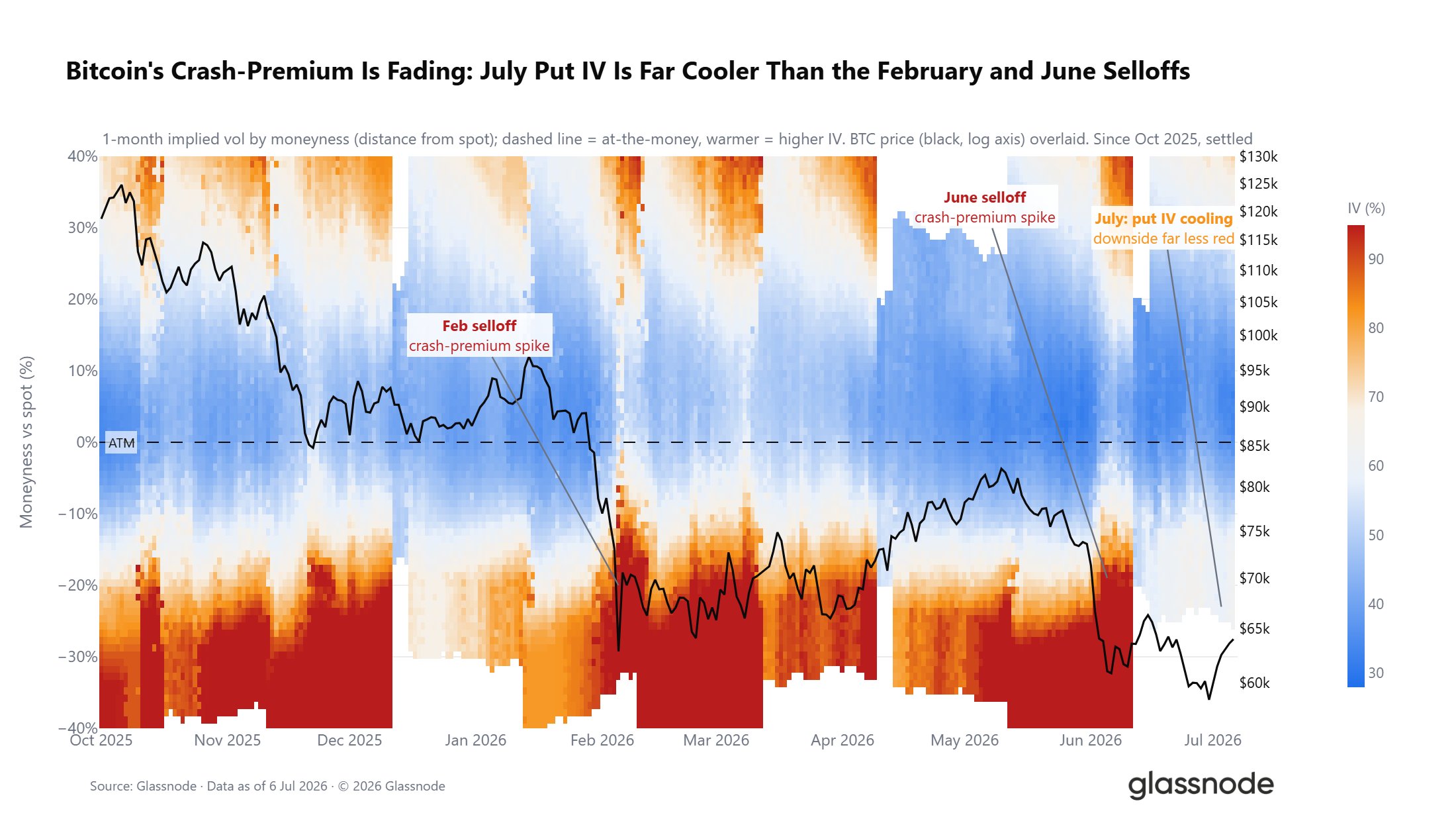
Bitcoin’s options market nuances cautious spot participation, although investors are no longer pricing downside risk as aggressively compared to the previous sell-offs.

During the February and June selloffs, put implied volatility surged as traders rushed to hedge against deeper losses. July presents a different picture. In contrast, in July, as Bitcoin traded between $60,000 and $65,000, downside premiums have cooled noticeably.

Such a divergence indicates that expectations are shifting from another capitulation toward a slower bottoming process.
Source: Glassnode

This shift reflects a market that has already experienced significant declines over several months. As a result, reducing the urgency for costly downside protection. Even so, investors should be cautious since calmer options pricing does not necessarily translate to renewed conviction.

Additionally, ETF participation remains inconsistent while spot accumulation has fallen behind derivative demand. Therefore, until fresh capital flows back into spot markets, improved sentiment could face challenges in generating widespread buying needed for a durable recovery.

Distribution remains a market headwind

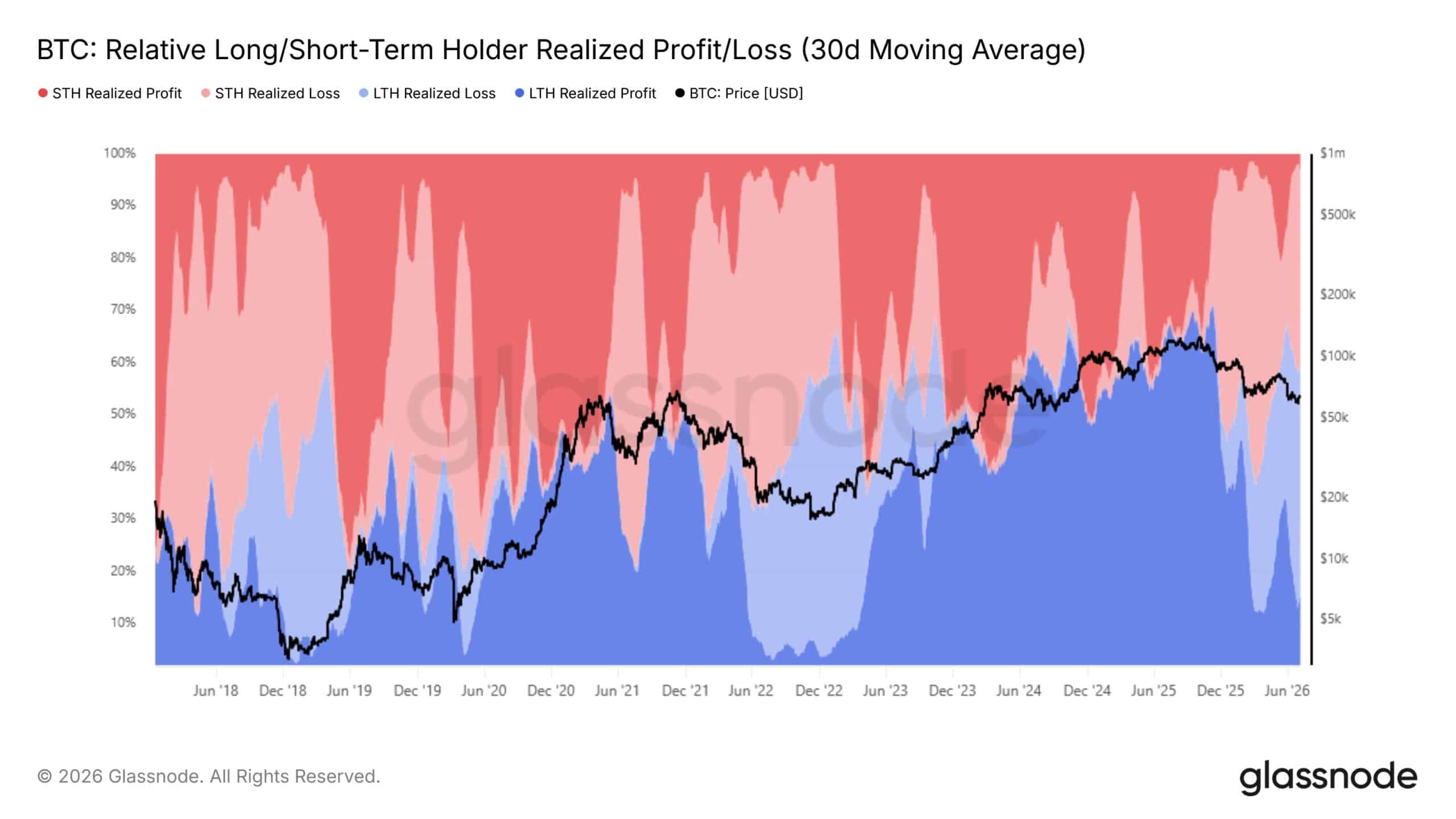
Even as downside fears continue easing, Bitcoin’s recovery is still meeting resistance from holders taking profits accumulated during the previous cycle. Long-term holder realized losses remain elevated on the 30-day Moving Average, although they have moderated from the extreme spikes recorded during the 2022 bear market.
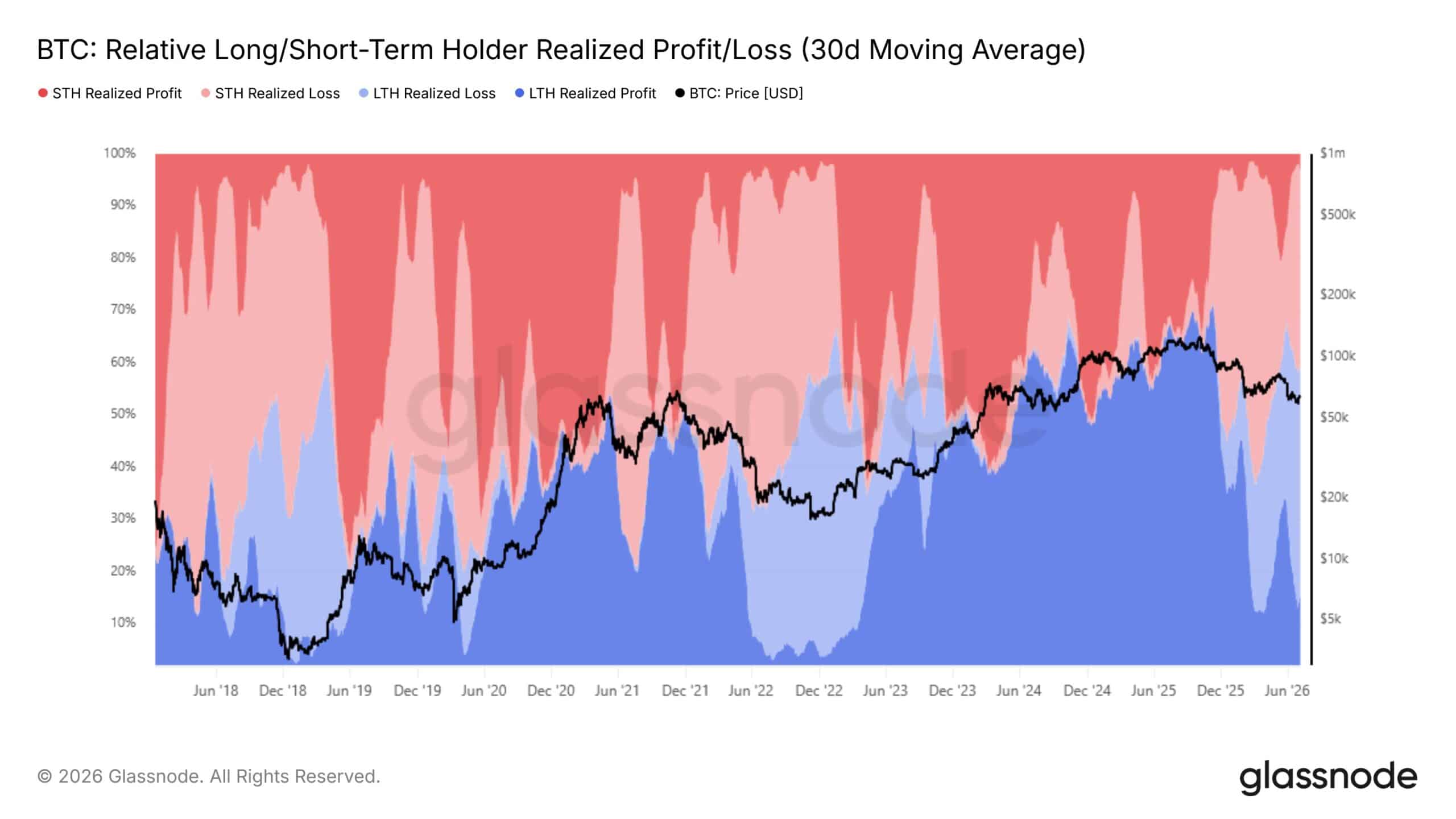
Source: Glassnode

Meanwhile, realized profit and loss data shows short-term holders continue accounting for a larger share of market activity, reflecting uncertainty among newer investors as prices stabilize.

That combination suggests supply is gradually rotating from experienced holders to fresh participants rather than disappearing altogether. Furthermore, an increase in demand for bitcoin is absorbing most of the distribution of supply.

However, until long-term holder selling slows further, Bitcoin’s recovery is likely to remain gradual instead of accelerating into a sustained bullish trend.


Final Summary

  • Bitcoin recovery remains incomplete as spot demand continues trailing derivatives activity.
  • BTC still faces long-term holder selling despite easing downside fears and improving market sentiment.


Criptomoedas em alta

Perguntas relacionadas

QAccording to the article, what is the key factor limiting the robustness of Bitcoin's price recovery?

AThe key limiting factor is the weakness in spot market demand and accumulation. While futures/derivatives demand has recovered, spot demand remains weak, indicating long-term investors are waiting for stronger confirmation. The recovery remains vulnerable until spot accumulation strengthens.

QWhat does the change in Bitcoin's options market in July indicate compared to the selloffs in February and June?

AThe change indicates that downside fears are easing. During the February and June selloffs, put implied volatility surged as traders aggressively hedged against losses. In July, with Bitcoin trading between $60k and $65k, downside premiums have cooled noticeably, suggesting expectations are shifting from another capitulation to a slower bottoming process.

QWhat source of supply is creating a headwind for Bitcoin's price recovery?

AThe headwind comes from long-term holders who are distributing (selling) coins, likely taking profits accumulated during the previous cycle. This selling pressure, along with ongoing uncertainty among newer short-term holders, prevents the recovery from accelerating into a sustained bullish trend.

QWhat specific metric showed a sharp rebound from nearly -500,000 BTC to around -75,000 BTC, signaling returning risk appetite?

AThe 30-day cumulative demand metric showed this sharp rebound. This shift signaled that risk appetite is gradually returning to the Bitcoin market.

QWhy might improved market sentiment alone be insufficient for a durable Bitcoin recovery, according to the article?

AImproved sentiment alone might be insufficient because ETF participation remains inconsistent and, crucially, spot accumulation (actual buying of Bitcoin) has fallen behind derivative demand. Without fresh capital flowing back into the spot markets, the improved sentiment may not generate the widespread buying needed for a durable recovery.

Leituras Relacionadas

Tsinghua AI Mathematician Emerges: From Intuition to Theorem, Contributing to an 84-Page Quantum Algorithm Paper

Tsinghua University’s Intelligent Industry Research Institute (AIR) has developed an AI mathematician agent named AIM, designed not just to solve math problems but to actively participate in early-stage research. In a recent study, researchers collaborated with AIM to develop "Sign Embedding Quantum Algorithms," resulting in an 84-page paper on quantum algorithms for matrix equations and functions. The research began with a human researcher's intuition: can rational approximation serve as a design principle for quantum algorithms? AIM helped expand this idea into multiple candidate research directions. Human researchers then filtered and focused on the most promising path. AIM assisted in organizing theorems, generating proof drafts, and performing complexity analysis, while humans maintained oversight, auditing assumptions and refining derivations. This case illustrates a human-AI collaborative workflow: AI rapidly explores and expands research avenues, generates draft materials, and aids in checking derivations; human researchers provide critical judgment on direction, value, and validity. The process emphasizes "high-throughput candidate generation + human value gating + AI-assisted audit and repair + human final integration." The resulting quantum algorithm framework offers a unified approach to several matrix problems, advancing quantum linear algebra under more general conditions. This work suggests AI's role in theoretical research is evolving from task-specific assistance to supporting the entire research lifecycle—enhancing exploration and efficiency while keeping human expertise central to guiding inquiry and ensuring rigor. *Paper & System Links:* - AIM application report: https://arxiv.org/abs/2606.24899 - Quantum algorithm paper: https://arxiv.org/abs/2604.25333 - AIM repository: https://github.com/TheoryFoundry/AIMv2

marsbitHá 22m

Tsinghua AI Mathematician Emerges: From Intuition to Theorem, Contributing to an 84-Page Quantum Algorithm Paper

marsbitHá 22m

Short-Lived Meme Mania: Can It Be the Icebreaker for Robinhood's RWA Narrative?

Robinhood recently launched its own Layer 2 network, Robinhood Chain, built on Arbitrum and focusing on tokenized stocks, RWA, DeFi, and AI finance. Shortly after launch, a meme coin called CASHCAT, named after an early unused Robinhood brand, surged in popularity, achieving a market cap near $150 million and high daily trading volume. It gained traction through third-party DEXs and launchpads like Uniswap and Noxa.fun, bypassing Robinhood's official listing process. This highlights a key feature of the permissionless chain: even assets not officially approved can achieve significant liquidity and trading activity. While CASHCAT currently dominates the chain's meme coin sector, its high turnover indicates speculative trading. The rapid proliferation of new meme coins risks dispersing liquidity. Meanwhile, the chain's core RWA sector remains relatively small at $12.5 million. CEO Vlad Tenev has expressed that the chain is well-suited for both RWA and meme coins. In the optimistic scenario, meme-driven activity could bootstrap the chain's user base and liquidity for its long-term RWA vision. However, if the meme frenzy fades quickly, the RWA narrative may struggle to gain traction independently. The incident demonstrates that on a permissionless platform, the market itself can create major assets, offering Robinhood a potential new growth avenue beyond its core crypto business as it navigates the long-term development of the tokenized asset market.

Foresight NewsHá 25m

Short-Lived Meme Mania: Can It Be the Icebreaker for Robinhood's RWA Narrative?

Foresight NewsHá 25m

The Fall of Zapper: An Act of God or a Human Error?

The Fall of Zapper: A Post-Mortem of a DeFi Pioneer In July 2026, Zapper, a once-dominant DeFi portfolio tracker, announced its shutdown. Born in 2020 from a merger, Zapper capitalized on the DeFi Summer boom, reaching 2 million monthly users and processing over $13B in transactions, backed by $16.5M in funding from investors like Framework Ventures and Coinbase Ventures. Its core "Zap" feature simplified complex multi-step DeFi operations. Despite its early success, Zapper failed to build a sustainable business model. Revenue from DEX aggregation was minimal due to fierce competition, while maintaining its multi-chain data infrastructure was costly. Furthermore, the DeFi landscape shifted: capital consolidated around top protocols, reducing the need for complex portfolio tracking across numerous platforms. Zapper's user base and core demand eroded. The company attempted multiple pivots, including an NFT-based points system, a social app (Chainchat), and plans for a ZAP token protocol. However, these initiatives—often focused on creating new, speculative C端需求 rather than solving existing pain points—ultimately failed. Critics argue Zapper remained trapped in a "blockchain purist" mindset, prioritizing costly, non-revenue-generating features over its competitive DEX aggregator. Unlike competitor DeBank, which successfully pivoted to its Rabby Wallet, Zapper lacked a diversified revenue stream. Its closure highlights the peril for tooling projects that fail to adapt to market shifts and monetize effectively, serving as a cautionary tale for the industry.

Foresight NewsHá 1h

The Fall of Zapper: An Act of God or a Human Error?

Foresight NewsHá 1h

Trading

Spot

Artigos em Destaque

Como comprar EDGE

Bem-vindo à HTX.com!Tornámos a compra de edgeX (EDGE) simples e conveniente.Segue o nosso guia passo a passo para iniciar a tua jornada no mundo das criptos.Passo 1: cria a tua conta HTXUtiliza o teu e-mail ou número de telefone para te inscreveres numa conta gratuita na HTX.Desfruta de um processo de inscrição sem complicações e desbloqueia todas as funcionalidades.Obter a minha contaPasso 2: vai para Comprar Cripto e escolhe o teu método de pagamentoCartão de crédito/débito: usa o teu visa ou mastercard para comprar edgeX (EDGE) instantaneamente.Saldo: usa os fundos da tua conta HTX para transacionar sem problemas.Terceiros: adicionamos métodos de pagamento populares, como Google Pay e Apple Pay, para aumentar a conveniência.P2P: transaciona diretamente com outros utilizadores na HTX.Mercado de balcão (OTC): oferecemos serviços personalizados e taxas de câmbio competitivas para os traders.Passo 3: armazena teu edgeX (EDGE)Depois de comprar o teu edgeX (EDGE), armazena-o na tua conta HTX.Alternativamente, podes enviá-lo para outro lugar através de transferência blockchain ou usá-lo para transacionar outras criptomoedas.Passo 4: transaciona edgeX (EDGE)Transaciona facilmente edgeX (EDGE) no mercado à vista da HTX.Acede simplesmente à tua conta, seleciona o teu par de trading, executa as tuas transações e monitoriza em tempo real.Oferecemos uma experiência de fácil utilização tanto para principiantes como para traders experientes.

427 Visualizações TotaisPublicado em {updateTime}Atualizado em 2026.06.02

Como comprar EDGE

Discussões

Bem-vindo à Comunidade HTX. Aqui, pode manter-se informado sobre os mais recentes desenvolvimentos da plataforma e obter acesso a análises profissionais de mercado. As opiniões dos utilizadores sobre o preço de EDGE (EDGE) são apresentadas abaixo.

活动图片