Bitcoin Price Forecast: BTC Aims for $70K Target as Weekly ETF Inflows Surpass $626M

cryptonews.ruPublicado em 2026-08-06Última atualização em 2026-08-06

Resumo

Bitcoin Price Forecast: BTC Targets $70K as Weekly ETF Inflows Surpass $626M Bitcoin is breaking out of a classic "cup and handle" pattern, trading around $64,742 on August 6th. This technical breakout is supported by the daily RSI moving above 50, indicating a shift in momentum towards buyers. Key resistance levels are the 100-day EMA at $66,988 and the 200-day EMA at $72,494, with crucial support at the $62,000 handle level. Fundamentally, spot Bitcoin ETFs have recorded net inflows of $626 million in the first three sessions of the week, already making it the best week since early May. A single day on August 5th saw $244.42 million flow in, led by BlackRock's IBIT. This marks a sharp reversal from the net outflows of the previous week. On-chain data from Glassnode shows the market is in a state of extreme compression, with realized volatility near multi-year lows and call option premiums at record lows, suggesting few traders are positioned for a major move. However, such conditions have historically preceded significant upward breakouts. Analyst Ali Martinez also highlighted that Bitcoin's Net Capital Flows are showing a bullish divergence from price, a signal that marked the cycle bottom before the previous massive rally. **Bullish Target:** A sustained breakout above the $64,000 neckline, fueled by continued strong ETF inflows, could propel BTC toward the 100-day EMA at $66,988. **Bearish Risk:** A failure to hold the $64,000-$64,500 level could invalidate the patt...

Bitcoin is breaking out of a classic cup-and-handle pattern at the $64,742 level on August 6, as spot ETFs have already posted their best week since May, and a cycle bottom signal flashes on net capital flows.

$BTC Breaks Cup and Handle with RSI Above 50
Price action of $BTC (Source: TradingView)

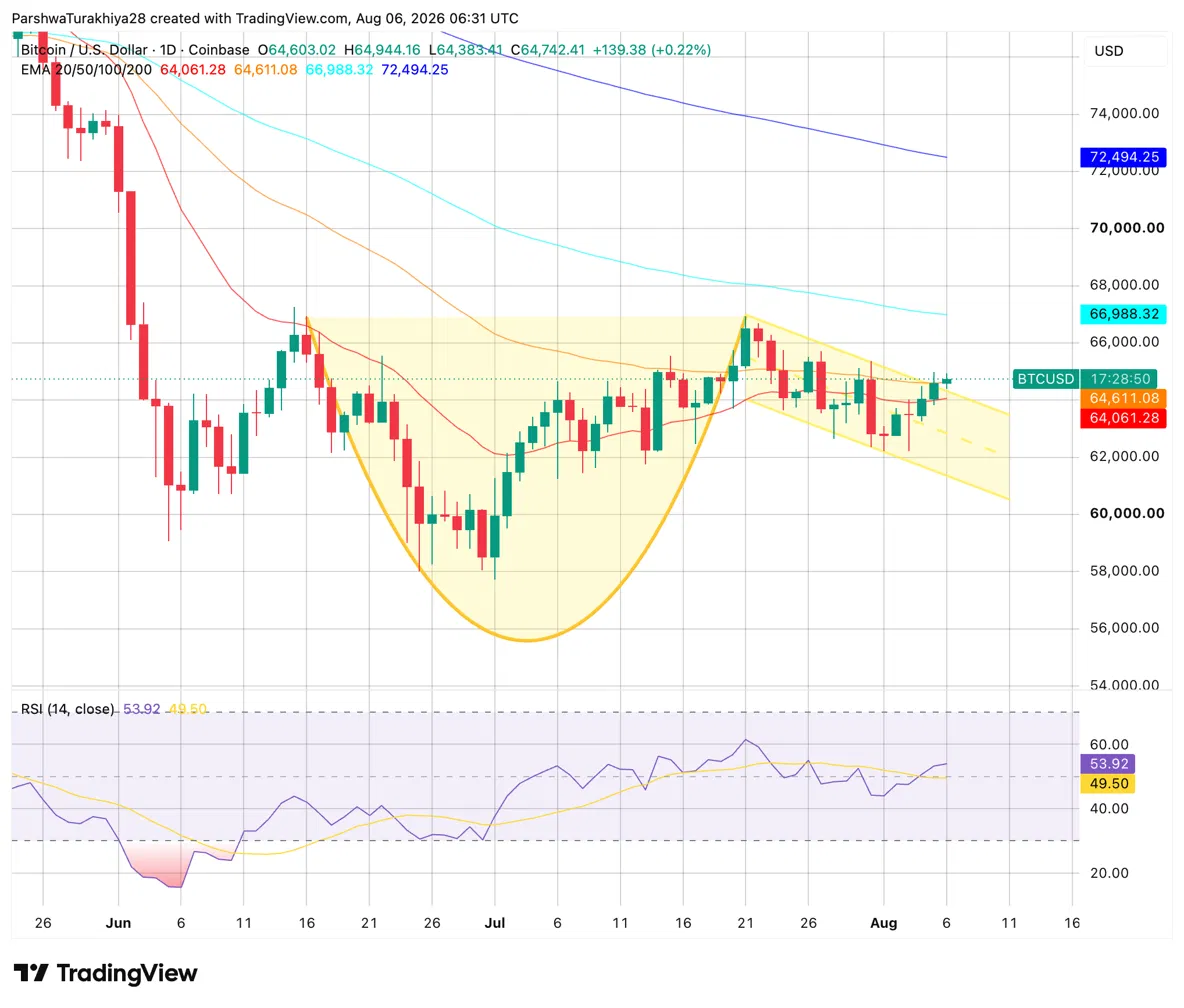
The daily chart shows $BTC completing a 'cup and handle' pattern formed between the June lows around $57,700 and the August recovery. The cup base formed in June and early July, the price recovered to retest the neckline around $65,000, was then pushed back forming the handle between $62,000 and $64,500, and is now breaking above the neckline. Today's session opened at $64,603, rose to $64,944, and is holding at $64,742.

The RSI at 53.92 is above the neutral 50 line for the first time since July's highs, confirming momentum has shifted in favor of buyers. The 20-day EMA at $64,061 and the 50-day at $64,611 are both clustered just below the current price and have been reclaimed.

Related: Zcash Price Forecast for August 2026: ZEC Presses for Triangle Breakout as DCG Buys Mining Site in Nebraska

The 100-day EMA at $66,988 is the next target above, while the 200-day at $72,494 represents the long-term ceiling. Horizontal support at $62,000 is the level that must hold on any pullback to preserve the cup-and-handle structure.

$BTC Support and Resistance Levels for August 6, 2026

Type Price Level
Resistance $66,988 100-day EMA, next major target
Resistance $72,494 200-day EMA, long-term ceiling
Support $64,611 50-day EMA
Support $64,061 20-day EMA
Support $62,000 Cup and Handle Neckline, must hold
Support $57,000 Cup Base, last major floor

Spot ETF Flows Exceed $626M, Two Days Still Remain This Week

Spot Bitcoin ETFs recorded net inflows of $626M over the first three sessions of the week ending August 5, with Wednesday and Thursday yet to close, according to SoSoValue. This already makes it the highest weekly sum since early May, when the week of May 8 brought $622.75M. If the pace holds in the remaining sessions, it will be the best ETF week in roughly three months.

August 5 alone brought $244.42M — the largest day of the week so far. BlackRock's IBIT led with $196.83M, followed by ARK and 21Shares' ARKB with $37.63M, Fidelity's FBTC with $11.28M, and Bitwise's BITB with $10.56M. VanEck's HODL was the only product to record an outflow of $14.67M. Cumulative net inflows across all products now stand at $51.95B with total net assets of $79.21B.

The reversal from the prior week is sharp. The week beginning July 31 recorded a net outflow of $61.53M, driven by one poor day on July 31 itself. The three days since have literally erased that in a single session.

Glassnode: Bitcoin, Unresponsive to Everything

In its latest report, Glassnode describes Bitcoin as a market where bottom signals are building, but the final piece is still missing. On-chain data shows price compression reaching levels that have historically preceded major rallies. The problem is, past recoveries had institutional buyers actively absorbing supply in the background. That is not the case yet: spot ETFs took in just 65,800 $BTC in June — the worst month on record.

The options market reinforces the picture. Traders are paying the lowest amount ever for upside — around 23% implied volatility, while demand for downside protection is also low. Simply put, no one is pricing in a big move in either direction. In Glassnode's view, such quietness typically ends loudly, and when the move happens, most people will not be ready for it and will be chasing price higher rather than already positioned.

Metric Reading What It Means
One-Month Realized Volatility Near multi-year lows Compressions this deep have nearly always resolved upwards
Upside Implied Volatility ~23%, lowest ever No one is paying for upside; The crowd will chase late
June ETF Net Flows Took in just 65,800 $BTC Worst month on record; Demand engine not fully recovered
Seller Exhaustion Constant Inside lower zone Still a third higher than every prior bear cycle level
Coldcard-Related $BTC Movement ~119,000 $BTC moved Price barely reacted; No live bids or offers under the surface

Bitcoin Net Capital Flows Signal Cycle Bottom

BITCOIN MARKET BOTTOM

The last bullish divergence between the $BTC price and Net Capital Flows marked the cycle bottom.

What followed was a bull run from $15,000 to $126,000.

The same signal is back. https://t.co/SxJ0w635qE pic.twitter.com/suckGSld8s

— Ali Charts (@alicharts) August 5, 2026

Analyst Ali Martinez noted on X that Bitcoin's net capital flow is showing the same bullish divergence from price that marked the cycle bottom ahead of the rally from $15,000 to $126,000.

The signal occurs when capital flows turn positive while price remains depressed, and has historically preceded significant recoveries. Ali Charts explicitly noted: the same pattern is back.

Bitcoin Price Forecast: Upside and Downside Targets

Bull Case, Target: $66,988 (100-day EMA)

The cup-and-handle breakout holds above the $64,000 neckline on a daily close, with the RSI holding above 50 confirming the momentum shift. Weekly ETF inflows continuing through Wednesday and Thursday lift the week's total above $700M, indicating a real return of institutional demand. Short liquidations continue to fuel the move, and price advances towards the 100-day EMA at $66,988, fitting Glassnode's historical observation that volatility compressions this deep nearly always resolve to the upside.

Bear Case, Risk Level: $62,000 (Handle Support)

The $64,000–$64,500 neckline fails to hold on a daily close, invalidating the cup and handle. ETF inflows slow in the week's remaining sessions, and Glassnode's warning about the missing demand engine proves prescient as institutional flows fail to materialize. Price pulls back towards handle support at $62,000, where buyers must step in to prevent a deeper retest of the cup base around $57,000.

end-content

Criptomoedas em alta

Perguntas relacionadas

QWhat is the key technical chart pattern mentioned in the article that Bitcoin ($BTC) is breaking out of?

AThe key technical chart pattern mentioned is the 'cup and handle' pattern, which is completing between the June low and the August recovery.

QAccording to the article, what milestone did Spot Bitcoin ETFs achieve in the first three sessions of the week ending August 5, 2026?

ASpot Bitcoin ETFs recorded net inflows of $626 million in the first three sessions of that week, which was already the highest weekly amount since early May.

QWhat does the analyst Ali Martinez identify in the Net Capital Flow for Bitcoin, and what is its historical significance?

AAli Martinez identifies a bullish divergence between the Bitcoin price and Net Capital Flows. Historically, this same signal marked the cycle bottom before a bull run from $15,000 to $126,000.

QBased on the bullish case outlined in the article, what is the initial price target for Bitcoin ($BTC) and what indicator does it correspond to?

AThe initial bullish price target is $66,988, which corresponds to the 100-day Exponential Moving Average (EMA).

QWhat critical support level must hold to maintain the bullish structure according to the bearish case described?

AAccording to the bearish case, the critical support level that must hold to maintain the bullish structure is $62,000, which is the support level of the 'handle' in the cup and handle pattern.

Leituras Relacionadas

Home Furnishing Listed Companies Are Trying to Turn Around with AI and Semiconductors

Chinese home furnishing listed companies are increasingly turning to AI and semiconductor cross-border ventures to revive their fortunes amid declining core businesses. A prominent example is PVC flooring giant **Elegant Home Furnishing**, whose stock price skyrocketed with 10 consecutive trading limits after announcing a plan to acquire a majority stake in **Ou Kang Nuo**, a semiconductor storage testing equipment and services company. Despite Elegant Home's own financial struggles—including recent losses and tight cash flow—the acquisition, funded through asset sales and loans, has dramatically boosted its market value. The deal involves a cross-shareholding structure with Ou Kang Nuo's controlling shareholder. This trend is widespread. Over the past year, numerous home furnishing firms with stagnant main operations have seen their stock prices surge after announcing moves into hot sectors like AI, semiconductors, or computing power. Key cases include: * **Markor Home Furnishings** ("high-end home furnishing first share"), after years of heavy losses, acquired an AI server high-speed copper cable company and later introduced AI computing power investors. * **Zhenai Meijia** ("blanket king") became the first A-listed manufacturer controlled by an AI large model company following a takeover. * **Fasilon** (integrated ceiling) saw its stock soar after establishing an AI subsidiary. * **Jinlong Decoration** experienced multiple trading limits after being linked to "commercial aerospace" and "AI computing," despite clarifying these segments contribute less than 1% of its business. Statistics show over 20 A-share companies announced semiconductor crossovers in 2025, with home furnishing and building materials firms being the most active. This shift is largely driven by pressures from the real estate downturn, shrinking overseas demand, and trade tariffs, pushing companies to seek growth through trendy concepts rather than core business improvement. However, the article warns that such speculative frenzies often end when the hype fades, leaving stock prices to eventually reflect the companies' weak fundamentals, as seen in Jinlong Decoration's subsequent sharp price correction. The repeated attempts to "ride the trend" highlight a desperate struggle for survival in a challenging traditional industry.

marsbitHá 17m

Home Furnishing Listed Companies Are Trying to Turn Around with AI and Semiconductors

marsbitHá 17m

"Sell America" Trade Resurfaces: Global Funds Reprice Washington Policy Risks, Dollar and Treasuries Bear the Brunt

"Sale of America" Trade Resurges as Global Funds Reprice Washington Policy Risks, Hitting Dollar and Treasuries First Recent policy signals from Washington are prompting global bond and foreign exchange investors to reignite the "Sale of America" debate. Uncertainty stems from Fed Chair Wash's shift towards less policy communication, Treasury Secretary Bessant's approval of joint intervention with Japan to support the Yen (the first such coordinated move in nearly 30 years), expanding fiscal deficits, and trade war fears. These factors are undermining confidence in U.S. assets. The 30-year Treasury yield recently broke above 5%, hitting a high not seen since 2007, while the Bloomberg Dollar Spot Index has fallen about 2% from its June peak. This dollar weakness is unusual given still-high U.S. interest rates. Investors cite policy uncertainty as a key driver, with one manager calling the Fed Chair and Treasury Secretary a "double whammy" creating a "Trump administration premium." While the S&P 500 continues hitting record highs and foreign holdings of U.S. Treasuries remain high, parts of the bond and FX markets are adjusting. A core concern is whether the Fed under Wash can effectively anchor inflation expectations; analysts warn that if the Fed lags the hiking cycle, long-end yields could face further upward pressure. The 30-year term premium has risen sharply. The U.S.-backed Yen intervention has also sparked debate on the dollar's structural outlook. While framed by Bessant as a "reallocation of reserves," market participants caution that if Japan—America's largest foreign creditor—must sell Treasuries to fund interventions, ripple effects could hit the bond market. Strategists predict moderate dollar depreciation ahead. Most experts are not predicting an end to dollar hegemony or the safe-haven status of Treasuries. However, a key underlying risk is highlighted: the pace of foreign buying of U.S. debt may not keep up with the speed of American borrowing, gradually eroding the structural advantages that have long supported "American exceptionalism."

marsbitHá 18m

"Sell America" Trade Resurfaces: Global Funds Reprice Washington Policy Risks, Dollar and Treasuries Bear the Brunt

marsbitHá 18m

Trading

Spot

Artigos em Destaque

O que é BITCOIN

Compreender o HarryPotterObamaSonic10Inu (ERC-20) e a Sua Posição no Espaço Cripto Nos últimos anos, o mercado de criptomoedas assistiu a um aumento na popularidade das moedas meme, cativando não apenas os traders, mas também aqueles que procuram envolvimento comunitário e valor de entretenimento. Entre estes tokens únicos está o HarryPotterObamaSonic10Inu (ERC-20), um projeto intrigante que mistura referências culturais no tecido das criptomoedas. Este artigo explora os principais aspetos do HarryPotterObamaSonic10Inu, examinando os seus mecanismos, a sua ética orientada pela comunidade e o seu envolvimento com o vasto panorama cripto. O que é o HarryPotterObamaSonic10Inu (ERC-20)? Como o nome sugere, o HarryPotterObamaSonic10Inu é uma moeda meme construída na blockchain Ethereum, classificada sob o padrão ERC-20. Ao contrário das criptomoedas tradicionais, que podem enfatizar a utilidade prática ou o potencial de investimento, este token prospera no valor de entretenimento e na força da sua comunidade. O projeto visa promover um ambiente onde utilizadores envolvidos possam reunir-se, partilhar ideias e participar em atividades inspiradas por diversos fenómenos culturais. Uma característica notável do HarryPotterObamaSonic10Inu é a zero taxa sobre transações. Este elemento atraente visa encorajar a negociação e o envolvimento da comunidade, isento de encargos adicionais que podem desencorajar os traders de pequena escala. A oferta total da moeda está fixada em mil milhões de tokens, uma cifra que marca a sua intenção de manter uma circulação substancial dentro da comunidade. Criador do HarryPotterObamaSonic10Inu (ERC-20) As origens do HarryPotterObamaSonic10Inu estão um pouco envoltas em mistério; os detalhes sobre o criador permanecem desconhecidos. O desenvolvimento deste token carece de uma equipa identificável ou de um plano explícito, o que não é raro no setor das moedas meme. Em vez disso, o projeto surgiu de forma orgânica, com o seu progresso a depender fortemente do entusiasmo e da participação da sua comunidade. Investidores do HarryPotterObamaSonic10Inu (ERC-20) No que diz respeito a investimentos externos e apoios, o HarryPotterObamaSonic10Inu também permanece ambíguo. O token não lista quaisquer fundações de investimento conhecidas ou apoio organizacional significativo. Em vez disso, o “sangue vital” do projeto é a sua comunidade de base, que informa o seu crescimento e sustentabilidade através da ação coletiva e do envolvimento no espaço cripto. Como Funciona o HarryPotterObamaSonic10Inu (ERC-20)? Como uma moeda meme, o HarryPotterObamaSonic10Inu opera principalmente fora dos quadros tradicionais que muitas vezes governam o valor dos ativos. Existem vários aspetos distintivos que definem como o projeto funciona: Transações Sem Taxas: Sem taxas sobre transações, os utilizadores podem comprar e vender o token livremente, sem a preocupação de custos ocultos. Envolvimento da Comunidade: O projeto prospera na interação da comunidade, aproveitando plataformas de redes sociais para criar entusiasmo e facilitar a participação. Discussões, partilha de conteúdo e envolvimento são elementos cruciais que ajudam a expandir o seu alcance e a fomentar a lealdade entre os apoiantes. Sem Utilidade Prática: Deve ser notado que o HarryPotterObamaSonic10Inu não oferece utilidade concreta dentro do ecossistema financeiro. Em vez disso, é classificado como um token principalmente para entretenimento e atividades comunitárias. Referência Cultural: O token incorpora de forma inteligente elementos da cultura popular para atrair interesse, conectando-se tanto com entusiastas de memes como com seguidores de criptomoedas. HarryPotterObamaSonic10Inu exemplifica como as moedas meme operam de forma diferente de projetos de criptomoedas mais tradicionais, entrando no mercado como construções sociais inovadoras em vez de ativos utilitários. Linha do Tempo do HarryPotterObamaSonic10Inu (ERC-20) A história do HarryPotterObamaSonic10Inu é marcada por vários marcos notáveis: Criação: O token surgiu de um meme viral, capturando a imaginação de muitos entusiastas de criptomoedas. Datas específicas de criação não estão disponíveis, sublinhando a sua ascensão orgânica. Listagem em Exchanges: O HarryPotterObamaSonic10Inu conseguiu entrar em várias exchanges, permitindo um acesso e negociação mais fáceis pela comunidade. Iniciativas de Envolvimento da Comunidade: Atividades contínuas direcionadas a melhorar a interação comunitária, incluindo concursos, campanhas em redes sociais e geração de conteúdo por fãs e defensores. Planos de Expansão Futura: O roteiro do projeto inclui o lançamento de uma coleção de NFTs, mercadorias e um site de eCommerce relacionado aos seus temas culturais, envolvendo ainda mais a comunidade e tentando adicionar mais dimensões ao seu ecossistema. Pontos-Chave sobre o HarryPotterObamaSonic10Inu (ERC-20) Natureza Orientada pela Comunidade: O projeto prioriza a contribuição coletiva e a criatividade, assegurando que o envolvimento dos utilizadores está na vanguarda do seu desenvolvimento. Classificação como Moeda Meme: Representa o epítome da criptomoeda baseada em entretenimento, destacando-se dos veículos de investimento tradicionais. Sem Afiliação Direta com o Bitcoin: Apesar da semelhança no nome do ticker, o HarryPotterObamaSonic10Inu é distinto e não tem qualquer relação com o Bitcoin ou outras criptomoedas estabelecidas. Foco na Colaboração: O HarryPotterObamaSonic10Inu é projetado para criar um espaço de colaboração e partilha de histórias entre os seus detentores, proporcionando uma via para a criatividade e o fortalecimento da comunidade. Perspectivas Futuras: A ambição de expandir além da sua premissa inicial para NFTs e mercadorias delineia um caminho para o projeto potencialmente entrar em avenidas mais mainstream dentro da cultura digital. À medida que as moedas meme continuam a capturar a imaginação da comunidade cripto, HarryPotterObamaSonic10Inu (ERC-20) destaca-se devido aos seus laços culturais e abordagem centrada na comunidade. Embora possa não se encaixar no molde típico de um token orientado para utilidade, a sua essência reside na alegria e camaradagem fomentadas entre os seus apoiantes, destacando a natureza em evolução das criptomoedas em uma era cada vez mais digital. À medida que o projeto continua a desenvolver-se, será importante observar como as dinâmicas comunitárias influenciam a sua trajetória no panorama em constante mudança da tecnologia blockchain.

2.1k Visualizações TotaisPublicado em {updateTime}Atualizado em 2024.12.03

O que é BITCOIN

Como comprar BTC

Bem-vindo à HTX.com!Tornámos a compra de Bitcoin (BTC) simples e conveniente.Segue o nosso guia passo a passo para iniciar a tua jornada no mundo das criptos.Passo 1: cria a tua conta HTXUtiliza o teu e-mail ou número de telefone para te inscreveres numa conta gratuita na HTX.Desfruta de um processo de inscrição sem complicações e desbloqueia todas as funcionalidades.Obter a minha contaPasso 2: vai para Comprar Cripto e escolhe o teu método de pagamentoCartão de crédito/débito: usa o teu visa ou mastercard para comprar Bitcoin (BTC) instantaneamente.Saldo: usa os fundos da tua conta HTX para transacionar sem problemas.Terceiros: adicionamos métodos de pagamento populares, como Google Pay e Apple Pay, para aumentar a conveniência.P2P: transaciona diretamente com outros utilizadores na HTX.Mercado de balcão (OTC): oferecemos serviços personalizados e taxas de câmbio competitivas para os traders.Passo 3: armazena teu Bitcoin (BTC)Depois de comprar o teu Bitcoin (BTC), armazena-o na tua conta HTX.Alternativamente, podes enviá-lo para outro lugar através de transferência blockchain ou usá-lo para transacionar outras criptomoedas.Passo 4: transaciona Bitcoin (BTC)Transaciona facilmente Bitcoin (BTC) no mercado à vista da HTX.Acede simplesmente à tua conta, seleciona o teu par de trading, executa as tuas transações e monitoriza em tempo real.Oferecemos uma experiência de fácil utilização tanto para principiantes como para traders experientes.

4.7k Visualizações TotaisPublicado em {updateTime}Atualizado em 2026.06.02

Como comprar BTC

O que é $BITCOIN

OURO DIGITAL ($BITCOIN): Uma Análise Abrangente Introdução ao OURO DIGITAL ($BITCOIN) OURO DIGITAL ($BITCOIN) é um projeto baseado em blockchain que opera na rede Solana, com o objetivo de combinar as características dos metais preciosos tradicionais com a inovação das tecnologias descentralizadas. Embora partilhe um nome com o Bitcoin, frequentemente referido como “ouro digital” devido à sua percepção como uma reserva de valor, o OURO DIGITAL é um token separado projetado para criar um ecossistema único dentro da paisagem Web3. O seu objetivo é posicionar-se como um ativo digital alternativo viável, embora os detalhes sobre as suas aplicações e funcionalidades ainda estejam em desenvolvimento. O que é o OURO DIGITAL ($BITCOIN)? OURO DIGITAL ($BITCOIN) é um token de criptomoeda explicitamente projetado para uso na blockchain Solana. Em contraste com o Bitcoin, que fornece um papel amplamente reconhecido como armazenamento de valor, este token parece focar em aplicações e características mais amplas. Aspectos notáveis incluem: Infraestrutura Blockchain: O token é construído na blockchain Solana, conhecida pela sua capacidade de lidar com transações de alta velocidade e baixo custo. Dinâmicas de Oferta: O OURO DIGITAL tem um fornecimento máximo limitado a 100 quatrilhões de tokens (100P $BITCOIN), embora os detalhes sobre o seu fornecimento circulante ainda não tenham sido divulgados. Utilidade: Embora as funcionalidades precisas não estejam explicitamente delineadas, existem indicações de que o token poderia ser utilizado para várias aplicações, potencialmente envolvendo aplicações descentralizadas (dApps) ou estratégias de tokenização de ativos. Quem é o Criador do OURO DIGITAL ($BITCOIN)? Neste momento, a identidade dos criadores e da equipa de desenvolvimento por trás do OURO DIGITAL ($BITCOIN) permanece desconhecida. Esta situação é típica entre muitos projetos inovadores no espaço da blockchain, particularmente aqueles alinhados com finanças descentralizadas e fenómenos de moedas meme. Embora tal anonimato possa fomentar uma cultura orientada pela comunidade, intensifica as preocupações sobre governança e responsabilidade. Quem são os Investidores do OURO DIGITAL ($BITCOIN)? As informações disponíveis indicam que o OURO DIGITAL ($BITCOIN) não tem apoiantes institucionais conhecidos ou investimentos proeminentes de capital de risco. O projeto parece operar num modelo peer-to-peer focado no apoio e adoção da comunidade, em vez de rotas de financiamento tradicionais. A sua atividade e liquidez estão principalmente situadas em exchanges descentralizadas (DEXs), como a PumpSwap, em vez de plataformas de negociação centralizadas estabelecidas, destacando ainda mais a sua abordagem de base. Como Funciona o OURO DIGITAL ($BITCOIN) A mecânica operacional do OURO DIGITAL ($BITCOIN) pode ser elaborada com base no seu design de blockchain e nas características da rede: Mecanismo de Consenso: Ao aproveitar o exclusivo proof-of-history (PoH) da Solana combinado com um modelo de proof-of-stake (PoS), o projeto assegura uma validação eficiente das transações, contribuindo para o alto desempenho da rede. Tokenomics: Embora mecanismos deflacionários específicos não tenham sido extensivamente detalhados, o vasto fornecimento máximo de tokens implica que pode atender a microtransações ou casos de uso de nicho que ainda estão por definir. Interoperabilidade: Existe o potencial para integração com o ecossistema mais amplo da Solana, incluindo várias plataformas de finanças descentralizadas (DeFi). No entanto, os detalhes sobre integrações específicas permanecem não especificados. Cronologia de Eventos Chave Aqui está uma cronologia que destaca marcos significativos relacionados ao OURO DIGITAL ($BITCOIN): 2023: O lançamento inicial do token ocorre na blockchain Solana, marcado pelo seu endereço de contrato. 2024: O OURO DIGITAL ganha visibilidade ao tornar-se disponível para negociação em exchanges descentralizadas como a PumpSwap, permitindo que os utilizadores o negociem contra SOL. 2025: O projeto testemunha atividade de negociação esporádica e potencial interesse em envolvimentos liderados pela comunidade, embora não tenham sido documentadas parcerias ou avanços técnicos notáveis até ao momento. Análise Crítica Forças Escalabilidade: A infraestrutura subjacente da Solana suporta altos volumes de transações, o que pode aumentar a utilidade do $BITCOIN em vários cenários de transação. Acessibilidade: O potencial preço de negociação baixo por token pode atrair investidores de retalho, facilitando uma participação mais ampla devido a oportunidades de propriedade fracionada. Riscos Falta de Transparência: A ausência de apoiantes, desenvolvedores ou um processo de auditoria publicamente conhecidos pode gerar ceticismo em relação à sustentabilidade e confiabilidade do projeto. Volatilidade do Mercado: A atividade de negociação depende fortemente do comportamento especulativo, o que pode resultar em volatilidade significativa dos preços e incerteza para os investidores. Conclusão O OURO DIGITAL ($BITCOIN) surge como um projeto intrigante, mas ambíguo, dentro do ecossistema em rápida evolução da Solana. Embora tente aproveitar a narrativa do “ouro digital”, a sua divergência do papel estabelecido do Bitcoin como reserva de valor sublinha a necessidade de uma diferenciação mais clara da sua utilidade pretendida e estrutura de governança. A aceitação e adoção futuras dependerão provavelmente da abordagem da atual opacidade e da definição mais explícita das suas estratégias operacionais e económicas. Nota: Este relatório abrange informações sintetizadas disponíveis até outubro de 2023, e desenvolvimentos podem ter ocorrido além do período de pesquisa.

360 Visualizações TotaisPublicado em {updateTime}Atualizado em 2025.05.13

O que é $BITCOIN

Discussões

Bem-vindo à Comunidade HTX. Aqui, pode manter-se informado sobre os mais recentes desenvolvimentos da plataforma e obter acesso a análises profissionais de mercado. As opiniões dos utilizadores sobre o preço de BTC (BTC) são apresentadas abaixo.

活动图片