Bitcoin Price Bottom Not In Yet, Crypto Founder Calls ‘One Final Dump’

bitcoinistPublicado em 2026-04-12Última atualização em 2026-04-12

Resumo

Bitcoin's recent price surge above $73,000 has sparked debate on whether the market has bottomed. However, crypto founder Joao Wedson suggests a "final dump" may still occur. His analysis, based on on-chain data, indicates that the Investor Price has fallen below the Long-Term Holder Realized Price—a signal that historically precedes a cycle bottom. This pattern suggests weaker investors are exiting while stronger hands accumulate, but the process is slow, leading to sideways or downward pressure. Market rallies are likely to fade due to selling pressure from investors seeking to break even. Wedson concludes the current structure resembles a mid-cycle reset rather than a final bottom, favoring gradual accumulation over rapid price expansion.

The Bitcoin price and the general cryptocurrency market received a major boost over the past week, as the geopolitical tensions in the Middle East seemingly reached a temporary halt. The premier cryptocurrency has maintained relatively strong momentum since breaking the psychological $70,000 resistance on Tuesday, April 7.

Now, this sudden resurgence has sparked conversations among the crypto crowd on whether the Bitcoin price has formed a structural bottom yet. According to a prominent crypto founder, the world’s largest cryptocurrency might still experience “one final dump” before the end of this bear phase.

On-Chain Signal Points To One More BTC Drop

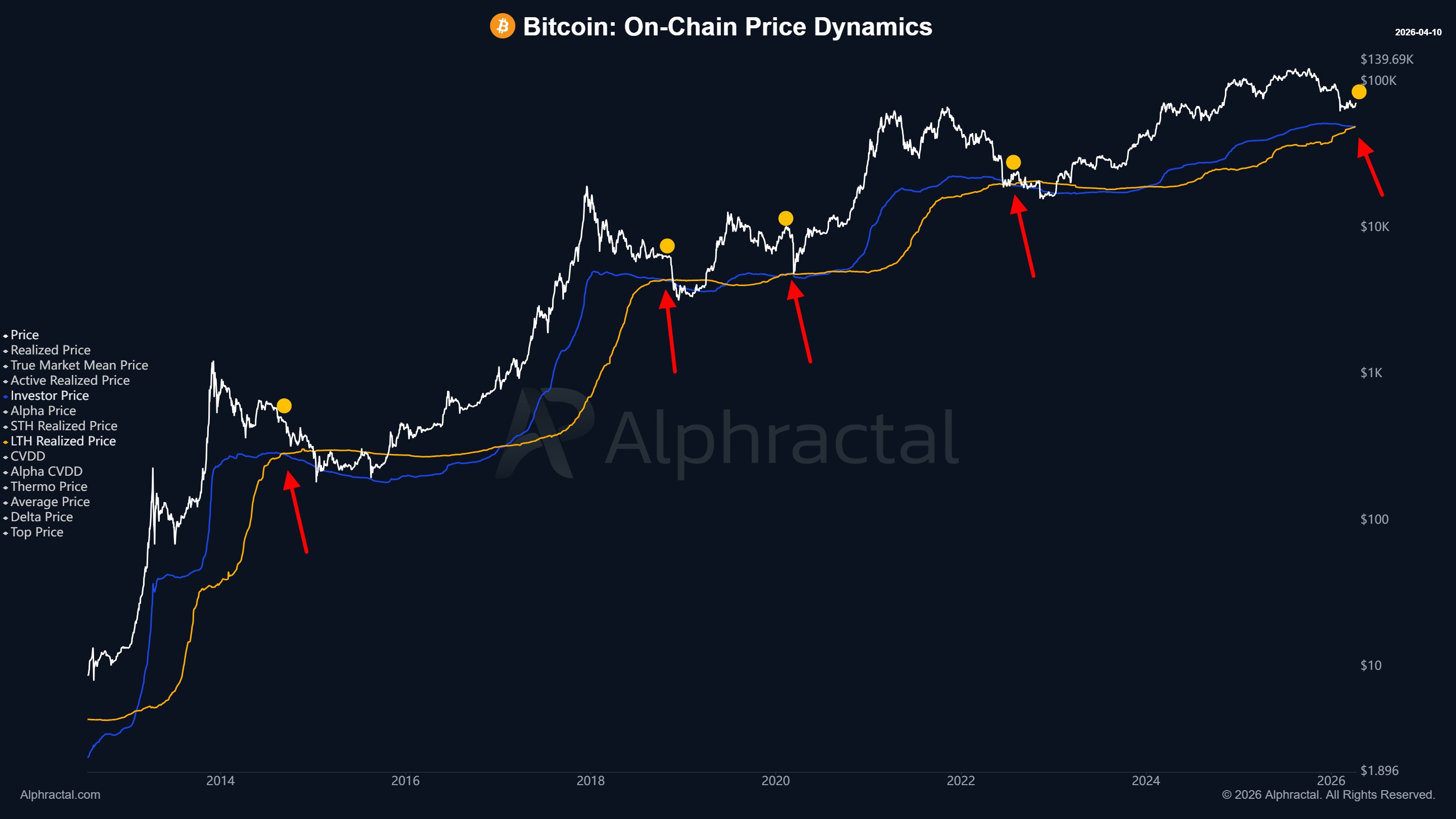
In an April 10 post on the X platform, the Alphractal founder and CEO, Joao Wedson, highlighted an emerging signal that suggests that the Bitcoin price still likely has one more trip to the downside. This projection is based on an on-chain insight that suggests that BTC’s price tends to move toward a cycle bottom when the Investor Price falls below the Long-Term Holder (LTH) Realized Price.

Wedson explained the relevance of this on-chain insight and why it emerges before a major price and an ensuing coin accumulation. According to the on-chain data expert, the Investor Price is a metric that measures the average cost of economically active coins, and, when it falls below the LTH Realized Price, suggests fresher capital has flowed in at lower prices than long-term investors paid.

Wedson wrote on X:

This usually happens after distribution phases, when demand weakens, and marginal buyers step back. Long-term holders historically sell less when the price approaches or dips below their cost basis.
Source: @joao_wedson on X

As shown in the chart above, the LTH Realized Price appears to be breaking above the Investor Price, indicating a transition phase in which weaker hands exit while stronger hands gradually absorb supply. However, it is worth noting that this absorption is slower than expected, which explains why the Bitcoin price often falls into an intermediate accumulation range.

Moreover, with Investor Price below LTH Realized Price, market surges tend to quickly wane as they meet supply (selling pressure) from investors looking to exit at their breakeven prices. This phenomenon caps the current upside potential of the premier cryptocurrency, reinforcing possible sideways to downward price movements until a new demand impulse appears.

Finally, Wedson noted that the current Bitcoin price structure historically aligns with mid-cycle resets rather than final bottoms, mirroring a market “digesting” prior excesses, rebalancing cost bases, and moving coins to the more patient investors. “The environment favors time-based accumulation over momentum-driven expansion,” the Alphractal founder wrote.

Bitcoin Price At A Glance

As of this writing, the price of BTC sits just above the $73,100 mark, reflecting a nearly 2% jump in the past day.

The price of BTC on the daily timeframe | Source: BTCUSDT chart on TradingView


Criptomoedas em alta

Perguntas relacionadas

QAccording to Joao Wedson, what on-chain signal suggests that the Bitcoin price might experience one more trip to the downside?

AThe signal is when the Investor Price falls below the Long-Term Holder (LTH) Realized Price, indicating that fresher capital has entered at lower prices and suggesting a potential move towards a cycle bottom.

QWhat does the Investor Price metric measure, and what does it imply when it is below the LTH Realized Price?

AThe Investor Price measures the average cost of economically active coins. When it falls below the LTH Realized Price, it implies that newer investors have bought in at lower prices than long-term holders, often occurring after distribution phase when demand weakens.

QWhy do market surges tend to wane quickly when the Investor Price is below the LTH Realized Price?

AMarket surges quickly wane because they meet selling pressure from investors looking to exit at their breakeven prices, which caps the upside potential and reinforces sideways or downward price movements.

QWhat did the Alphractal founder say about the current Bitcoin price structure in historical terms?

AHe stated that the current price structure historically aligns with mid-cycle resets rather than final bottoms, indicating the market is digesting prior excesses and rebalancing cost bases, favoring time-based accumulation over momentum-driven expansion.

QWhat was the Bitcoin price at the time of writing, and how much had it increased in the past day?

AAt the time of writing, the Bitcoin price was just above $73,100, reflecting a nearly 2% jump in the past day.

Leituras Relacionadas

CPU Makes a Comeback to the Table, A $170 Billion "Power Seizure" Drama Begins

A new era is dawning for the server CPU (Central Processing Unit), driven by the shift from AI model training to large-scale reasoning and the rise of Agentic AI. This article explores how the CPU is reclaiming a central role in the AI data center. For years, the focus has been on the GPU (Graphics Processing Unit) for AI training. However, as AI moves to the inference and Agent phase—where tasks involve complex, multi-step reasoning, tool calls, and data management—the workload balance is flipping. Studies show CPUs now handle over 70% of the workload in Agentic AI, up from 10-30% in training. This is because Agent tasks generate massive intermediate data (KV Cache) that exceeds GPU memory, forcing it to be offloaded to the CPU's larger, more scalable memory pools. This increased importance is translating into market changes. Major players are taking note: NVIDIA launched its first standalone CPU line, Vera, based on ARM architecture and optimized for Agent performance. AMD doubled its server CPU market forecast to over $1200 billion by 2030. Analyst reports project the total server CPU market could reach $1700 billion by 2030, with AI-driven demand being a primary driver. Furthermore, the classic ratio of CPUs to GPUs in AI servers is rapidly changing, converging from 1:8 toward 1:1 for Agent deployments. This surge in demand has led to a rare industry-wide price increase of 10-15% for server CPUs from Intel and AMD, breaking a decade-long trend of "more performance for the same price." Demand is bifurcating into high-core-count CPUs for in-rack GPU support and moderate-core CPUs for standalone Agent task orchestration. In China, this global trend presents an opportunity for domestic CPU manufacturers like Hygon (海光信息) and Huawei Kunpeng, who are bolstered by both growing AI infrastructure needs and national policies promoting technological self-reliance ("xin chuang"). The maturity of their software ecosystems is also accelerating, evidenced by faster adaptation to new AI models. In conclusion, the narrative is shifting from a GPU-centric view to one where CPU-GPU synergy is critical. The CPU is no longer a peripheral component but a performance-defining bottleneck and a key growth driver in the AI hardware stack, opening a massive new market estimated in the hundreds of billions of dollars.

marsbitHá 3h

CPU Makes a Comeback to the Table, A $170 Billion "Power Seizure" Drama Begins

marsbitHá 3h

TechFlow Intelligence: AMD AI Director Publicly Criticizes Claude Code for "Becoming Dumber and Lazier", Trump Claims Full Ceasefire in Hormuz But Strait Still Has 80 Unexploded Mines

TechFlow Intelligence Report: This daily digest covers key developments in AI, crypto, hardware, and geopolitics. In AI, SK Telecom faces US export control scrutiny over its partnership with Anthropic, while a Gemini user reports being misled in a scam scenario, sparking safety debates. China's Z.AI launches the GLM-5.2 model, rivaling Claude Opus without NVIDIA chips. In crypto, Bithumb lists ReProtocol, and Upbit delists KernelDAO. On the hardware front, MIT researchers build a custom OS to study chips, ASML denies US claims its advanced lithography machines are in China, and Amazon considers selling its in-house AI chips. Apple's future A21 Pro chip may use TSMC's latest N2P process. Major tech issues include 10,000 GitHub repositories distributing malware and Apple patching a critical eavesdropping flaw in Beats earbuds. US stocks rise, led by semiconductors, with Intel surging 10.6%, while SpaceX falls 3.5%. Geopolitically, despite a US-Iran deal, the Strait of Hormuz remains risky with ~80 uncleared mines, stalling 80M barrels of oil on standby tankers. Iran postpones Switzerland talks, and Trump calls the agreement an "unconditional surrender." The report highlights a contrast: temporary geopolitical calm versus the ongoing, fundamental restructuring of tech supply chains and chip independence.

marsbitHá 3h

TechFlow Intelligence: AMD AI Director Publicly Criticizes Claude Code for "Becoming Dumber and Lazier", Trump Claims Full Ceasefire in Hormuz But Strait Still Has 80 Unexploded Mines

marsbitHá 3h

Trading

Spot
Futuros

Artigos em Destaque

Como comprar ONE

Bem-vindo à HTX.com!Tornámos a compra de Harmony (ONE) simples e conveniente.Segue o nosso guia passo a passo para iniciar a tua jornada no mundo das criptos.Passo 1: cria a tua conta HTXUtiliza o teu e-mail ou número de telefone para te inscreveres numa conta gratuita na HTX.Desfruta de um processo de inscrição sem complicações e desbloqueia todas as funcionalidades.Obter a minha contaPasso 2: vai para Comprar Cripto e escolhe o teu método de pagamentoCartão de crédito/débito: usa o teu visa ou mastercard para comprar Harmony (ONE) instantaneamente.Saldo: usa os fundos da tua conta HTX para transacionar sem problemas.Terceiros: adicionamos métodos de pagamento populares, como Google Pay e Apple Pay, para aumentar a conveniência.P2P: transaciona diretamente com outros utilizadores na HTX.Mercado de balcão (OTC): oferecemos serviços personalizados e taxas de câmbio competitivas para os traders.Passo 3: armazena teu Harmony (ONE)Depois de comprar o teu Harmony (ONE), armazena-o na tua conta HTX.Alternativamente, podes enviá-lo para outro lugar através de transferência blockchain ou usá-lo para transacionar outras criptomoedas.Passo 4: transaciona Harmony (ONE)Transaciona facilmente Harmony (ONE) no mercado à vista da HTX.Acede simplesmente à tua conta, seleciona o teu par de trading, executa as tuas transações e monitoriza em tempo real.Oferecemos uma experiência de fácil utilização tanto para principiantes como para traders experientes.

315 Visualizações TotaisPublicado em {updateTime}Atualizado em 2026.06.02

Como comprar ONE

Discussões

Bem-vindo à Comunidade HTX. Aqui, pode manter-se informado sobre os mais recentes desenvolvimentos da plataforma e obter acesso a análises profissionais de mercado. As opiniões dos utilizadores sobre o preço de ONE (ONE) são apresentadas abaixo.

活动图片