Bitcoin Price Bottom Could Be Around $40,000, On-Chain Data Shows

bitcoinistPublicado em 2026-02-22Última atualização em 2026-02-22

Resumo

Based on on-chain data analysis by Ali Martinez, the Bitcoin price bottom in the current bear market could be around $40,000. This projection hinges on the cost basis of long-term holders (LTH), investors who have held their coins for over 155 days. Historically, this level acts as a strong support during downturns, as these investors are less likely to sell and often increase their buying when the price approaches their average acquisition cost, which is currently approximately $40,363. If selling pressure does not overwhelm this renewed buying activity, this cost basis could mark the market bottom. Currently, Bitcoin is trading near $68,330, down over 45% from its all-time high.

The biggest question so far in the bear phase has been when and where the Bitcoin price will bounce back. According to the latest on-chain data, there might be a fresh answer as to where the price bottom will be in the current bear market.

Here’s Why $40,000 Could Be Pivotal To The Bear Market

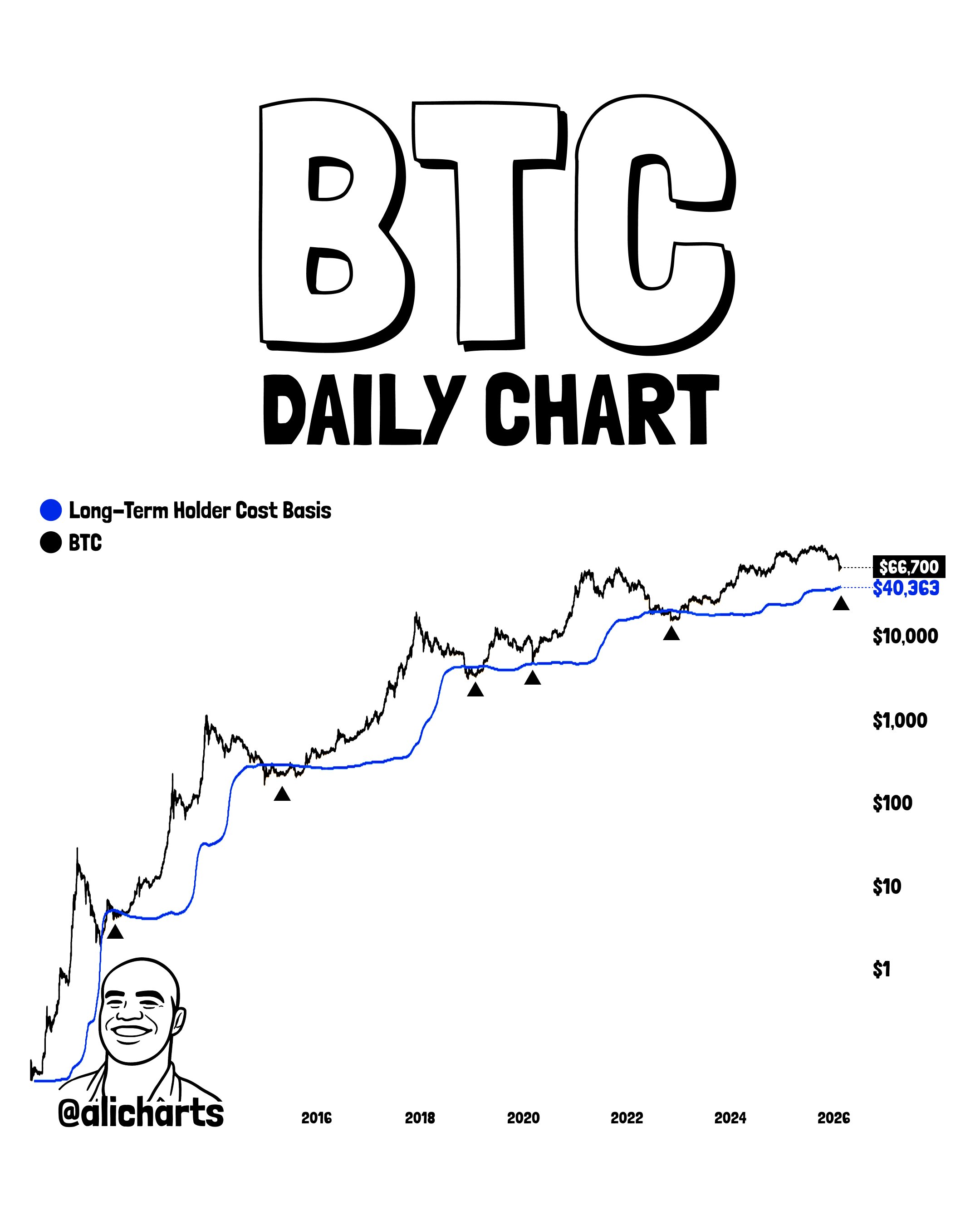
In a recent post on the X platform, crypto analyst Ali Martinez identified the $40,000 level as a potential bottom for the Bitcoin price in the current market phase. This projection is based on the cost basis of an old investor cohort known as the long-term holders (LTH)

For context, the cost basis of long-term holders refers to the average price at which Bitcoin investors (who have held their coins for 155 days or more) acquired their coins. This price level is often relevant because long-term investors are often referred to as diamond hands, who are less likely to sell during periods of downside volatility.

Moreover, the LTH cost basis tends to act as the ultimate support level during bear markets, as most long-term investors are usually still in profit even in the thick of the bear market. Hence, when the Bitcoin price falls to this support, the long-term holders double down on their positions.
Source: @ali_charts on X

This renewed buying activity by the long-term holders would prop up the price of the premier cryptocurrency above their cost basis, as observed in the chart above. According to the highlighted data, the LTH cost basis is currently around $40,363, about 40% from the current price point.

If the Bitcoin price were to face further downside pressure and approach this cost basis, there is a likelihood it would receive support from the long-term investors’ increased reaccumulation. Hence, this cost basis could become the bottom for the current bear market.

On the flip side, the Bitcoin market could face an even deeper correction if the selling pressure overwhelms the long-term holders’ reaccumulation spree.

Bitcoin Price Overview

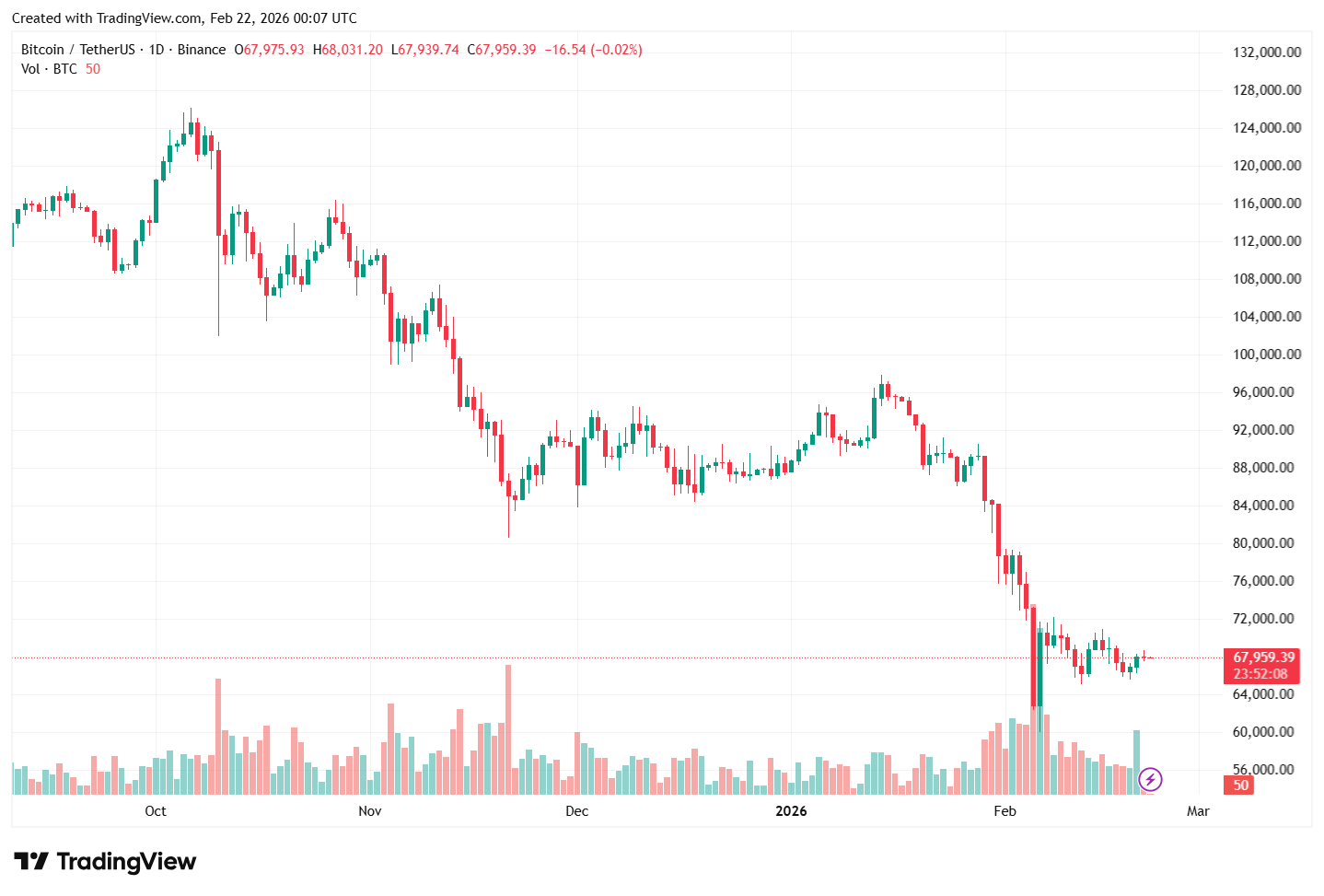
As of this writing, the price of BTC stands at around $68,330, reflecting a nearly 1% increase in the past 24 hours. However, this mild single-day action does little to correct the over 2% price decline witnessed by the premier cryptocurrency over the past week. According to data from CoinGecko, the Bitcoin price is currently down from its all-time high by more than 45%.
The price of BTC on the daily timeframe | Source: BTCUSDT chart on TradingView


Perguntas relacionadas

QWhat is the on-chain data suggesting about the potential price bottom for Bitcoin in the current bear market?

AThe on-chain data suggests that the price bottom for Bitcoin could be around $40,000, based on the cost basis of long-term holders.

QWho are the 'long-term holders' (LTH) mentioned in the analysis, and why is their cost basis significant?

ALong-term holders are investors who have held their Bitcoin for 155 days or more. Their cost basis is significant because it often acts as a strong support level during bear markets, as these investors are less likely to sell and may even buy more when the price approaches their average purchase price.

QWhat is the specific cost basis for long-term holders that is cited as a potential support level?

AThe specific cost basis for long-term holders is currently around $40,363.

QWhat could happen if the selling pressure in the market overpowers the buying activity of long-term holders?

AIf the selling pressure overwhelms the long-term holders' reaccumulation, the Bitcoin market could experience an even deeper correction beyond the $40,000 support level.

QWhat was the price of Bitcoin and its performance at the time of writing, according to the article?

AAt the time of writing, the price of Bitcoin was around $68,330, reflecting a nearly 1% increase in the past 24 hours, but it was still down over 2% for the week and more than 45% from its all-time high.

Leituras Relacionadas

MSX US Stock Daily Insight: Amazon 2026 Q2 Earnings: AWS Records Fastest Growth in Five Years

**MSX Daily US Stock Observation: Amazon's Q2 2026 Earnings: AWS Achieves Fastest Growth in Five Years** Amazon's latest quarterly results exceeded expectations, driven by a strong performance from its cloud computing unit. The company reported revenue of $200.66 billion, surpassing estimates of approximately $197 billion. The key highlight was Amazon Web Services (AWS), which generated $42.232 billion in revenue, surging 37% year-over-year. This marked the segment's fastest growth pace in 18 quarters, indicating robust demand for cloud services. Reported Earnings Per Share (EPS) of $5.75 significantly exceeded the $1.84 forecast. However, this figure included a substantial one-time, non-operating gain of $53.4 billion, primarily from the revaluation of Amazon's investment in AI company Anthropic. Excluding this item, core operating profit was $27.461 billion, a strong increase of 43% compared to the same period last year. Despite the positive results, Amazon provided guidance for the upcoming third quarter that fell short of market expectations. The company's revenue guidance midpoint is $199.5 billion, below the consensus estimate of around $204 billion. Operating profit guidance of $24.5 billion also slightly missed expectations of approximately $247.9 billion. Furthermore, Amazon raised its forecast for full-year capital expenditures to $220 billion, citing rising memory chip costs, which weighed on investor sentiment regarding future profitability. In summary, Amazon's quarter showcased accelerating momentum in its core AWS business. The underlying operational profit growth remains solid. However, cautious forward guidance and increased investment spending present key areas for monitoring in the coming quarters, as the market assesses whether the current growth phase will translate into sustained profit margin expansion.

Odaily星球日报Há 5m

MSX US Stock Daily Insight: Amazon 2026 Q2 Earnings: AWS Records Fastest Growth in Five Years

Odaily星球日报Há 5m

Cyclical Stock or Growth Stock? Coinbase's Q2 Earnings Report Reveals 'Valuation Disagreement'

Coinbase's Q2 2026 financial results revealed a mixed performance, reigniting debate over whether the company should be valued as a cyclical stock tied to crypto markets or a growth stock with future potential. Total revenue missed expectations at $1.22 billion, down 19% year-over-year. Transaction revenue fell to $599 million, with retail crypto spot trading revenue dropping 30% to $452 million, back to 2023 levels. The company reported a net loss of $359 million, marking its third consecutive quarterly loss. Despite CEO Brian Armstrong's positive commentary on metrics like a 10.3% overall crypto trading market share and 106% growth in prediction markets, the market reacted negatively, with shares dropping over 5% after-hours. A key issue is the decline in core retail trading. While Coinbase touted record market share, this figure includes derivatives and new products. Its traditional crypto spot trading share is likely shrinking. New ventures like prediction markets, while growing, contributed less than $30 million, insufficient to offset the core revenue decline. The valuation debate hinges on perspective. As a cyclical stock, Coinbase remains deeply tied to the crypto bear market, with user attrition and competitive pressures justifying a lower valuation. The company's strategy appears focused on surviving until the next bull cycle. Viewed as a growth stock, however, Coinbase shows promising diversification. Subscription and service revenue reached $555 million, nearly matching transaction revenue. Stablecoin revenue, its second-largest source at $292 million, remains strong through its partnership with Circle. Critically, Coinbase is positioning itself as a leader in the emerging on-chain "agent economy." Over 90% of agent-based stablecoin transactions occur on its Base network, which it believes could handle trillions in future agent transactions. The recent acquisition of Deribit also aims to boost its international derivatives offering. In summary, Coinbase's present struggles are clear, but its future hinges on whether its investments in revenue diversification, stablecoins, and the agent economy can ultimately transform its business model and justify a growth premium.

Odaily星球日报Há 25m

Cyclical Stock or Growth Stock? Coinbase's Q2 Earnings Report Reveals 'Valuation Disagreement'

Odaily星球日报Há 25m

Global Market Share Survey: Japanese Firms Lead in Semiconductor Materials

Global Market Share Survey: Japanese Firms Lead in Semiconductor Materials According to the 2025 "Major Goods and Services Market Share Survey" by Nikkei, Japanese companies maintain strong positions in semiconductor-related materials. In silicon wafers, Shin-Etsu Chemical ranks first with a 26.3% share, followed by SUMCO at 17.8%. Together, they hold 44.1% of the market, widening their lead over competitors from Taiwan, Germany, and South Korea. In photoresists, Tokyo Ohka Kogyo, JSR, and Shin-Etsu Chemical occupy the top three spots, with a combined share of 60.5%. Despite their strength in materials, Japanese firms have a weaker presence in core semiconductor segments like DRAM and NAND flash memory, where South Korean and U.S. companies dominate. For instance, SK Hynix and Samsung lead in DRAM, while China’s CXMT doubled its share to 6% in 2025. The semiconductor market is projected to grow rapidly, with WSTS forecasting a 90% increase to $1.5112 trillion by 2026. Major players like Samsung, SK Hynix, and Micron are making massive investments to expand capacity. To maintain their edge in materials, Japanese companies must similarly commit to large-scale, risk-taking investments. In contrast, Japan’s automotive sector shows stagnation. Toyota remains the global leader but with only a slight share increase to 12.3%, while Japanese brands are absent from the top five in the EV market. In shipbuilding, Imabari Shipbuilding rose to third place globally with a 7.2% share, benefiting from large container ship deliveries. However, Chinese and South Korean firms dominate the sector, holding the top two positions. Japan aims to revitalize its shipbuilding industry through government and corporate efforts, targeting a near doubling of output by 2035. Addressing labor shortages and adopting advanced technologies like physical AI will be critical for competitiveness.

marsbitHá 49m

Global Market Share Survey: Japanese Firms Lead in Semiconductor Materials

marsbitHá 49m

Trading

Spot
活动图片