The cryptocurrency market is experiencing one of its toughest tests of resilience this week since the launch of the US spot ETFs. After Bitcoin reached new all-time highs for much of the past year, a massive price drop has triggered a chain reaction that is hitting institutional products particularly hard. What was considered an unstoppable price driver for months is now turning into a burden for the entire market structure. As capital flows out of the funds, many market participants are asking the fundamental question of how resilient the cryptocurrency's new investor base really is.
Current data now reveals for the first time the precise extent of the financial imbalance in which many ETF investors currently find themselves.
Bitcoin ETFs: Price Drop Below Cost Basis Forces Rethink
Market dynamics have deteriorated drastically, with US Bitcoin ETFs at the center of the storm. A key indicator of the current panic is the so-called "Cost Basis," i.e., the average purchase price of the ETF shares. Current chart data from Bloomberg Intelligence shows that the Bitcoin price, at around $76,140, has fallen significantly below the Net Cost Basis of $82,405. The discrepancy is even clearer with the Gross Cost Basis, which only considers purchases and is currently at $83,655. This means the leading cryptocurrency is trading significantly below the level at which the bulk of institutional money flowed into the market.
Have seen a few charts out there with similar data (namely from @intangiblecoins & @biancoresearch), but here's my spin on the data. Bitcoin ETF holders in aggregate are sitting on their biggest losses since the ETFs launched in Jan 2024 thanks to Bitcoin's price collapse. pic.twitter.com/xFNkU7wOwX
— James Seyffart (@JSeyff) February 4, 2026
This circumstance is immediately reflected in investor profitability. According to the available data from Bloomberg Intelligence, aggregate Bitcoin ETF holders are in the deepest loss zone since the products launched in January 2024. The average unrealized loss currently amounts to approximately $7.31 billion. This marks a dramatic turning point compared to the summer of 2025, when investors were sitting on paper profits of over $80 billion at times.
Bloomberg analyst James Seyffart emphasizes in this context that Bitcoin ETF holders are collectively facing the biggest losses since the launch, which massively increases the psychological pressure on the market.
The current correction is being interpreted more as a stress test for the long-term conviction of ETF buyers. While the Bitcoin price reached peak values of over $120,000 in October 2025, the recent downward movement has sustainably dampened the euphoria. Nevertheless, the data shows that, despite the billions in losses, there has been no uncontrolled mass capitulation so far. Analysts are now closely watching whether the net cost basis of around $82,400 will act as a massive resistance level in a recovery, as many investors might try to close their positions there without a loss.
Bitcoin L2: New Narratives for 2026?
The current market situation illustrates that the dependence on institutional ETF inflows has brought a new form of volatility into the ecosystem, posing challenges for many investors. As the dust settles around the record outflows, many market participants are already looking towards technological innovations that could create intrinsic value for the network independent of exchange-traded products. In particular, the segment of Bitcoin Layer-2 solutions is coming into focus as a potential catalyst for the next market cycle, as it directly expands the fundamental utility of the leading cryptocurrency.
In this dynamic environment, the project Bitcoin Hyper is currently generating significant attention as it addresses a technological gap that has remained unfulfilled by Bitcoin's pure store-of-value function. The project aims to massively increase the efficiency and scalability of the network through a specialized Layer-2 structure to make Bitcoin usable for a broader range of applications in the decentralized finance (DeFi) space.
Go Directly to the Bitcoin Hyper Presale
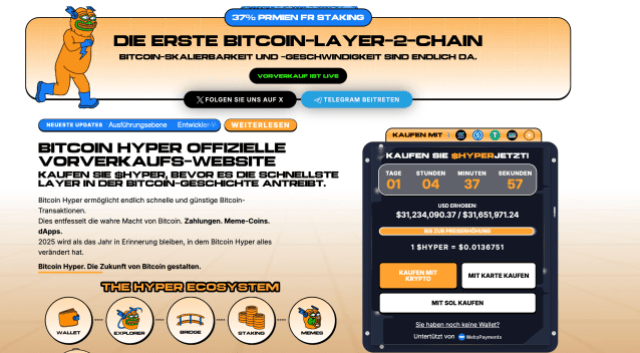
The narrative behind Bitcoin Hyper is closely linked to the community's desire to underpin Bitcoin's dominance with real utility, rather than relying solely on spot market price dynamics. The project is currently showing significant momentum, reflected in an above-average demand during its ongoing funding phase. A key driver for the growing interest is the integrated staking model, which currently promises an annual percentage yield (APY) of 38 percent.
Compared to the broad market average, this figure signals a strong attraction for investors seeking productive yield opportunities within the Bitcoin ecosystem. By combining technical scaling with economic incentives, Bitcoin Hyper distinguishes itself from purely speculative approaches and attempts to establish a sustainable infrastructure for the future Bitcoin network. Interested observers currently have the opportunity to benefit from planned price increases within the presale structure through early participation, which could lead to paper gains.
Go Directly to the Bitcoin Hyper Presale



















