Bitcoin Mining Difficulty Drops for the Third Time in a Row. What Does This Mean?

RBK-cryptoPublicado em 2025-12-11Última atualização em 2025-12-11

Resumo

Bitcoin mining difficulty has decreased for the third consecutive time, dropping by 0.74% to 148.2 trillion on December 11. This means miners now need to compute approximately 148 trillion hash functions on average to add a new block and earn the 3.125 BTC reward (around $281,000 at current rates). This prolonged decline in difficulty, last seen in 2024 after the halving event, reflects reduced mining activity. The global hashrate has fallen from its peak of 1.31 Zh/s on October 24 to 1.14 Zh/s, indicating some miners are switching off unprofitable equipment. According to Anton Gonterev, Commercial Director of Intelion, this adjustment reflects the market adapting to Bitcoin's lower price. Since reaching approximately $126,000 on October 6, Bitcoin's price has fallen 28% to $90,000. Despite this, mining difficulty is still over 40% higher than a year ago, indicating sustained structural demand for computational power and continued investor interest in mining. The current correction is seen as a normal industry dynamic where less efficient operators are gradually leaving the network. Mining is shifting towards players with modern equipment, stable infrastructure, and controlled project economics, particularly those with access to predictable, competitive energy prices. These efficient operators remain stable despite short-term fluctuations in Bitcoin's price or mining difficulty.

On the morning of December 11, Bitcoin's mining difficulty decreased by 0.74%. According to Cloverpool, the indicator dropped to 148.2 T (trillion). This means that miners now need to compute approximately 148 trillion hash functions on average to add one block to the Bitcoin network and receive the new reward of 3.125 BTC (about $281,000 at the current exchange rate).

Today's drop in Bitcoin's mining difficulty is the third consecutive one. Such a prolonged decline was only observed in 2024 during the months following the halving, when the miners' reward was cut in half, and they turned off equipment that had become unprofitable.

The difficulty recalculation takes into account the reduced activity of miners, indicated by the global hashrate—the total power of all devices actively mining Bitcoin. The hashrate reached a maximum of 1.31 Zh/s (zettahashes per second) on October 24. As of 5:00 PM Moscow time on December 11, the average hashrate over the past 24 hours is 1.14 Zh/s.

"An Element of Industry Dynamics"

The current decrease in mining difficulty reflects the market's adaptation to a more restrained Bitcoin price, says Anton Gonterev, Commercial Director of Intelion. After reaching a new high of around $126,000 on October 6, the first cryptocurrency has since depreciated by 28%, to $90,000.

Nevertheless, a year ago, the difficulty was approximately at 104 T, and a growth of over 40% over the year indicates the continuation of structural demand for computing power, the expert says. According to him, investor interest in mining remains, and the market still highly values Bitcoin's long-term potential.

He noted that against this backdrop, the differences in mining costs are particularly noticeable: operators with predictable and competitive energy prices navigate such cycles much more confidently. This fully applies to sites with their own generation, where it is possible to maintain low electricity costs and reduce the impact of market fluctuations, the expert says.

"This is precisely why the current correction is perceived by us as a normal element of industry dynamics. Less efficient capacities are gradually leaving, and the share of mining is shifting to those who rely on modern equipment, sustainable infrastructure, and controlled project economics. Such operators remain stable regardless of short-term movements in difficulty or the price of Bitcoin," said Gonterev.

"The market in Russia is emerging": Anatoly Popov — on Sber's crypto strategy

The Central Bank responded to the call to "exit the sandbox" and allow stablecoins

The Central Bank proposed limiting ordinary Russians' right to buy cryptocurrency

Criptomoedas em alta

Perguntas relacionadas

QWhat is Bitcoin mining difficulty and how much did it drop on December 11th?

ABitcoin mining difficulty is a measure of how hard it is to find a new block compared to the easiest it can ever be. On the morning of December 11th, it dropped by 0.74% to 148.2 trillion, meaning miners now need to compute an average of 148 trillion hash functions to add a new block.

QHow many times in a row has the Bitcoin mining difficulty fallen recently, and when was a similar prolonged decline last observed?

AThe drop on December 11th was the third consecutive decline in a row. A similar prolonged period of falling difficulty was observed earlier in 2024, for several months after the halving event.

QWhat is the global hashrate and what does its recent drop from the October 24th peak indicate?

AThe global hashrate is the total combined processing power of all devices actively mining Bitcoin. It reached a peak of 1.31 Zh/s (zettahashes per second) on October 24th. Its subsequent drop to an average of 1.14 Zh/s by December 11th indicates reduced mining activity, which directly led to the decrease in mining difficulty.

QAccording to Anton Gonterev, what does the current drop in mining difficulty reflect, and what is a key factor that helps some operators weather market cycles?

AAccording to Anton Gonterev, the current drop in mining difficulty reflects the market's adaptation to a more restrained Bitcoin price. He states that operators with predictable and competitive energy costs, particularly those with their own power generation, navigate these cycles with significantly more confidence.

QDespite the recent drop, what does the 40%+ annual growth in mining difficulty from a year ago (104 T) signify according to the expert?

AThe growth of over 40% from the approximate level of 104 T a year ago signifies the continuation of structural demand for computing power. It shows that investor interest in mining persists and the market still highly values the long-term potential of Bitcoin.

Leituras Relacionadas

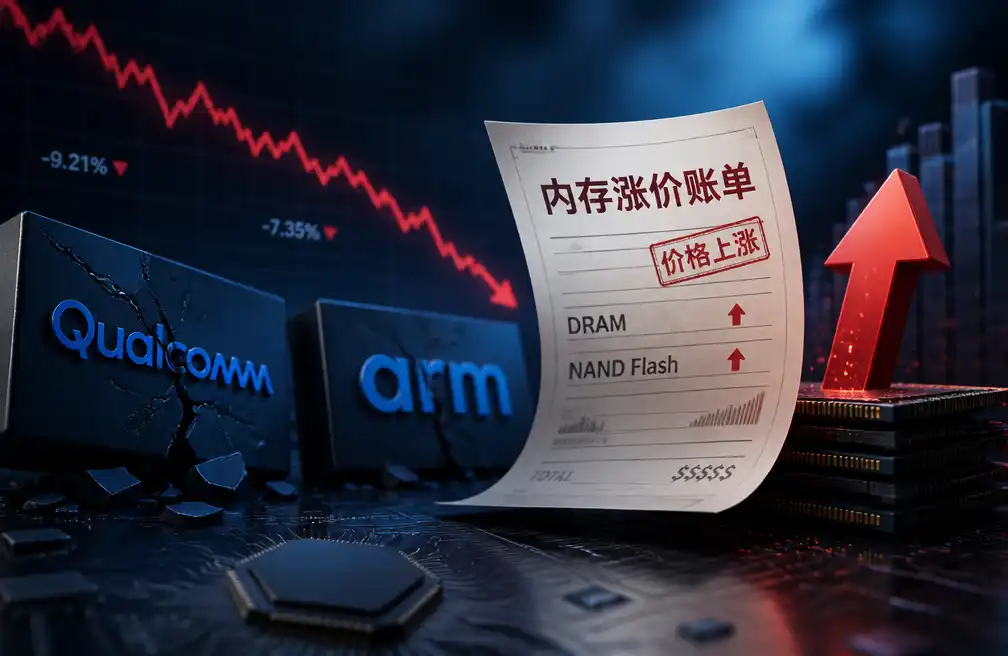
Qualcomm and Arm Fall Together: The Bill for Memory Price Hikes Finally Arrives at Mobile Chip Companies

After posting Q2 FY2026 results, Qualcomm and Arm both saw their shares decline, reflecting the impact of memory price increases on the smartphone chip sector. Qualcomm's revenue of $9.95B slightly beat expectations, but EPS of $2.21 fell short. More concerning was its guidance for next quarter, with EPS projections below analyst estimates. The company directly attributed a >$1.50 per share annual EPS headwind to rising memory costs and supply constraints in Android phones, prompting planned price hikes. While automotive revenue grew 61% and is approaching one-third of phone revenue, the mobile segment declined 20%. Qualcomm also confirmed a significant reduction in its modem share for the upcoming iPhone and outlined a plan for data center revenue to replace all Apple-related income by FY2027. Arm's results surpassed expectations with revenue of $1.29B and EPS of $0.45, and its guidance was also strong. However, its stock fell. Key concerns included royalty revenue failing to set a new record and a downward revision to full-year royalty growth guidance from ~20% to the high-teens, citing weak smartphone demand and high memory prices. Despite robust growth in its data center business, Arm's premium valuation (over 100x forward P/E) means even beating expectations isn't enough to push the stock higher, as any sign of uncertainty is magnified. Ongoing global antitrust investigations add another risk factor. The situation highlights a broader shift. Memory price surges, which boosted Samsung's profits, are now pressuring chip designers. Meanwhile, the semiconductor sector saw significant corrections in July, with the hardest-hit stocks often being those with the biggest AI-driven gains year-to-date. Qualcomm, lacking such a premium, was an exception.

marsbitHá 16m

Qualcomm and Arm Fall Together: The Bill for Memory Price Hikes Finally Arrives at Mobile Chip Companies

marsbitHá 16m

13 Business Lines Surpass $100 Million in Annualized Revenue, Robinhood Moves Toward a 'Super Financial App'

Robinhood Q2 2026 Earnings: Record Revenue and a Push Towards a "Super Financial App" Robinhood (HOOD) reported strong Q2 2026 results, with net revenue reaching $1.308 billion, up 32% year-over-year, and net income hitting $561 million, a 45% increase. The company now has 13 distinct business lines each generating over $100 million in annualized revenue. Key drivers included a 44% surge in transaction-based revenue to $776 million, led by a more than 10x growth in "event contracts" (prediction markets) and strong performance in stocks and options. User metrics also grew, with funded accounts rising to 28.4 million and total assets under custody reaching $369 billion. The Robinhood Gold subscription service hit a record 4.8 million users. The report highlights a strategic shift for Robinhood. Moving beyond its core as a zero-commission trading platform for retail investors, it is actively building a broader financial ecosystem. This includes expanding into wealth management (Robinhood Strategies), payments (Robinhood Credit Card), and next-generation infrastructure like AI-powered "Agentic Trading" and its own Ethereum Layer 2 blockchain, Robinhood Chain. The company's goal is to evolve from a trading app into a comprehensive "super financial app," offering a one-stop shop for investing, cash management, and future on-chain finance.

Odaily星球日报Há 46m

13 Business Lines Surpass $100 Million in Annualized Revenue, Robinhood Moves Toward a 'Super Financial App'

Odaily星球日报Há 46m

13 Business Lines Surpass $100 Million in Annualized Revenue, Robinhood Advances Toward a 'Super Financial App'

On July 30th, Robinhood (HOOD) reported its Q2 2026 financial results, showcasing significant growth with record revenue and profits. The company achieved a net revenue of $1.308 billion, a 32% year-over-year (YoY) increase, and a net income of $561 million, up 45% YoY. This strong performance was driven by robust trading activity and expansion into new financial services. A key highlight was the surge in transaction-based revenue, which rose 44% YoY to $776 million. Notably, income from event contracts (prediction markets) skyrocketed over 10x to $156 million, emerging as a major new growth driver alongside strong gains in stock and options trading. However, crypto trading revenue declined by 38%. Beyond trading, Robinhood is successfully diversifying its revenue streams. User assets grew 32% to $369 billion, and the subscription service Robinhood Gold reached a record 4.8 million users. The company revealed that 13 of its business lines now generate over $100 million in annualized revenue, including its new credit card, prediction markets, and Gold subscriptions. Looking forward, Robinhood is strategically investing in AI and blockchain to build a comprehensive financial ecosystem. It has launched AI-powered "Agentic Trading" and the "Robinhood Chain," a layer-2 blockchain network. The company's vision is evolving from a retail trading platform into a "super financial app" that integrates trading, wealth management, payments, and next-generation digital asset services, though regulatory hurdles remain for some new ventures.

marsbitHá 46m

13 Business Lines Surpass $100 Million in Annualized Revenue, Robinhood Advances Toward a 'Super Financial App'

marsbitHá 46m

Trading

Spot

Artigos em Destaque

Como comprar O

Bem-vindo à HTX.com!Tornámos a compra de O1 exchange (O) simples e conveniente.Segue o nosso guia passo a passo para iniciar a tua jornada no mundo das criptos.Passo 1: cria a tua conta HTXUtiliza o teu e-mail ou número de telefone para te inscreveres numa conta gratuita na HTX.Desfruta de um processo de inscrição sem complicações e desbloqueia todas as funcionalidades.Obter a minha contaPasso 2: vai para Comprar Cripto e escolhe o teu método de pagamentoCartão de crédito/débito: usa o teu visa ou mastercard para comprar O1 exchange (O) instantaneamente.Saldo: usa os fundos da tua conta HTX para transacionar sem problemas.Terceiros: adicionamos métodos de pagamento populares, como Google Pay e Apple Pay, para aumentar a conveniência.P2P: transaciona diretamente com outros utilizadores na HTX.Mercado de balcão (OTC): oferecemos serviços personalizados e taxas de câmbio competitivas para os traders.Passo 3: armazena teu O1 exchange (O)Depois de comprar o teu O1 exchange (O), armazena-o na tua conta HTX.Alternativamente, podes enviá-lo para outro lugar através de transferência blockchain ou usá-lo para transacionar outras criptomoedas.Passo 4: transaciona O1 exchange (O)Transaciona facilmente O1 exchange (O) no mercado à vista da HTX.Acede simplesmente à tua conta, seleciona o teu par de trading, executa as tuas transações e monitoriza em tempo real.Oferecemos uma experiência de fácil utilização tanto para principiantes como para traders experientes.

285 Visualizações TotaisPublicado em {updateTime}Atualizado em 2026.06.29

Como comprar O

Como comprar PROS

Bem-vindo à HTX.com!Tornámos a compra de Pharos (PROS) simples e conveniente.Segue o nosso guia passo a passo para iniciar a tua jornada no mundo das criptos.Passo 1: cria a tua conta HTXUtiliza o teu e-mail ou número de telefone para te inscreveres numa conta gratuita na HTX.Desfruta de um processo de inscrição sem complicações e desbloqueia todas as funcionalidades.Obter a minha contaPasso 2: vai para Comprar Cripto e escolhe o teu método de pagamentoCartão de crédito/débito: usa o teu visa ou mastercard para comprar Pharos (PROS) instantaneamente.Saldo: usa os fundos da tua conta HTX para transacionar sem problemas.Terceiros: adicionamos métodos de pagamento populares, como Google Pay e Apple Pay, para aumentar a conveniência.P2P: transaciona diretamente com outros utilizadores na HTX.Mercado de balcão (OTC): oferecemos serviços personalizados e taxas de câmbio competitivas para os traders.Passo 3: armazena teu Pharos (PROS)Depois de comprar o teu Pharos (PROS), armazena-o na tua conta HTX.Alternativamente, podes enviá-lo para outro lugar através de transferência blockchain ou usá-lo para transacionar outras criptomoedas.Passo 4: transaciona Pharos (PROS)Transaciona facilmente Pharos (PROS) no mercado à vista da HTX.Acede simplesmente à tua conta, seleciona o teu par de trading, executa as tuas transações e monitoriza em tempo real.Oferecemos uma experiência de fácil utilização tanto para principiantes como para traders experientes.

276 Visualizações TotaisPublicado em {updateTime}Atualizado em 2026.06.29

Como comprar PROS

O que é VERONA

I. Introdução ao Projeto VERONA é uma blockchain construída para todos, em todo o lado, através da abstração da cadeia. Utilizando a sua camada de Abstração Generalizada, a VERONA distingue-se por integrar funcionalidades complexas de blockchain, como contas, assinaturas e interoperabilidade, diretamente ao nível do protocolo. Esta abordagem permite a interação com aplicações de blockchain sem a necessidade de compreender as tecnologias subjacentes.1) Informação Básica Nome: VERONA (VERONA)III. Links Relacionados Link do site oficial: https://xion.burnt.com/ Whitepaper: https://xion.burnt.com/whitepaper.pdf Exploradores: https://explorer.burnt.com/ Mídias Sociais: https://x.com/burnt_xion Nota: A introdução ao projeto provém dos materiais publicados ou fornecidos pela equipa oficial do projeto, que é apenas para referência e não constitui aconselhamento de investimento. A HTX não se responsabiliza por quaisquer perdas diretas ou indiretas resultantes.

920 Visualizações TotaisPublicado em {updateTime}Atualizado em 2026.06.22

O que é VERONA

Discussões

Bem-vindo à Comunidade HTX. Aqui, pode manter-se informado sobre os mais recentes desenvolvimentos da plataforma e obter acesso a análises profissionais de mercado. As opiniões dos utilizadores sobre o preço de A (A) são apresentadas abaixo.

活动图片