Bitcoin Large Holders Lead the Way As BTC Accumulation Picks Up, Is A Rebound Brewing?

bitcoinistPublicado em 2026-01-26Última atualização em 2026-01-26

Resumo

Despite recent volatility pushing Bitcoin's price back to around $86,000, on-chain data reveals a significant shift in market sentiment. Large Bitcoin holders (wallets with over 1,000 BTC) are leading a strong accumulation trend, acquiring approximately 104,340 BTC in recent months. This represents a 1.5% increase, bringing their collective holdings to 7.17 million BTC—the highest level since September 2025. This sustained buying activity, alongside a surge in large transactions exceeding $1 million, indicates deep-pocketed investors are building positions with confidence in Bitcoin's medium to long-term potential, often during periods of price uncertainty. Conversely, Bitcoin's Open Interest has continued to decline steadily since November, suggesting a lack of momentum for a new trend. While this deleveraging is bearish in the short term, it helps cleanse the market of excessive leverage. The divergence between whale accumulation and falling open interest presents a complex picture, where underlying bullish conviction meets near-term market weakness.

Over the weekend, volatility observed across the broader cryptocurrency market intensified, causing the price of Bitcoin to fall back to the $86,000 mark once again. Even with the bearish price action in the past few days, buying activity continues to pick up pace in the market, especially among large BTC holders.

Bitcoin’s Largest Wallets Show Conviction

Bitcoin’s price may have been struggling with heightened volatility as a result of the broader market bearish market action, but bullish sentiment remains present among investors. In the weakening condition, large BTC whales or deep-pocket investors’ sentiment turns positive and are steadily reentering the market.

Data from Santiment, a popular market intelligence and on-chain data platform, suggests that these major investors are building positions at an encouraging and steady pace, even though the broader momentum is demonstrating weakening conditions. In the past, long-term whale accumulation has typically happened in uncertain times when prices don’t accurately reflect underlying confidence.

Santiment noted that the buying activity is spotted among wallet addresses holding over 1,000 BTC. After months of consistent buying, the group has now collectively acquired about 104,340 BTC, which represents a more than 1.5% rise.
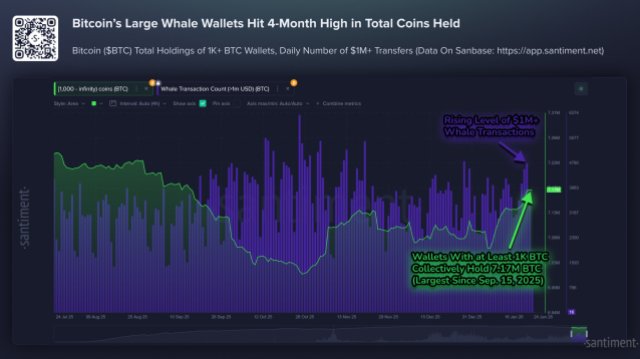
Large whales are steadily buying BTC | Source: Chart from Santiment on X

As a result of the recent purchase, the investors’ overall holdings are currently sitting at 7.17 million BTC, marking their largest level since September 15, 2025. These wealthy investors are subtly consuming available supplies rather than distributing into recent market swings, indicating confidence in Bitcoin’s medium- to long-term potential.

While buying pressure is growing among large Bitcoin holders, the number of whale transactions has also experienced a massive upswing. Santiment added that the amount of +$1 million daily transfers has exploded, reaching a 2-month high level.

A Continued Drop In BTC Open Interest

A continued drop in Bitcoin’s Open Interest is coinciding with the ongoing drop in price. Darkfost, a market expert and CryptoQuant author, highlighted that open interest is steadily declining, which does not support the emergence of a new trend as seen on the weekly change basis.

Since November, the metric has remained broadly negative, suggesting that the drop has continued for several weeks. Although there was a brief improvement earlier this month, it was followed by a price reaction.

Overall, when open interest rises, Darkfost stated that it mostly signals trend continuation to even a trend reversal, triggered by an influx of long positions. Furthermore, this is confirmed with funding rates, but this is what happens in most cases.

On Sunday, as BTC displays a steady correction, deleveraging also increased. While this is bearish in the short term, these phases simultaneously aid in cleaning the market of excessive leverage. Thus, it is critical to remember that futures are still the primary source of volume, making keeping an eye on developments there an essential move.

BTC trading at $87,935 on the 1D chart | Source: BTCUSDT on Tradingview.com

Perguntas relacionadas

QWhat is the current trend among large Bitcoin holders (whales) according to Santiment data?

ALarge Bitcoin holders (wallets with over 1,000 BTC) are steadily accumulating and building positions, acquiring about 104,340 BTC collectively, representing a more than 1.5% rise, indicating confidence in Bitcoin's medium- to long-term potential.

QHow has Bitcoin's Open Interest changed recently, and what does it suggest?

ABitcoin's Open Interest has been steadily declining and remained broadly negative since November, which does not support the emergence of a new trend and suggests continued price drop, though rising open interest can sometimes signal trend continuation or reversal.

QWhat significant level have large BTC whales reached in terms of their holdings?

ALarge BTC whales now hold 7.17 million BTC, marking their largest level since September 15, 2025, as they subtly consume available supplies rather than distributing during market swings.

QWhat has happened to the number of large whale transactions (+$1 million daily transfers)?

AThe amount of +$1 million daily transfers has exploded, reaching a 2-month high level, indicating increased activity among large investors.

QHow does deleveraging during BTC's correction impact the market in the short and long term?

ADeleveraging during BTC's correction is bearish in the short term but aids in cleaning the market of excessive leverage, which is crucial since futures are still the primary source of volume.

Leituras Relacionadas

Can Iran 'Control' the Strait of Hormuz?

Iran has announced a comprehensive plan to assert control over the strategic Strait of Hormuz, a critical global oil shipping chokepoint. The proposed measures include requiring all vessels to obtain Iranian permission for passage, imposing fees for security, environmental protection, and navigation management—preferably paid in Iranian rials—and absolutely banning Israeli ships. Vessels from countries deemed hostile by Iran’s top security bodies may also be barred. Analysts suggest Iran’s motives are multifaceted: increasing pressure on the U.S. and Israel by leveraging control over oil transit to influence global prices and inflation; creating a new revenue stream, potentially exceeding $7.7 billion annually, to counter Western sanctions and support postwar reconstruction; and using transit permissions as bargaining chips in future negotiations, notably with the U.S. However, the plan faces significant practical and diplomatic challenges. Enforcing comprehensive interception and fee collection in the busy waterway, patrolled by international military forces, would be difficult. The U.S. has already countering with a blockade of Iranian ports and threats to intercept any ship paying fees, potentially strangling Iran’s oil exports and fee revenue. Broad international opposition, led by European and Gulf states, and legal controversies further complicate implementation. The proposal may ultimately serve more as a negotiating tactic than a feasible policy, with its execution remaining highly uncertain.

marsbitHá 10m

Can Iran 'Control' the Strait of Hormuz?

marsbitHá 10m

Trading

Spot
Futuros
活动图片





